Reasoning can be the fastest place to bank marks in SSC CGL Tier 1. Yet many aspirants open a hard seating-arrangement puzzle first, spend four anxious minutes on it, and lose the time that could have cleared several direct analogy or series questions.
The fix is not another bag of shortcuts. It is a solving order based on return per minute, backed by enough practice that the quick topics really are quick.
Why reasoning is your rate-limiting section
Reasoning rewards correct recognition under time pressure. If you identify the pattern quickly, the work is short. If you choose a slow puzzle at the wrong moment, one question can hold the rest of the section hostage.
Recent SSC notifications give the Tier 1 reasoning section a fixed question structure, but the exact current pattern should always be checked on the official SSC portal. For preparation, the important principle remains stable: speed comes from topic order, not from rushing every question equally.
The SSC CGL syllabus areas guide shows how reasoning fits beside quantitative aptitude, English and general awareness. Use that full map before deciding how much of your overall week reasoning should receive.
High-yield reasoning topics ranked by yield per minute
The ranking reflects how quickly a trained aspirant can recognise and execute the forms that recur in recent papers. Shifts vary in their mix, so treat the tiers as your default attempt order and adjust once the paper is in front of you.
Tier | Topics | Why they sit here |
|---|---|---|
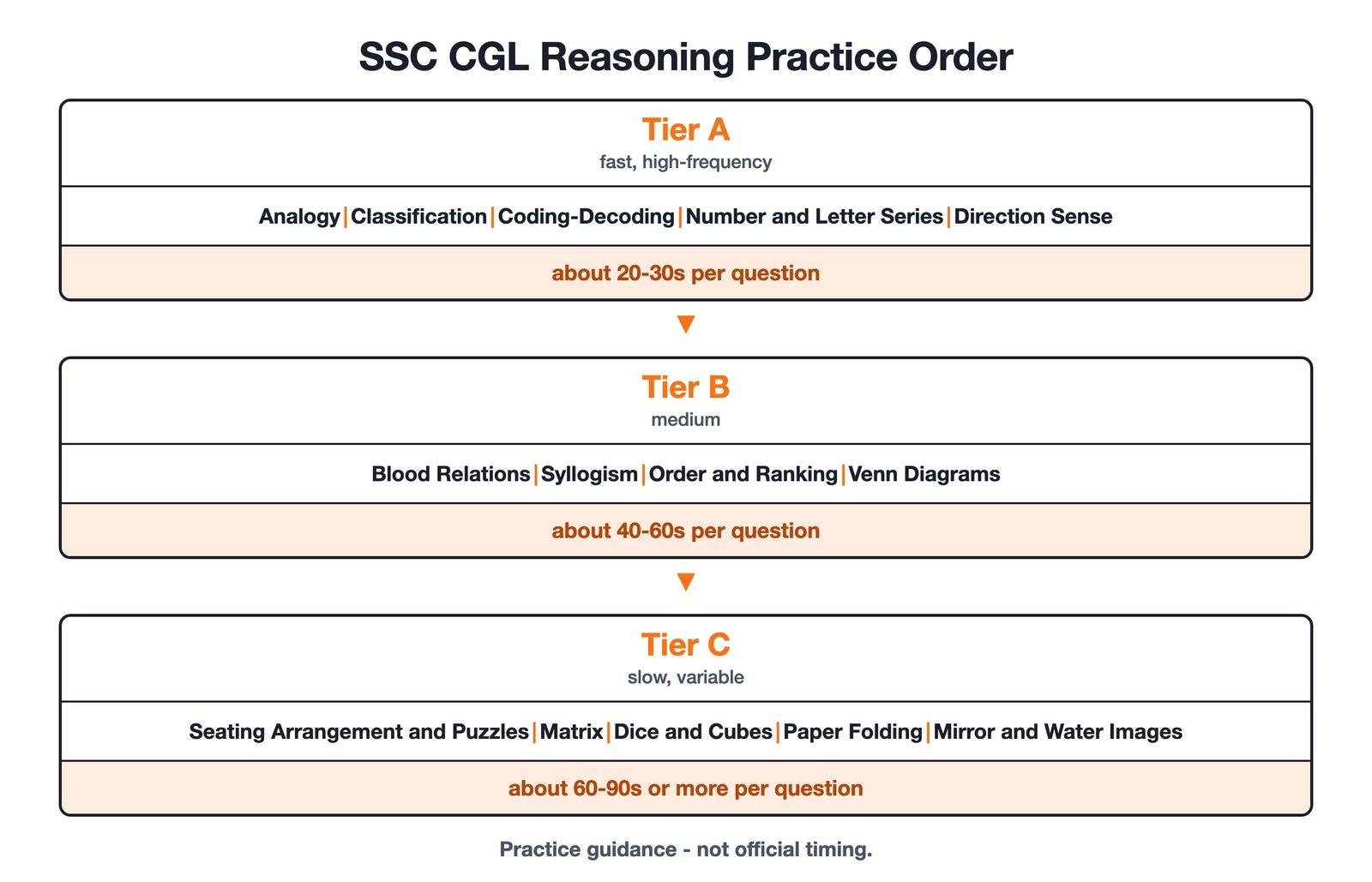
A: fast, high-frequency (about 20 to 30 seconds per question) | Analogy, classification, coding-decoding, number and letter series, direction sense | Short setup and repeatable patterns make them strong first-pass questions |
B: medium (about 40 to 60 seconds per question) | Blood relations, syllogism, order and ranking, Venn diagrams | Usually manageable, but the relation or diagram must be built carefully |
C: slow, variable (about 60 to 90 seconds or more per question) | Seating arrangement and puzzles, matrix, dice and cubes, paper folding, mirror and water images | Setup time and unfamiliar forms can vary sharply |
Within Tier A, learn to name the operation before calculating. A number series may use differences, ratios or alternating operations. A coding-decoding item may shift letters, reverse positions or map symbols. Identification prevents blind trial and error.
For the series 5, 12, 26, 54 and a missing fifth term, do not start testing random differences. Name the operation first: multiply the previous term by 2 and add 2. The check runs cleanly, 5 x 2 + 2 = 12, 12 x 2 + 2 = 26, and 26 x 2 + 2 = 54. Apply the same rule once more, 54 x 2 + 2 = 110, so the missing term is 110.
In a code where ROAD becomes TQCF, again name the operation first: move every letter two places forward in the alphabet. Check each position, R to T, O to Q, A to C, and D to F. Now apply that rule to MILK: M to O, I to K, L to N, and K to M. The coded answer is OKNM.
Tier B needs a compact representation. Draw a family relation, a Venn diagram or a rank line instead of holding every condition in memory. The drawing takes seconds and often prevents a reread.
Tier C is not unimportant. It is simply dangerous as a first stop because the upper time cost is uncertain. The SSC CGL previous-year topic distribution can help you compare this priority order with the patterns visible in actual papers.
The solving order inside the exam
Use three passes:
Tier A first: collect direct analogy, classification, coding, series and direction questions.
Tier B next: solve the relation and diagram questions that need a little more setup.
Tier C last: attempt longer puzzles and non-verbal forms with the time still available.
Apply one skip rule throughout: if a puzzle is not opening up in about 90 seconds, mark it and move. Return only after the cleaner questions are finished. SSC sets no per-question limit; the 90 seconds is a threshold you train yourself against, and its job is to stop sunk-cost thinking.
Also distinguish a nearly solved question from a badly chosen one. If the setup is complete and one comparison remains, finish it. If you are still rereading the conditions without a representation, leave it. Your first pass should feel controlled, not heroic.
A Tier A question that has already eaten a minute is behaving like a Tier C question, so treat it as one. Direction sense is the boundary case inside Tier A: a two or three turn item is genuine first-pass work, but a long multi-turn route or a statement-heavy variant costs Tier B or Tier C time, so apply the skip rule to it like any slow question.
A concrete six-week reasoning practice model
Budget about five hours per week. A schedule with two buffer days is more durable than a perfect seven-day plan that collapses after one missed class.
One workable weekly budget is:
Three focused topic sessions of 50 minutes each:
3 x 50 = 150 minutes.One mixed drill of 60 minutes:
150 + 60 = 210 minutes.One timed sectional plus review block of 60 minutes:
210 + 60 = 270 minutes.Two short error-log reviews totalling 30 minutes:
270 + 30 = 300 minutes, or five hours.
Place those sessions across five days and leave two days as buffers. If college or work takes a planned day, move that session into a buffer. If the week still breaks, protect the timed sectional slot and the error review before adding new theory.
Weeks 1 and 2: automate Tier A
Take one Tier A topic every two active days and solve 20 questions on it. The first session is for method and accuracy. The second repeats the form under a tighter practice clock. Write the cause of every error: pattern not recognised, calculation wrong, condition missed or time wasted.
Weeks 3 and 4: add Tier B without losing speed
Introduce blood relations, syllogism, ranking and Venn diagrams. Keep a short Tier A speed drill at the start of each mixed session. The aim is to make the medium topics reliable while preserving the automatic responses you already built.
Weeks 5 and 6: control Tier C and run sectionals
Train puzzles, seating arrangement, matrix forms and non-verbal questions. Then run full 25-question practice sectionals and previous-year sets using the A, B, C order. Review not only wrong answers but also correct answers that consumed too much time.
This six-week model is a loop, not a deadline. If accuracy remains weak in one tier, keep it in the next cycle rather than pretending the calendar has mastered it for you.
Non-verbal shortcuts worth memorising
Some Tier C forms become much faster when their fixed rules are automatic:
In a vertical mirror image, left and right reverse while top and bottom remain placed.
In a water image, top and bottom reverse while left and right remain placed.
For paper folding, unfold one fold at a time in reverse order and mirror each cut across that fold.
For a standard dice question, map the faces shown together before deciding which faces can be opposite.
These rules do not replace practice. They reduce the setup needed to understand a familiar form, which can move a personal weak area closer to Tier A speed.
Turn the ranking into timed reasoning practice
Bank Tier A first, move through Tier B, and leave uncertain Tier C puzzles for the final pass. Use the 90-second skip rule in practice until leaving a stuck question feels normal. Confirm the current Tier 1 structure on the official SSC portal before your attempt.
Build the topic base with the SSC CGL Tier 1 course, connect it to the full journey through the complete SSC CGL preparation bundle, and use the government-jobs catalogue for related preparation. More than 6,000 reasoning questions sit in the KnowledgeGate question bank, so turn the ranked list into timed sets instead of another page of notes.