

Trigonometry for Competitive Exams: Concepts, Shortcuts and Solved Examples
Build trigonometry from one right triangle, recover standard values safely, and solve identities, equations, and height-and-distance problems step by step.
KnowledgeGate Team
Exam prep & CS education
Updated 8 Nov 20266 min read
Trigonometry questions become slow when ratios, identities, and diagrams are memorised as separate tricks. A better method starts with one right triangle, rebuilds the standard values, and selects the right tool. That method handles equations and height-and-distance problems with exact calculations.
Start with one right triangle and define every ratio
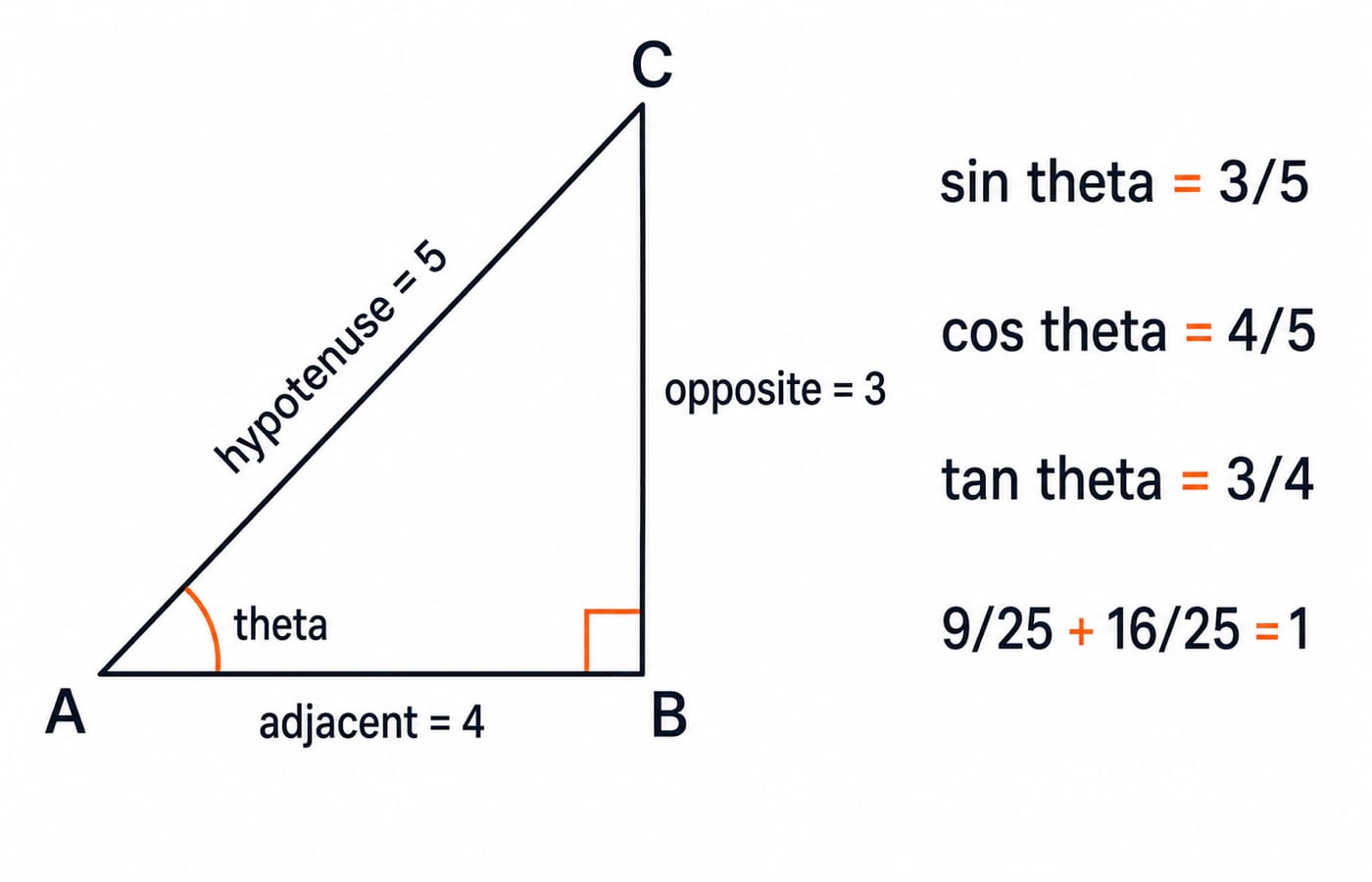
Choose an acute angle theta. The side across from theta is opposite. The side touching theta, other than the hypotenuse, is adjacent. The hypotenuse lies opposite the right angle and is the longest side.
The three basic ratios are:
sin theta = opposite/hypotenuse
cos theta = adjacent/hypotenuse
tan theta = opposite/adjacent
Take a 3-4-5 triangle with theta beside the side of length 4. The opposite side is 3 and the hypotenuse is 5. Therefore:
sin theta = 3/5, cos theta = 4/5, tan theta = 3/4
cosec theta = 5/3, sec theta = 5/4, cot theta = 4/3
The basic identity also checks out:
sin^2 theta + cos^2 theta = 9/25 + 16/25 = 25/25 = 1.
Rebuild the standard-angle table instead of cramming it
Use this table for the five standard angles:
theta | 0 degrees | 30 degrees | 45 degrees | 60 degrees | 90 degrees |
|---|---|---|---|---|---|
sin theta | 0 | 1/2 | sqrt(2)/2 | sqrt(3)/2 | 1 |
cos theta | 1 | sqrt(3)/2 | sqrt(2)/2 | 1/2 | 0 |
tan theta | 0 | 1/sqrt(3) | 1 | sqrt(3) | undefined |
For a safe recall shortcut, write sin theta as sqrt(n)/2 for n = 0, 1, 2, 3, 4 across the five angles. Cosine uses the list in reverse. Reconstruct tangent as sin theta/cos theta. For example:
tan 60 degrees = (sqrt(3)/2)/(1/2) = sqrt(3).
At 90 degrees, cos 90 degrees = 0, so the division for tangent has a zero denominator. That makes tan 90 degrees undefined.
Complementary angles swap sine and cosine:
sin(90 degrees - theta) = cos theta
cos(90 degrees - theta) = sin theta
tan(90 degrees - theta) = cot theta
For a numerical check, sin 30 degrees = cos 60 degrees = 1/2, while tan 30 degrees = cot 60 degrees = 1/sqrt(3).
Use identities as conversion tools
The identities are connected. Start with sin^2 theta + cos^2 theta = 1. Divide by cos^2 theta to get 1 + tan^2 theta = sec^2 theta, or by sin^2 theta to get 1 + cot^2 theta = cosec^2 theta.
Choose the identity that contains both the given ratio and the ratio required. Suppose tan theta = 3/4 and theta is acute. Build a triangle with opposite side 3 and adjacent side 4. Its hypotenuse is sqrt(3^2 + 4^2) = 5, so sin theta = 3/5 and cos theta = 4/5. Then:
(sin theta + cos theta)/(sin theta - cos theta)
= (3/5 + 4/5)/(3/5 - 4/5)
= (7/5)/(-1/5)
= -7.
Identity cancellation can be just as direct:
(1 - cos^2 60 degrees)/sin^2 60 degrees = (1 - 1/4)/(3/4) = (3/4)/(3/4) = 1.
This substitution works because the numerator and denominator are complete expressions. It does not justify cancelling terms inside an addition formula.
Solve compound angles and equations in controlled steps
The compound-angle formulas needed here are:
sin(A + B) = sin A cos B + cos A sin B
sin(A - B) = sin A cos B - cos A sin B
cos(A + B) = cos A cos B - sin A sin B
cos(A - B) = cos A cos B + sin A sin B
tan(A - B) = (tan A - tan B)/(1 + tan A tan B)
To find tan 15 degrees, write 15 degrees as 45 degrees - 30 degrees:
tan 15 degrees = (1 - 1/sqrt(3))/(1 + 1/sqrt(3))
= (sqrt(3) - 1)/(sqrt(3) + 1).
Rationalise by multiplying numerator and denominator by sqrt(3) - 1:
((sqrt(3) - 1)(sqrt(3) - 1))/((sqrt(3) + 1)(sqrt(3) - 1))
= (4 - 2sqrt(3))/(3 - 1)
= 2 - sqrt(3).
Now solve 2sin^2 x - 3sin x + 1 = 0 for 0 degrees <= x <= 90 degrees. Let y = sin x:
2y^2 - 3y + 1 = (2y - 1)(y - 1) = 0.
So y = 1/2 or y = 1. Hence sin x = 1/2 or sin x = 1, giving x = 30 degrees or 90 degrees in the stated interval. Always filter equation answers through the interval supplied in the question.
Translate height and distance into one tangent equation
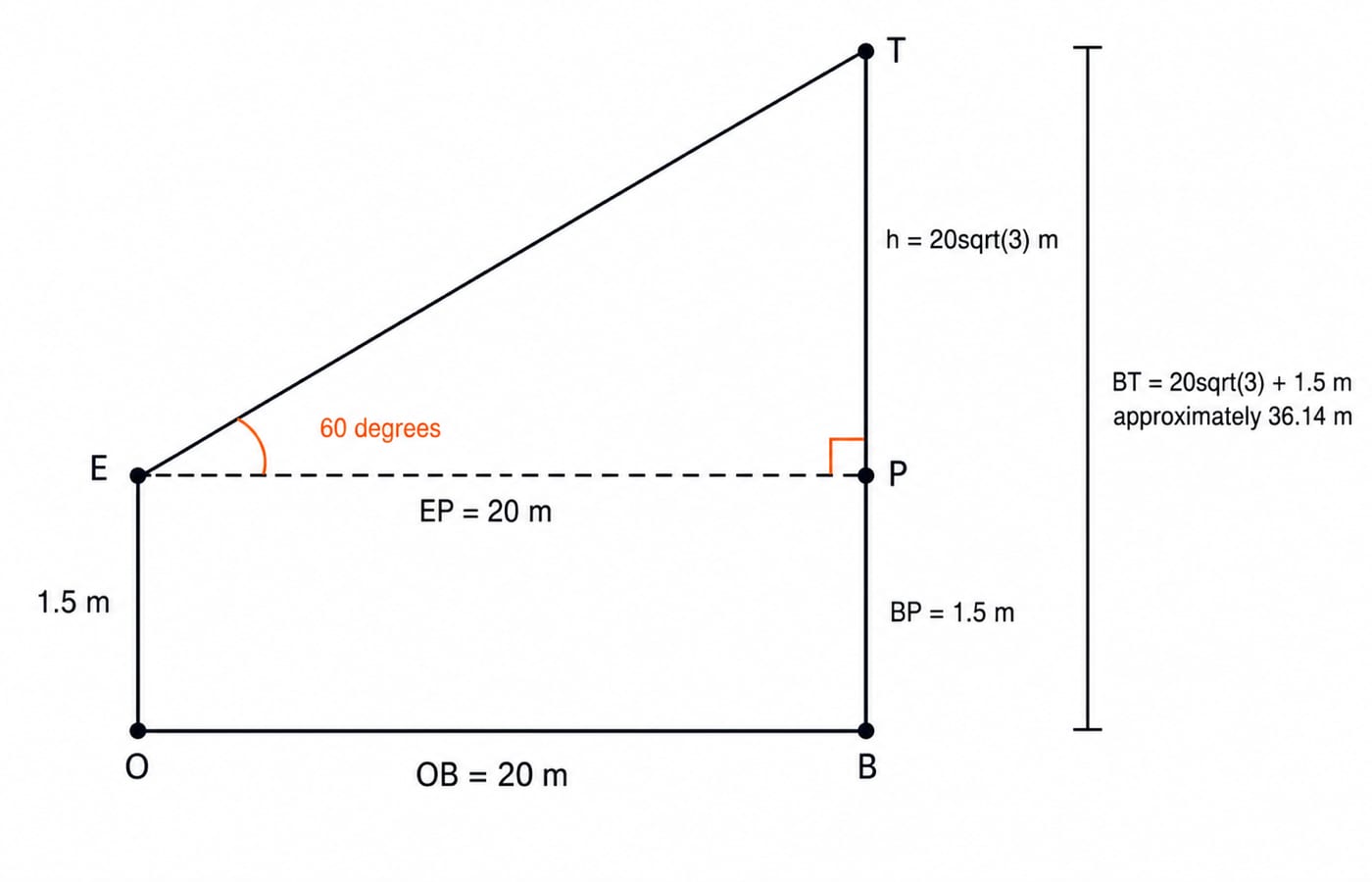
An angle of elevation is measured upward from a horizontal line of sight. An angle of depression is measured downward from it. Before choosing a ratio, draw the right angle, horizontal distance, vertical height above eye level, viewing angle, and observer height.
Suppose an observer's eye is 1.5 m above the ground. The observer stands 20 m horizontally from a vertical pole, and the angle of elevation to its top is 60 degrees. Let h be the pole height above eye level:
tan 60 degrees = h/20
sqrt(3) = h/20
h = 20sqrt(3) m.
The full pole height includes the observer's eye height:
20sqrt(3) + 1.5 m approximately 20(1.732) + 1.5 = 34.64 + 1.5 = 36.14 m.
Pick the fastest safe route and verify the result
Match the question to the tool:
Use triangle ratios when sides are given.
Use the standard-value table for special angles.
Use identities to convert one ratio into another.
Use compound-angle formulas for angles such as 15 degrees or 75 degrees.
Use tangent for one horizontal distance and one vertical height.
For a rapid conversion, suppose sin theta = 5/13 and theta is acute. The triangle is 5-12-13 because sqrt(13^2 - 5^2) = sqrt144 = 12. Therefore cos theta = 12/13 and tan theta = 5/12. Then:
tan theta + cot theta = 5/12 + 12/5 = 25/60 + 144/60 = 169/60.
The acute-angle condition fixes both signs as positive. End each calculation with a check: sine and cosine cannot have magnitude greater than 1, the hypotenuse must be longest, and a decimal should agree with the geometry. In the pole example, a 60-degree line over 20 m should produce a rise greater than 20 m, so 20sqrt(3) m is plausible.
Recognise question shapes and correct common traps
Common question shapes include direct ratio evaluation, missing-side conversion, standard-angle simplification, identity reduction, restricted-interval equations, and height-and-distance models. The Placement Preparation category places these skills within a broader aptitude plan.
Correct the usual traps precisely:
Label sides relative to the stated angle.
Never write sin(A + B) as sin A + sin B. For example, sin(30 degrees + 60 degrees) = 1, but sin 30 degrees + sin 60 degrees = (1 + sqrt(3))/2.
Keep tan 90 degrees undefined.
Distinguish inverse sine, sin^-1 x, from reciprocal sine, cosec x.
Preserve the stated solution interval.
Add observer height only after finding height above eye level.
For wider placement context, read Aptitude for Placements. If your target is SSC, use the SSC CGL Quant Strategy to organise topic practice. Confirm the current syllabus and notification on the official site for your chosen exam.
The short version, then practise by question family
Use this recall chain: label the triangle, write only the needed ratio, use exact standard values before decimals, convert with one identity at a time, and check signs plus the allowed angle interval.
Practise in three rounds: five ratio and standard-value questions, five identity and equation questions, then five height-and-distance questions. For every miss, record whether the error came from the diagram, formula choice, algebra, or arithmetic.
For the next step, use the Aptitude Course for Placement as a broader placement-focused aptitude path.
Keep learning

Data Sufficiency: A 5-Step Method, Shortcuts and Solved Examples
Learn to test each statement independently, prove insufficiency with two valid cases, and stop as soon as the target becomes unique. Three worked problems make the method concrete.
Updated 15 Nov 20266 min readAptitude & Reasoning

Data Arrangement Questions: Concepts, Shortcuts and Solved Examples
Turn names, cities, roles and scores into a clean grid. This guide shows safe shortcuts and solves one complete arrangement from clues to answer.
Updated 11 Nov 20266 min readAptitude & Reasoning
Coding-Decoding Concepts and Shortcuts with Solved Examples
Identify, validate and reverse coding-decoding rules through letter shifts, rearrangements, number codes and sentence substitution.
Updated 9 Nov 20265 min readAptitude & Reasoning

Time and Work Concepts and Shortcuts: Solved Examples for Competitive Exams
Learn how to model Time and Work questions, select the right shortcut, and solve combined-work, efficiency, worker-hour, and changing-schedule problems accurately.
Updated 7 Nov 20265 min readAptitude & Reasoning