

Cubes and Dice Reasoning: Concepts, Shortcuts and Solved Examples
Learn cubes and dice through ordered face positions, anchored net folding, and disjoint painted-cube counts, with shortcuts and fully checked examples.
KnowledgeGate Team
Exam prep & CS education
Updated 10 Nov 20265 min read
A flat cube net must be folded mentally, while two dice views must be compared without accidentally turning one into a mirror image. Visual guessing makes both tasks harder than they need to be. A repeatable method uses ordered face positions, adjacency and disjoint counting, all of which fit naturally into broader practice through Aptitude Courses for Exams & Placements.
Cubes and dice: the face relationships to know first
A cube has 6 faces, 12 edges and 8 vertices. Three mutually adjacent faces meet at every vertex. Opposite faces never share an edge or a vertex.
Questions belong to three main families:
Dice-view rotation: compare faces after rotation.
Labelled cube nets: find face positions after folding.
Painted cubes: count small cubes after painting and cutting.
Do not assume that labels 1 to 6 make a standard die. Opposite faces add to 7 only when the question explicitly says that the die is standard or ordinary. For any other labelled cube, infer adjacency and opposition only from the supplied views.
Dice views: use ordered positions, not visual memory
Record every view as (top, front, right). A valid rotation preserves which faces touch and how they turn around a common face. A mirror image reverses that arrangement.
Consider these two views:
View A is
(2, 4, 1).View B is
(2, 6, 4).
Keep face 2 on top. In View A, face 4 is at the front. In View B, face 4 has moved to the right, so the old left face has moved to the front. The new front face is 6, which means face 6 was on the left in View A.
View A has face 1 on the right and face 6 on the left. They are opposite, so face 6 is opposite face 1. The views do not establish the other unseen opposite pairs.
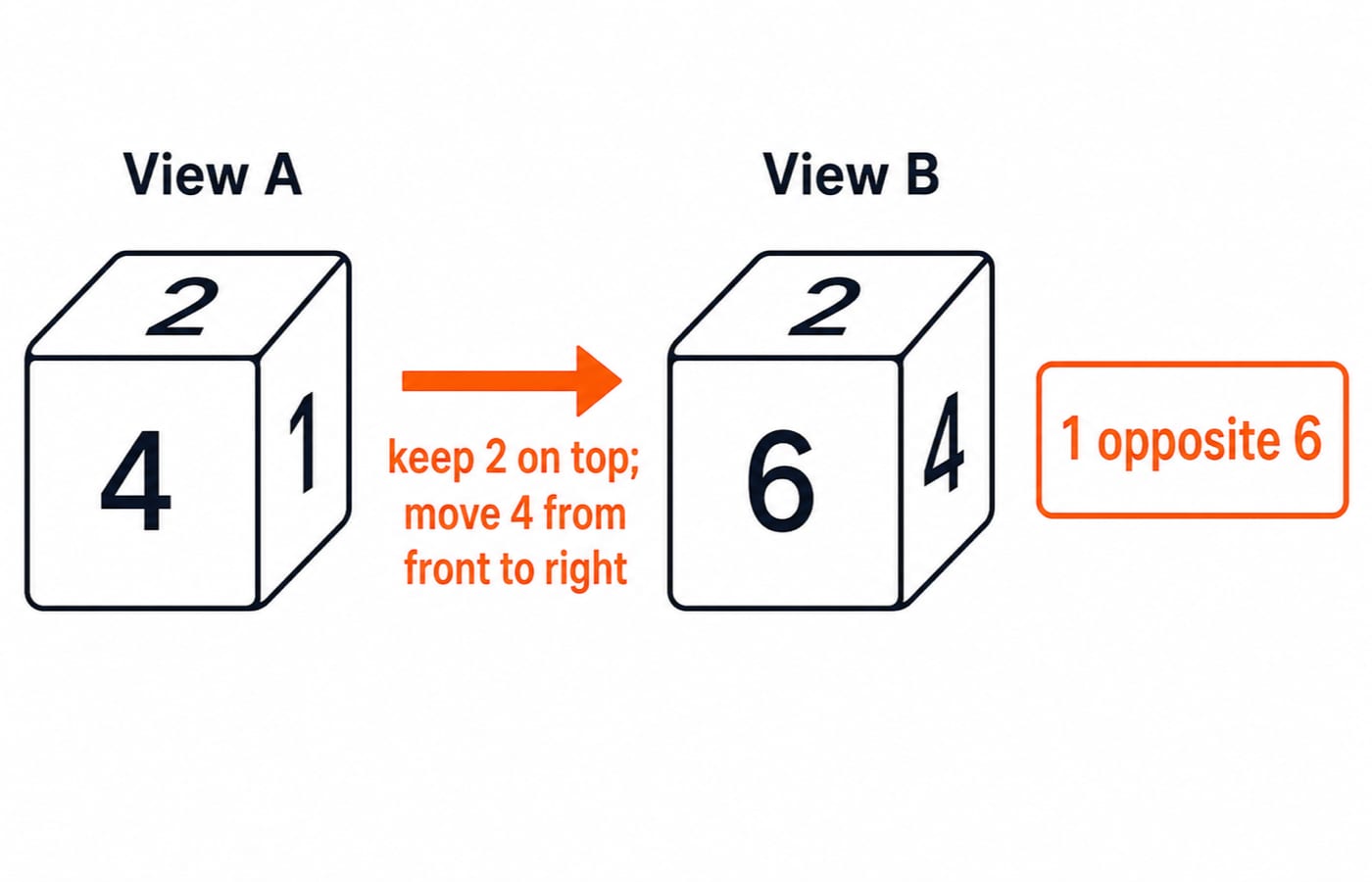
There is a quick consistency check. Each visible triple, {2, 4, 1} and {2, 6, 4}, represents three faces meeting at a corner, so every pair within that triple is adjacent. Faces 1 and 6 never appear in the same shown corner, so the opposite-face result contradicts neither view.
Cube nets: fold from one anchor face
Take this labelled net:
  B
E A C F
  D
Fix A as the anchor face. When the net folds, B and D rise on opposite sides of A. In the same way, C and E rise on opposite sides. The extra square F, attached beyond C, closes the cube across from A.
The opposite pairs are therefore:
A-FB-DC-E
If the question asks, "Which face is opposite C?", the answer is E.
Mark one anchor, trace shared edges and form opposite pairs after folding. Squares that look far apart on a flat net are not automatically opposite.
Painted cubes: count disjoint regions so nothing is counted twice
Suppose all six faces of an n x n x n cube are painted before it is cut. For n of at least 2, the smaller cubes fall into four non-overlapping groups:
Small-cube position | Painted faces | Count |
|---|---|---|
Corner | Exactly 3 |
|
Edge interior | Exactly 2 |
|
Face interior | Exactly 1 |
|
Core | None |
|
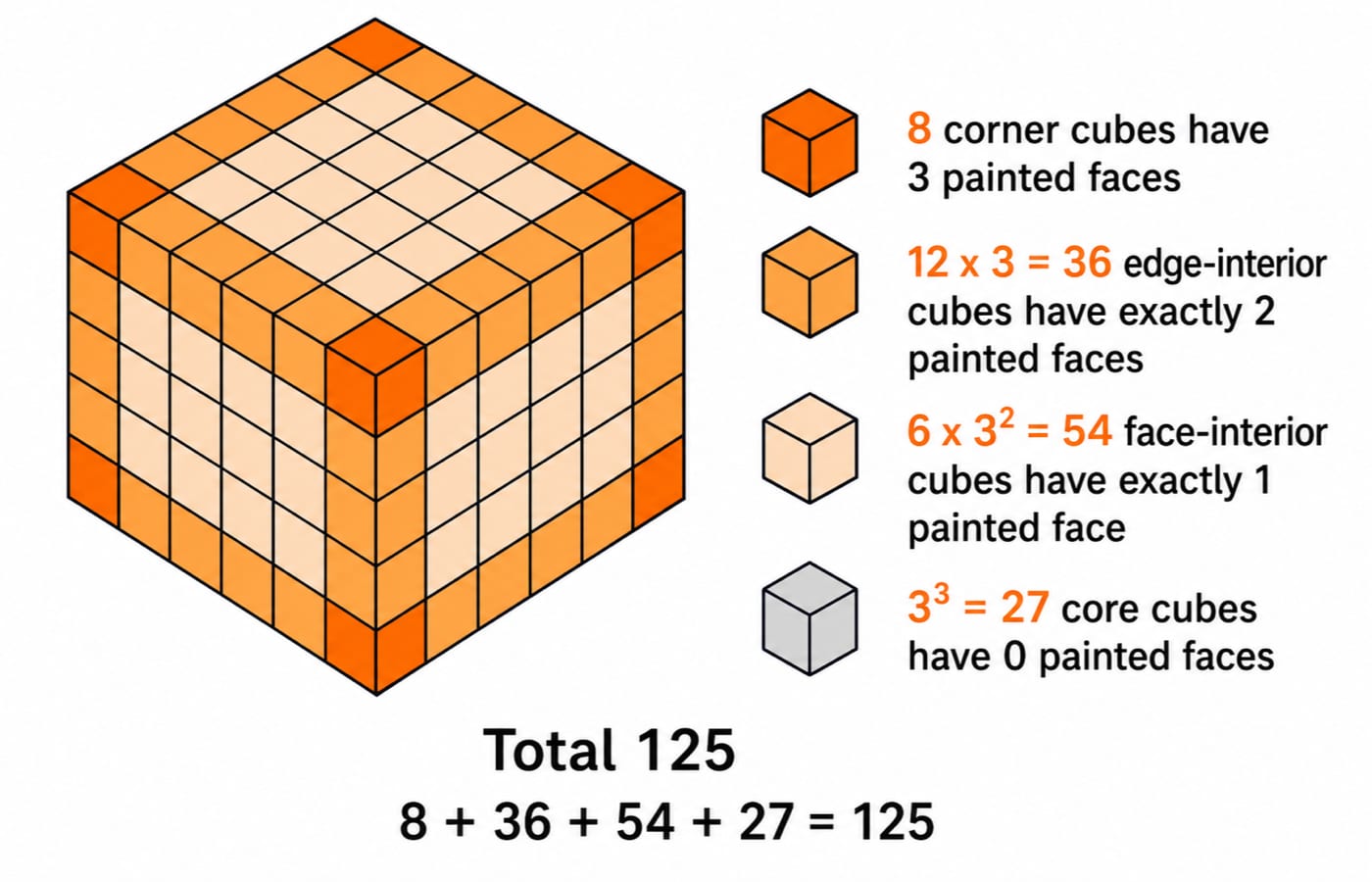
The formulas follow directly from the geometry. There are 8 corners. Each of 12 edges has n-2 cubes after its two corners are removed. Each of 6 faces has an interior grid of (n-2) x (n-2). The unpainted core has side length n-2.
Now cut a painted cube into 5 equal parts along every edge. The total number of small cubes is:
5^3 = 125
Classify them without overlap:
Exactly 3 painted faces:
8Exactly 2 painted faces:
12(5-2) = 12 x 3 = 36Exactly 1 painted face:
6(5-2)^2 = 6 x 3^2 = 6 x 9 = 54No painted face:
(5-2)^3 = 3^3 = 27
Check the complete partition:
8 + 36 + 54 + 27 = 125
If the question asks for cubes with at least 2 painted faces, use the 3-face and 2-face groups:
8 + 36 = 44
Do not confuse cuts with parts. Four equally spaced cuts along each edge create 5 parts per edge, giving 5^3 = 125 small cubes. Using 4^3 = 64 counts the cuts as parts and is incorrect.
Cubes and dice shortcuts that are safe under time pressure
Make a one-line face ledger. Every face has four adjacent faces and one opposite face. Once four different faces are known to be adjacent to a chosen face, the only remaining label must be opposite it.
For dice views, align a common face first, then track a move such as front to right or top to front. For nets, anchor one square and preserve every shared edge. For painted cubes, translate words such as exactly, at least and none into disjoint groups before doing arithmetic.
This is the same habit used in Logical Reasoning for Placement Tests: 3 Solving Methods: convert visual or verbal information into a fixed representation before solving.
Common cubes and dice mistakes, with the correction for each
Treating a visible triple as unordered. Repeated labels across views can tempt you to match sets alone, turning a rotation into a mirror. Always write (top, front, right).
Assuming opposite faces sum to 7. This works for an ordinary die, but it is unsupported for an arbitrary labelled cube. Apply the sum rule only when the question states the die type.
Confusing cuts with parts. Four cuts create five parts along that edge. Convert c cuts to c + 1 parts before cubing.
Adding overlapping painted-face groups. Counting all edge cubes without removing corners counts corner cubes again. Use the four disjoint groups with 3, 2, 1 and 0 painted faces, then verify that their sum is n^3.
How competitive exams test cubes and dice reasoning
Common formats include finding an opposite face, checking a view or net, identifying a face after rotation and counting cubes by painted faces. Use the same solving order:
Classify the question as a view, net or painted-cube problem.
Copy the ordered labels or the value of
n.Apply the matching invariant: adjacency, shared edges or a disjoint formula.
Verify the result against the visible corners or the total cube count.
In the dice example, faces 1 and 6 never share a shown corner. In the painted-cube example, all four groups add to 125. These checks are short enough to perform before accepting an answer.
For one broader example of organising non-verbal practice, see SSC CGL Reasoning: High-Yield Topics and Solving Order.
Cubes and dice: the short version and next practice step
Record dice views as ordered triples.
Preserve adjacency when rotating a die.
Fold a net from one anchor face.
Use disjoint painted-cube formulas and verify their sum against
n^3.
Once these four habits are secure, cubes and dice become bookkeeping rather than guesswork. For a structured sequence of lessons and practice across related reasoning topics, continue with the Aptitude Course for Placement.
Keep learning
Fallacy in Logical Reasoning: Types, Shortcuts and Solved Examples
Learn to test fallacy questions by separating the conclusion, evidence and hidden bridge. Includes conditional, survey, analogy, causation and language examples.
Updated 18 Nov 20266 min readAptitude & Reasoning
Clock Reasoning for Competitive Exams: Concepts, Shortcuts and Solved Examples
Clock questions become easier when you treat both hands as moving objects. Derive the core formulas, solve angle and meeting problems, and handle mirrors and faulty clocks without guesswork.
Updated 1 Nov 20266 min readAptitude & Reasoning

Calendar Reasoning for Competitive Exams: Shortcuts and Solved Examples
Turn calendar questions into small remainder calculations. Learn the core rules, follow solved dates, and avoid the inclusion errors that spoil otherwise correct work.
Updated 31 Oct 20266 min readAptitude & Reasoning

Blood Relations Reasoning: Concepts, Shortcuts and Solved Examples
Learn a repeatable way to solve direct family trees, coded relations and photograph statements without assuming gender or inventing missing links.
Updated 30 Oct 20266 min readAptitude & Reasoning