

Coding-Decoding Concepts and Shortcuts with Solved Examples
Identify, validate and reverse coding-decoding rules through letter shifts, rearrangements, number codes and sentence substitution.
KnowledgeGate Team
Exam prep & CS education
Updated 9 Nov 20265 min read
Coding-decoding becomes slow when you start calculating before identifying what has changed. One promising letter match can tempt you into applying a rule that fails at the next position. A safer method is to recognise the likely rule family, test it across every given pair and only then decode the target. A shortcut means avoiding unnecessary trials. It never means guessing from one convenient letter. That distinction matters under pressure.
What Coding-Decoding Questions Are Really Testing
A code is a consistent mapping between a given form and its coded form. Most coding-decoding questions fall into five useful solving families: uniform or alternating letter shifts, reversal or rearrangement, letter-to-number operations, word-substitution codes, and symbol or condition codes. These are recognition tools, not an official syllabus classification.
Look first at the shape of the evidence. Equal word lengths often suggest a letter-wise mapping. A changed order suggests reversal or rearrangement. One number for a whole word points towards an operation on alphabet positions. Repeated words across coded sentences help reveal repeated code tokens. These recognition habits also support puzzles, syllogisms and series in a broader logical-reasoning practice plan.
Use This Detection Order Before Trying a Shortcut
Follow the same scan each time:
Compare the input and output lengths.
Check whether the order is preserved or reversed.
Write A=1 through Z=26 only for the letters you need.
Compute each letter difference, including wrap-around.
Test alternating or position-based changes.
Validate the candidate rule on every supplied pair.
Apply the confirmed rule to the target.
For MIND -> NJOE, the changes are M13->N14, I9->J10, N14->O15 and D4->E5. Every letter moves +1. Confirm it on COLD -> DPME: C3->D4, O15->P16, L12->M13 and D4->E5. Now decode UJNF by moving each letter -1: U->T, J->I, N->M and F->E. The answer is TIME.
Reject an option as soon as one position violates the confirmed mapping, but never infer the mapping from the options alone.
Worked Example: Reverse First, Then Shift Each Letter
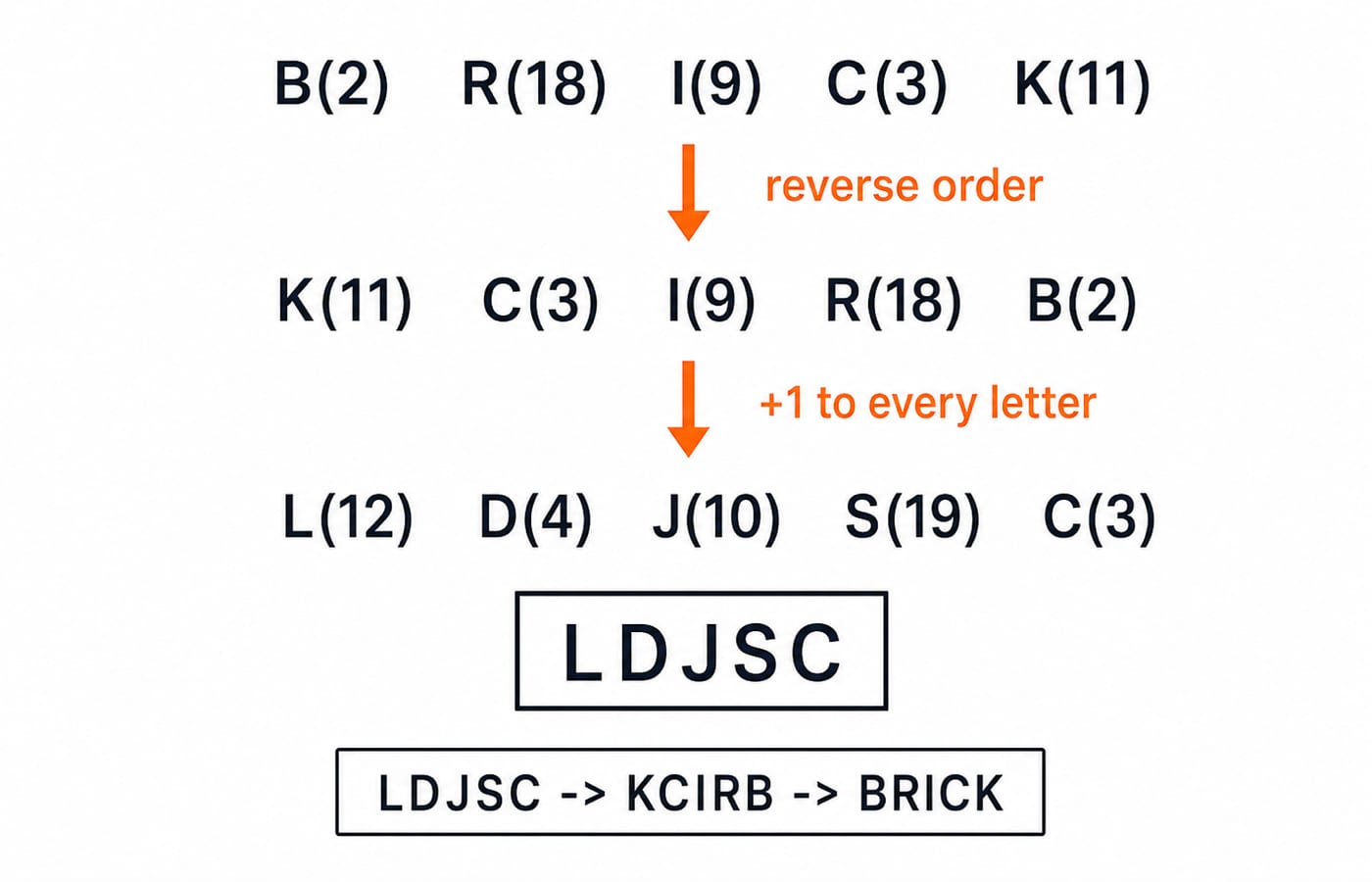
Consider this rule: a code reverses a word and then moves every letter one place forward. PLANT becomes UOBMQ. How will BRICK be coded?
First verify that the stated rule really produces the model pair:
Reverse
PLANTto getTNALP.Shift each reversed letter by +1: T20->U21, N14->O15, A1->B2, L12->M13 and P16->Q17.
Join the new letters to produce
UOBMQ.
Now apply the identical operations, in the identical order, to the target:
Reverse
BRICKto getKCIRB.Shift each letter by +1: K11->L12, C3->D4, I9->J10, R18->S19 and B2->C3.
Concatenate the results as
LDJSC.
An inverse check confirms the result. Move every letter in LDJSC back by one to recover KCIRB, then reverse that string to recover BRICK. Notice that the check undoes the last coding operation first.
Worked Example: Turn a Word into a Number
Suppose CAT = 24, BAT = 23 and HEN = 27. What is the code for DOG?
(a) 24
(b) 25
(c) 26
(d) 27
Test the sum of alphabet positions against every supplied pair. CAT gives C3+A1+T20 = 3+1+20 = 24. BAT gives B2+A1+T20 = 2+1+20 = 23. HEN gives H8+E5+N14 = 8+5+14 = 27. The same operation fits all three examples.
Therefore, DOG gives D4+O15+G7 = 4+15+7 = 26. The answer is option (c), 26. A single pair can support many invented rules, so use all supplied pairs. Do not introduce multiplication, reverse positions or digital roots unless the evidence requires them.
Worked Example: Solve a Sentence-Substitution Code by Overlap
Use these three statements:
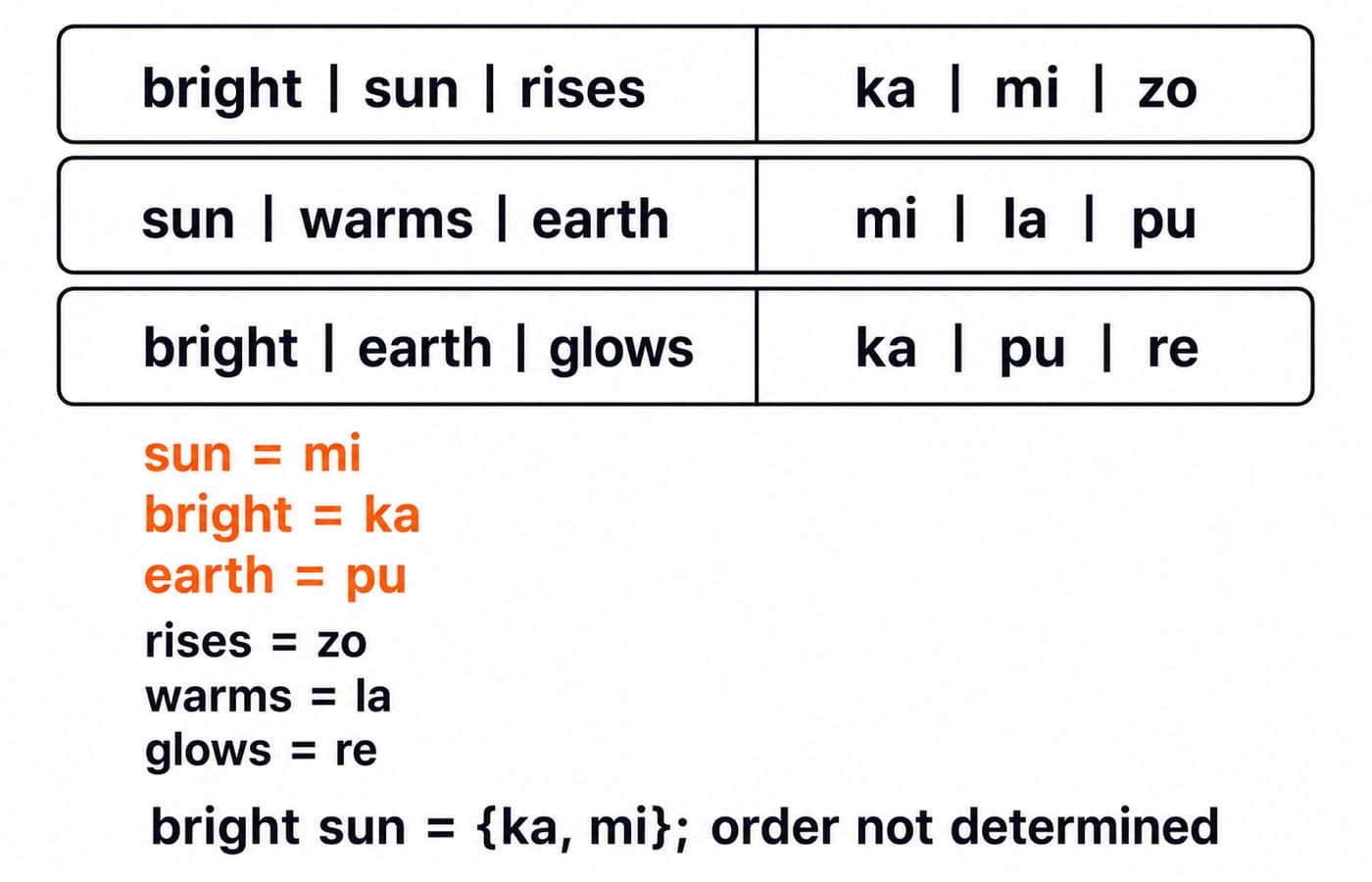
bright sun rises = ka mi zosun warms earth = mi la pubright earth glows = ka pu re
Do not match words and tokens merely by their positions. Compare repeated items across sentences instead.
sun occurs in the first two statements, and mi is the token common to their coded forms. Therefore, sun = mi. bright occurs in the first and third statements, while ka is common to those coded forms. Therefore, bright = ka. earth occurs in the second and third statements, and their common token is pu. Therefore, earth = pu.
The unmatched items now give rises = zo, warms = la and glows = re. For "bright sun", the required code-token set is {ka, mi}. These statements treat each coded side as a set, so they do not prove token order. Accept ka mi or mi ka unless the question separately defines a positional rule.
Shortcuts That Save Time Without Sacrificing Accuracy
Three compact tools reduce writing and repeated counting:
Remember alphabet-position anchors such as A=1, E=5, J=10, O=15, T=20 and Z=26.
Write only the letters required by the question instead of copying the whole alphabet.
When the data indicates opposite-letter coding, use complementary pairs A-Z, B-Y and C-X. Their positions sum to 27.
Handle wrap-around deliberately. For Y + 3, Y is 25, so 25+3 = 28. Subtract 26 to get position 2, which is B. For B - 3, 2-3 = -1; adding 26 gives 25, which is Y. Never leave a result outside 1 to 26.
For multi-step rules, use the inverse-check shortcut seen with LDJSC: undo the last operation first, then undo the earlier one. Any shortcut is valid only after the rule survives every provided example.
Common Traps and the Exact Correction for Each
Matching only the first letters: A rule that fits one or two positions can still be wrong. Test every position in every supplied pair.
Doing operations in the wrong order: Take MATH with alternating shifts +1,-1,+1,-1. Shifting first gives M->N, A->Z, T->U and H->G, or NZUG; reversing then gives GUZN. Reversing first gives HTAM. Applying the same shifts gives H->I, T->S, A->B and M->L, or ISBL. Since GUZN and ISBL differ, follow the stated order.
Assuming sentence-code order: The earlier evidence establishes {ka, mi} for "bright sun", but its order remains undetermined.
Mixing conventions: Declare A=1 or A=0 before calculating and use it consistently. Apply wrap-around whenever a shift crosses A or Z.
Forcing a familiar pattern: If even one letter or one given pair fails, discard the rule instead of calling the question defective.
How to Practise for Placement and Government-Exam Contexts
The question mix, marking scheme and time allowance can vary by exam and cycle. Before preparing for a particular paper, confirm its current syllabus, notification and instructions on the relevant exam body's official website.
The SSC CGL guide uses coding-decoding as one fast topic inside a broader ranking and solving-order plan; use the SSC CGL Reasoning: High-Yield Topics and Solving Order for that wider view. The Bank PO guide places letter-shift and sentence-overlap coding among several smaller topics within its topic-priority and puzzle method; see the Reasoning Chapters for Banking: Puzzles and Topic Priorities. The worked traces here develop the detection order, multiple rule families and the underdetermined token-order case in full.
The Short Version
Identify the likely rule family, validate it against all the evidence, apply each operation in order, and inverse-check the result. Placement-focused readers can continue through the Placement Preparation category. For a structured next step covering reasoning and quantitative practice, use the Aptitude Course for Placement.
Keep learning
Data Sufficiency: A 5-Step Method, Shortcuts and Solved Examples
Learn to test each statement independently, prove insufficiency with two valid cases, and stop as soon as the target becomes unique. Three worked problems make the method concrete.
Updated 15 Nov 20266 min readAptitude & Reasoning
Data Arrangement Questions: Concepts, Shortcuts and Solved Examples
Turn names, cities, roles and scores into a clean grid. This guide shows safe shortcuts and solves one complete arrangement from clues to answer.
Updated 11 Nov 20266 min readAptitude & Reasoning
Trigonometry for Competitive Exams: Concepts, Shortcuts and Solved Examples
Build trigonometry from one right triangle, recover standard values safely, and solve identities, equations, and height-and-distance problems step by step.
Updated 8 Nov 20266 min readAptitude & Reasoning
Time and Work Concepts and Shortcuts: Solved Examples for Competitive Exams
Learn how to model Time and Work questions, select the right shortcut, and solve combined-work, efficiency, worker-hour, and changing-schedule problems accurately.
Updated 7 Nov 20265 min readAptitude & Reasoning