A row of six people has 6! = 720 orders, but the same six people around an ordinary round table have only 5! = 120 distinct arrangements. The arithmetic becomes easy once you decide whether rotations and reflections count as new arrangements. The rule follows from rotational symmetry; halving is valid only when reflections are identical, and together, apart, alternating, opposite, and fixed-gap seating have corresponding shortcuts.
Circular permutations begin with the equivalence rule
Before choosing a formula, define what counts as the same arrangement.
A row or a set of labelled seats has
n!arrangements because every position is distinct.Distinct objects around an unlabelled circle have
(n-1)!arrangements when rotations are identical.A reversible necklace or garland has
(n-1)!/2arrangements when rotations and reflections are both identical. This rule assumesn >= 3and all objects are distinct.
For A, B, C, and D, the three models give 4! = 24, (4-1)! = 6, and (4-1)!/2 = 3, respectively. The word “circle” does not choose the formula. The equivalence condition does. If the linear stage still feels uncertain, revise the permutation and combination counting method before removing circular symmetry.
Derive the (n-1)! rule instead of memorising it
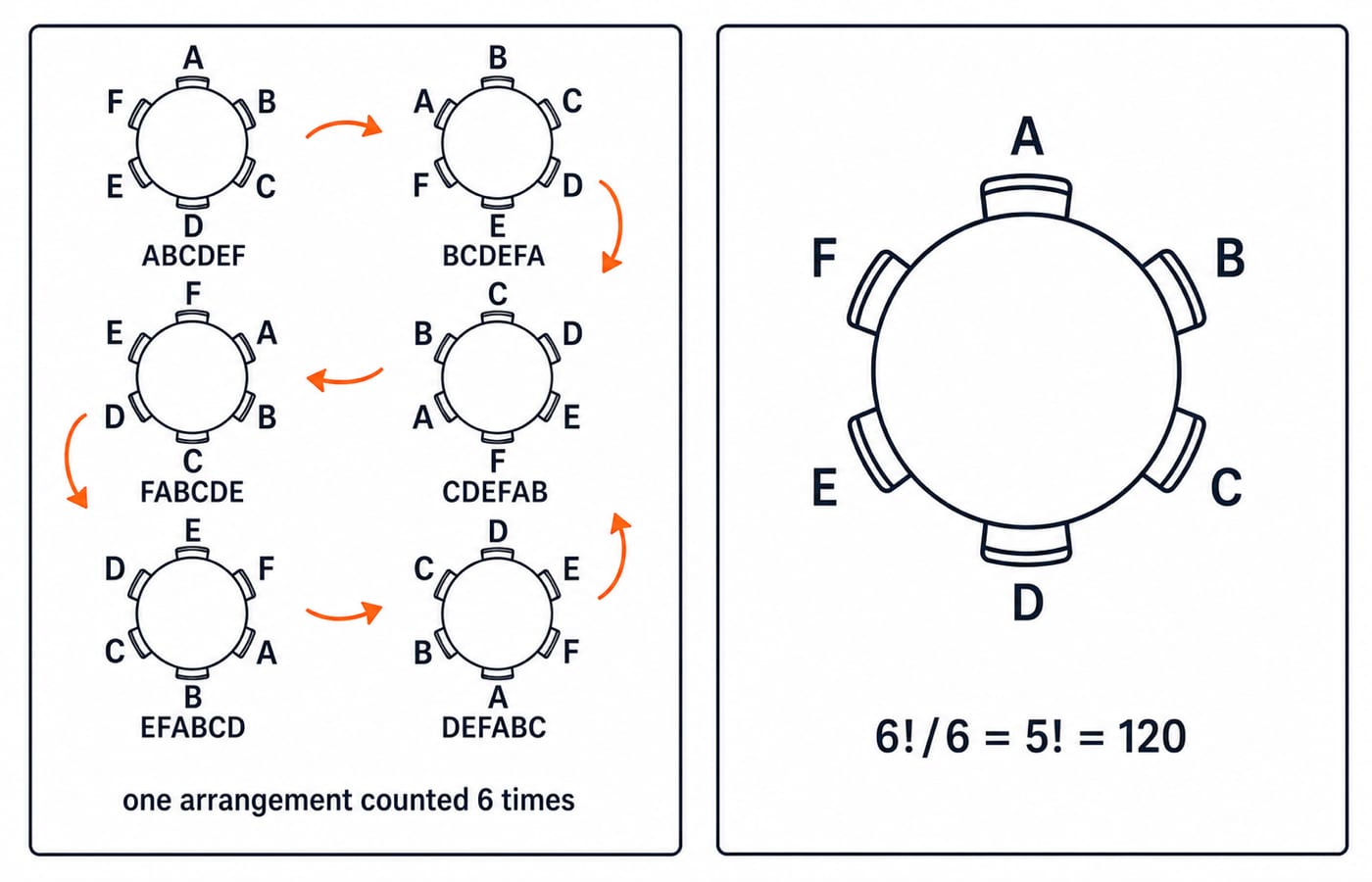
Take six friends A, B, C, D, E, and F. A linear listing gives 6! = 720 orders, but each circular arrangement appears through six rotations:
ABCDEF, BCDEFA, CDEFAB, DEFABC, EFABCD, and FABCDE.
These listings preserve the same clockwise neighbours. Every circle was therefore counted six times, so
6!/6 = 720/6 = 120 = 5!.
The anchor shortcut performs the same symmetry removal. Fix A at the top, then arrange B, C, D, E, and F in the five remaining relative positions. That gives 5! = 120. Fixing A is not an extra restriction because any completed circle can be rotated until A reaches the top.
Know exactly when clockwise-anticlockwise halving applies
At an ordinary table, clockwise A-B-C-D-E-F and clockwise A-F-E-D-C-B are reflections, not rotations. In the first arrangement, B is on A's right; in the second, B is on A's left. They are different seating arrangements, so both belong among the 120.
Now take seven distinct beads on a reversible necklace. Rotation first reduces 7! linear orders to 6! = 720 circular orders. Flipping the necklace pairs every clockwise order with its reverse, so the answer is 720/2 = 360.
A one-sided printed badge or seating plan cannot be flipped, so its count remains 720. Divide by 2 only when the object can be turned over or the question explicitly says clockwise and anticlockwise arrangements are identical.
Use the block method for people who must sit together
Suppose eight distinct people A through H sit around a table, with A and B together. Treat AB as one block beside C, D, E, F, G, and H. These are seven circular units, giving
(7-1)! = 6! = 720 orders.
Inside the block, A and B can appear as AB or BA. Thus the required count is
2 x 720 = 1440.
For A and B not together, subtract from all eight-person circular arrangements:
7! - 2 x 6! = 5040 - 1440 = 3600.
Do not divide by 8 again. The 6! block count already removed rotational duplication. In general, if k specified people among n must remain together, the formula is k!(n-k)!. For A, B, and C together among eight people, it gives 3! x 5! = 6 x 120 = 720.
Turn alternating, opposite, and fixed-gap wording into seat choices
Seat four distinct men M1 to M4 and four distinct women W1 to W4 alternately. Arrange the men around the circle in (4-1)! = 3! = 6 ways. Their four gaps are then fixed, and the women can occupy those gaps in 4! = 24 ways. The total is
6 x 24 = 144.
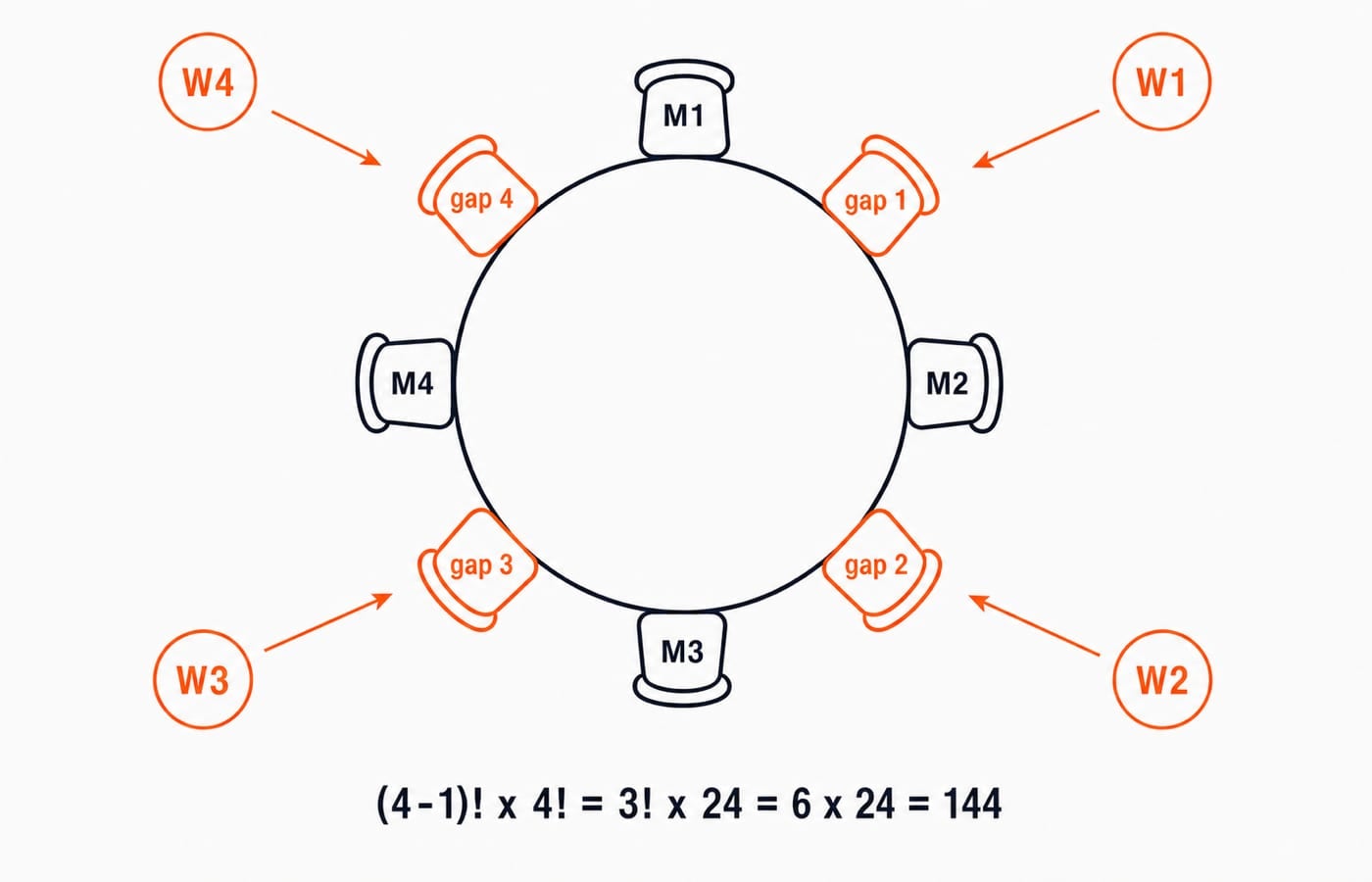
For eight people with A and B opposite, anchor A. B has one opposite chair, while the other six people can be arranged in 6! = 720 ways.
Now change the condition to exactly two people on the shorter arc between A and B. From anchored A, B has two eligible chairs, three steps clockwise or three steps anticlockwise. Arrange the remaining six people freely, giving 2 x 6! = 2 x 720 = 1440.
Avoid the shortcuts that produce confident wrong answers
Three checks prevent most errors:
Test the seats. Labelled chairs, a fixed head chair, or a room feature may distinguish positions. Ask whether rotating everyone together creates a genuinely new assignment before changing
n!to(n-1)!.Test reflection separately. Ordinary table reflections reverse left and right, so they remain different. Halving belongs to reversible necklaces, garlands, bracelets, or explicit wording.
Remove symmetry once. After removing rotational duplication, apply the block, gap, opposite, alternation, or complement condition. Do not divide again without a new symmetry argument.
The eight-person results provide a useful check: all arrangements = 5040, A and B together = 1440, and A and B apart = 3600. Since 1440 + 3600 = 5040, the restricted cases recover the total.
How aptitude questions disguise the same counting decision
Use this 20-second routine:
Identify whether the seats are labelled.
Decide whether rotations are identical.
Decide separately whether flips are identical.
Anchor one object if rotations are identical.
Apply block, gap, alternation, opposite, or complement counting.
The wording controls the model. A named exam does not automatically imply one convention.
Answer choices can expose a missed symmetry step. For eight distinct objects, a row or labelled seats gives 8! = 40320; an ordinary table gives 7! = 5040; a reversible necklace gives 7!/2 = 2520; and an ordinary table with A and B together gives 2 x 6! = 1440. Use these options as a diagnostic, but still justify the equivalence rule.
For the wider preparation context, read Aptitude for Placements: Quant, Reasoning, Verbal and use the aptitude courses and topic hub to continue with related material.
Short version and the next practice step
Keep this formula box attached to its conditions:
Ordinary unlabelled circle:
(n-1)!Reversible circle with distinct objects and
n >= 3:(n-1)!/2kspecified people together amongn:k!(n-k)!Two equal groups of size
malternating:(m-1)!m!
The condition matters more than the formula. Without looking back, reproduce 120 for six friends, 360 for seven reversible beads, 3600 for eight people with A and B apart, and 144 for four men and four women alternating. If one answer differs, return to the relevant symmetry, block, or gap step instead of memorising another shortcut.
If you need guided quant, reasoning, verbal practice, tests, and revision, explore the Aptitude Course for Placement.