Communication Models for Teaching Exams: 10 Models with Worked Classroom Examples
Learn the major linear, interactive and transactional communication models through one classroom situation, compact comparisons and solved exam-style prompts.
KnowledgeGate Team
Exam prep & CS education
Updated 30 Jul 20266 min read
Aristotle, Lasswell, Shannon-Weaver, Berlo and Schramm all contain a sender and a message. Memorise only the names and their diagrams soon look alike. Three structural questions keep them apart: does feedback exist, is noise part of the model, and do both sides act at the same moment? Ten models matter for CTET/TET, UGC NET and teaching-recruitment papers, and one classroom announcement about a quiz time is enough to separate every one of them.
Related reading: learners and learning and classroom pedagogy.
1. First sort communication models into three families
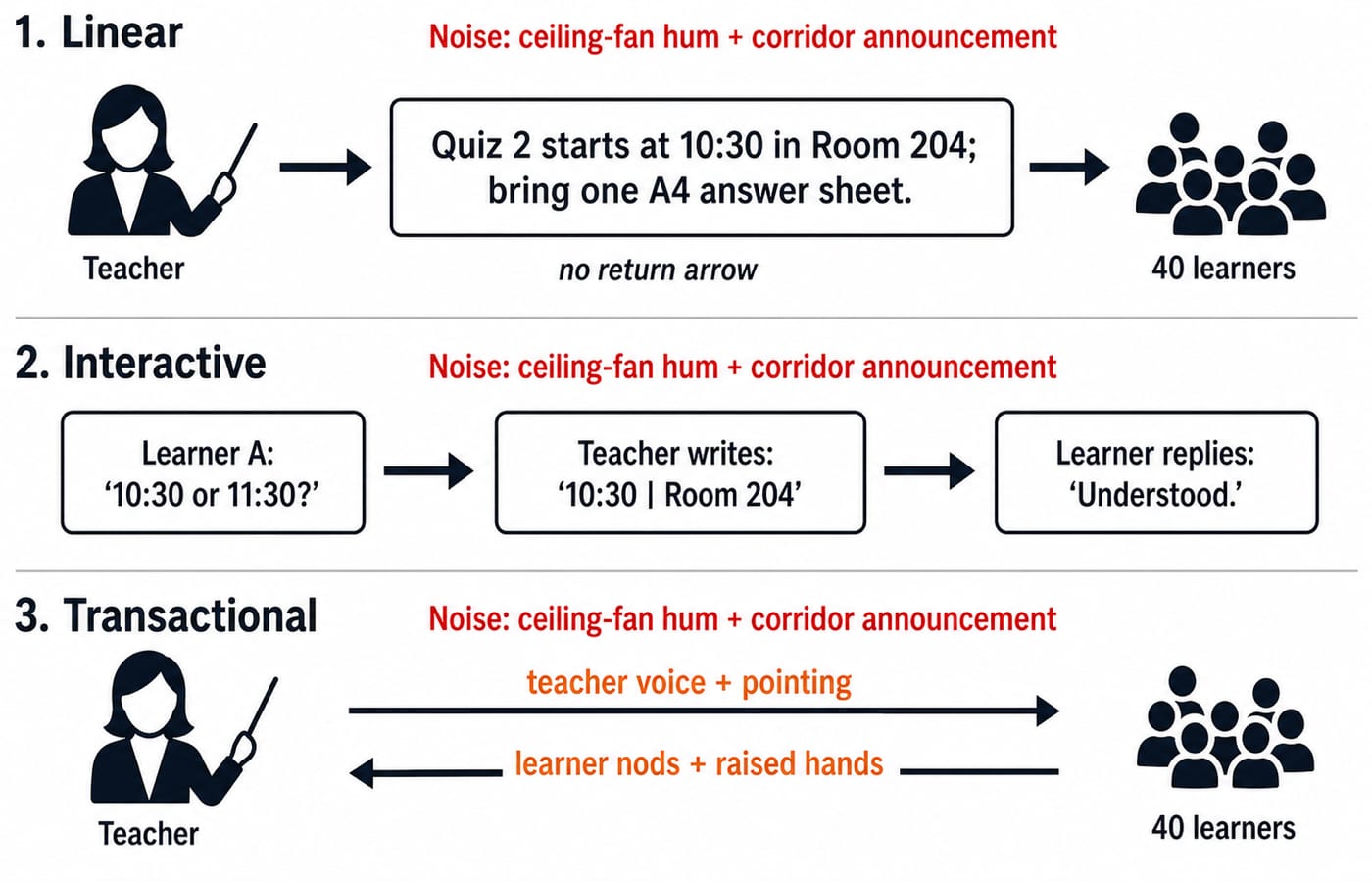
Running message: "Quiz 2 starts at 10:30 in Room 204; bring one A4 answer sheet." A teacher says it to 40 learners and writes it on the board.
The sender/source encodes an idea into a message, which travels through a channel. The receiver decodes it. Feedback returns a response, noise interferes, and context shapes the exchange.
Family | Basic idea | Models here |
|---|---|---|
Linear | One-way transmission | Aristotle, Lasswell, Shannon-Weaver, Berlo |
Interactive | Alternating message and feedback | Schramm, Osgood-Schramm |
Transactional | Simultaneous sending and receiving in context | Barnlund |
Six of the ten repay real reasoning: Aristotle, Lasswell, Shannon-Weaver, Berlo, Schramm (with its circular Osgood-Schramm form) and Barnlund. Four more need recognition only: Newcomb's ABX, Westley-MacLean, Dance's helix and Jakobson.
Decision rule: look first for feedback. Without it, test for noise, effect or SMCR. With it, look for field of experience or rotating roles. Simultaneous cues suggest a transactional model. Barriers, the 7 Cs and the full communication cycle are a separate topic, treated in Communication Basics: Models, Barriers, Solved MCQs.
2. Aristotle and Lasswell: speaker, audience and effect
Aristotle highlights speaker, speech, occasion, audience and effect. The teacher is the speaker, the announcement the speech, the end of class the occasion, 40 learners the audience, and correct preparation the intended effect. Its lens is rhetoric and persuasion.
Lasswell asks: Who says What in Which Channel to Whom with What Effect? Map it as teacher -> quiz instruction -> microphone and speech -> 40 learners -> 36 record 10:30 correctly while 4 seek clarification. Its final question is effect, not feedback. Lasswell suits effect-oriented mass-communication analysis. Both models remain linear because the receiver's reply is not central.
3. Shannon-Weaver: transmission, noise and the lost detail
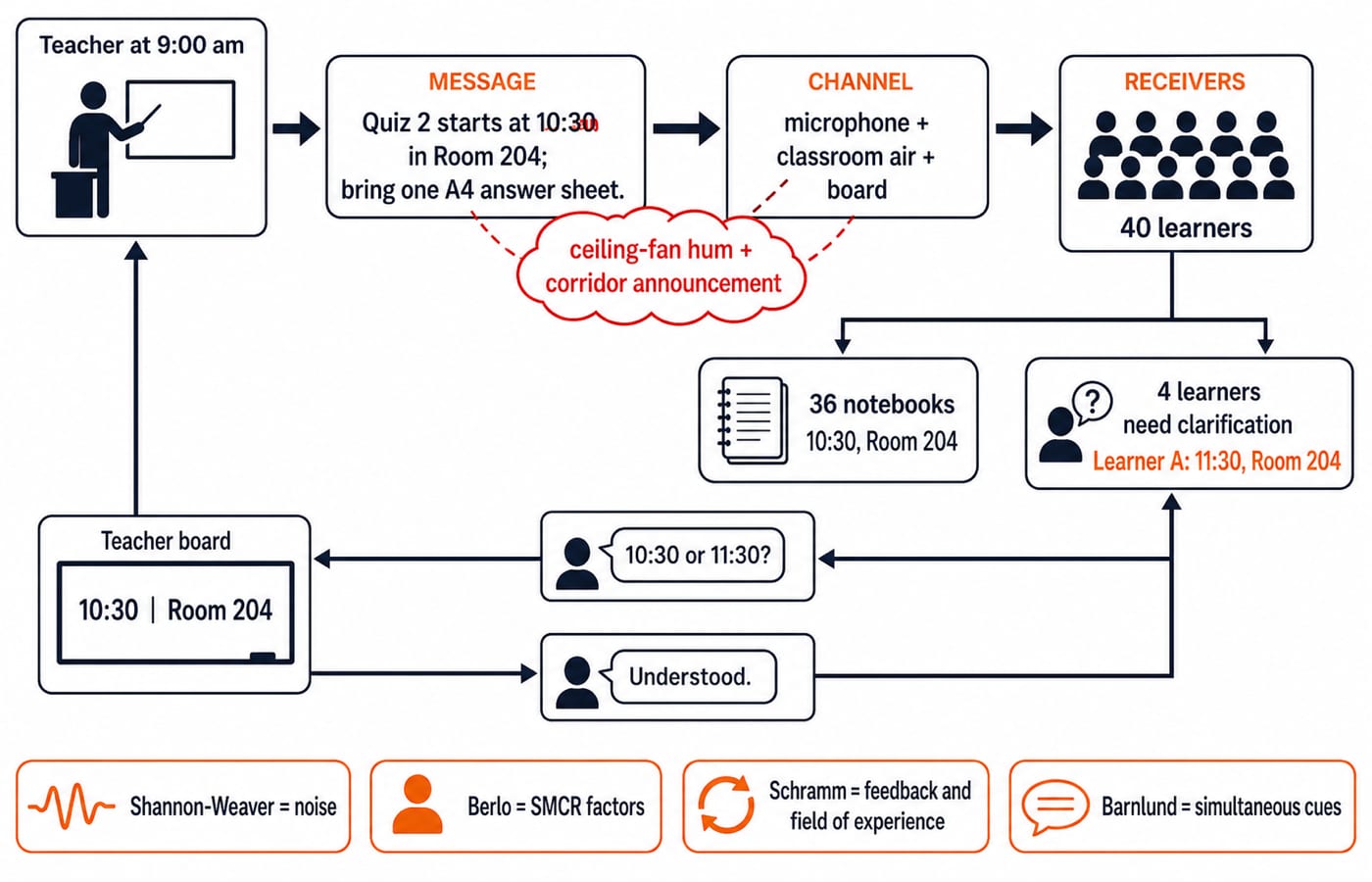
The sequence is information source -> transmitter/encoder -> signal through channel -> receiver/decoder -> destination, disturbed by noise. The teacher is the source, microphone the transmitter, amplified speech the signal, classroom air the channel, ears the receiver, and learners the destination.
A ceiling fan and corridor announcement mask ten. Learner A writes 11:30 but hears Room 204 correctly. That is physical noise. Hearing A4 without understanding it is semantic noise. Feedback is not core to the original linear formulation. Transmission noise points to Shannon-Weaver; feedback plus shared experience points to Schramm.
4. Berlo's SMCR model: what each letter contains
S-M-C-R means Source, Message, Channel and Receiver. Source and receiver each involve communication skills, attitudes, knowledge, social system and culture. Message covers content, elements, treatment, structure and code. Berlo commonly links channels to seeing, hearing, touching, smelling and tasting.
Clear pronunciation and quiz knowledge belong to Source. Quiz 2 / 10:30 / Room 204 / one A4 sheet form the Message; English, numerals and board writing supply code and treatment. Hearing and seeing are Channels. Learners' language and classroom conventions shape the Receiver. SMCR lacks explicit feedback, and Berlo's channel may mean a sensory route, not a microphone or internet.
5. Schramm, Osgood-Schramm and Barnlund: feedback changes the picture
Schramm uses encoder, decoder, interpreter, feedback and overlapping fields of experience. Learner A asks, "10:30 or 11:30?" The teacher writes "10:30 | Room 204", and the learner replies, "Understood." Shared clock and room-number conventions enlarge the overlap; jargon reduces it.
In Osgood-Schramm's circular model, each participant repeatedly encodes, interprets and decodes, so roles rotate. Barnlund is transactional: as the teacher speaks and points, learners simultaneously send public cues such as nods and raised hands. Private cues include attention and confusion. Checking them is a teaching decision as well as a theory label.
6. Four recognition-only models that complete the map
Model | Unmistakable cue | Tiny example |
|---|---|---|
Newcomb ABX | A and B relate through shared topic X to maintain social balance | A and B disagree about X |
Westley-MacLean | Events, selection and gatekeeping | An editor selects 3 of 20 school-news items |
Dance's helical model | Communication accumulates and changes over time | Explanations improve in Week 1, Week 4 and Week 8 |
Jakobson | Addresser, message, addressee, context, contact and code | A question foregrounds code or contact |
A teaching paper rarely asks you to map these four element by element. One line each is what the questions want: Newcomb for social balance around a shared topic, Westley-MacLean for gatekeeping between events and audience, Dance for a message that grows across repeated attempts, Jakobson for the six factors of a speech event. Save the full element-by-element mapping for the six core models.
7. Work the classroom example from start to finish
At 9:00 am, the teacher gives 40 learners the fixed message. Noise masks ten, so Learner A, one of 4 needing clarification, writes 11:30. The teacher answers on the board; the learner says "Understood". Before clarification, 36 recorded 10:30 correctly and 4 did not, so 36 + 4 = 40.
Model | What it notices | Exact mapping | What it leaves weak |
|---|---|---|---|
Aristotle | Speaker, audience, effect | Teacher, 40 learners, correct preparation | Transmission detail |
Lasswell | Who, message, channel, audience, effect | Teacher, instruction, speech, class, recorded time | Feedback |
Shannon-Weaver | Signal corrupted by noise | 10:30 becomes 11:30 | Shared experience |
Berlo | SMCR factors | Skills, message code, seeing/hearing, learners | Explicit feedback |
Schramm | Clarification and experience overlap | Question, board correction, "Understood" | Simultaneous cues |
Barnlund | Live simultaneous exchange | Voice, pointing, nods, raised hands | Simple transmission diagnosis |
Use Shannon-Weaver to diagnose why 10:30 became 11:30, Schramm to explain how feedback repairs it, and Barnlund to describe the live classroom interaction. No one model is universally best.
8. How teaching exams test the models, common traps and the next step
Test the trigger, then explain it:
"Who says what...?" Answer: Lasswell, because its formula examines effect.
A noise source disturbs a signal. Answer: Shannon-Weaver, where transmission failure is central.
The five senses act as channel. Answer: Berlo, the SMCR channel cue.
Fields of experience overlap. Answer: Schramm, where shared experience supports feedback.
A and B are oriented towards X. Answer: Newcomb, because ABX links them with a shared topic.
Arrange source, transmitter, channel, receiver, destination. Answer: that is Shannon-Weaver's correct order.
Why is Learner A's clarification feedback rather than effect? Answer: it returns a response that lets the teacher repair meaning; effect is the outcome produced.
Avoid common swaps. Effect is not feedback. Noise may be physical or semantic. Berlo's channel may be a sense. Schramm's field of experience is not Shannon-Weaver's noise source. Osgood-Schramm rotates roles; Barnlund stresses simultaneous exchange. For exam context, read UGC NET Paper 1 vs Paper 2.
60-second cue | Model |
|---|---|
Effect | Lasswell |
Noise | Shannon-Weaver |
SMCR and senses | Berlo |
Shared experience and feedback | Schramm |
Simultaneous cues | Barnlund |
The short version
Identify the family, find the trigger, then map every element onto the situation in front of you. UGC NET learners can continue with the NTA UGC NET Paper 1 course; CTET learners can prepare both papers with the CTET 2026 (Paper 1 and 2) bundle; and readers comparing routes can browse the Teaching Eligibility Tests category. Over 30 practice questions on communication models are waiting once you can name the triggers without looking.
Keep learning

सामान्य अशुद्धियाँ (Samanya Ashuddhiyaan): Complete Hindi Grammar Notes for CTET and TET Exams
Learn to identify and correct Hindi word-form, agreement, pronoun and redundancy errors through exact examples, a worked MCQ and a scored diagnostic.
Updated 6 Oct 20266 min readCTET & UPTET

Universities and Learning Programmes for Teaching Exams: Types, Modes and Solved Examples
Separate university status, delivery mode and programme purpose with a repeatable method, then test it on five UGC NET-style classification cases.
Updated 2 Oct 20265 min readCTET & UPTET

National Education Policy (NEP) 2020 Notes for Teaching Exams: 5+3+3+4, Reforms and MCQ Traps
Build an exam-ready map of NEP 2020, from the age-stage structure to pedagogy, language, PARAKH, B.Ed. routes and reliable distractor elimination.
Updated 26 Sep 20265 min readCTET & UPTET

Miscellaneous Pedagogy Topics for Teaching Exams: Complete Notes and Worked Examples
Turn a loose syllabus label into a five-part concept map, then use classroom evidence to distinguish sound pedagogy from attractive but incomplete options.
Updated 25 Sep 20266 min readCTET & UPTET