Communication Basics for Teaching Exams: Models, Barriers and Worked Examples
Learn to trace a communication cycle, compare major models, classify types, diagnose barriers, and solve classroom-based objective questions with confidence.
KnowledgeGate Team
Exam prep & CS education
Updated 27 Jul 20266 min read
You may know sender, message, and feedback, yet lose marks the moment a question describes a real classroom. Objective papers rarely ask for a bare definition. They hand you a scenario and ask which model it fits, which barrier broke it, and which repair belongs to that barrier. Diagnosis, not recall, is what scores.
1. Communication means shared meaning, not merely sending information
Communication lets participants reach shared meaning using symbols, a channel, interpretation, and feedback. A sent notice can still be misunderstood. Compare Read the chapter soon with Read pages 42-48 before 6:00 pm on Friday. The second is complete and precise.
A sender encodes an idea into words or signs and sends it through a channel. A receiver decodes it in context; feedback reveals understanding. Noise can interfere anywhere, while each participant's field of experience shapes meaning.
Quick distinction: Encoding converts an idea into symbols. Decoding interprets them. A channel is the path. Feedback returns information about reception or understanding.
For a teaching-method companion, read Computer Science Pedagogy for Teacher Exams.
2. The major communication models and what each one adds
Model | Core form | Focus or limit |
|---|---|---|
Aristotle |
| Public speaking; linear, no built-in feedback |
Lasswell |
| Linear analysis of source, message, channel, audience, and effect |
Shannon-Weaver | Information source, transmitter, channel, receiver, destination, with noise | Originally technical and linear; no feedback in the original chain |
Berlo SMCR | Source-Message-Channel-Receiver | Skills, attitudes, knowledge, social system, culture; no explicit feedback |
Schramm | Encoder, interpreter, decoder | Shared field of experience and feedback; interactive or circular |
Transactional | Participants send and receive together | Physical, social, and cultural context |
No return path suggests linear communication; alternating reply suggests interactional; simultaneous words, gaze, gesture, silence, and relationship cues suggest transactional. A classroom is usually transactional, although one announcement may be one-way. A recorded lecture with comments disabled is linear. Add a learner's later question and teacher's answer, and it is interactional. A live discussion with adjustment to tone and expression is transactional.
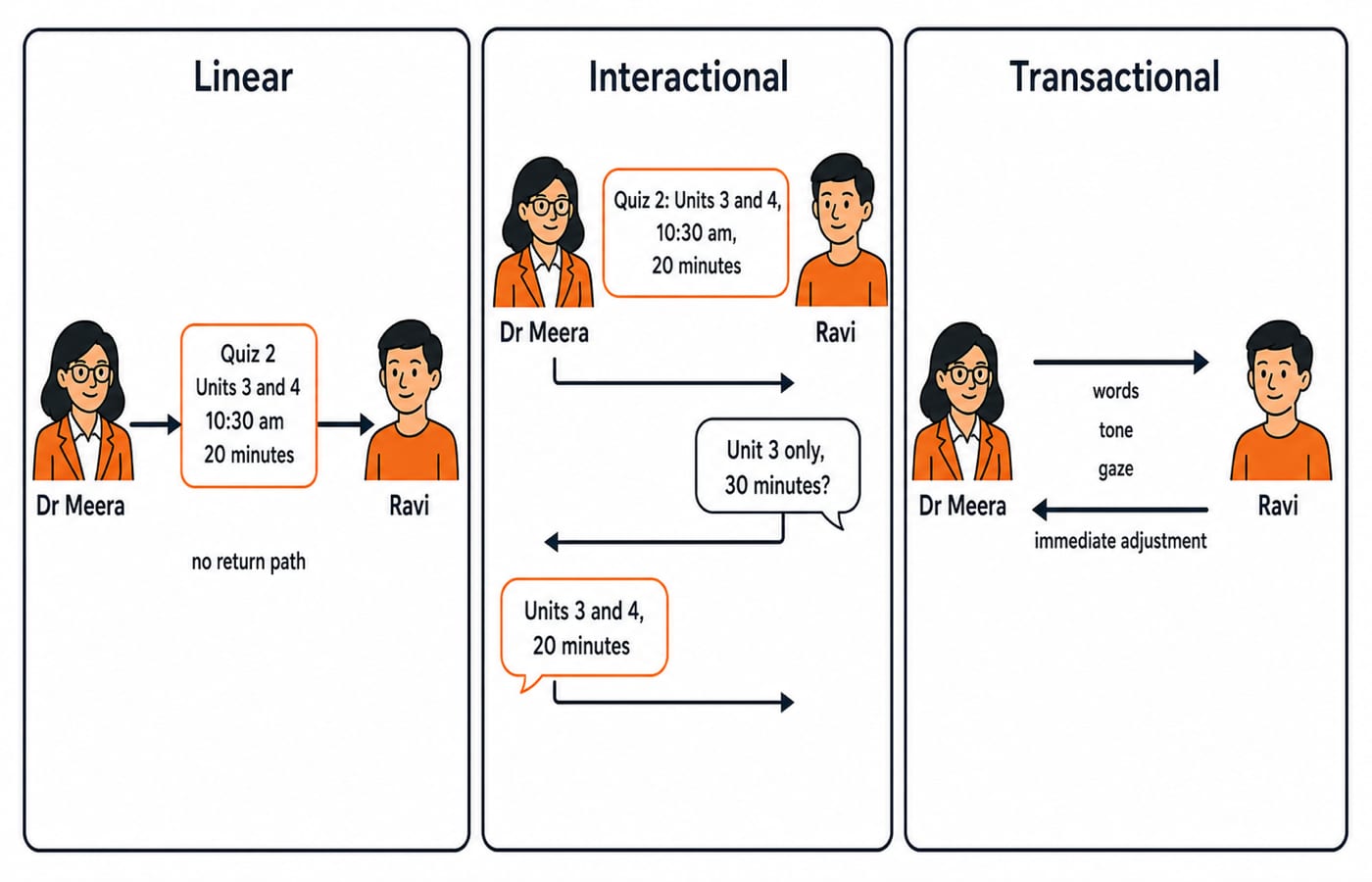
3. Types of communication: classify by mode, participants, direction, and formality
Axis | Types | Exact examples |
|---|---|---|
Mode | Verbal (oral or written), non-verbal, visual | Spoken explanation (verbal, oral); the LMS notice text |
Participants | Intrapersonal, interpersonal, group, mass | Ravi's silent |
Formality | Formal, informal | The official LMS notice (formal); a corridor reminder to a colleague (informal) |
Direction | Downward, upward, horizontal, diagonal | Principal's circular to teachers (downward); a teacher's leave request to the principal (upward); same-grade test planning between two teachers (horizontal); a teacher reporting a lab fault to an IT administrator outside the reporting line (diagonal) |
Non-verbal cues include expression, posture, gesture, eye contact, space, and paralanguage. One event may fit several axes: the LMS notice is written, formal, and downward.
4. Fully worked example: trace the complete communication cycle
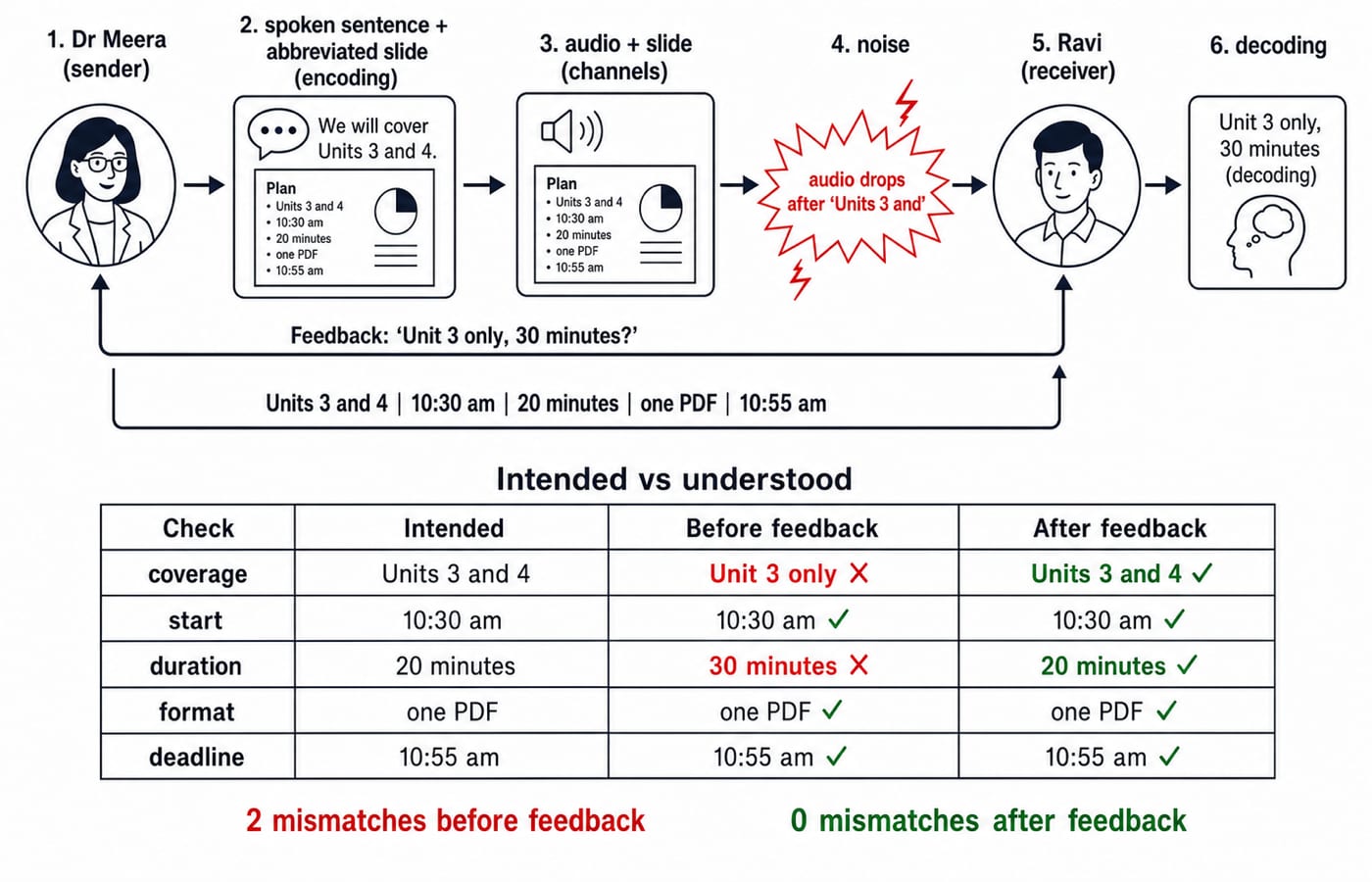
Dr Meera intends to say, Quiz 2 covers Units 3 and 4, starts at 10:30 am, lasts 20 minutes, and must be uploaded as one PDF by 10:55 am. During an online class, audio drops after Units 3 and, while the slide says Quiz 2 | 10:30 | 20 min | one PDF | 10:55. Ravi decodes this as Unit 3 only and assumes 30 minutes. He asks, Unit 3 only, 30 minutes? Dr Meera replies, No. Units 3 and 4, 20 minutes, one PDF by 10:55 am.
Element | Trace |
|---|---|
Sender, idea | Dr Meera; quiz instructions |
Encoding, message | Spoken sentence plus abbreviated slide; five facts |
Channels, receiver | Video-call audio and slide; Ravi |
Decoding, noise | Unit 3 and 30 minutes; audio dropout and slide's omission of |
Feedback, correction | Ravi's question; Dr Meera's reply |
Before feedback, two of five facts mismatch: coverage and duration. After it, all five match: Units 3 and 4, 10:30 am, 20 minutes, one PDF, 10:55 am. Mismatches therefore fall from 2 to 0.
5. Barriers, noise, and the repair that fits each problem
Type | Exact example | Repair |
|---|---|---|
Physical or technical | Dropout hides | Give a complete written message; test the connection |
Semantic |
| Say |
Psychological | Anxiety makes Ravi assume | Pause and verify |
Physiological | Hearing difficulty affects reception | Add captions and an accessible written version |
Cultural |
| Use direct language |
Organisational or status | Learner fears asking the principal | Create a safe feedback route |
Information overload | 17 instructions fill one slide | Group them into four labelled steps; highlight the deadline |
Noise may be semantic, psychological, cultural, technical, or physical. Barriers can arise at the sender, message, channel, receiver, or context. Feedback reveals interpretation, not guaranteed agreement.
Diagnose in four steps: locate the change, cite evidence, choose the narrowest barrier, then repair its cause. Here, the missing phrase after Units 3 and proves technical audio loss; a written five-fact message plus confirmation repairs it.
6. Effective communication: the 7 Cs, listening, and useful feedback
The 7 Cs of effective communication are clear, concise, concrete, correct, coherent, complete, and courteous. Replace Bring the work soon with Upload answers to Questions 3-5 as one PDF by 4:00 pm today: task, range, format, and deadline are explicit.
Active listeners attend, do not interrupt, paraphrase, ask specifically, and confirm the next action. Ravi can say: I will prepare Units 3 and 4, start at 10:30 am, work for 20 minutes, and upload one PDF by 10:55 am. Is that correct?
Replace evaluative Your explanation was poor with actionable The definition was clear, but the example did not show feedback; add the receiver's reply after the message. Matching verbal and non-verbal cues strengthen clarity; a smile with harsh words creates a mixed message.
7. How teaching-exam questions test communication basics
Objective papers keep returning to the same six stems: a definition, the order of the elements, a named model, a classification, a barrier, and the element a linear chain leaves out. One check for each, in that order.
Converting an idea into words is called: A feedback, B encoding, C decoding, D noise. Answer: B, because encoding creates symbols.
In the cycle idea, ___, message, channel, ___, feedback, the two blanks are: A decoding then encoding, B encoding then decoding, C noise then context, D feedback then noise. Answer: B, because the sender encodes before the receiver decodes.
Which model explicitly foregrounds shared field of experience and feedback? A Aristotle, B Lasswell, C Schramm, D Berlo SMCR. Answer: C, Schramm.
A principal sends a circular to teachers through the official portal. On formality and direction axes it is: A informal and upward, B formal and downward, C formal and horizontal, D informal and diagonal. Answer: B.
“Submit soon” means today to one learner and next week to another. The main barrier is: A physiological, B semantic, C physical, D mechanical. Answer: B, because
soonpermits different meanings.The original Shannon-Weaver chain runs information source, transmitter, channel, receiver, destination, with noise. The element it leaves out is: A noise, B channel, C feedback, D receiver. Answer: C, because nothing in that chain carries the receiver's understanding back to the source.
A reply does not mean transactional; alternating reply is usually interactional. Non-verbal is not wordless only: tone, pitch, pace, and pause accompany speech. For context, read UGC NET Paper 1 vs Paper 2 Explained.
8. Short version, retrieval drill, and next step
Communication aims at shared meaning.
Encoding creates the message.
Decoding interprets it.
A channel carries it.
Noise can enter anywhere.
Feedback exposes understanding.
Linear, interactional, and transactional models differ mainly in return flow and simultaneity.
Effective communication is clear, complete, context-aware, and open to confirmation.
In five minutes: draw the cycle in 90 seconds; classify a recorded lecture, delayed question, and live discussion; diagnose submit soon; rewrite it with a 6:00 pm Friday deadline; explain why Ravi's question is feedback.
Answer key: sender, encoding, message, channel, receiver, decoding, noise, feedback; linear, interactional, transactional; semantic; Submit by 6:00 pm on Friday; the question returns Ravi's interpretation.
For structured Paper 1 preparation, use NTA UGC NET Paper 1. For CTET Paper 1, use CTET Paper 1. Or browse Government and Teaching Eligibility Tests. Check your exam's current official notification for the syllabus and paper pattern before you plan.
Keep learning

सामान्य अशुद्धियाँ (Samanya Ashuddhiyaan): Complete Hindi Grammar Notes for CTET and TET Exams
Learn to identify and correct Hindi word-form, agreement, pronoun and redundancy errors through exact examples, a worked MCQ and a scored diagnostic.
Updated 6 Oct 20266 min readCTET & UPTET

Universities and Learning Programmes for Teaching Exams: Types, Modes and Solved Examples
Separate university status, delivery mode and programme purpose with a repeatable method, then test it on five UGC NET-style classification cases.
Updated 2 Oct 20265 min readCTET & UPTET

National Education Policy (NEP) 2020 Notes for Teaching Exams: 5+3+3+4, Reforms and MCQ Traps
Build an exam-ready map of NEP 2020, from the age-stage structure to pedagogy, language, PARAKH, B.Ed. routes and reliable distractor elimination.
Updated 26 Sep 20265 min readCTET & UPTET

Miscellaneous Pedagogy Topics for Teaching Exams: Complete Notes and Worked Examples
Turn a loose syllabus label into a five-part concept map, then use classroom evidence to distinguish sound pedagogy from attractive but incomplete options.
Updated 25 Sep 20266 min readCTET & UPTET