Miscellaneous Pedagogy Topics for Teaching Exams: Complete Notes and Worked Examples
Turn a loose syllabus label into a five-part concept map, then use classroom evidence to distinguish sound pedagogy from attractive but incomplete options.
KnowledgeGate Team
Exam prep & CS education
Updated 25 Sep 20266 min read

A syllabus label such as “miscellaneous topics” can invite shallow memorisation. Treat it as a connected set: learner-centred teaching, inclusion, assessment, purposeful technology and classroom research. These ideas recur in CTET and UPTET questions because they change what a teacher does with classroom evidence. The CTET and UPTET Teaching Eligibility Test Prep page provides the wider eligibility-test study path.
What miscellaneous pedagogy actually covers
Miscellaneous pedagogy is a cross-cutting cluster, not a dustbin of unrelated facts. It has five families:
learner-centred approaches;
experiential, inquiry and project work;
inclusive and differentiated design;
formative assessment and purposeful technology;
reflective practice, action research and educational innovation.
Keep four terms separate. Pedagogy explains learning design. A teaching method is the chosen procedure, while a technique is one move within it. An innovation solves a learning problem and is checked with evidence.
Pedagogy names the design logic; method, technique and innovation describe choices at different levels. That hierarchy prevents term-feature questions from collapsing into synonym matching.
Learner-centred, experiential, inquiry and project approaches
Learners connect prior knowledge, investigate, explain, use feedback and transfer an idea. Learner-centred teaching does not make the teacher absent. The teacher frames and structures the work.
Guided inquiry supplies a question, materials or prompts for examining evidence. Unguided discovery removes much of that support. A project has an objective and evidence of learning. Display craft alone does not qualify.
Consider 30 Class VI learners in 6 groups of 5. Each group maps shaded and unshaded parts of the school courtyard, records surface temperature at three marked points at 9:00 and 12:00, compares the two sets, and proposes where a reading corner should be placed. The teacher supplies the question, a recording table, a safety boundary and prompts about fair comparison.
The first map and prediction activate prior knowledge.
Measurements provide evidence for guided inquiry.
Comparing locations and times requires explanation, not display craft.
The reading-corner proposal transfers the evidence into a project decision.
An activity becomes experiential learning only when experience is followed by reflection, conceptual explanation and another application. Experiential Pedagogy for Teaching Exams: Complete Notes, Kolb Cycle and Classroom Examples owns the full act-reflect-concept-apply cycle and controlled water-filter trials; the courtyard task here shows how teacher framing turns an open activity into guided inquiry and a project decision.
Inclusive and differentiated teaching without lowering the goal
Inclusion keeps learners in the common classroom. Differentiation changes the route, support, pace or response format, not automatically the objective. Do not make a diagnosis the learner's identity or default to low-expectation work.
For the objective “Compare two causes of soil erosion and justify one prevention method,” learners may examine a tactile soil tray, a labelled photo set or a short audio description. They may answer through a two-column note, a labelled sketch or a one-minute oral explanation. The formats differ, but each learner must connect a cause to soil movement and justify a prevention method from evidence.
Every response is assessed through the same three checks:
two causes are identified correctly;
each cause is linked to soil movement;
one prevention method is justified from evidence.
Access and response vary, but the goal and evidence checks remain common.
Formative assessment and technology that serve a purpose
Formative evidence changes the next teaching move. Summative assessment records achievement after a learning period. Frequent marks are not formative unless they guide teaching. Assessment and Evaluation for Teaching Exams: Complete Notes with Worked Examples owns the measurement-assessment-evaluation taxonomy and tool-quality criteria; this section focuses on turning one evidence pattern into the next teaching move.
In 20 exit tickets, 12 learners distinguish evaporation from boiling, 5 give an incomplete temperature explanation, and 3 say both require 100 degrees Celsius. Check the total: 12 + 5 + 3 = 20.
Next comes a demonstration for the 3 misconceptions, a comparison prompt for the 5 partial responses, and an extension for the 12 secure responses. The evidence changed teaching.
A digital tool is not innovative merely because it is digital. Ask:
Does it improve access?
Does it shorten useful feedback time?
Does it enable a learning task that paper alone would make impractical?
If every answer is no, the tool may simply reproduce passive teaching.
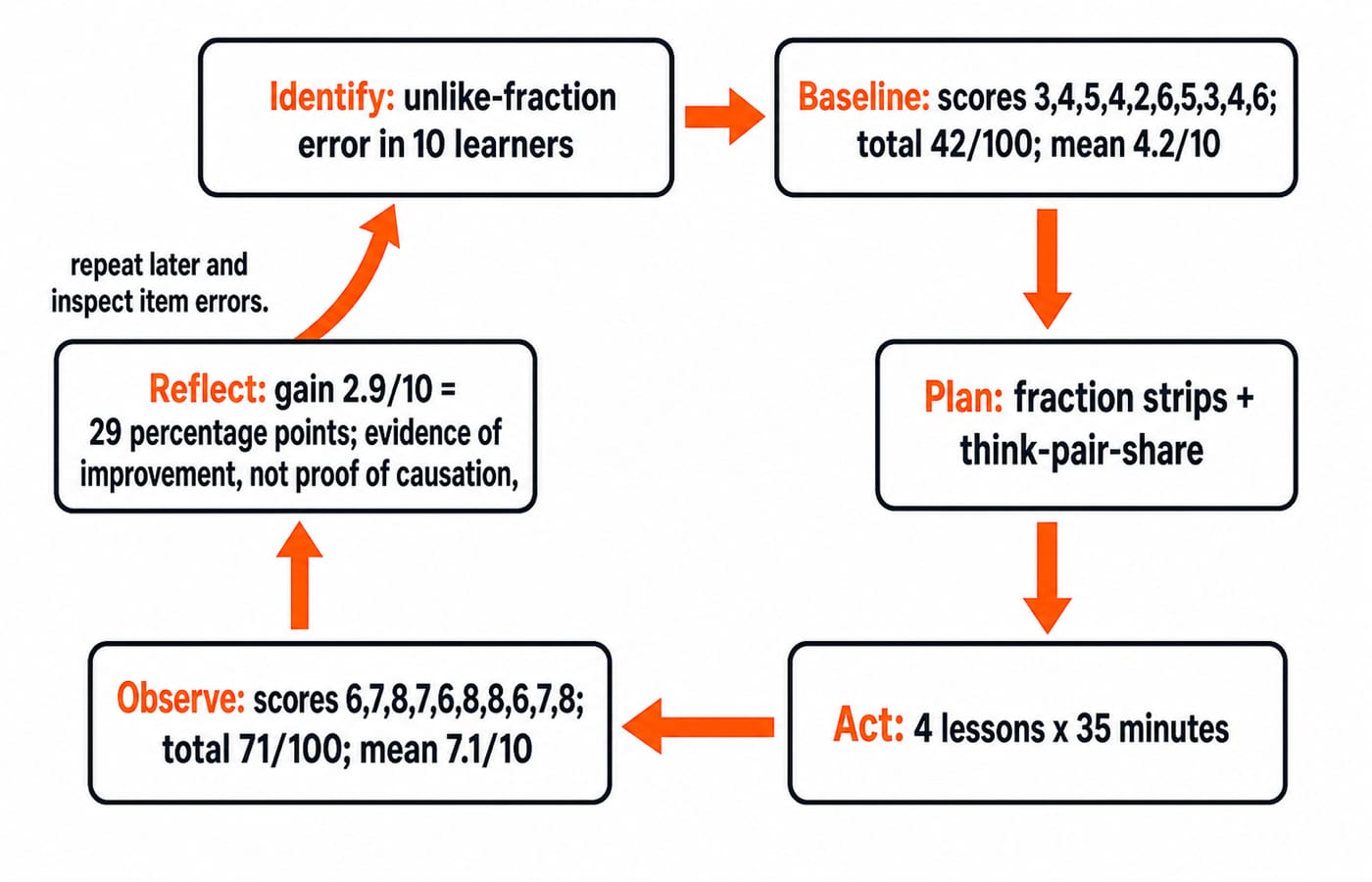
Fully worked classroom action-research example
A teacher finds 10 focus learners adding unlike fractions by adding numerators and denominators. Their pre-test scores out of 10 are:
3, 4, 5, 4, 2, 6, 5, 3, 4, 6
First find the total:
3 + 4 + 5 + 4 + 2 + 6 + 5 + 3 + 4 + 6 = 42
The maximum is 10 learners × 10 marks = 100 marks. Therefore:
mean = 42 ÷ 10 = 4.2 out of 10;
percentage = 42 ÷ 100 × 100 = 42%.
For 4 lessons of 35 minutes, the teacher uses fraction strips, think-pair-share and one exit ticket per lesson. A parallel post-test gives:
6, 7, 8, 7, 6, 8, 8, 6, 7, 8
Again find the total:
6 + 7 + 8 + 7 + 6 + 8 + 8 + 6 + 7 + 8 = 71
So:
mean = 71 ÷ 10 = 7.1 out of 10;
percentage = 71 ÷ 100 × 100 = 71%;
observed mean gain = 7.1 − 4.2 = 2.9 marks out of 10;
percentage-point gain = 71% − 42% = 29 percentage points.
This supports continuing and refining the approach, but not causation. With no comparison group, repeated practice may have helped. The teacher should inspect item errors, repeat the check later and record changes.
How teaching exams turn these ideas into questions
Questions commonly use four shapes:
a classroom situation asking for the most learner-centred response;
a term-feature match;
the correct sequence of an action-research cycle;
a short data set asking what can and cannot be concluded.
Multiple routes to one objective indicate differentiation and inclusion. The 12/5/3 groups require targeted follow-up. A rise from 4.2 to 7.1 shows improvement, not causation. Filtration with reflection and redesign fits experiential learning better than filtration alone.
Check paper-specific scope in the current official syllabus or information bulletin. In a scenario question, identify the learning goal, the evidence, the teacher’s next move and the limit of the conclusion before choosing an option.
Traps that make plausible options wrong
Trap | Why it is wrong | Correction |
|---|---|---|
Technology equals innovation | A tool can reproduce passive teaching | Test its learning purpose |
Activity equals experiential learning | Reflection and transfer are missing | Complete the cycle |
Inclusion means easier work | It lowers the common goal | Vary access and support |
A higher post-test proves the method | Rival explanations remain | Report evidence, not causation |
Formative assessment means frequent marks | Scores alone do not guide teaching | Change the next move |
Learner-centred does not mean teacher-absent, discovery need not be unguided, and a project is not automatically collaborative. Action research studies a local problem, not a universal law.
The short version and the next study action
Five checks organise the cluster: learner-centred work keeps the teacher as designer; experience becomes learning after reflection and transfer; inclusion changes access without automatically lowering the goal; formative evidence changes the next teaching move; action research improves a local practice while keeping causal claims modest.
Recalculate the 20-ticket and 10-learner examples, then explain why each result changes a teaching decision but does not prove causation. Next, classify mixed scenarios across the five families and justify each answer before checking it.
Primary-level learners can review the CTET Paper 1 course, while upper-primary learners can review the CTET Paper 2 course. Choose the course matching your paper, then map these five families against the current syllabus.
Keep learning

सामान्य अशुद्धियाँ (Samanya Ashuddhiyaan): Complete Hindi Grammar Notes for CTET and TET Exams
Learn to identify and correct Hindi word-form, agreement, pronoun and redundancy errors through exact examples, a worked MCQ and a scored diagnostic.
Updated 6 Oct 20266 min readCTET & UPTET

Universities and Learning Programmes for Teaching Exams: Types, Modes and Solved Examples
Separate university status, delivery mode and programme purpose with a repeatable method, then test it on five UGC NET-style classification cases.
Updated 2 Oct 20265 min readCTET & UPTET

National Education Policy (NEP) 2020 Notes for Teaching Exams: 5+3+3+4, Reforms and MCQ Traps
Build an exam-ready map of NEP 2020, from the age-stage structure to pedagogy, language, PARAKH, B.Ed. routes and reliable distractor elimination.
Updated 26 Sep 20265 min readCTET & UPTET

Mental Health and Life Skills for Teaching Exams: Complete Notes, Examples and Traps
Revise mental health, ten life skills and counselling approaches through clear contrasts, classroom examples and fast option-elimination rules.
Updated 23 Sep 20265 min readCTET & UPTET