Communication General Knowledge and General Studies for Teaching Exams: Facts and Worked Examples
Build a reliable Communication GK revision map for teaching exams, then practise chronology, matching and statement questions with fully checked answers.
KnowledgeGate Team
Exam prep & CS education
Updated 1 Aug 20265 min read
“Communication GK” can look like a loose current-affairs bucket, so learners often collect disconnected names and dates without knowing what each one means. The useful core is smaller: stable Indian media milestones, institutions, Acts and functions linked to the communication syllabus. That core comes down to four organisations, five dates, and one enactment-versus-enforcement distinction. CTET, TET, UGC NET and individual recruitment boards do not set one identical paper, so the widest version of the communication syllabus is the one in the UGC NET Paper I course, with the NET preparation category covering the rest of that path.
1. What Communication GK and General Studies Covers
“General Knowledge and General Studies related to Communication” is a revision heading, not a separate bullet in any official syllabus.
The UGC NET Bureau syllabus page and its linked English PDF, applicable from June 2019 onwards, place four areas inside Unit IV: meaning, types and characteristics of communication; effective verbal, non-verbal, intercultural, group and classroom communication; barriers to effective communication; and mass media and society. Communication GK is best treated as a revision layer around that last area.
Build it through four buckets:
Indian broadcasting milestones
Media institutions and their governing laws
Medium-versus-function distinctions
Stable public-information facts
Leave out daily news, personalities currently in office and unsupported “first in the world” trivia. Also keep the institution facts separate from the communication concepts that sit beside them. Communication Basics for Teaching Exams covers the process, the models and the barriers. Communication GK asks a different question: which institution, medium, law or milestone a given fact describes.
2. The Core Fact Map: Service, Corporation, Council and Law
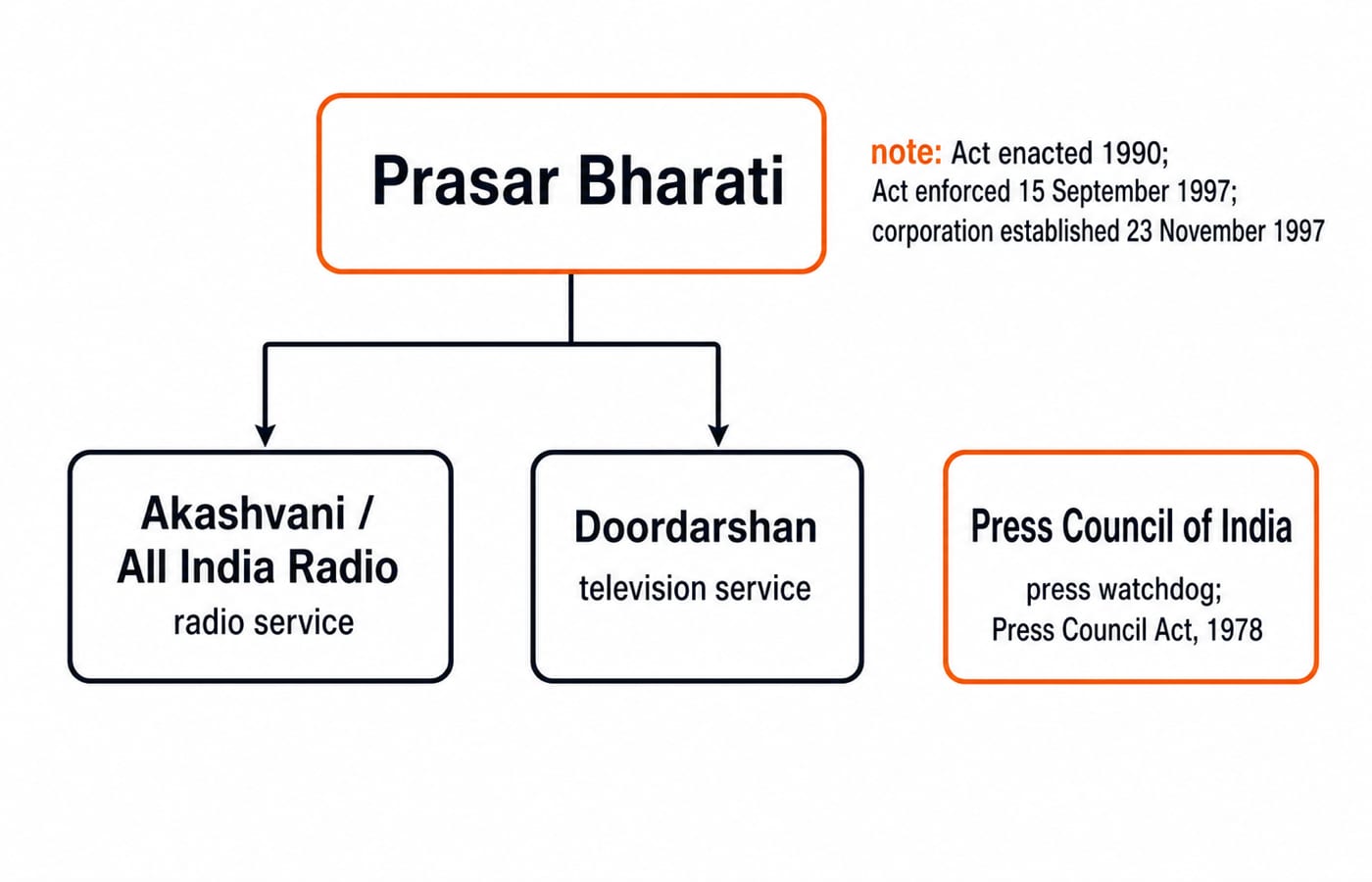
Akashvani, also called All India Radio or AIR, is the radio service. Doordarshan is the television service. Both are constituents of Prasar Bharati, the statutory public-service broadcasting corporation. The Press Council of India is separate. It is a statutory, quasi-judicial press watchdog functioning under the Press Council Act, 1978 to preserve press freedom and maintain and improve press standards.
Do not treat an organisation, its service, its governing law and the law’s enactment year as the same answer type. Keep these pairs fixed:
AIR or Akashvani: radio service
Doordarshan: television service
Prasar Bharati: statutory broadcasting corporation
Press Council of India: press freedom and standards watchdog
3. Indian Broadcasting Milestones You Should Be Able to Order
Prasar Bharati records the AIR and Doordarshan dates, the Press Council records its own formation, and India Code records the Act details.
Date | Milestone | Answer cue |
|---|---|---|
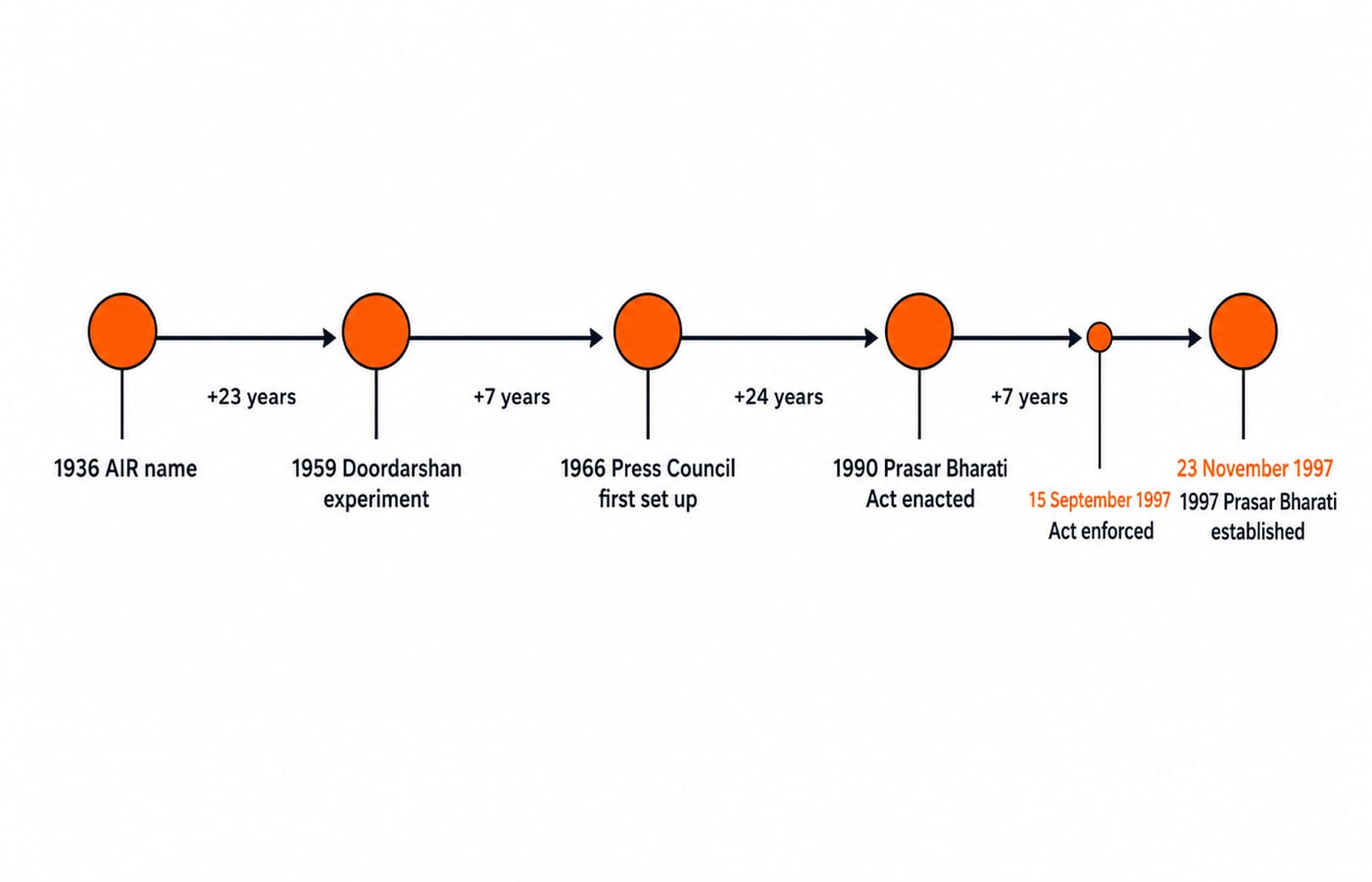
8 June 1936 | Indian State Broadcasting Service became All India Radio | Radio name |
15 September 1959 | Doordarshan began experimental public-service telecasting | Television experiment |
1966 | Press Council of India was first set up | Press watchdog |
12 September 1990 | Prasar Bharati Act was enacted | Law enacted |
23 November 1997 | Prasar Bharati was established | Corporation established |
India Code separately gives 15 September 1997 as the Act’s enforcement date. That is not the corporation’s establishment date.
Worked chronology: Arrange A. Press Council first set up, B. All India Radio receives its name, C. Prasar Bharati established, D. Doordarshan experimental telecast, E. Prasar Bharati Act enacted.
Write the dates beside the letters first:
B = 1936
D = 1959
A = 1966
E = 1990
C = 1997
Ordering the years gives B-D-A-E-C. Now check the gaps:
1959 − 1936 = 23 years
1966 − 1959 = 7 years
1990 − 1966 = 24 years
1997 − 1990 = 7 years
The repeated seven-year gaps check the arithmetic, not the order.
4. Worked Matching and Statement Questions
Column I | Column II |
|---|---|
1. Akashvani | P. television service |
2. Doordarshan | Q. statutory broadcasting corporation |
3. Prasar Bharati | R. press standards and freedom watchdog |
4. Press Council of India | S. radio service |
The mapping is 1-S, 2-P, 3-Q, 4-R. “Radio” resolves Akashvani. “Television” resolves Doordarshan. “Corporation” resolves Prasar Bharati. “Press standards and freedom” resolves the Press Council.
Now judge two statements:
I. The Prasar Bharati Act was enacted in 1990.
II. The Act came into force in 1990.
Statement I is true. Statement II is false. India Code records enactment on 12 September 1990 and enforcement on 15 September 1997. Prasar Bharati’s establishment on 23 November 1997 is a third event, not another name for enforcement.
Use a two-step rule: first identify whether the stem asks for a service, body, law or date. Then test every option against that category before recalling a familiar name.
5. Common Traps and How to Correct Them
Treating AIR, Doordarshan and Prasar Bharati as interchangeable. Redraw the parent-service map and ask whether the stem says radio, television or corporation.
Equating an Act’s title year with commencement or establishment. Preserve all three values: enacted in 1990, enforced on 15 September 1997, corporation established on 23 November 1997.
Memorising disputed single-inventor claims. Prioritise officially attributable Indian facts. If an exam asks “invented by”, follow that exam’s stated standard source.
Assuming every teaching exam follows UGC NET Paper I. UGC NET, CTET and DSSSB each publish their own syllabus, and a topic that sits in UGC NET Unit IV can be absent from a state TET blueprint, so check the paper you are actually sitting.
6. How Teaching Exams Can Test These Facts
Five formats recur: chronology ordering, organisation-to-function matching, Act-versus-body identification, one-incorrect-statement items, and a single fact planted inside a mass-media-and-society concept question. Drill all five, because the same four organisations and five dates answer every one of them.
Paper I carries Unit IV whatever your subject, while Paper II is subject-specific, a split the UGC NET Paper 1 versus Paper 2 guide works through. Unit IV’s scope comes from the UGC NET Bureau syllabus; for any other teaching exam, read that exam’s own current syllabus or recruitment notice, because the communication area is worded differently from board to board.
For a quick transfer check, “public-service television” points to Doordarshan, “statutory broadcasting corporation” points to Prasar Bharati, and “press standards” points to the Press Council of India. The noun in the stem often matters more than the familiar name in an option.
7. A 15-Minute Revision Drill
Use one focused quarter-hour:
Minutes 1 to 5: redraw the four-box organisation map.
Minutes 6 to 10: reconstruct the five-date timeline from a blank page.
Minutes 11 to 15: answer the matching set and the two-statement Prasar Bharati item without notes.
Stop only when all four relationships are correct, all five milestones are in order and both statements are judged correctly. If one item fails, rewrite only that pair or date and retest it the next day. Do not turn the repair into random current-affairs reading.
A ten-card deck is enough: five date cards, four organisation-function cards and one enactment-versus-enforcement card.
8. Short Version and Next Step
AIR means radio, Doordarshan means television, Prasar Bharati means the corporation, and the Press Council concerns press freedom and standards. Keep the chronology as 1936 → 1959 → 1966 → 1990 → 1997. For the complete Unit IV sequence, continue with the NTA UGC NET Paper I course. Use the DSSSB Section A course only if you are preparing that recruitment paper. Now reproduce the map and timeline once from memory.
Keep learning
सामान्य अशुद्धियाँ (Samanya Ashuddhiyaan): Complete Hindi Grammar Notes for CTET and TET Exams
Learn to identify and correct Hindi word-form, agreement, pronoun and redundancy errors through exact examples, a worked MCQ and a scored diagnostic.
Updated 6 Oct 20266 min readCTET & UPTET
Universities and Learning Programmes for Teaching Exams: Types, Modes and Solved Examples
Separate university status, delivery mode and programme purpose with a repeatable method, then test it on five UGC NET-style classification cases.
Updated 2 Oct 20265 min readCTET & UPTET
National Education Policy (NEP) 2020 Notes for Teaching Exams: 5+3+3+4, Reforms and MCQ Traps
Build an exam-ready map of NEP 2020, from the age-stage structure to pedagogy, language, PARAKH, B.Ed. routes and reliable distractor elimination.
Updated 26 Sep 20265 min readCTET & UPTET
Miscellaneous Pedagogy Topics for Teaching Exams: Complete Notes and Worked Examples
Turn a loose syllabus label into a five-part concept map, then use classroom evidence to distinguish sound pedagogy from attractive but incomplete options.
Updated 25 Sep 20266 min readCTET & UPTET