Coal India MT Cutoffs: Qualifying Marks vs Merit List
Learn why clearing Coal India MT's paper-wise minimum does not guarantee selection. Read the 2026 System rules in order with a worked merit example.
KnowledgeGate Team
Exam prep & CS education
Updated 8 Aug 20265 min read321 views

A Coal India MT score can clear the qualifying rule and still fall short of selection. A high total can also fail if one paper misses its minimum. For System, three gates decide the outcome in that order: a 60% academic floor, a separate minimum in each CBT paper, and then a category-wise merit line drawn against 43 notified System vacancies.
Coal India MT “cutoff” means three different gates
Candidates often use one word for three different numbers:
The minimum marks in the required academic qualification decide eligibility.
The minimum CBT marks in each paper decide whether a candidate qualifies for merit consideration.
The later discipline-wise and category-wise selection cutoff is created by merit and available vacancies.
Only the third number answers, “Was this score high enough for selection?”
Coal India Limited's Detailed Advertisement No. 03/2026, dated 5 May 2026, separates these gates. Academic marks establish eligibility, CBT floors apply paper by paper, and qualifiers are ranked for empanelment. Passing a floor permits ranking, not appointment.
The degree, branch and percentage checks behind that first gate are worked post code by post code in Coal India MT eligibility: match your degree to the right discipline. For the wider set of public-sector recruitments, start from the PSU exam preparation hub.
Read the 2026 CBT rule paper by paper
Advertisement No. 03/2026 specifies one three-hour CBT sitting with two papers. Each paper has 100 MCQs worth 100 marks. A correct answer earns 1 mark; wrong and unattempted answers earn no mark. There is no wrong-answer penalty.
For System, Paper I covers general knowledge or awareness, reasoning, numerical ability and General English. Paper II covers professional knowledge.
Advertisement No. 03/2026 sets these floors:
Category | Minimum in Paper I | Minimum in Paper II |
|---|---|---|
General (UR) and EWS | 40 | 40 |
OBC (Non-Creamy Layer) | 35 | 35 |
SC, ST and PwD | 30 | 30 |
The key phrase is in each paper. A UR candidate needs 40 in Paper I and 40 in Paper II, not one combined floor of 80 out of 200. An OBC-NCL candidate with 34 in Paper I is out even after scoring 90 in Paper II.
Worked example: a higher total can still fail
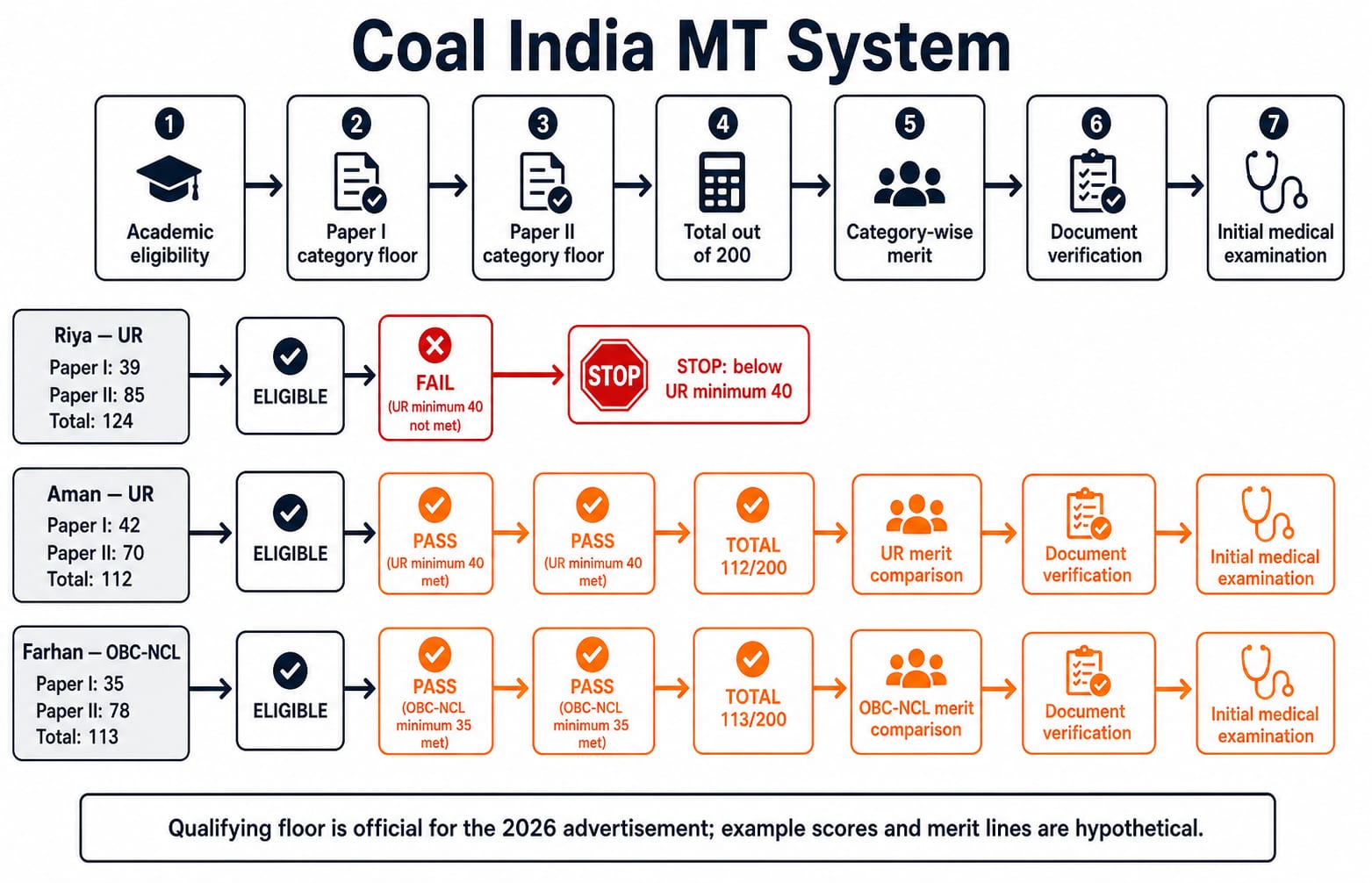
The names and scores below are invented to show the arithmetic. The qualifying floors are official; the merit lines are not.
Candidate | Category | Paper I | Paper II | Total / 200 | Per-paper result |
|---|---|---|---|---|---|
Riya | UR | 39 | 85 | 124 | Fails the 40-mark Paper I floor |
Aman | UR | 42 | 70 | 112 | Clears both 40-mark floors |
Farhan | OBC-NCL | 35 | 78 | 113 | Clears both 35-mark floors |
Meena | SC | 30 | 76 | 106 | Clears both 30-mark floors |
Riya has 39 + 85 = 124, the table's highest total. Yet 39 is below the UR Paper I minimum of 40, so she does not enter merit comparison. Aman has 42 + 70 = 112, Farhan 35 + 78 = 113, and Meena 30 + 76 = 106. Those three clear their respective floors in each paper, so their totals enter the applicable discipline and category process.
Suppose an illustrative selection notice showed UR 118, OBC-NCL 111 and SC 108. Aman qualifies but 112 < 118, below the UR line. Farhan has 113 >= 111, above the OBC-NCL line. Meena qualifies but 106 < 108, below the SC line. Notice what that does to the outcome: Farhan's 113 clears his line while Aman's 112 misses his, because the two are compared inside separate category panels and never against each other.
Understand how the merit cutoff is created
Under the 2026 advertisement, selection and the final merit panel use CBT marks only, with no interview. CIL says selection notices will show separate category-wise cutoffs. Document Verification and Initial Medical Examination remain mandatory, but add no merit marks.
The advertisement listed 43 tentative System vacancies: 19 UR, 4 EWS, 6 SC, 3 ST and 11 OBC-NCL. These dated figures show why one universal cutoff misleads. The eventual boundary depends on eligible candidates' marks within the discipline and category, plus notified vacancies. With 19 UR seats and 3 ST seats in System, those two lines are drawn from very different pools and will not land on the same mark.
CIL provides for filling non-reporting or non-joining vacancies in phases from the balance category-wise panel, by merit and in line with DoPT guidelines. So a candidate just under a first-phase line can still be called later, which means a selection notice marks the boundary for that phase rather than a permanent cutoff.
Do not import rules from another exam or discipline
The SSC CGL tier structure runs several tiers, each with its own qualifying rule, which is why every recruitment has to be read on its own terms. Coal India MT 2026 runs a single CBT sitting and, per the same advertisement, holds no interview at all.
Advertisement No. 03/2026 contains a naming trap. Computer Science and IT is System, post code 14. Company Secretary is post code 19. The special “CS Discipline” tie wording about listed-company experience concerns Company Secretary, not System.
Do not assume normalisation, sectional percentiles, a common cutoff or a System tie-break unless a dated CIL notice provides it.
Check academic eligibility before doing merit arithmetic
The 2026 advertisement requires 60% in the minimum qualification for General (UR), OBC-NCL and EWS. SC, ST and PwBD receive a 5 percentage-point relaxation to 55%. For CGPA or GPA, provide the conversion evidence accepted by the notice.
The rule does not permit rounding up. A UR System applicant with 59.99% cannot claim 60%. Even Paper I 55 and Paper II 82, totalling 55 + 82 = 137, cannot cure the failure. An otherwise eligible applicant at exactly 60.00% clears this threshold, but must meet the notified degree, recognition and other conditions.
Keep the terms separate: 60% or 55% is academic eligibility; 40, 35 or 30 in each CBT paper is exam qualification. Neither is the final selection cutoff.
The short version and the next action
Use this sequence:
Check the dated official advertisement and the correct discipline.
Clear academic eligibility.
Clear the category minimum in Paper I and Paper II separately.
Total the CBT marks.
Compare only with an official discipline and category selection notice.
Complete DV and IME if called.
Qualifying does not guarantee a place on the final selected list. If you need structured coverage of Paper I and System professional knowledge, use the Coal India Management Trainee course. For timed paper-wise and full-length practice, use the Coal India Management Trainee CS Recruitment Test Series.
Keep learning
Coal India MT Mock Analysis: Manage Both Papers as One Exam
A combined mock score can hide which paper cost you marks. Use this worked two-paper scorecard to test section order, diagnose errors and plan the next retest.
Updated 12 Aug 20265 min read54 viewsCoal India MT
Coal India MT PYQ Analysis: Balance Paper I and Professional Knowledge
A combined Coal India MT score hides which paper is weak. Score Paper I and professional knowledge separately, classify every miss by cause, and rebalance the week from that.
Updated 10 Aug 20265 min read245 viewsCoal India MT
Coal India MT Numerical Ability: Ratios, Percentages and a Worked DI Set
Learn how ratio parts, percentage bases, and table reading work together. Includes checked examples, conversion shortcuts, common traps, and a 30-minute drill.
Updated 5 Aug 20266 min readCoal India MT
Coal India MT Computer Awareness: Office Tools, Internet and Security Guide
Turn a broad syllabus phrase into four practical revision buckets, then test your understanding with worked spreadsheet calculations and six concept checks.
Updated 3 Aug 20265 min readCoal India MT