Coal India MT Numerical Ability: Ratios, Percentages and a Worked DI Set
Learn how ratio parts, percentage bases, and table reading work together. Includes checked examples, conversion shortcuts, common traps, and a 30-minute drill.
KnowledgeGate Team
Exam prep & CS education
Updated 5 Aug 20266 min read

Ratios, percentages, and data interpretation look like separate chapters, but one Coal India Management Trainee question can demand all three at once: pull the right cell from a table, form a ratio, then turn it into a percentage. The marks go missing at that last step, because the base moves depending on whether the question asks for a share or for a change. Fix the base first and the arithmetic that follows is short.
Coal India MT Numerical Ability: connect the three skills before solving
Ratios compare quantities; percentages compare against a base of 100. Data interpretation (DI) first requires the right quantities and base. For example, 3:5 becomes 3/5, then 60% when the second quantity is the base.
Ratio, percentage and table questions in Coal India MT exam preparation are decided by which quantities you compare and which base you pick, not by the arithmetic after it. Name both before calculating anything.
Task | Operation | Question to ask |
|---|---|---|
Simplify a ratio | Divide both terms by their HCF | What common factor divides both terms? |
Split a total | Divide by the sum of ratio parts | How much does one part represent? |
Find percentage change |
| Which value is the original base? |
Find a percentage share |
| What is the complete whole? |
Read a DI table | Check labels and units first | Which row, column, and unit are required? |
Ratio and proportion: solve by parts, not by guesswork
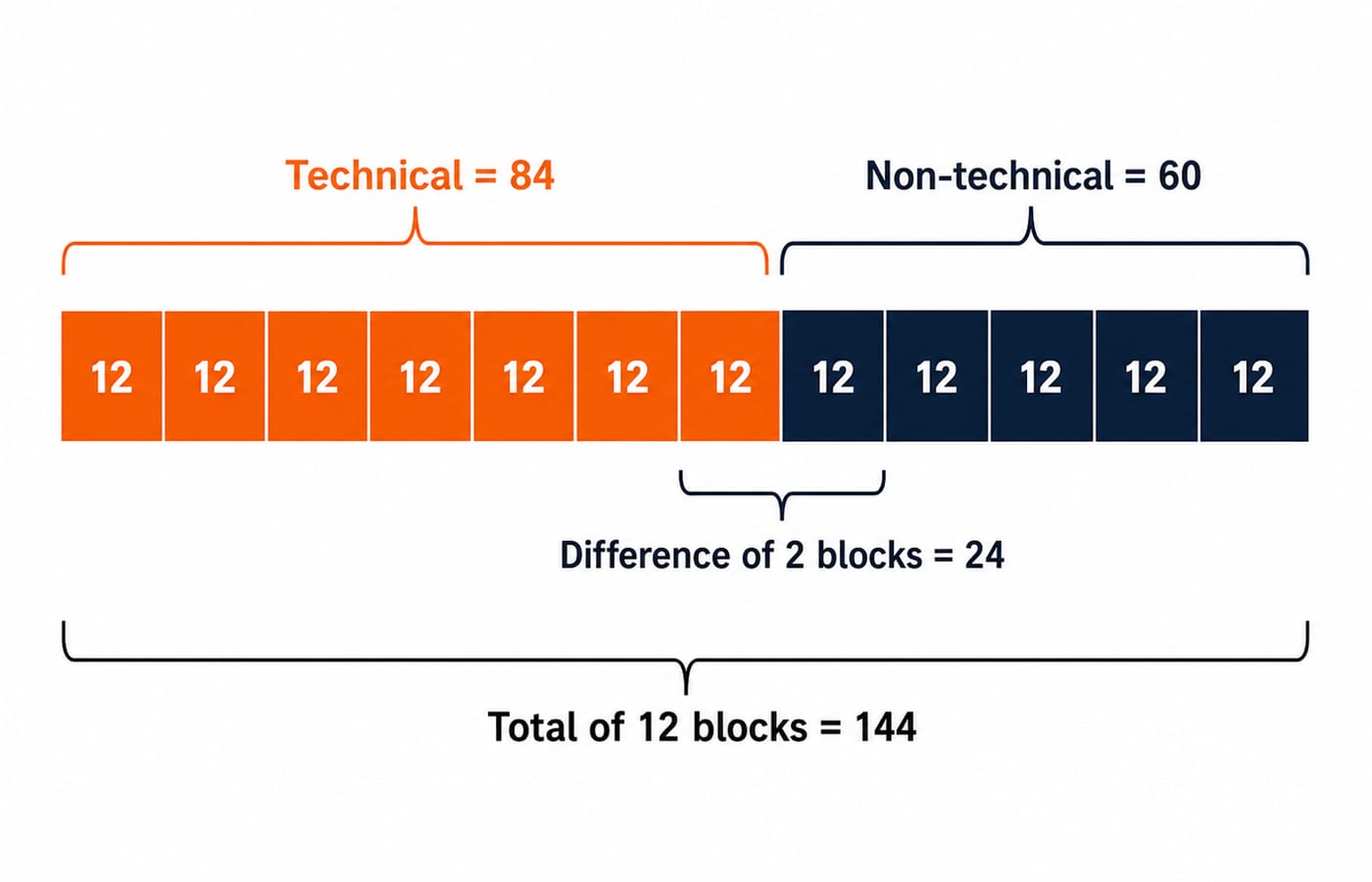
A training batch has technical and non-technical trainees in the ratio 7:5. Technical trainees exceed the others by 24.
Let one ratio part be x trainees. Then:
Technical trainees =
7x; non-technical trainees =5x.Difference:
7x - 5x = 24, so2x = 24andx = 12.Technical trainees =
7 x 12 = 84; non-technical trainees =5 x 12 = 60.Total trainees =
84 + 60 = 144.
Check both conditions: 84:60 = 7:5, and 84 - 60 = 24.
If 12 non-technical trainees join, their number becomes 60 + 12 = 72, and the ratio becomes 84:72 = 7:6. Do not add 12 to the ratio term 5. Ratio terms count parts, while 12 is a headcount.
Percentages: fix the base before using a shortcut
A practice score rises from 240 to 300, then returns to 240. The increase is (60/240) x 100 = 25%. The fall has base 300, so the decrease is (60/300) x 100 = 20%.
The final score equals the start, so net change is 0%, not 5%. Multipliers confirm it: 240 x 1.25 x 0.80 = 240. Never combine percentage changes blindly when their bases differ.
For reverse percentage, a value is 384 after a 20% reduction. Since 384 is 80% of the original, original value = 384/0.80 = 480. Dividing by 80 is dimensionally wrong; first convert the percentage to 0.80.
Keep three formulas ready:
Percentage of a whole:
(part/whole) x 100Percentage change:
(change/original) x 100Original after a known percentage:
final/remaining decimal multiplier
Data interpretation: one complete table set using ratios and percentages
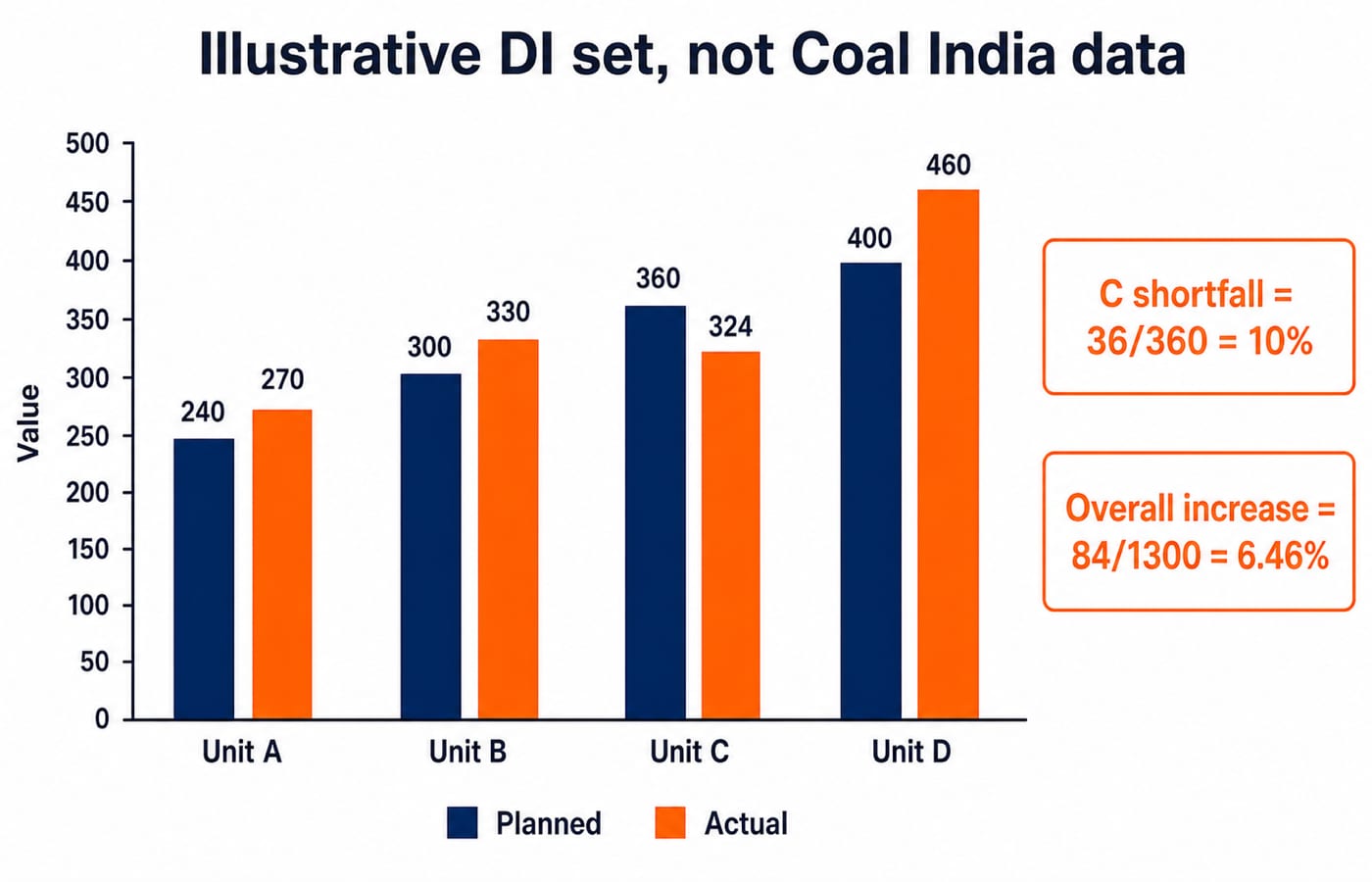
The figures below are a practice table, all in one common unit. What decides each answer is the denominator the question names, not the size of the numbers.
Unit | Planned output | Actual output |
|---|---|---|
A | 240 | 270 |
B | 300 | 330 |
C | 360 | 324 |
D | 400 | 460 |
Question 1: What is the ratio of actual output for A to B?
Retain the common unit and form 270:330. Dividing by the HCF 30 gives 9:11. No denominator is needed for this ratio. A being slightly below B matches 270 being below 330.
Question 2: By what percentage does C fall short of its plan?
C's shortfall is 360 - 324 = 36 units. Planned C is the denominator, so shortfall = (36/360) x 100 = 10%. The result is plausible because 36 is one-tenth of 360.
Question 3: By what percentage does total actual output exceed total planned output?
Planned total = 240 + 300 + 360 + 400 = 1,300 units. Actual total = 270 + 330 + 324 + 460 = 1,384 units. Increase = 1,384 - 1,300 = 84 units. With planned total as the denominator, the increase is (84/1,300) x 100 = 6.46% to two decimals. An 84-unit rise on 1,300 should be slightly above 6%.
Question 4: What percentage of total actual output comes from D?
D contributes 460 of 1,384 actual units. With total actual as the denominator, its share is (460/1,384) x 100 = 33.24%. About one-third is plausible because D has the largest actual value.
For every DI answer, name the denominator, retain units until forming the ratio, and test plausibility.
Ratio-percentage conversions that save calculation time
For the ratio 3:5, three similar-looking statements have different bases:
The first quantity is
3/5 = 60%of the second.The first quantity is
3/8 = 37.5%of the total.The second quantity is
5/8 = 62.5%of the total.
The figures 60% and 37.5% differ because one uses the second quantity as its base and the other uses all eight parts.
Memorise exact conversions: 1/2 = 50%, 1/4 = 25%, 1/5 = 20%, 1/8 = 12.5%, and 1/10 = 10%. In the DI set, A rises by 30 from 240. Since 30/240 = 1/8, the increase is 12.5%.
For cross-exam topic priorities, read SSC CGL Quant Strategy: High-Yield Topics and Weekly Plan. The context differs, but exact conversions transfer.
Common traps in ratios, percentages, and DI
Wrong base: For the rise from 240 to 300, dividing 60 by 300 gives 20%. That answers the decrease from 300, not the increase from 240. Write change/original before substituting numbers.
Ratio parts treated as actual values: In 7:5 with a difference of 24, the difference is two parts, not two people. Find one part first.
Percentage changes added directly: A 25% rise followed by a 20% fall returns to the starting value because the second change uses a larger base.
DI arithmetic started before reading labels: C's shortfall uses planned C, 360, as the denominator. D's contribution uses total actual output, 1,384. Use a three-step habit: circle the row, underline the column, and write the denominator.
How Coal India MT can test the same concepts, and how to practise them
These three skills do not arrive from the same section. In our Coal India MT (CS) course line-up the numerical-ability material splits across two Paper-I sections: Ratio and Proportion and Percentage sit under Paper-I Quantitative Aptitude, while Data Interpretation sits under Paper-I Logical Reasoning. A table set can therefore reach you from the reasoning half of the paper even though every step in it is arithmetic, and Paper-II, the discipline paper, leaves this material alone. The Coal India MT CBT Syllabus: General and Discipline Paper Map lays out all four Paper-I lanes and the Paper-II clusters. For marks, question counts, sectional timing and negative marking, read the latest applicable recruitment notice on the official Coal India Limited careers page.
Practise direct ratio splits, percentage changes, reverse percentages, table comparisons, and two-operation DI items that turn a difference into a percentage.
Build a repeatable 30-minute drill:
Spend 8 minutes on four direct ratio or percentage questions.
Spend 12 minutes on one four-question DI table.
Spend 6 minutes redoing errors without notes.
Spend 4 minutes recording whether each error came from the base, simplification, unit, or arithmetic.
After a missed day, resume the drill without doubling it. Once concepts are stable, the Coal India MT (CS) Test Series is a structured next step for mixed timed practice.
The short version: name the base, then choose the operation
Ratios need total parts or difference parts. Percentages need the correct base. DI needs the correct row, column, unit, and denominator before any calculation.
The two strongest checks from the worked set are simple: 270:330 must simplify to 9:11, and the overall change must use planned output as its base, giving 84/1,300 = 6.46%.
For the whole preparation sequence in order, the Coal India MT (CS) 2026 Complete Course is the structured next step. If your concepts are already secure and you mainly need timed application, use the test series instead.
Keep learning

Coal India MT Mock Analysis: Manage Both Papers as One Exam
A combined mock score can hide which paper cost you marks. Use this worked two-paper scorecard to test section order, diagnose errors and plan the next retest.
Updated 12 Aug 20265 min read54 viewsCoal India MT

Coal India MT PYQ Analysis: Balance Paper I and Professional Knowledge
A combined Coal India MT score hides which paper is weak. Score Paper I and professional knowledge separately, classify every miss by cause, and rebalance the week from that.
Updated 10 Aug 20265 min read245 viewsCoal India MT

Coal India MT Cutoffs: Qualifying Marks vs Merit List
Learn why clearing Coal India MT's paper-wise minimum does not guarantee selection. Read the 2026 System rules in order with a worked merit example.
Updated 8 Aug 20265 min read321 viewsCoal India MT

Coal India MT Computer Awareness: Office Tools, Internet and Security Guide
Turn a broad syllabus phrase into four practical revision buckets, then test your understanding with worked spreadsheet calculations and six concept checks.
Updated 3 Aug 20265 min readCoal India MT