CAT Quant Preparation: Build Arithmetic and Algebra Before Advanced Topics
Build CAT Quant in the right order with worked percentage and ratio examples, a 12-hour weekly plan, mixed revision, and a readiness gate for advanced topics.
KnowledgeGate Team
Exam prep & CS education
Updated 28 Jul 20265 min read

It is tempting to start geometry, number-system puzzles, logarithms and probability together because advanced-looking chapters seem more valuable. Then a percentage change takes three attempts, a ratio is misread, or the equation never gets written. A better sequence is practical: use arithmetic to make quantities fluent, use algebra to translate relationships, keep both alive through mixed revision, and unlock advanced topics only when your work supports the move.
CAT Quant preparation: why arithmetic and algebra come first
Arithmetic supplies fractions, percentages, ratios, averages, rates and proportional change. Algebra turns those relationships into equations, inequalities and expressions. When calculation and translation become fluent, later work in geometry, number systems, logarithms and probability becomes easier.
This order is flexible. Clear the foundation diagnostic and you can compress the early phases. If you cannot set up a ratio or equation, repair that gap before adding variety. Our CAT course coverage spans ratio and proportion, percentages, averages, number system, logarithms, algebra, probability, mensuration and geometry. CAT & MBA Entrance Preparation organises those resources, but your diagnostic decides their order and time allocation. The syllabus statement, exam pattern and dates are published by the exam body at iimcat.ac.in.
CAT Quant arithmetic foundation: make percentage and ratio changes visible
Start with fractions, decimals, percentages, ratio and proportion, averages, percentage gain and loss, mixtures, and rates such as time-work and speed-distance. Treat them as connected representations. Move from 3/5 to 0.6 to 60% without restarting.
Consider a quantity of 250. A 20% rise adds 0.20 x 250 = 50, so the new quantity is 300. A 20% fall now removes 0.20 x 300 = 60, leaving 240. The net change is 240 - 250 = -10, and -10/250 x 100 = -4%. Equal percentage changes do not cancel because the second percentage uses 300, not 250, as its base.
Ratios shift the same way, and for the same reason. Split 250 in the ratio 3:2 and the parts are 150 and 100. Add 50 to each part and the split becomes 200:150, which is 4:3, not 3:2. Adding equal amounts always pulls a ratio towards 1:1; only multiplying both parts by the same factor leaves it unchanged.
After learning a method, solve 8 untimed representation questions, then a timed 12-question set. Retry every wrong item without the solution. Watch the gap between untimed and timed accuracy: when accuracy collapses under the clock, the method is understood but not yet automatic.
CAT Quant algebra foundation: translate words before manipulating symbols
Study linear equations, identities and factorisation, quadratics, inequalities, exponents and logarithms, then basic functions. For a word problem, identify the unknown, express each relationship, solve, and substitute back into the wording.
Suppose a class initially has boys and girls in the ratio 3:5. Let their counts be 3k and 5k. After 6 boys join, the ratio becomes 3:4, so (3k + 6)/(5k) = 3/4. Cross-multiplication gives 12k + 24 = 15k, then 3k = 24, so k = 8. The original counts are 24 boys and 40 girls. Afterwards they are 30 and 40, and 30:40 = 3:4, which verifies the answer.
Label every failure translation, manipulation, or calculation. This tells the next session to repair equation setup, algebraic steps, or arithmetic accuracy.
CAT Quant six-week plan: a concrete 12-hour progression
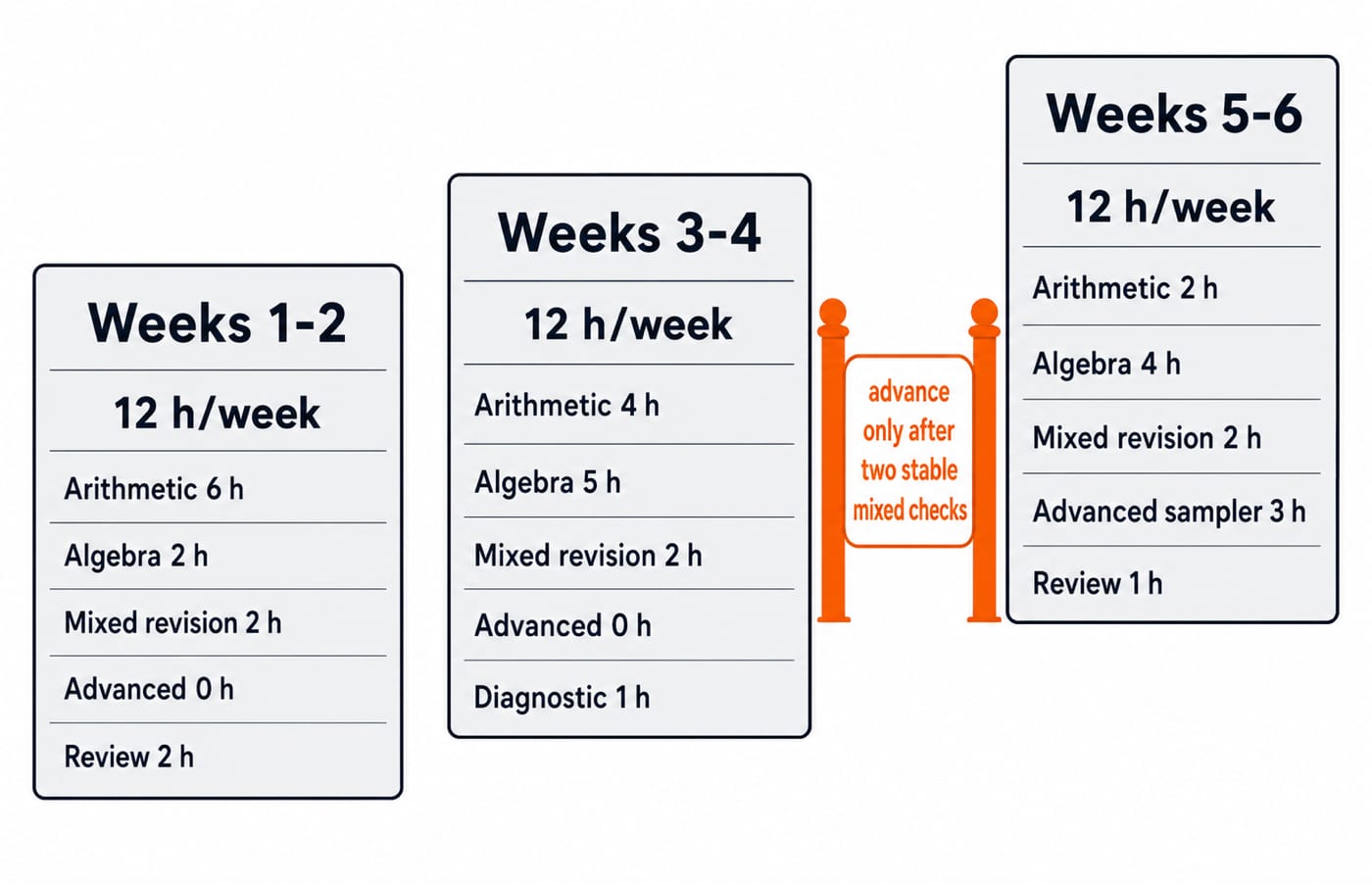
Three phases, each holding the same twelve hours a week:
Weeks | Arithmetic | Algebra | Mixed revision | Advanced sampler | Review or diagnostic |
|---|---|---|---|---|---|
1-2 | 6 h | 2 h | 2 h | 0 h | 2 h |
3-4 | 4 h | 5 h | 2 h | 0 h | 1 h |
5-6, after the gate | 2 h | 4 h | 2 h | 3 h | 1 h |
Each row totals 12 h/week. The advanced sampler means one extension, such as geometry or number system, not five chapters together.
For an ordinary session, use 20 min retrieval, 65 min teaching and examples, 25 min timed questions, and 10 min error logging. The check is 20 + 65 + 25 + 10 = 120 minutes. A Saturday mixed block can use 20 min recall, 50 min for 20 arithmetic-algebra questions, and 50 min for review and retries. Aptitude for Placements: A 30-Day Practice Routine runs the same discipline on a shorter cycle and is worth reading for how a daily routine survives a full month.
CAT Quant mixed revision: stop foundations from fading
A Week 3 set should draw from Weeks 1, 2 and 3. Start with a 20-question Saturday pack you assemble yourself, containing 12 arithmetic and 8 algebra questions. Move to 10 + 10 when algebra is no longer weaker.
Use these review-sheet columns: Topic, My setup, Correct setup, Error type, Retry date, and Second-attempt result. A question closes only when you reconstruct it unaided after a gap. Bank PO Quant: High-Yield Topics First works the same foundation-first ordering out for a different paper; borrow its review method and let your own error log set the topic priorities.
CAT Quant readiness gate: earn advanced topics with two stable checks
After Week 4, attempt two comparable 24-question packs, each with 12 arithmetic and 12 algebra questions. Set a gate of at least 10/12 in each family on both packs, with no repeated translation error. Two packs matter more than the number itself, because a single strong session can just mean a friendly question set.
Suppose Priya scores 9/12 in arithmetic and 6/12 in algebra. Neither clears the gate, and algebra is the larger gap. She assigns 3 h to arithmetic repair, 6 h to algebra repair, 2 h to mixed practice and 1 h to error review. The check is 3 + 6 + 2 + 1 = 12 h; advanced work remains 0 h.
If both families reach 10/12 on two checks, add 3 h/week of one advanced topic. Preserve 2 h arithmetic retrieval, 4 h algebra, 2 h mixed revision and 1 h review.
CAT Quant missed days: reduce scope without creating a backlog
A normal week has six two-hour sessions, Monday to Saturday. If one day disappears, accept a 10-hour week. Preserve mixed revision and the weaker-foundation block, then drop the lowest-priority new-topic or sampler session. Do not invent a four-hour Sunday catch-up.
If Priya misses Tuesday's two-hour algebra block in Week 5, she keeps 4 h algebra, 3 h arithmetic, 2 h mixed work and 1 h review, totalling 10 h. She carries only two recurring algebra error types into Week 6. After two disrupted weeks, repeat a comparable diagnostic and rebuild from current evidence.
CAT Quant preparation: the short version and next step
Gain arithmetic fluency, translate relationships through algebra, revise both weekly, then open one advanced topic after two stable checks. The model is 12 h/week, but an honest 10-hour disrupted week beats a fictional catch-up plan.
If you want the wider syllabus, practice and strategy organised in one place, use the CAT Preparation Course. It supplies structured coverage across Quant and the other CAT preparation areas, while your diagnostic and error log still decide what you practise first.
Keep learning

CAT Mock Analysis: Diagnose Time, Accuracy and Question Choice
Turn one mock into a practical review sheet. Separate execution, selection and reach problems, then test one measurable rule per section.
Updated 22 Aug 20265 min readMBA Entrance (CAT)

CAT for Non-Engineers: Build a Quant Foundation Before Chasing Shortcuts
Use this 12-week quant plan to find your real gaps, rebuild core relationships, revisit errors and add timed mixed practice only when the foundation is ready.
Updated 20 Aug 20266 min readMBA Entrance (CAT)

CAT Preparation for Working Professionals: A Sustainable 10-Hour Week
Build a repeatable CAT week around a full-time job, then use completed work and error patterns to decide what the next 600 minutes should contain.
Updated 18 Aug 20266 min readMBA Entrance (CAT)

CAT Quant for Non-Engineers: A 16-Week Foundation Plan Without Shortcuts
Rebuild CAT quant in dependency order: a 24-question diagnostic, a 16-week 160-hour map, an exact 10-hour week, an accuracy gate and a missed-day rule.
Updated 16 Aug 20265 min readMBA Entrance (CAT)