Capital One Recruitment Process: Stage-by-Stage Guide for India Applicants
Prepare for a Capital One India application with a cautious five-stage map, worked technical and case drills, and a practical 14-hour schedule.
KnowledgeGate Team
Exam prep & CS education
Updated 24 Sep 20265 min read
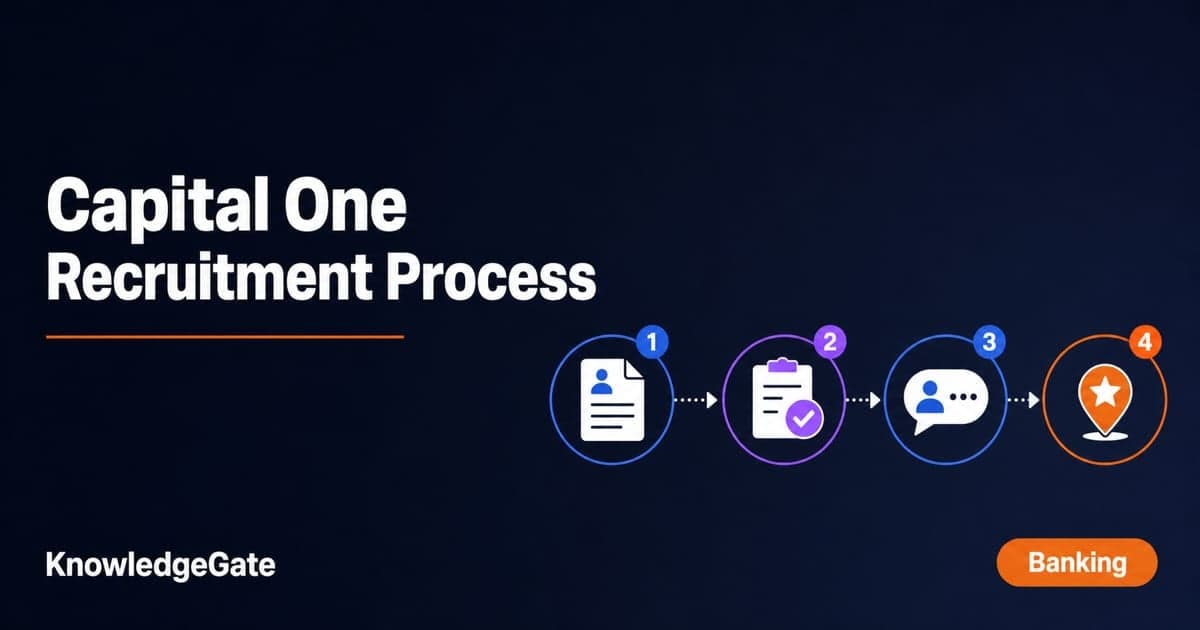
Capital One interviews vary by position, and the job description plus recruiter invitation govern your actual sequence. For an India applicant, the useful working map is application check, a role-dependent assessment, recruiter or hiring-manager screening, Power Day, and recruiter-led outcome and next steps. Prepare evidence for the requisition first, then practise only the assessment and interview formats named in your invitation.
Capital One recruitment process at a glance
Not every stage is mandatory: application and qualification check, role-dependent assessment, recruiter or hiring-manager conversation, Power Day interview series, then recruiter-led outcome and next steps.
Stage | What may happen | What to prepare |
|---|---|---|
1. Application check | Basic Qualifications are matched to the requisition | Evidence bullets tied to each requirement |
2. Assessment, if invited | A role-dependent virtual test or Virtual Job Tryout | Only the reasoning or coding format named in the invitation |
3. Recruiter or manager screen | Role fit, experience and project evidence | A 90-second introduction and two concise project examples |
4. Power Day | A role-dependent series of job-fit, behavioural, case or technical interviews | Structured evidence, a case drill and technical practice suited to the role |
5. Outcome and next steps | Recruiter-led communication after the interview series | Questions, availability and any requested documents |
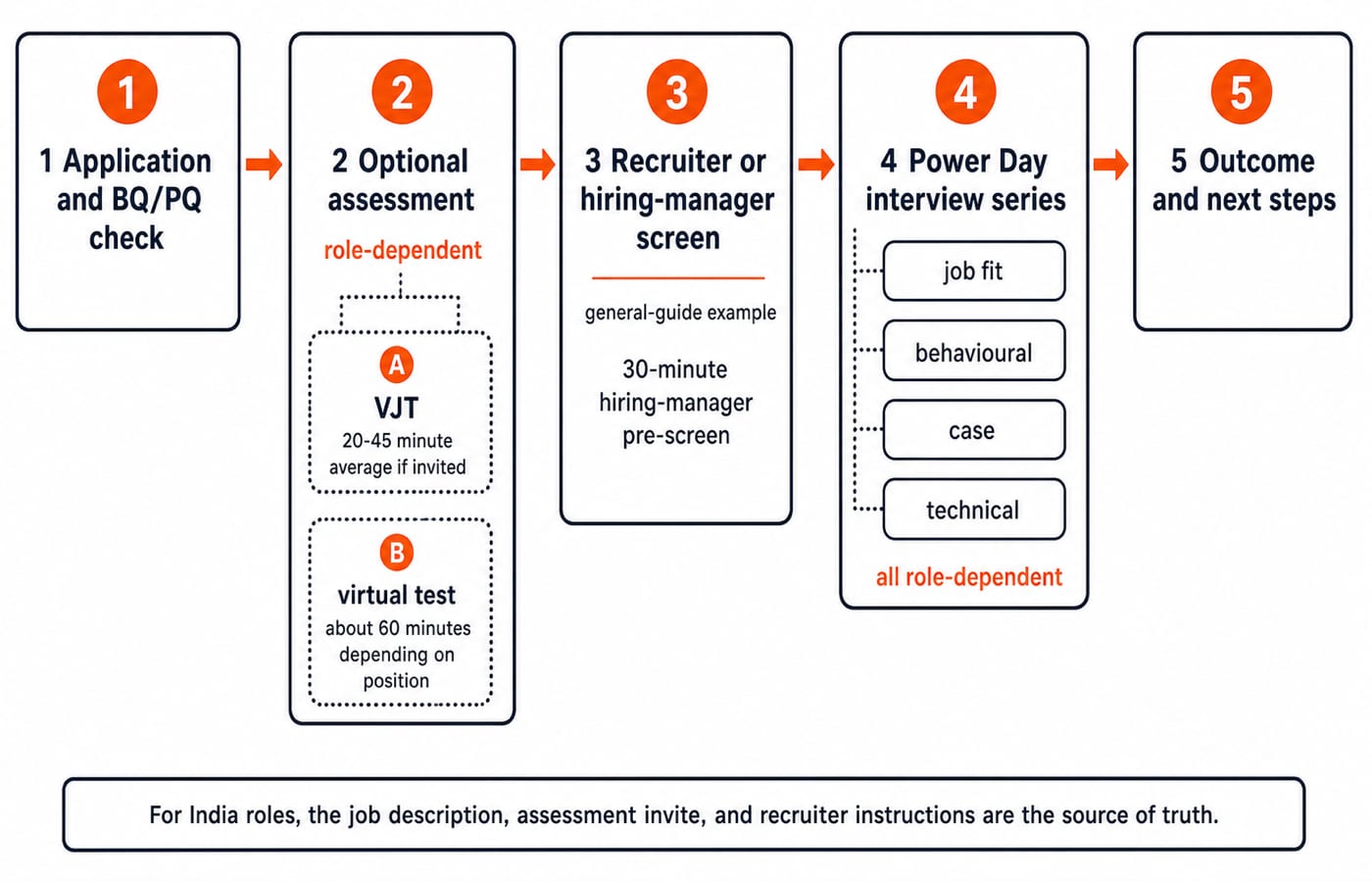
Stage 1: Application screen and role-evidence matching
Capital One's candidate FAQ says listed Basic Qualifications are required, while Preferred Qualifications can strengthen an application. The India careers page places technology, data science, business analysis, design and other product-development teams in Bangalore, so the requisition, not an India-wide syllabus, defines what you must prove.
For example, a Bengaluru software candidate can map project evidence to the requisition before rewriting the resume:
Candidate evidence | Qualification category |
|---|---|
Owned a Java service for 18 months | Backend experience |
Deployed three AWS services | Cloud delivery |
Reduced API p95 latency from 820 ms to 310 ms | Performance |
Handled 2 million events per day | Scale |
Coordinated four engineers | Collaboration |
Restored a production incident in 37 minutes | Reliability |
Turn the strongest matches into bullets: “Owned a Java service for 18 months”; “Cut API p95 from 820 ms to 310 ms”; “Coordinated four engineers on 2 million daily events.” Apply to the current job posting, not a generic syllabus.
Stage 2: Online assessment, if the role uses one
Capital One's careers guide and FAQ describe role-dependent assessments, including an automated assessment, a virtual test or an optional Virtual Job Tryout. Your invitation determines the format. A 2025 candidate account reported medium coding problems, but that experience does not establish a universal India pattern.
Software-role drill: for transactions = [120, -20, 50, -150, 80], find the maximum-sum contiguous range. Best-ending-here is 120, 100, 150, 0, 80; answer 150, indices 0..2. Kadane's algorithm uses O(n) time and O(1) space. State assumptions, define or reject [], note that [-4, -2, -7] returns -2, and dry-run every update.
Use Aptitude for Placement for timed reasoning and the 30-day aptitude routine for a longer runway. The TCS NQT structure explainer organises preparation around a separately defined test pattern; Capital One preparation starts from the role invitation.
Stage 3: Recruiter and hiring-manager conversations
Capital One's careers guide describes a recruiter screen and a possible hiring-manager pre-screen. Prepare evidence, not memorised praise.
Practise a 90-second answer: 20 seconds on present scope, 30 on a project, 30 on impact, 10 on why this role. “Across two sprints, our four-person team cut API p95 from 820 ms to 310 ms. I owned profiling and caching.” Ask: Why this role? Which project proves a Basic Qualification? Which gap will you address honestly? Never recite a generic round sequence.
Stage 4: Power Day technical and case work
Capital One's careers guide describes Power Day as a post-screen series whose mix depends on the position. Examples are job fit, behavioural and case interviews. Prepare technical work only when your role or invite requires it.
Case drill: a team receives 1,200 tickets weekly. At 70% automation, manual tickets are 1,200 x 30% = 360. At 82%, they are 1,200 x 18% = 216. Reduction: 360 - 216 = 144. Relative reduction: 144 / 360 = 40%. State assumptions, test constant quality, and recommend a pilot rather than overclaiming.
A strong technical answer clarifies constraints, outlines options, implements or diagrams, tests concrete inputs, and discusses trade-offs.
Inside Power Day: job-fit and behavioural interviews
Capital One's careers guide says job-fit interviews assess fit for the role, team and culture. Behavioural questions examine past problem solving, influence and results focus. Do not assume a final “HR round”.
Build a labelled STAR answer: Situation: a four-person team's API was at 820 ms p95. Task: improve it safely. Action: own profiling and caching across two sprints. Result: 310 ms p95, with rollback below 1%. Learning: add cache-hit and stale-data alerts before rollout.
Build six stories: conflict, failure, influence without authority, difficult trade-off, customer impact and learning. Each needs one number, personal action and reflection. Continue with the Interview & Resume Preparation course.
Stage 5: Recruiter-led outcome and next steps
Capital One's careers guidance places recruiter communication after the interview series. Follow the channel and timing your recruiter gives you; another candidate's timeline cannot predict your decision date.
Before replying, check the role title, listed location, team, start-date discussion and any documents requested through an official Capital One channel. Keep brief notes on the evidence, technical drill or case step that felt weakest so the interview produces a useful next action regardless of the outcome.
Capital One seven-day preparation plan and short version
Use 14 hours: Day 1, two hours on the evidence matrix; Days 2 and 3, four hours total on assessment drills; Day 4, two hours on the case; Day 5, two hours on six stories; Day 6, two hours on a full mock; Day 7, two hours on light review, device checks and recruiter questions. For a non-technical loop, move coding time to case or job-fit practice.
The short version: prepare to the requisition, treat assessments as role-dependent, attach evidence to every answer, and confirm the loop with your recruiter. Use Placement Preparation for broader aptitude, company-specific and interview preparation.
Keep learning
Paging and TLB Explained: Address Translation, EMAT and Exam Traps
Follow one virtual address from its VPN through the TLB to a physical frame, then calculate page-table size, TLB reach and effective memory access time.
Updated 4 Oct 20266 min readOperating Systems
Operating System Scenarios: Solve Scheduling, Concurrency, and Page Replacement
Learn one state-trace method for three common OS problem families, then apply it to complete Round Robin, concurrency, FIFO, and LRU examples.
Updated 29 Sep 20265 min readOperating Systems
Tower Research Hiring Process: Stage-by-Stage Prep for Quant and Dev Roles
Prepare for a Tower Research application without treating one online account as a universal process. Use this role-led map, worked drills, and seven-day plan.
Updated 25 Sep 20265 min readOperating Systems
Capgemini Exceller Drive Hiring Process: A Stage-by-Stage Preparation Map
Map each typical Capgemini fresher stage to a concrete practice output before an Exceller drive, then use worked aptitude, coding, interview, and safety checks.
Updated 23 Sep 20265 min read107 viewsOperating Systems