

Google Recruitment: A Preparation Map for Freshers
Prepare for your next confirmed Google hiring step with a role-specific checklist, a worked coding trace and a college-project story backed by evidence.
KnowledgeGate Team
Exam prep & CS education
Updated 18 Nov 20264 min read
Google role postings and assessment invitations vary, so software engineering freshers need a preparation map tied to the role they actually applied for. Start with the invitation, then practise evidence you can explain.
Before you plan: Your role posting, recruiter instructions and assessment invitation govern eligibility, sequence, format and deadlines. The coding and project scenarios here are original practice exercises, not Google questions or candidate reports.
Google recruitment stages: use a role-specific preparation map
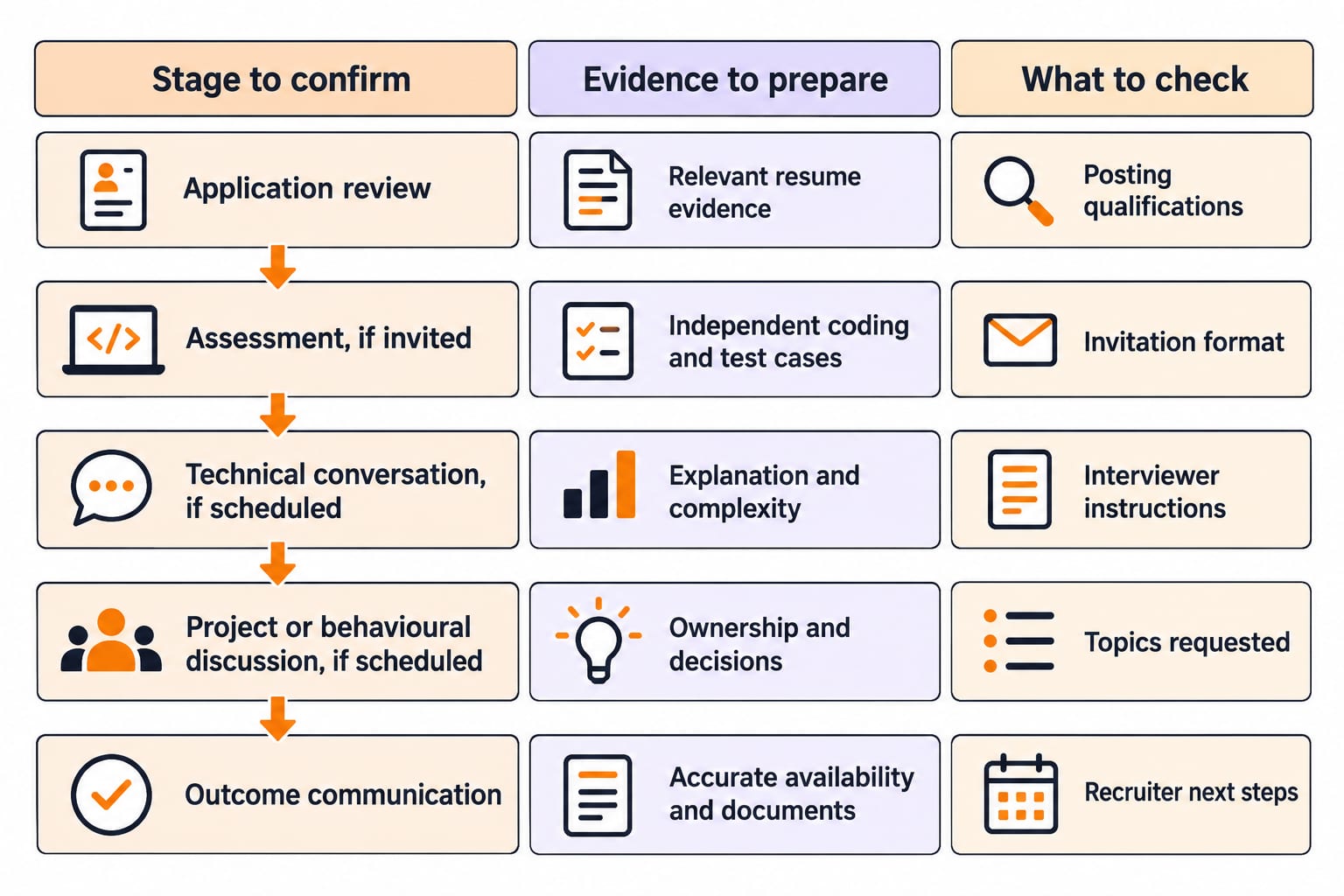
Build your checklist from the stage named in the posting or invitation, then prepare the evidence that stage can test.
Stage to confirm | Evidence to prepare | What to check |
|---|---|---|
Application review | Relevant resume evidence | Posting qualifications |
Assessment, if invited | Independent coding and test cases | Invitation format |
Technical conversation, if scheduled | Explanation and complexity | Interviewer instructions |
Project or behavioural discussion, if scheduled | Ownership and decisions | Topics requested |
Outcome communication | Accurate availability and documents | Recruiter next steps |
A self-administered coding test needs independent reading, implementation and submission checks. A live technical conversation also needs spoken reasoning: clarify the problem, explain a choice and respond to questions.
Google's role-specific map starts with your invitation. The Wipro Interview Process: What to Prepare for Each Hiring Stage post owns its three-stage plan; the Accenture Recruitment Process and Test Pattern: Verify Every Stage post owns drive verification; and the Coforge Recruitment Process and Test Pattern: A Fresher’s Stage-by-Stage Guide post owns its stage checklist. This page focuses on Google role variability and evidence-based practice. Broader recruiter preparation is organised in the Company Specific category.
Application screening: make each claim easy to verify
According to Google Careers Help’s Apply for a job guidance, you should read the job overview and qualifications for fit, create the required Careers Profile and monitor your application email. Recruiters assess skills and experience and contact potential matches.
In a resume, replace “worked on backend” with “implemented duplicate-request handling and added 7 automated retry tests for a college booking app”. The stronger sentence identifies both the work and evidence. Support it with commits, test results and an explanation of your contribution.
Record the role title, location and qualifications verbatim from your posting. Compare each requirement with evidence you can explain.
Test pattern: extract the actual rules from your invitation
Turn the invitation into a checklist before practising under timed conditions:
Assessment type and permitted programming languages.
Question count and time limit.
Submission rules and permitted tools or assistance.
Proctoring instructions.
Deadline and time zone.
Ask the recruiter to clarify any missing checklist details.
For a self-set mock, allocate 55 minutes across 2 tasks: 5 minutes to inspect both, 20 minutes on task A, 20 minutes on task B and 10 minutes for tests and submission. The total is 5 + 20 + 20 + 10 = 55 minutes.
Use the final 10 minutes to test edge cases and check each submission.
Technical interviews: explain a correct solution before optimising
A Google-style technical conversation rewards a clear dependency model before code. Make the inputs, ordering rule and failure case explicit.
Try this original practice task: four services have these dependencies: lint before unit tests, compile before unit tests, unit tests before package, and security scan before package. Produce a valid build order and report a cycle if one appears.
Step | Ready work | Action |
|---|---|---|
1 | compile, lint, security scan | Start with zero-dependency services. |
2 | unit tests | Run it after compile and lint finish. |
3 | package | Run it after unit tests and security scan finish. |
Result | compile -> lint -> security scan -> unit tests -> package | Every dependency points left to right. |
The order is valid because compile and lint both precede unit tests, while security scan and unit tests both precede package. A topological sort takes O(V + E) time and O(V) auxiliary space for V services and E dependency edges.
If a service remains with a non-zero dependency count after the queue empties, the graph contains a cycle. State that failure instead of returning a partial order, then explain which edge must be removed or revised.
Practise the explanation aloud: define the contract, trace one ready item, justify the complexity and name the edge case.
Project and behavioural answers: show your own decisions
Build a STAR answer from situation, task, action and result. Consider this college-project example:
Situation: A three-person campus shuttle app returns stale arrival times after a route update.
Task: You own cache invalidation for the arrival endpoint.
Action: You add route-version keys and 7 regression fixtures for old and new route data.
Result: Replaying the same 25 requests reduces stale responses from 9 to 1 while the route data stays unchanged.
Explain an alternative you considered, your personal contribution and what you would change next time.
Use the STAR structure as a prompt, then support each claim with evidence from your own project.
After an interview: track instructions and review gaps
Keep a simple tracking row:
Role A | application submitted | recruiter instructions pending | resume version 2
Update status only when communication confirms a change.
Suppose one mock exposes three issues: an unclear assumption, a missed single-element case and an unsupported O(n) claim. Repair them by rewriting the problem contract, adding the [5] test and stating the average constant-time hash-table assumption. Then explain the solution again without notes.
Keep other applications moving. Follow recruiter instructions for requested documents and follow-up timing.
The short version: prepare for the next confirmed step
Read the role and invitation, choose one programming language, practise one explained coding solution with edge cases, and prepare one project story supported by evidence.
For foundational practice, Coding For Placements covers C, C++, Java, Python, data structures and algorithms, including sorting, dynamic programming and graphs. Use the material matching your current gap.
Start by diagnosing one weakness: implementation, complexity analysis or testing. Study that area, solve a fresh problem and explain your answer aloud. Let the next confirmed step guide your preparation.
Keep learning
Infosys Recruitment Process and Test Pattern: Freshers' Stage-by-Stage Guide
Learn which Infosys hiring details come from your invitation, how to prepare for possible assessments and interviews, and how to verify an offer safely.
Updated 30 Oct 20265 min read167 viewsCompany-Specific Prep
HCLTech Recruitment Process and Test Pattern: Build Your Drive Map
Build a source-controlled HCLTech drive map from the current role page and invitation, then use worked diagnostics to prepare for each assigned stage.
Updated 30 Oct 20265 min read90 viewsCompany-Specific Prep
Coforge Recruitment Process and Test Pattern: A Fresher’s Stage-by-Stage Guide
Conflicting lists of Coforge rounds can leave you practising the wrong thing. Use your invitation to identify the next stage, then rehearse assessments, project explanations and HR answers with concrete examples.
Updated 16 Nov 20265 min readCompany-Specific Prep
Hexaware Recruitment Process and Test Pattern: What to Prepare for Each Round
Do not prepare for a generic Hexaware pattern. Build your plan from the current invitation, then practise the skills and explanations each listed stage needs.
Updated 8 Nov 20264 min readCompany-Specific Prep