Tower Research Hiring Process: Stage-by-Stage Prep for Quant and Dev Roles
Prepare for a Tower Research application without treating one online account as a universal process. Use this role-led map, worked drills, and seven-day plan.
KnowledgeGate Team
Exam prep & CS education
Updated 25 Sep 20265 min read
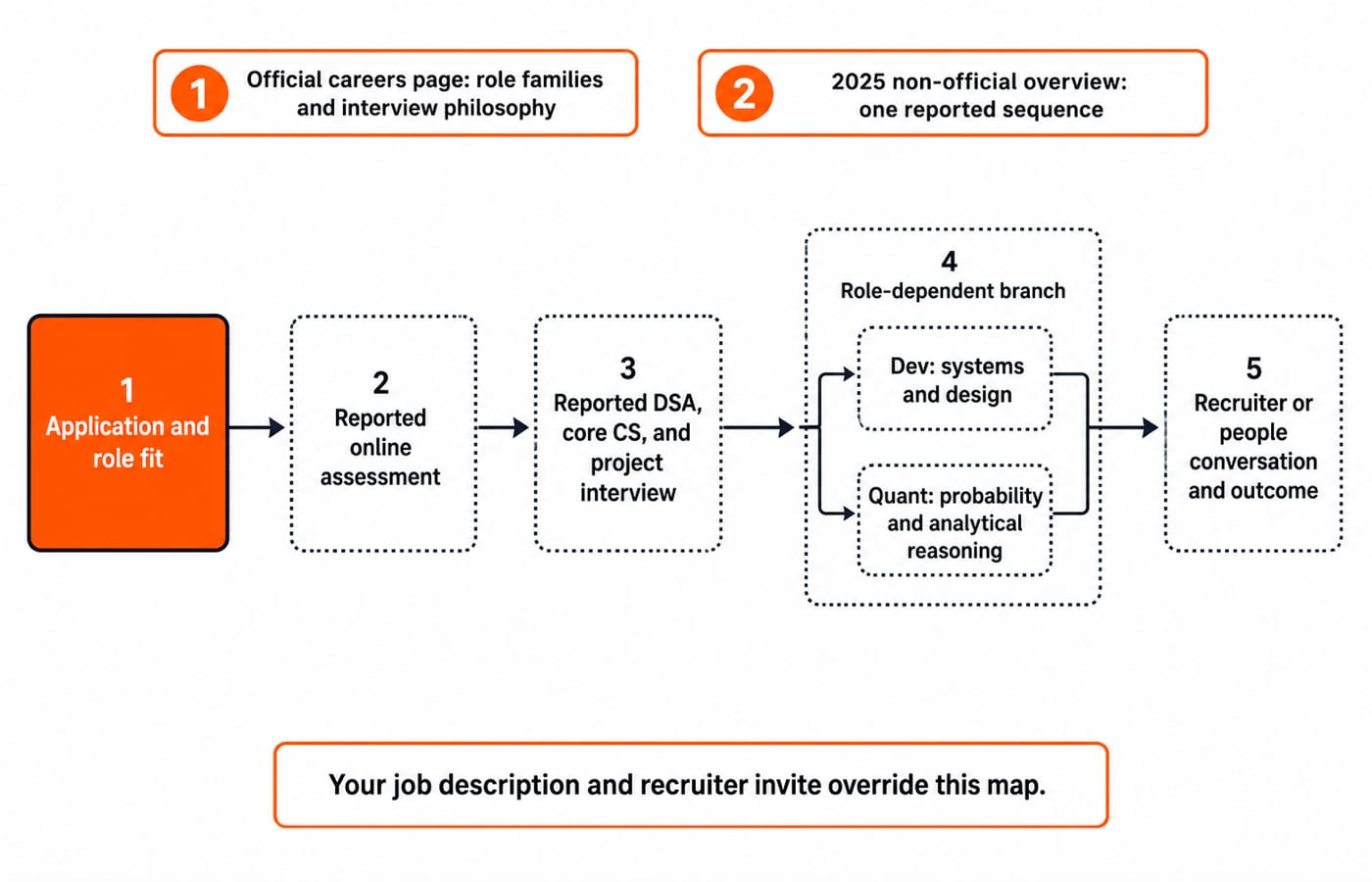
Tower Research candidates need two maps: the reported sequence and the role-specific branch. Tower's official careers page distinguishes quantitative trading from core engineering, while a secondary overview updated in 2025 reports one possible interview sequence. Let the current job description and recruiter invitation decide the actual loop.
Tower Research hiring process at a glance
One reported sequence runs from application and role fit through an online assessment and a DSA, core-CS, and project interview. It then branches into systems or quant work before a people conversation. Official guidance establishes role families and interview philosophy; the 2025 secondary account supplies the possible stages, not a universal round count.
Source | What it supports | What it does not prove |
|---|---|---|
Role families, valued qualities, practical interview philosophy | A fixed round count, assessment format, or universal sequence | |
GeeksforGeeks overview, updated 23 July 2025 | One reported assessment, technical interview, design, and HR pattern | Tower's current process for every role or office |
Two earlier company-process guides own different preparation loops: Capgemini Exceller Drive Hiring Process covers mass-hiring assessments, eligibility, documents, and recruitment safety; Capital One Recruitment Process covers recruiter screening, Power Day, case work, and behavioural evidence. Tower preparation instead branches into low-latency engineering or quant research, so its core drills are systems throughput, algorithms, probability, and experimental reasoning.
Stage 1: Match the application to the role family
Quantitative trading roles centre on research, market data, signals, and experiments. Core engineering roles centre on technology, data, infrastructure, and low-latency systems. Match every resume claim to one of those role signals and to the exact requisition.
For a developer application, identify one performance constraint, the measurement method, the change you owned, and the trade-off that remained. For a quant application, identify the hypothesis, dataset boundary, baseline, leakage check, out-of-sample test, and your personal contribution.
Write evidence at claim-level specificity. 'Reduced p99 latency' is incomplete without workload, before-and-after measurement, and the change that caused it. 'Built a prediction model' is incomplete without target, dataset size, time split, baseline, stability test, and failure mode. Keep only numbers you can defend under follow-up questions.
Stage 2: Prepare for a reported online assessment
A 2025 secondary account names aptitude, coding, and CS concepts in an online assessment. Use that as a rehearsal mix until the invitation names the format.
Probability warm-up: an outcome pays +4 with probability 0.40 and -1 with probability 0.60. Expected value is (0.40 x 4) + (0.60 x -1) = 1.60 - 0.60 = 1.00 unit. After a 1.20 cost, net expected value is 1.00 - 1.20 = -0.20, so the decision changes. State the assumptions; expectation is not a guaranteed single-trial result.
Build a branch-neutral 75-minute simulation: 5 minutes to scan, 25 for reasoning, 40 for one coding problem, and 5 for edge cases. Replace that split with the format named in the invitation.
Stage 3: DSA, core CS, and project discussion
The same account names DSA, OS, OOP, DBMS, networks, and projects. Clarify constraints, state a baseline, improve, dry-run, analyse time and space, then test edges. For projects, explain the failure signal, measurement method, change you owned, and remaining trade-off.
Illustrative drill: for a = [9, 3, 5, 1, 7, 8], k = 3, return [9, 5, 7, 8].
Window | Deque indices | Deque values | Maximum |
|---|---|---|---|
|
|
|
|
|
|
|
|
|
|
|
|
|
|
|
|
Each index enters and leaves once: O(n) time and O(k) space, versus O(nk) scanning. Drill more patterns in Coding for Placements, then rehearse the invariant and complexity aloud.
Stage 4: Split preparation for dev systems and quant reasoning
The job description decides emphasis. Developer prep prioritises data structures, concurrency, networking, memory, performance, and design trade-offs. Quant prep prioritises probability, expectation, statistics, experiments, and assumptions.
Dev drill: 128 bytes x 250,000 messages/second = 32,000,000 bytes/second = 32 MB/s in decimal units. With 20% overhead, 32 x 1.20 = 38.4 MB/s. Discuss batching, copies, queue growth, p99 latency, backpressure, and needed measurements.
Quant warm-up: at win probability 0.30, (0.30 x 4) + (0.70 x -1) = 1.20 - 0.70 = 0.50; after cost, 0.50 - 1.20 = -0.70. The lesson is sensitivity to assumptions, not arithmetic alone.
Later conversations: design, projects, communication, and fit
Tower's careers page emphasises practical, thoughtful conversation, clear communication, and calm focus. Turn those values into evidence: one decision made under incomplete information, one trade-off you explained clearly, and one mistake you corrected without hiding it.
Use a 90-second project answer: 15 seconds on the problem and constraint, 35 on the method and decision you owned, 25 on the result and validation, and 15 on a failure mode or next measurement. Developer candidates can sketch data flow, queueing, backpressure, and recovery. Quant candidates can defend target choice, leakage controls, baseline, out-of-sample result, and model risk.
Ask: Which team and role family? Is there an assessment? Should preparation lean towards coding, systems, or quant reasoning? What will each conversation test, and which tools are allowed? For project and behavioural rehearsal, use the Interview and Resume Preparation course.
A seven-day Tower Research preparation plan and final checks
Use 10 hours across seven days: Day 1, one hour matching evidence to the role; Day 2, 90 minutes on DSA and complexity; Day 3, two hours on the dev-systems or quant-reasoning branch; Day 4, 90 minutes on core CS or probability; Day 5, 90 minutes on project and design answers; Day 6, 90 minutes on a full mock; Day 7, one hour on light review, recruiter questions, and device checks.
If you lose two hours, preserve the full mock and final-day review. Cut duplicate practice instead: 30 minutes from Day 2, one hour from Day 3, and 15 minutes each from Days 4 and 5. Reallocate the surviving branch time as soon as the invitation identifies dev, quant, infrastructure, or another speciality.
Prepare to the requisition, separate shared DSA and core-CS work from role-specific depth, and confirm the loop. The Placement Preparation category supports coding, aptitude, resume, and interview practice. Spend the final hour on the branch named in your invitation, not on another company's sequence.
Keep learning
Paging and TLB Explained: Address Translation, EMAT and Exam Traps
Follow one virtual address from its VPN through the TLB to a physical frame, then calculate page-table size, TLB reach and effective memory access time.
Updated 4 Oct 20266 min readOperating Systems
Operating System Scenarios: Solve Scheduling, Concurrency, and Page Replacement
Learn one state-trace method for three common OS problem families, then apply it to complete Round Robin, concurrency, FIFO, and LRU examples.
Updated 29 Sep 20265 min readOperating Systems
Capital One Recruitment Process: Stage-by-Stage Guide for India Applicants
Prepare for a Capital One India application with a cautious five-stage map, worked technical and case drills, and a practical 14-hour schedule.
Updated 24 Sep 20265 min readOperating Systems
Capgemini Exceller Drive Hiring Process: A Stage-by-Stage Preparation Map
Map each typical Capgemini fresher stage to a concrete practice output before an Exceller drive, then use worked aptitude, coding, interview, and safety checks.
Updated 23 Sep 20265 min read107 viewsOperating Systems