

Web Development Project Ladder: 3 Portfolio Builds with Review Gates
Move from a responsive event page to a persistent React tracker and a role-aware full-stack review board. Each four-week block ends in evidence, scoring, and repair.
KnowledgeGate Team
Exam prep & CS education
Updated 19 Nov 20265 min read
Tutorials create familiarity, but they do not prove you can scope, build, test, explain, and repair independently. This 12-week ladder moves from a responsive page to a stateful React app, then a role-aware full-stack system. Across 96 hours, you produce three builds and scored review packets. The gate, not the calendar, decides whether you advance.
Need project selection and a deployment sequence first? The MERN Portfolio Roadmap: 4 Projects from Responsive UI to Full Stack owns the four-build stack progression. Return here with three chosen scopes. Campus Code Day, Placement Application Tracker, and Project Review Board are worked examples for the peer-review evidence, blocker rules, pass thresholds, and repair loops after each four-week block.
1. Web Development Project Ladder: Budget 96 Hours Before Choosing Features
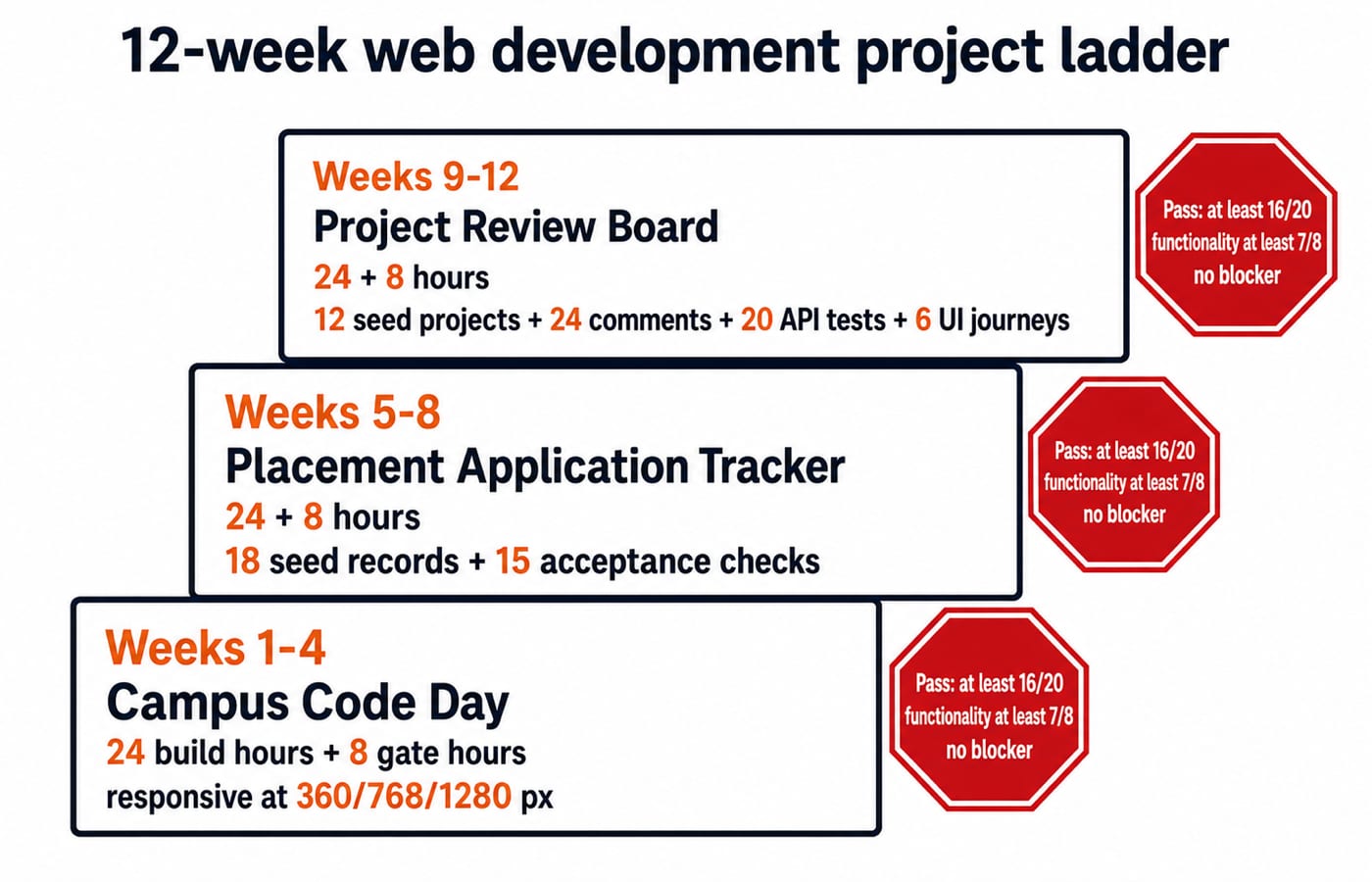
Budget four 90-minute weekday sessions plus one 2-hour weekend session: 4 x 1.5 + 2 = 8 hours. Each block has 24 build hours in Weeks 1 to 3 and 8 gate hours in Week 4. Therefore, 3 x (24 + 8) = 96 hours.
Block | Project | New constraint | Build hours | Gate hours | Exit evidence |
|---|---|---|---|---|---|
1 | Campus Code Day | Responsive HTML, CSS, JavaScript | 24 | 8 | Deployed page, 20-point scorecard |
2 | Placement Application Tracker | React state and persistence | 24 | 8 | 15 acceptance checks, scorecard |
3 | Project Review Board | React, Node.js, Express.js, MongoDB | 24 | 8 | API evidence, six UI journeys, scorecard |
Use Free Courses & Guidance by Prashant Sir for gate-exposed skill gaps. The catalogue supports repair, not building.
2. Build 1, Campus Code Day: Prove Responsive HTML, CSS, and JavaScript
Build navigation, hero, eight-session schedule, six-speaker grid, five-question FAQ, and registration form as semantic sections. Use two four-session tracks and form fields name, email, track, and consent. JavaScript handles only the mobile menu, FAQ disclosure, and validation. No framework.
At 360 px, show one card per row and a collapsed menu; at 768 px, two cards per row; at 1280 px, two columns inside a 1,080 px container. Require zero horizontal scroll, eight readable cards at 200% zoom, keyboard access to the menu and five FAQ controls, four labelled fields, 4/4 invalid cases blocked, and zero console errors.
A reviewer may use HTML Interview Questions for Freshers to probe semantics, forms, and browser behaviour. The scorecard decides the result.
3. Build 2, Placement Application Tracker: Make State Changes Observable
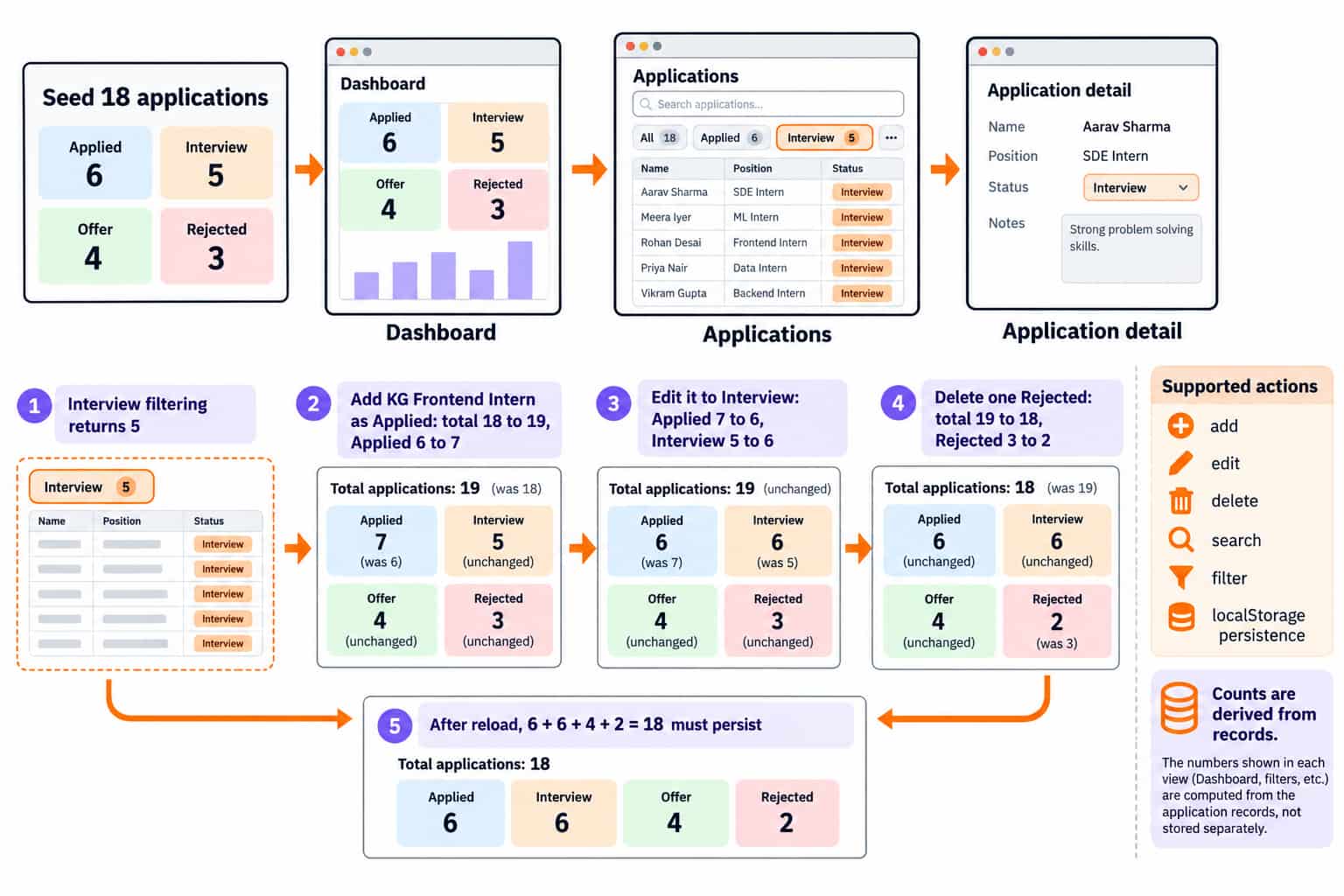
Create Dashboard, Applications, and Application detail views. Seed 18 applications: 6 Applied, 5 Interview, 4 Offer, 3 Rejected. Support add, edit, delete, search, filter, and localStorage persistence. Derive counts from records.
Run one path. Interview filtering returns 5. Add KG Frontend Intern as Applied: total 18 to 19, Applied 6 to 7. Edit it to Interview: Applied 7 to 6, Interview 5 to 6. Delete one Rejected: total 19 to 18, Rejected 3 to 2. After reload, 6 + 6 + 4 + 2 = 18 must persist.
Run 15 named checks: dashboard load; 18-record list; detail open; valid add; empty-title rejection; malformed-URL rejection; edit; delete; search; filter; derived counts; reload persistence; focus return after modal close; three-view navigation; zero console errors. For component, state, or derived-data gaps, use the React and Redux Course.
4. Build 3, Project Review Board: Connect UI, API, Database, and Roles
Use author and reviewer roles with DRAFT, IN_REVIEW, and APPROVED states. Implement six routes: login; filtered, paginated list; create; get one; update; add review decision. Paginate by 10 and return explicit 400, 401, 403, and 404 responses.
Seed 12 projects, four per state, plus 24 comments, two each. Creating project 13 as DRAFT changes 4/4/4 to 5/4/4. Submission gives 4/5/4; reviewer approval gives 4/4/5. Thirteen projects paginate as 10 then 3. Author approval returns 403; creation without title returns 400.
Require 20/20 API checks, 6/6 UI journeys, no unhandled server rejection, and no role bypass. The README covers setup, secret-free environment-variable names, seed steps, six-route contract, and test commands. For route, validation, or persistence gaps, use the Node.js, Express.js & MongoDB Course.
5. Web Development Review Gates: Score Evidence, Then Apply Stop or Go
Score functionality 8, usability and accessibility 4, code structure 4, and evidence quality 4. Pass at 16/20 or more with at least 7/8 functionality and no blocker. Blockers include data loss, inaccessible core actions, broken primary journeys, authorisation bypasses, or a build another person cannot run from its README.
The packet contains a deployment URL, repository URL, README, named checklist, 2-minute demo, score breakdown, and issue log with ID, severity, steps, expected, actual, and retest. Self-check, then ask a peer. Otherwise, wait 24 hours, test in a clean browser profile, record it, and do not edit mid-test.
Build 2 scores 7/8 + 3/4 + 3/4 + 4/4 = 17/20, but an edit reverts after reload. Data loss makes 17/20 fail. Repair persistence and rerun all 15 checks. Once cleared, the unchanged 17/20 passes.
6. Repair Weeks: Convert Review Findings into a Tested Second Version
Split the gate week into 1 hour to reproduce and rank findings, 4 to fix blockers and majors, 2 for full regression, and 1 for README, demo, and retrospective. 1 + 4 + 2 + 1 = 8 hours. Limit active issues to three.
Build 1 fixes 24 px overflow at 360 px, then retests 360, 768, and 1280 px. Build 2 reruns the 18-record path after fixing reload. Build 3 repairs approval until an author gets 403 and a reviewer succeeds.
Exit with a tagged second version, before-and-after blocker evidence, regression result, and the next constraint. If a blocker remains after 8 repair hours, extend the block.
7. Web Development Schedule Recovery: Protect the Gates When Days Are Missed
Missing two 90-minute sessions leaves 8 - (2 x 1.5) = 5 hours. Move those 3 hours into the gate week, leaving 5 for review and repair. Do not double the next day. Recover up to 4 hours only when the core path works.
Add a catch-up week and shift later blocks after more than 4 lost hours, an incomplete primary journey, or two consecutive sub-6-hour weeks. Cut animation before validation, accessibility, persistence, role checks, tests, or the gate.
8. Web Development Project Ladder: The Short Version and Next Step
Build a responsive document, stateful client, then full-stack role workflow. Advance only with at least 16/20, at least 7/8 functionality, and no blocker. Finish with three repositories, review packets, repaired versions, and one 2-minute demo per build.
In 30 minutes, create the Campus Code Day repository, put six section names and six gate checks in its README, add the semantic skeleton, and book the Week 4 review. It is a personal milestone, not an official deadline.
Choose the linked React and Redux course for a weak Build 2 state model, or the Node.js, Express.js and MongoDB course for a weak Build 3 API or database boundary. Let the gate identify the gap.
Keep learning
Web Design and Development Explained: How a Web Page Loads, HTML, CSS, JS and HTTP
Follow one web page from its URL to the server and back. See how HTML, CSS, JavaScript, HTTP and the database work as one connected system.
Updated 31 Oct 20265 min readGATE Strategy & Roadmap
MERN Portfolio Roadmap: 4 Projects from Responsive UI to Full Stack
Stop building renamed to-do apps. This 12-week ladder moves from responsive HTML and CSS to browser logic, React state, and a deployed MERN product.
Updated 19 Sep 20265 min readWeb Development
IBPS PO Reasoning Preparation: An 8-Week Puzzle-to-Mock Ladder
Build reasoning skill in a fixed sequence, from reliable singles and seating diagrams to multi-variable grids, set selection, and mock analysis.
Updated 30 Oct 20266 min readIBPS Exams
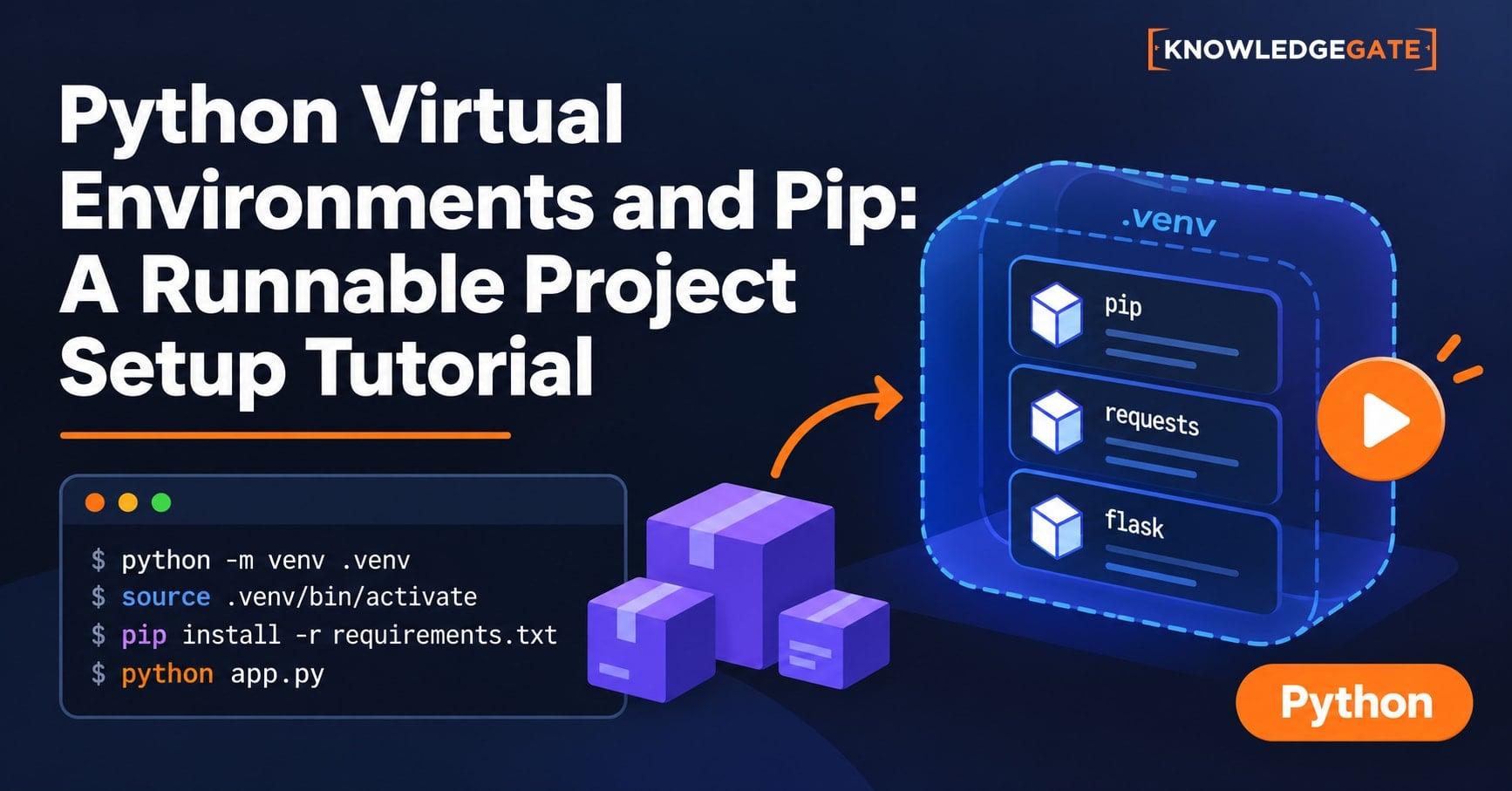
Python Virtual Environments and Pip: A Runnable Project Setup Tutorial
Build two isolated Python projects from zero, check exactly where pip installs a package, and reproduce a working setup from a requirements file.
Updated 12 Nov 20265 min readPython