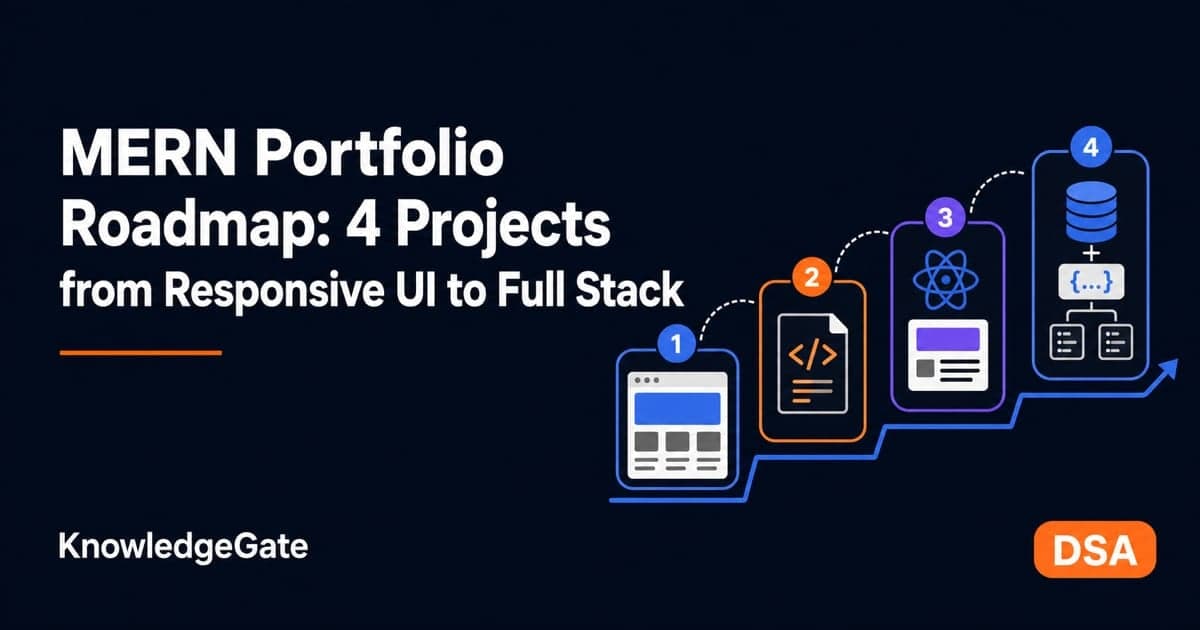
Watching MERN tutorials does not give you convincing proof of progress. Do not build four renamed to-do lists. Build four products in order, each proving a new layer: responsive layout, browser logic, React state, then a deployed API with persistent data.
Use a 12-week MERN portfolio proof ladder
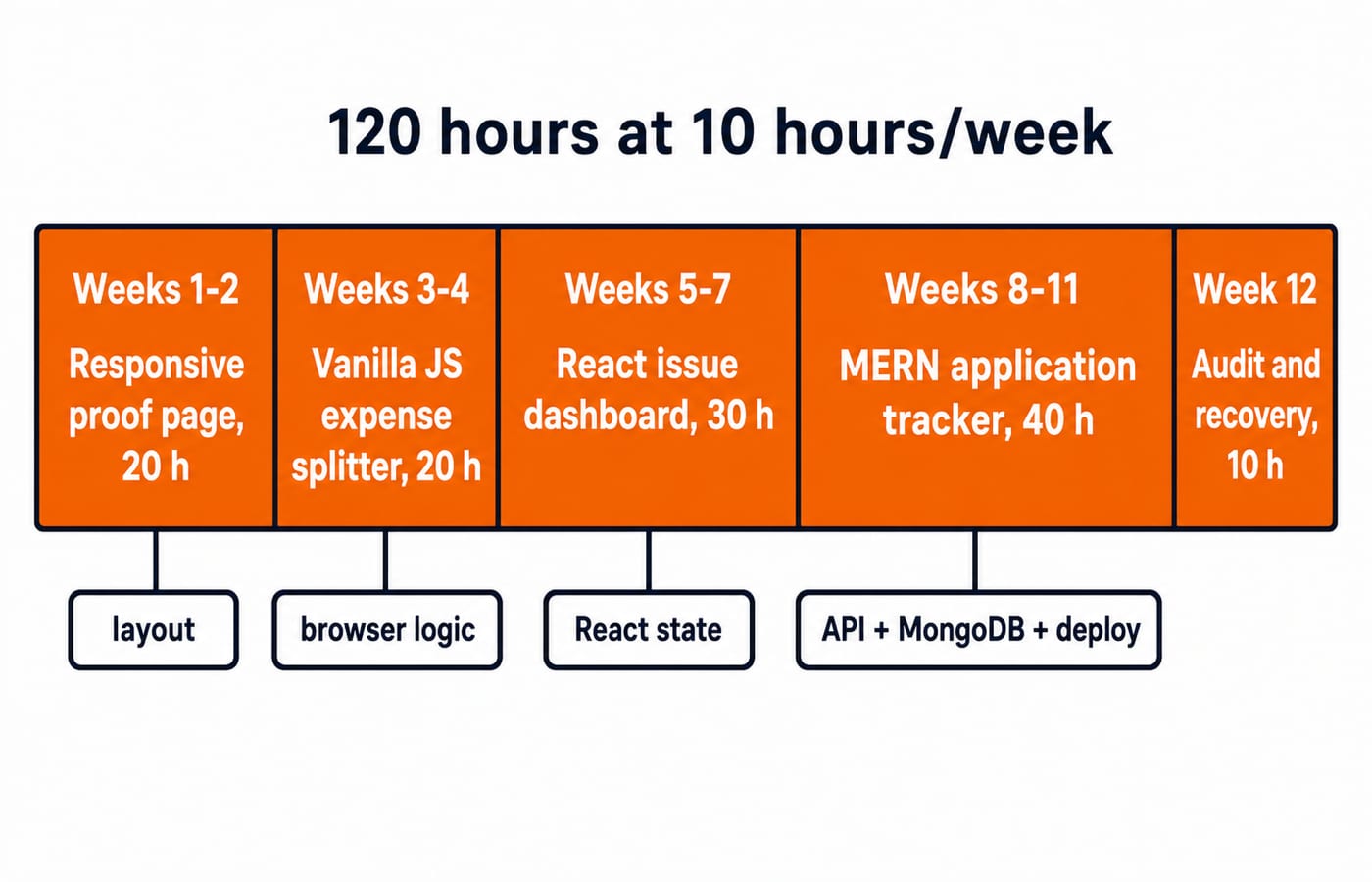
Commit 10 hours per week for 12 weeks, giving 120 hours. Count learning, building, testing, and documentation. Use Coding & Skill Development Courses to revisit weak foundations.
Time | Project | Proof |
|---|---|---|
Weeks 1-2, 20 hours | Responsive proof page | HTML, CSS, accessibility |
Weeks 3-4, 20 hours | Vanilla JS expense splitter | Data, DOM, storage |
Weeks 5-7, 30 hours | React issue dashboard | Components, state, routes |
Weeks 8-11, 40 hours | MERN application tracker | API, validation, MongoDB |
Week 12, 10 hours | Audit and recovery | Deployment, READMEs, demos |
The allocation closes exactly: 20 + 20 + 30 + 40 + 10 = 120. Move forward only when the project has a public URL, reproducible repository, and one explained design decision. An unhosted folder does not count. Keep the repositories separate so a reviewer can isolate layout, browser logic, React state, and server persistence; acceptance evidence, not a peer scorecard, controls progress.
Project 1: ship a responsive developer proof page
Build a semantic page with a header, keyboard-usable navigation, hero, skills section, four project cards, and contact footer. Show one card column at 360 px, two at 768 px, and three at 1280 px. Require meaningful headings, visible focus, descriptive alt text, and no horizontal scrolling.
Use CSS Grid for cards and Flexbox for navigation and card internals. Set gap: 24px, a 1120px container cap, and padding-inline: 16px, increasing to 32px from 768 px. Explain this choice in the README and include three viewport screenshots.
Tab through every control, deploy the page, and keep React out. Let this repository expose layout, semantic HTML, and accessibility gaps.
Project 2: prove browser logic with an expense splitter
Build a vanilla JavaScript app with participant rows, paid amounts, Add, Remove, Calculate, and Reset controls. Restore data from localStorage. Separate pure calculations from DOM rendering.
Work in integer paise. Asha pays INR 840, Bharat INR 460, and Charu INR 700, totalling INR 2,000 or 200,000 paise. Division by three gives 66,666 paise with remainder 2. Give one extra paisa to each of the first two shares: INR 666.67, INR 666.67, and INR 666.66. Their sum is INR 2,000.
Subtract each share from the amount paid. Asha has +INR 173.33, Bharat -INR 206.67, and Charu +INR 33.34. They sum to zero. Bharat pays Asha INR 173.33 and Charu INR 33.34, totalling INR 206.67.
Reject blank names and negative amounts, and require at least two participants. Test totals, remainder-paisa allocation, zero balance, and this settlement. The deployed app must reproduce it after refresh.
Project 3: make React state transitions visible
Seed eight issues: Open 3, In Progress 2, Done 3. Give only WEB-17, WEB-21, and WEB-25 High priority, and put the word nav only in WEB-17's title. Use IssueForm, FilterBar, IssueCard, StatusSummary, and IssueDetail, with /issues and /issues/:id. A reducer owns ADD_ISSUE, MOVE_ISSUE, and SET_FILTER.
Issue WEB-17, "Mobile nav overlaps hero", begins as High priority and Open. Selecting Start moves it to In Progress. The counts change from 3 / 2 / 3 to 2 / 3 / 3, while both totals remain eight. A High-only filter returns exactly WEB-17, WEB-21, and WEB-25; searching nav returns only WEB-17.
Show loading, empty, and invalid-route states. Test the initial summary, transition, and empty search. Deploy as a static client, then explain why counts are derived instead of separately stored.
Project 4: deploy the full MERN request cycle
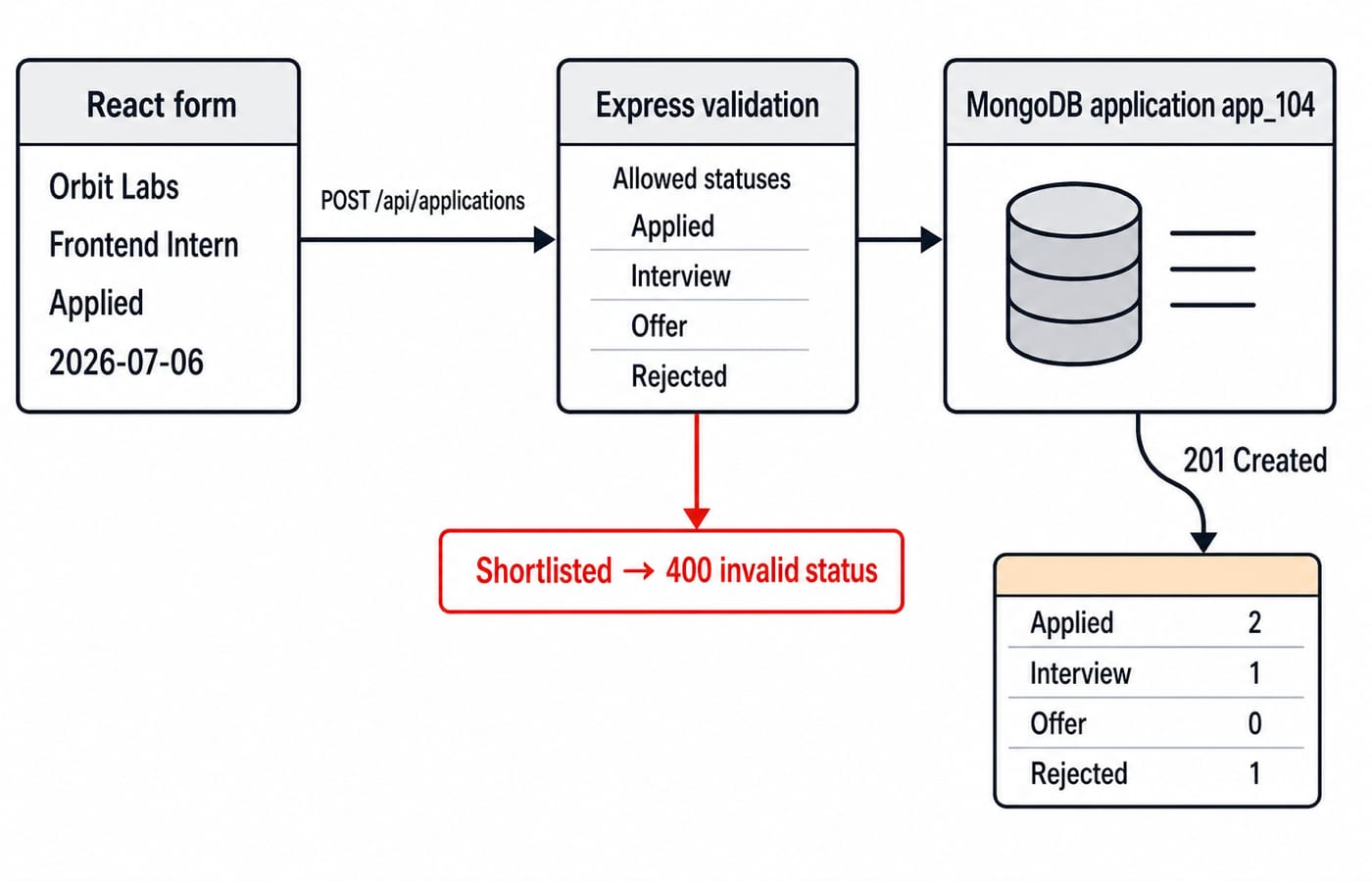
Use a React form and dashboard, Express API, and MongoDB. Store company, role, status, appliedOn, and optional notes. Permit only Applied, Interview, Offer, and Rejected. Use Mongoose Schemas and Models: Validation and Population for the data layer and the MERN Stack Course: Full Stack Development for the full sequence.
Trace sample data through every layer. POST /api/applications receives { "company": "Orbit Labs", "role": "Frontend Intern", "status": "Applied", "appliedOn": "2026-07-06" } and returns HTTP 201 with id 66a100000000000000000104. PATCH /api/applications/66a100000000000000000104 changes the status to Interview. For four seeds, GET /api/applications/summary returns { "Applied": 2, "Interview": 1, "Offer": 0, "Rejected": 1 }, whose counts total four. Shortlisted returns HTTP 400 with a field-level message. Orbit Labs and 66a100000000000000000104 are sample data.
Deploy client and API. GET /api/health must return HTTP 200 and { "status": "ok" }. Keep the connection string outside the repository. Verify create, refresh, update, and delete. Document setup, environment-variable names without values, API examples, one tradeoff, and one limitation.
Keep a 10-hour week that survives missed days
Use Tuesday 2 hours for a concept and acceptance test, Thursday 2 hours for one vertical slice, Saturday 4 hours for the main build, and Sunday 2 hours for testing, deployment, and README work. The total is 2 + 2 + 4 + 2 = 10 hours. End by writing the next 15-minute action.
Miss a 2-hour weekday? Use Sunday's first 60 minutes for the essential task, drop a stretch feature, and move one hour to week 12. Miss Saturday? Move the milestone one week and use 4 of the 10 recovery hours. Never compensate with an 8-hour marathon.
Apply five gates: private-window demo, clean-clone setup, correct worked example, visible bad-input response, and a spoken decision plus limitation.
Present four repositories as one progress story
Display the MERN tracker first, then the React dashboard, JavaScript splitter, and responsive page. Give each a 60-second demo: 10 seconds on the problem, 20 on behaviour, 20 on a technical decision, and 10 on the next improvement. The parts total 60.
Write evidence, not a feature list: "Built and deployed a MERN job-application tracker with a four-state workflow, server-side validation, persistent MongoDB data, and tested create, update, and delete paths." Resume for Freshers: Clear the First Screen gives wider context. Never invent user counts, performance gains, recruiter approval, salaries, or hiring outcomes.
Four projects are enough when each proves a new layer and is deployed, documented, and explainable. The course linked above is an optional route for structured full-stack coverage. The MERN Stack + DSA bundle is an optional route when combining projects with algorithms, not a placement promise. Next, create the first repository and write its three viewport tests.