UPPSC Teaching Eligibility and Selection Structure: Verify the Right Post Before Applying
A practical worksheet-based method to check the exact UPPSC post, qualification route, equivalence evidence and notified selection sequence before applying.
KnowledgeGate Team
Exam prep & CS education
Updated 2 Aug 20266 min read61 views
"UPPSC teaching" is a family label, not one eligibility rule. Eligibility belongs to an advertised post and discipline, so a degree that sounds close may still differ from the notified wording, and a selection stage used in one UPPSC recruitment may not apply to another. Work post by post: the qualification row first, then subject equivalence, then only the selection parts named in that same notice. The applicable notification on the official UPPSC portal decides your case.
1. UPPSC teaching eligibility starts with the exact post
The commission name alone tells you nothing about whether your qualification matches, because UPPSC runs more than one teaching recruitment. Polytechnic Lecturer (Computer Science) posts are filled through the U.P. Technical Education (Teaching) Service Examination, for lecturer posts in state polytechnics. LT Grade Assistant Teacher (Computer Science) is a separate UPPSC recruitment, for trained graduate teachers in Uttar Pradesh government secondary schools. Different advertisements, different qualification clauses, different selection sequences. Never merge them.
So pin the post down before you read any degree clause. Five identifiers settle it, and for the Polytechnic Lecturer route they read like this, with every blank filled only from the advertisement in front of you:
Advertisement number: as printed on the advertisement (A-__/E-__)
Exact post title: Polytechnic Lecturer
Discipline: Computer Science and Engineering
Department or service: U.P. Technical Education (Teaching) Service
Candidate category or branch: as that advertisement distinguishes it
If you are still choosing a recruitment family, use the teaching Computer Science exam choice guide first.
2. Build a post-specific eligibility matrix
Fill one row per condition, putting the notified wording on one side and your own certificate wording on the other:
Notification field | Exact notified wording | Candidate document | Exact document wording | Match | Evidence missing | Action |
|---|---|---|---|---|---|---|
Post and discipline | ||||||
Essential degree | ||||||
Accepted branch or subject | ||||||
Class or division | ||||||
Subject-equivalence authority | ||||||
Age on notified cutoff date | ||||||
Experience or teacher training |
MATCH means the notified route and document align. HOLD means equivalence, issuer, class conversion or cutoff evidence is missing. DOES NOT MATCH means official text excludes the route or an essential condition is absent. Higher degrees, similar syllabi and another commission's acceptance cannot upgrade HOLD.
3. Worked UPPSC eligibility audit: Kavya's documents
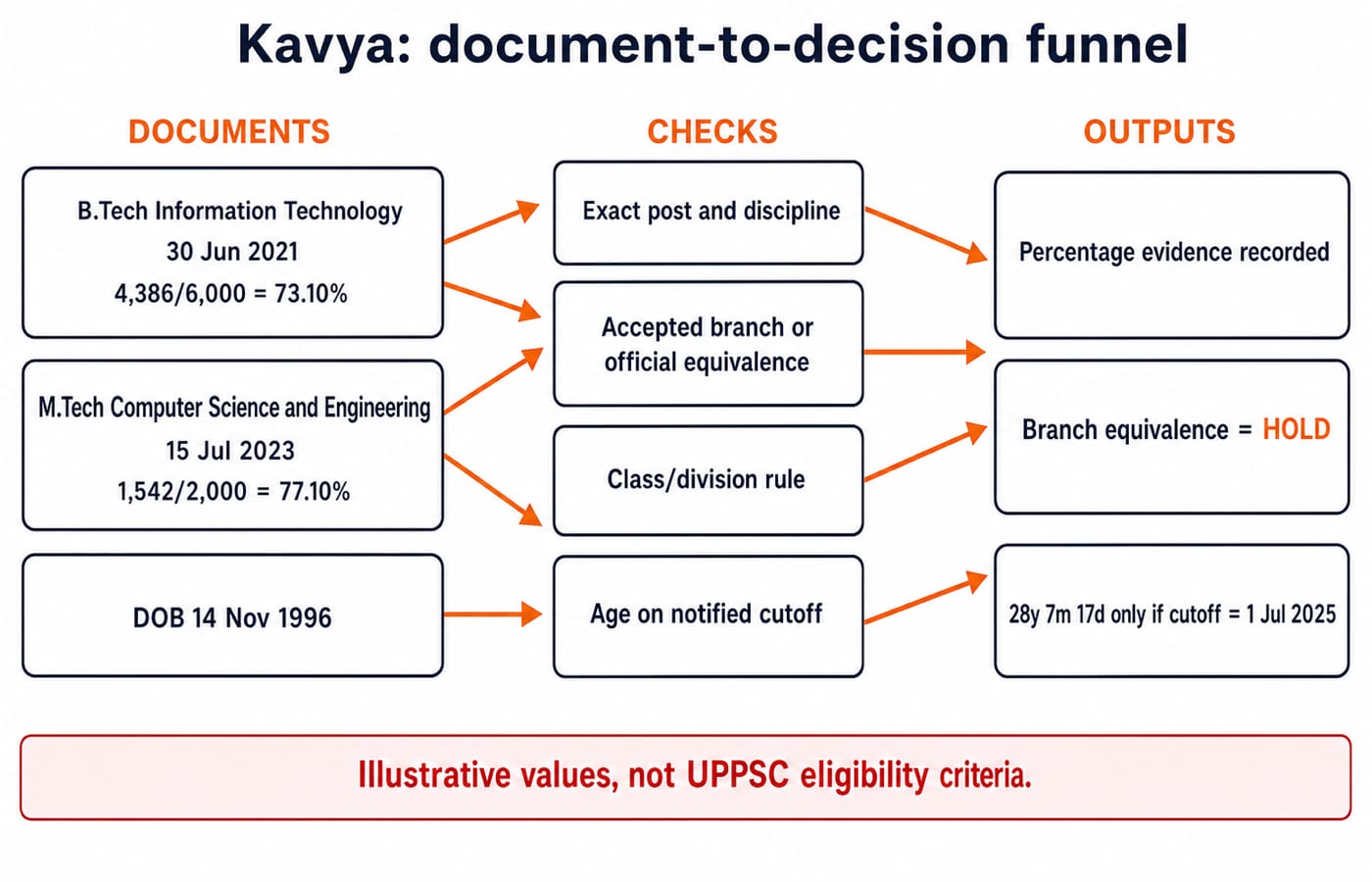
Kavya is a sample candidate, so the values below are her certificates and not UPPSC criteria. She targets the Polytechnic Lecturer Computer Science and Engineering row. Her B.Tech certificate says Information Technology, awarded 30 June 2021. Its consolidated marksheet records 4,386 out of 6,000, so (4,386 ÷ 6,000) × 100 = 73.10%.
Her M.Tech certificate says Computer Science and Engineering, awarded 15 July 2023. Its marks are 1,542 / 2,000, so (1,542 ÷ 2,000) × 100 = 77.10%. Both percentages and both award dates can be recorded as document facts.
The branch decision remains HOLD. B.Tech Information Technology does not match the target label Computer Science and Engineering character for character. It moves from HOLD only if the applicable notification accepts IT, names an equivalence route, or the notified authority supplies valid evidence. The M.Tech title does not silently repair a possible bachelor-level mismatch.
Kavya's date of birth is 14 November 1996. Age is only decidable against a notified cutoff date, so read the cutoff off the advertisement and count to it. Against an assumed cutoff of 1 July 2025 she would be 28 years, 7 months and 17 days old. Move the cutoff and that answer moves with it, so never carry this figure into a real application.
4. Copy selection structure from the same notification
UPPSC's teaching recruitments do not share one sequence, which is why this step is post-specific. Our UP LT Grade (CS) category page records that recruitment as a preliminary exam, then a mains exam, then document verification, then the final merit list, with an objective preliminary paper and a descriptive mains. That is the LT Grade sequence. It is not the Polytechnic Lecturer sequence, and carrying it across is the commonest way a teaching application goes wrong.
What you are checking | UP LT Grade Assistant Teacher (CS) | UPPSC Polytechnic Lecturer (CS) |
|---|---|---|
Post filled | Trained graduate assistant teacher in Uttar Pradesh government secondary schools | Lecturer in Uttar Pradesh government polytechnics |
Recruitment route | LT Grade Assistant Teacher recruitment | U.P. Technical Education (Teaching) Service Examination |
Sequence named on our category page | Preliminary exam, mains exam, document verification, final merit list | Not named on our pages, so copy it from the applicable advertisement |
Written structure our course coverage is built around | An objective preliminary paper and a descriptive mains | Paper 1 and Paper 2 as separate syllabus blocks |
What only the advertisement can give you | Marks, question counts, duration, negative marking, cutoff dates | Marks, question counts, duration, negative marking, interview weight, merit formula |
Build the same column for your own advertisement, and leave a cell blank rather than fill it from memory. Never borrow a written-paper count, an interview stage, a verification sequence or a merit formula from one of these recruitments into the other.
An interview or a document-verification stage exists for a Polytechnic Lecturer post only where that post's own advertisement names it. Our complete course settles the study split, not the scoring: its coverage is organised into Paper 1 and Paper 2 blocks.
5. Do not import another teaching exam's rules
Why it happens | What goes wrong | What to do instead |
|---|---|---|
Another board accepts IT | The application may fail at scrutiny | Keep |
A course uses Paper 1 and Paper 2 | Study blocks become invented marks or weight | Separate preparation coverage from official scoring |
An older or unrelated notice is reused | Post-specific changes are missed | Match advertisement, post, discipline and cycle |
The DSSSB TGT Computer Science Eligibility and CBT Marking Rules guide runs the same audit for a separate board, one that does publish its own marking rules. None of it is evidence for a UPPSC post.
6. Map the notification to preparation
Need | What our course pages give you | What it does not settle |
|---|---|---|
Build the Polytechnic Lecturer CS syllabus | UPPSC Polytechnic Lecturer 2025 (CS) complete course, split into Paper 1 blocks (Programming Language, Data Structures, Design and Analysis of Algorithms, Database Management Systems, Computer Networks, Computer Organization and Architecture, Cyber Security, Discrete Structures and Theory of Logic, General Hindi) and Paper 2 blocks (Operating Systems, Compiler Design, Software Engineering, Web Technologies, Computer Graphics, Image Processing, Artificial Intelligence and High Performance Computing, Soft Computing, Distributed Systems, General Studies) | Your personal eligibility |
Practise after or alongside coverage | UPPSC Polytechnic Lecturer CS Test Series, exam-focused practice for the same recruitment | The notified selection sequence |
Check whether LT Grade suits you instead | The UP LT Grade (CS) category page, with its own course and test series | Branch equivalence for either recruitment |
7. The short version and next step
Identify the exact post. Copy its essential qualification. Compare degree titles character for character. Obtain the notified equivalence evidence where required. Map only the selection parts in that same notice. Then choose course coverage and practice.
Your outcome should be MATCH, begin post-specific preparation; HOLD, resolve the named evidence gap; or DOES NOT MATCH, do not submit on assumption. For the Polytechnic Lecturer CS route, use the complete course for structured study and the test series for practice. Return to the official UPPSC portal before deciding to apply.
Keep learning
UPPSC Teaching vs UP LT Grade: Choose by Role, Eligibility and Syllabus
Choose between the Polytechnic Lecturer and LT Grade routes by checking the current notice first, then testing role fit, syllabus overlap and available hours.
Updated 7 Aug 20267 min readUPPSC Teaching
UPPSC Computer Science Problem Types: Solve Algorithms, DBMS and OS
Use one four-process dataset to practise insertion-sort traces, candidate-key and 3NF reasoning, and non-preemptive SJF calculations with reliable checks.
Updated 4 Aug 20266 min readUPPSC Teaching
UPPSC Teaching PYQ Analysis: Build an Error-Led Revision Plan
Learn a repeatable way to verify teaching PYQs, separate topic from reasoning demand, diagnose errors and convert the evidence into next week's study calendar.
Updated 30 Jul 20266 min readUPPSC Teaching
UPPSC Polytechnic Lecturer CS Syllabus: Complete Topic Map
Build a bounded UPPSC Polytechnic Lecturer Computer syllabus tracker from official headings, then turn diagnostic scores and prerequisites into a weekly plan.
Updated 28 Jul 20265 min read801 viewsUPPSC Teaching