UPPSC Teaching vs UP LT Grade: Choose by Role, Eligibility and Syllabus
Choose between the Polytechnic Lecturer and LT Grade routes by checking the current notice first, then testing role fit, syllabus overlap and available hours.
KnowledgeGate Team
Exam prep & CS education
Updated 7 Aug 20267 min read
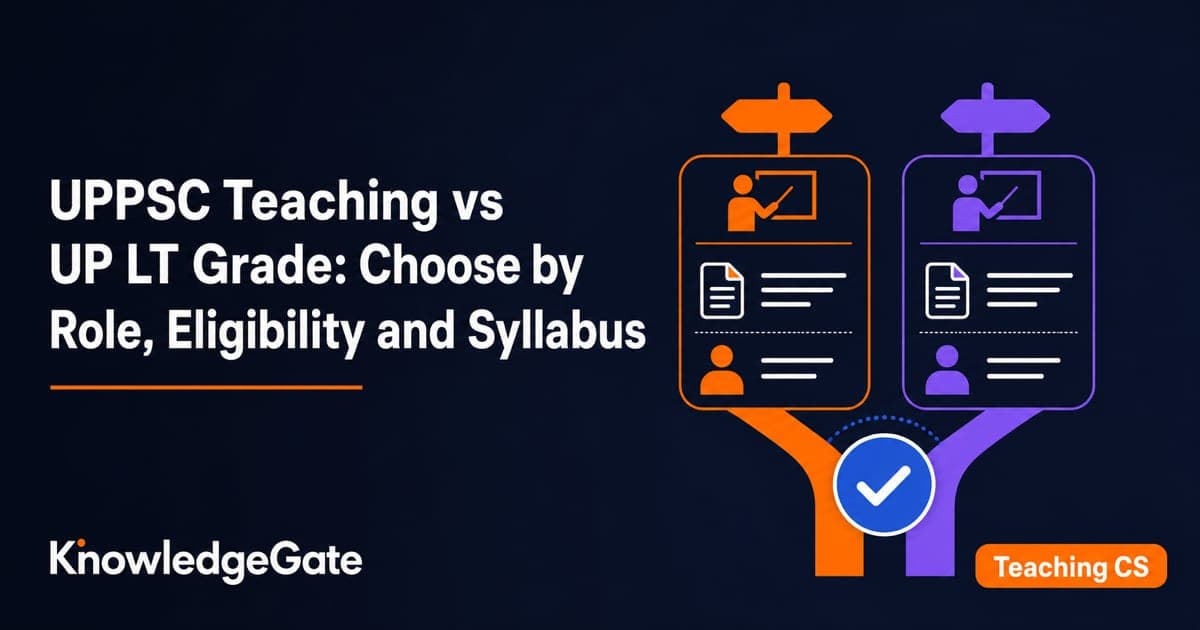
Two different posts, two different classrooms. The Polytechnic Lecturer (Computer Science) route recruits for diploma-level technical institutions, and the LT Grade Assistant Teacher (Computer Science) route recruits for Uttar Pradesh government schools. Their computer science ground overlaps heavily but not completely: twelve of the lecturer route's nineteen technical headings have a direct counterpart on the LT side, and seven do not. Settle four things, in this order: eligibility, teaching level, that overlap, and the weekly hours a dual target actually costs.
1. UPPSC Teaching vs UP LT Grade: the short answer
These routes target different teaching levels. The UPPSC Polytechnic Lecturer 2025 (CS) Course prepares a lecturer post recruited through the U.P. Technical Education (Teaching) Service Examination, whose written stage runs two Computer papers alongside General Hindi and General Studies. The UP LT Grade Assistant Teacher 2025 (CS) Course prepares an Assistant Teacher (Computer Science) post in UP government schools, and its course map is computer science end to end.
That difference decides most cases. If you want to teach diploma students, and you are willing to carry six postgraduate-level subjects on top of the core ground both routes share, the lecturer route fits. If you want a school classroom and a syllabus that stays at applied breadth, LT Grade fits. Dual targeting is thinkable because twelve headings are shared, and it is paid for in the seven that are not.
2. Clear the official eligibility gate before comparing preparation
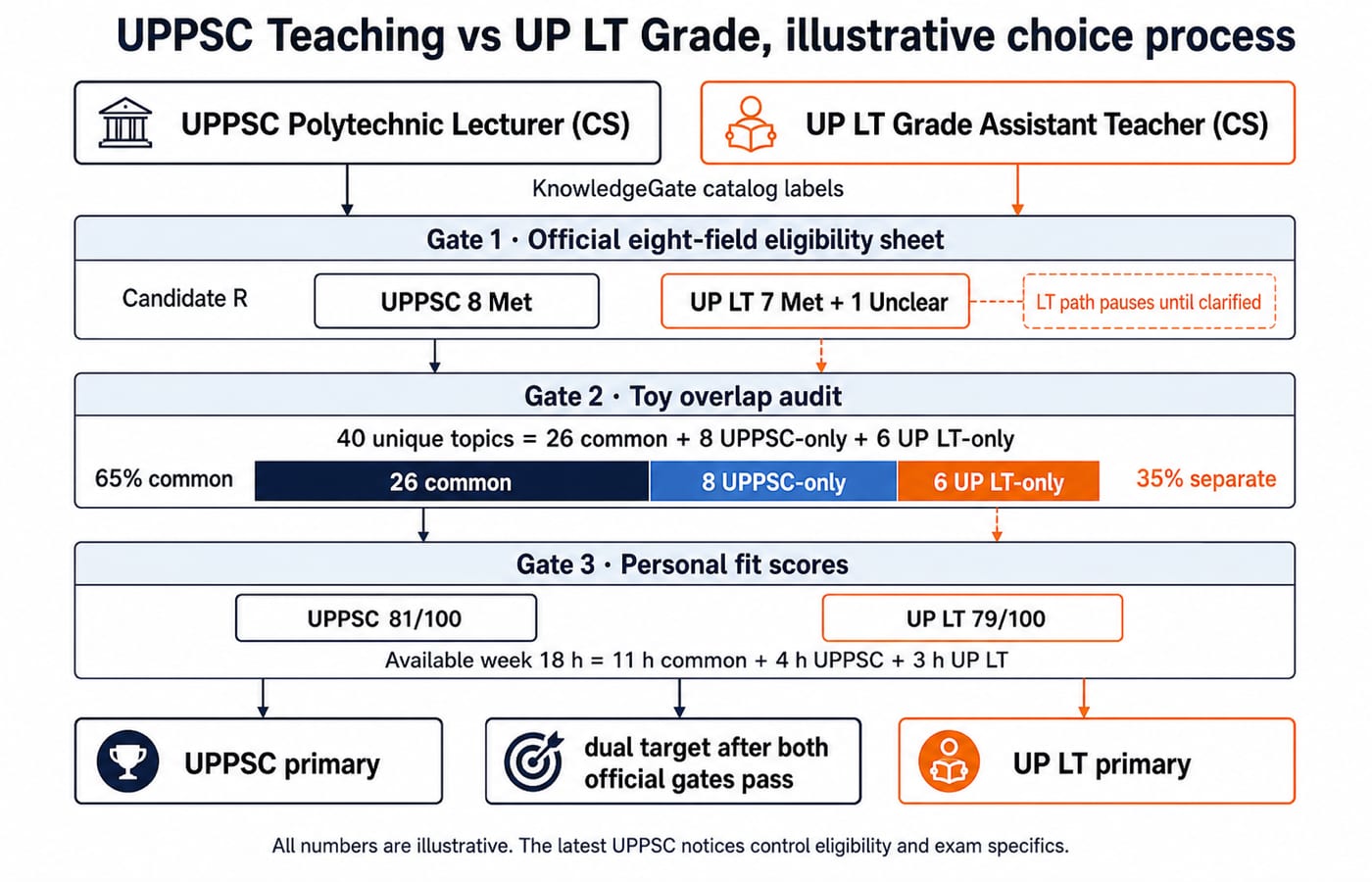
Eligibility closes a route faster than syllabus ever will, so settle it first. Open the official UPPSC gateway and build one eight-field sheet per route:
Exact advertisement number and post name
Subject or discipline
Essential degree
Required class or grade
Subject combination
Professional or teacher-training condition, if stated
Age or relaxation rule
Required certificates
Record the notice page each field came from, and mark the field Met, Not met or Unclear. A single Not met closes that route unless a corrigendum changes it. An Unclear field pauses the route until the notice or an official clarification settles it.
Identify each route by its advertisement rather than its popular name. The 2025 lecturer cycle ran as advertisement A-11/E-1/2025 dated 02.12.2025, U.P. Technical Education (Teaching) Service Examination 2025, post Lecturer, subject Computer. If any of those fields differ on the advertisement you are applying against, rebuild the sheet from that one. Marks, durations, vacancies, fees, age limits and cutoffs come from that route's own latest notice, never from a previous cycle and never from the other route. UPPSC Teaching Eligibility and Selection Structure runs that same check against each advertised post.
3. Choose the teaching level: polytechnic classroom or school classroom
The lecturer post teaches at diploma level in technical institutions. The LT Grade post teaches computer science to school students. That is the one difference between these routes that does not move between recruitment cycles, which is why it deserves the first vote.
The two syllabi say the same thing in subject terms. The lecturer route asks for postgraduate-level breadth, with separate headings for Compiler Design, Distributed System, High Performance Computing, Artificial Intelligence, Soft Computing and Image Processing. The LT route's map stays closer to applied teaching material: digital logic and circuits, problem solving through C, object oriented techniques with Java, system analysis and design, and web design, beside the core subjects both routes share.
Ask yourself:
Do I want a polytechnic lecture room or a school classroom, ten years from now?
Am I willing to keep six advanced subjects live for years, or do I want a syllabus I can hold in one pass?
Would I still choose this post if the other exam looked easier this year?
If the first answer is unclear, a timetable should not decide it for you.
4. Syllabus portability: twelve of nineteen lecturer headings have an LT counterpart
Run the comparison at topic level, not on the label Computer Science. Set our two course maps against each other and twelve headings appear on both sides: Computer Organization and Architecture, Discrete Structures and Theory of Logic, Data Structures, Design and Analysis of Algorithms, Database Management Systems, Computer Networks, Cyber Security, Principles of Programming Languages, Operating Systems, Software Engineering, Web Technologies and Computer Graphics. That is twelve of the lecturer route's nineteen technical headings, and twelve of the LT route's thirteen computer science modules.
Lecturer-only, with no LT counterpart: Compiler Design, Distributed System, High Performance Computing, Artificial Intelligence, Soft Computing, Image Processing and Software Project Management. LT-only: System Analysis and Design. On top of those seven, the lecturer route carries General Hindi and General Studies, which LT Grade computer science preparation does not touch at all.
Headings are revised between recruitment cycles, so rebuild that split from the two current official syllabi before you plan around it. UPPSC Polytechnic Lecturer CS Syllabus: Complete Topic Map does the lecturer side heading by heading. Then rate each shared heading honestly: 0 for not started, 1 for recognised, 2 for able to solve standard questions, 3 for mock-ready. A shared heading is portable only at 2 or above from both papers' angles, because the lecturer paper asks the same subject at greater depth than the school-level paper does.
5. Price the dual target in hours, not rupees
Dual targeting is paid in weekly hours, so write the number down before committing to it. Take a candidate with eighteen sustainable study hours a week: eleven go to the twelve shared headings, four to the lecturer-only side, three to the LT-only side. Those figures are an illustration rather than a prescription, but they show exactly where the bill lands. Four hours a week is thin cover for seven advanced headings plus General Hindi and General Studies, so on that split the lecturer route is a second priority, not a genuine joint target.
Do the same division on the hours you actually have, then look at what the smaller share is being asked to carry. When a planned block disappears, spread the recovery across the rest of the week and drop one low-priority practice set, rather than building a single long make-up day.
6. Score the fit, then challenge a close result
If both routes clear the current eligibility gate and the choice still feels close, score them rather than argue with yourself. Mark each route out of ten on five factors, then weight the marks: teaching-level fit 30, eligibility certainty 20, syllabus readiness 20, weekly schedule fit 20 and available resources 10. Teaching-level fit takes the largest weight because it is the only one of the five that does not move between recruitment cycles.
Factor and weight | Lecturer route | LT Grade route |
|---|---|---|
Teaching-level fit (30) | 8 of 10, so 24 | 7 of 10, so 21 |
Eligibility certainty (20) | 10 of 10, so 20 | 6 of 10, so 12 |
Syllabus readiness (20) | 8 of 10, so 16 | 9 of 10, so 18 |
Weekly schedule fit (20) | 6 of 10, so 12 | 9 of 10, so 18 |
Available resources (10) | 9 of 10, so 9 | 10 of 10, so 10 |
Weighted total out of 100 | 81 | 79 |
Those marks belong to one illustrative candidate: every field on the lecturer advertisement Met but one LT field still Unclear, most shared headings already at 2 or 3, and only four of eighteen weekly hours free for the lecturer-only side. Put your own marks in the two columns. What will not change is how to read a result like 81 against 79: two marks apart on a hundred-point sheet is not a separation. It means the sheet has decided nothing, and something else has to.
So test the close call in practice. Give one week of route-specific study to each exam, the lecturer-only headings for one and System Analysis and Design plus the school-level angle on shared topics for the other, then compare how much you could correct unaided at the end of each week.
7. UPPSC Teaching or UP LT Grade: the short version and next action
A failed eligibility gate stops a route outright. If both gates pass, preferred teaching level leads, because it is the difference that survives every cycle. Twelve shared headings make a dual target thinkable, and the seven lecturer-only headings plus two general papers decide whether it is affordable inside your week.
Before any course purchase or long timetable, spend half an hour on the basics: save both current notices, fill in the eight eligibility fields for each route, and mark your twelve shared headings 0 to 3.
Once the route is settled, the linked lecturer course covers both Computer papers along with General Hindi and General Studies, and the linked LT course covers the thirteen computer science modules with previous year questions, topic tests and mocks. Still weighing other state and central teaching exams? Govt Teaching Jobs lists the rest.
Keep learning
UPPSC Computer Science Problem Types: Solve Algorithms, DBMS and OS
Use one four-process dataset to practise insertion-sort traces, candidate-key and 3NF reasoning, and non-preemptive SJF calculations with reliable checks.
Updated 4 Aug 20266 min readUPPSC Teaching
UPPSC Teaching Eligibility and Selection Structure: Verify the Right Post Before Applying
A practical worksheet-based method to check the exact UPPSC post, qualification route, equivalence evidence and notified selection sequence before applying.
Updated 2 Aug 20266 min read61 viewsUPPSC Teaching
UPPSC Teaching PYQ Analysis: Build an Error-Led Revision Plan
Learn a repeatable way to verify teaching PYQs, separate topic from reasoning demand, diagnose errors and convert the evidence into next week's study calendar.
Updated 30 Jul 20266 min readUPPSC Teaching
UPPSC Polytechnic Lecturer CS Syllabus: Complete Topic Map
Build a bounded UPPSC Polytechnic Lecturer Computer syllabus tracker from official headings, then turn diagnostic scores and prerequisites into a weekly plan.
Updated 28 Jul 20265 min read800 viewsUPPSC Teaching