UPPSC Teaching PYQ Analysis: Build an Error-Led Revision Plan
Learn a repeatable way to verify teaching PYQs, separate topic from reasoning demand, diagnose errors and convert the evidence into next week's study calendar.
KnowledgeGate Team
Exam prep & CS education
Updated 30 Jul 20266 min read
Solving many previous questions can still leave mock scores unstable when every miss is recorded only as “wrong”. Tagging each verified question by syllabus block, reasoning demand and personal error turns that pile of misses into next week's revision queue. The worked example runs on one 40-item batch, 26 correct, 10 wrong and 4 unattempted, and ends in ten booked repair hours.
1. Start with verified papers and the current official scope
Save the current syllabus or notice from the UPPSC website, then copy its subject headings into your tracker. Computer Science runs across Paper 1 and Paper 2 for this post, and the previous-year stock is short: 2018 and 2022 are the two papers our UPPSC Polytechnic Lecturer CS test series carries. Record the paper as well as the year, because Paper 1 and Paper 2 items averaged together hide where the loss sits. Label each source as official PDF, official answer-key set or third-party reconstruction. Use reconstructions for practice, but do not label them official PYQs. Take changing instructions only from UPPSC.
Use these ledger columns: source URL or file, printed year/session, paper, item number, syllabus block, subtopic, reasoning demand, chosen answer, correct answer, result, confidence 1-3, time, personal error, repair action and retest day. Once those headings are in, match them against the courses in the Govt Teaching Jobs category to see which blocks already have a taught module behind them.
2. Tag topic and reasoning demand on separate axes
Give every item one primary demand label based on the work actually required:
recallretrieves a fact or definition;applyuses a rule;trace/calculatefollows state or computes;compare/eliminatedistinguishes close options.
Do not change the label because the question felt easy. A small traceable set repays deeper review than a large uncertain collection, because you can only tag what you can source.
Learner-made syllabus block | Recall | Apply | Trace/calculate | Compare/eliminate | Total |
|---|---|---|---|---|---|
DBMS | 3 | 3 | 3 | 1 | 10 |
Operating Systems | 2 | 2 | 4 | 1 | 9 |
Computer Networks | 2 | 3 | 2 | 1 | 8 |
Programming and Data Structures | 1 | 3 | 3 | 1 | 8 |
Software Engineering and Web | 3 | 1 | 0 | 1 | 5 |
Total | 11 | 12 | 12 | 5 | 40 |
Those counts describe the batch you picked, so they map your own coverage. Topic frequency for the exam is not derivable from 40 self-chosen items.
3. Record accuracy and personal error as different evidence
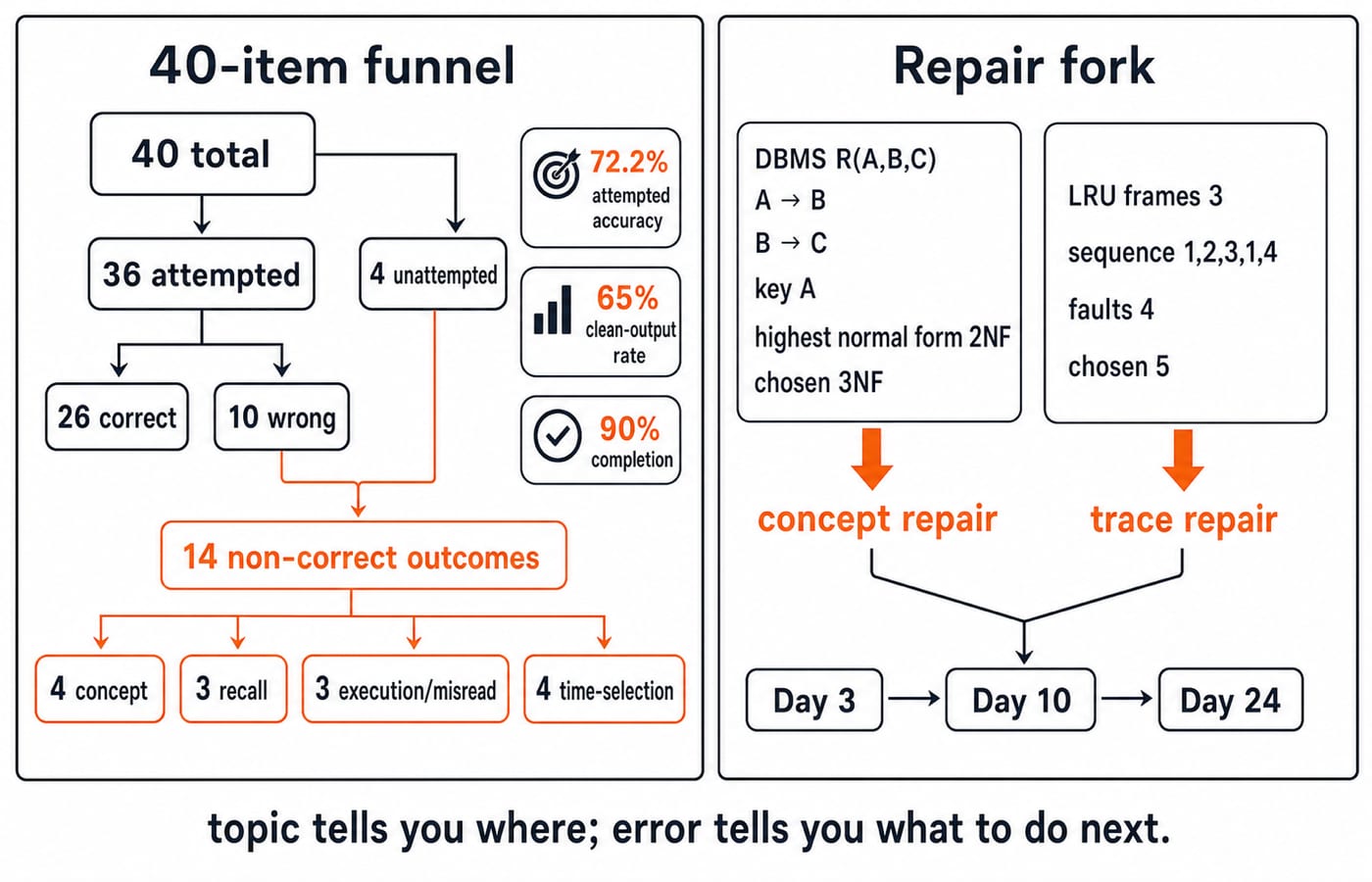
Suppose 40 items produce 26 correct, 10 wrong, 4 unattempted. Attempts are 26 + 10 = 36. Accuracy is 26 / 36 x 100 = 72.2%, clean output is 26 / 40 x 100 = 65%, and completion is 36 / 40 x 100 = 90%. Accuracy reports quality on what you attempted, clean output reports the share of the whole batch you banked, and completion reports how much of it you engaged with at all.
Classify all 14 non-correct outcomes: 4 concept gaps, 3 recall failures, 3 execution or misread errors, 4 time-selection failures. Relearn and explain concept gaps. Use retrieval for recall, redo the procedure for execution, and practise attempt choices for time selection.
Also flag 5 correct but confidence 1 items. Each needs a closed-book check so fragile correctness is not mistaken for mastery.
4. Work two questions from answer to diagnosis
Consider a learner-created DBMS example. For R(A,B,C) with A -> B and B -> C, A is the only candidate key. Its single attribute prevents partial dependency, so the relation reaches 2NF. But B -> C prevents 3NF because B is not a superkey and C is non-prime. Tag a 3NF choice DBMS > normalisation, demand apply, error concept gap. Reconstruct the definition and solve two changed-FD examples before retest.
Now take three empty LRU frames and reference string 1, 2, 3, 1, 4. The first three references fault, the second 1 hits, and 4 replaces 2: 4 faults, not 5. Counting the hit as a fault is an execution error. Trace the frames, then try 2, 1, 2, 3, 4, also with 4 faults.
5. Turn the error matrix into a 10-hour weekly queue
Split the 14 outcomes by block: DBMS has 2 concept + 1 recall = 3; Operating Systems has 1 concept + 1 recall + 2 execution/misread = 4; Networks has 1 recall + 1 execution/misread + 1 time = 3; Programming and Data Structures has 1 concept + 2 time = 3; Software Engineering and Web has 1 time = 1.
Weight concept 3, recall 2, and execution/misread or time 1. The scores become DBMS 2(3) + 1(2) = 8, OS 1(3) + 1(2) + 2(1) = 7, Programming 1(3) + 2(1) = 5, Networks 1(2) + 1(1) + 1(1) = 4, and Software Engineering and Web 1(1) = 1.
Book 2.5 hours DBMS + 2 hours OS + 1.5 hours programming + 1 hour networks + 1 hour mixed retest + 1 hour tagging the next verified batch + 1 hour buffer = 10 hours. The ranking follows your own error cost, so a heavily examined block can sit low in a week where you are not getting it wrong. Subject-level priority is the other calculation, worked from syllabus evidence in UPPSC Teaching Subject Weightage: Build a Revision Plan from Syllabus and PYQs, and these ten repair hours sit inside that week. For the concept-gap hours, the UPPSC Polytechnic Lecturer 2025 CS course covers both papers of the Computer Science syllabus in taught order.
6. Schedule retests, and let a missed day reduce volume
Use this closed-book sequence: Day 0 correction, Day 3 changed-value retest, Day 10 mixed retest, Day 24 final check. The retest set is the 14 diagnosed outcomes, with the 5 fragile-correct items checked closed-book on Day 0. If 10 of the 14 pass on Day 3, the rate is 10 / 14 x 100 = 71.4%, and the 4 failures go back for repair and a Day 6 retest. If 12 of the original 14 pass on Day 10, the rate is 12 / 14 x 100 = 85.7%. Return the other 2 to repair work.
If a two-hour OS block is lost, cover it with the buffer hour and that week's new-PYQ-tagging hour, which replace exactly the two hours gone. Preserve due retests and repairs instead of building a 12-hour punishment week. After two missed days, carry only the highest-priority repair forward and shrink the new batch.
7. Compare like-for-like batches before adding timed mocks
Require three 40-item batches with the same block mix before reading a trend.
Batch | Correct | Wrong | Unattempted | Attempted accuracy | Clean output | Concept errors |
|---|---|---|---|---|---|---|
Week 1 | 26 | 10 | 4 | 26 / 36 = 72.2% | 26 / 40 = 65% | 4 |
Week 2 | 29 | 8 | 3 | 29 / 37 = 78.4% | 29 / 40 = 72.5% | 2 |
Week 3 | 31 | 6 | 3 | 31 / 37 = 83.8% | 31 / 40 = 77.5% | 1 |
A different topic mix or easier source breaks the comparison. Add timed mixed practice after two comparable batches reach at least 80% attempted accuracy with no more than 2 concept errors. Only Week 3 clears that bar here: Week 1 misses on both counts, and Week 2 is held back by 78.4% accuracy alone. Use Teaching Exam Mock Strategy: Cadence and Review Plan for the review loop and the UPPSC Polytechnic Lecturer CS Test Series for timed sets, including its 2018 and 2022 previous-year papers.
8. The method in one weekly decision
Verify provenance and scope, tag topic and demand separately, calculate accuracy and clean output, diagnose non-correct outcomes, rank repairs, then retest on Days 3, 10 and 24. Analysis is complete only when it changes the calendar.
Create the ledger for your first 40 verified items before solving another batch. Fill the topic-by-demand table. On Sunday, use the weighted error matrix to book 10 hours, keeping the buffer visible.
Keep learning

UPPSC Teaching vs UP LT Grade: Choose by Role, Eligibility and Syllabus
Choose between the Polytechnic Lecturer and LT Grade routes by checking the current notice first, then testing role fit, syllabus overlap and available hours.
Updated 7 Aug 20267 min readUPPSC Teaching
UPPSC Computer Science Problem Types: Solve Algorithms, DBMS and OS
Use one four-process dataset to practise insertion-sort traces, candidate-key and 3NF reasoning, and non-preemptive SJF calculations with reliable checks.
Updated 4 Aug 20266 min readUPPSC Teaching

UPPSC Teaching Eligibility and Selection Structure: Verify the Right Post Before Applying
A practical worksheet-based method to check the exact UPPSC post, qualification route, equivalence evidence and notified selection sequence before applying.
Updated 2 Aug 20266 min read61 viewsUPPSC Teaching
UPPSC Polytechnic Lecturer CS Syllabus: Complete Topic Map
Build a bounded UPPSC Polytechnic Lecturer Computer syllabus tracker from official headings, then turn diagnostic scores and prerequisites into a weekly plan.
Updated 28 Jul 20265 min read800 viewsUPPSC Teaching