

Understanding Diverse Learners for Teaching Exams: Concepts, Caselets and a Six-Learner Classroom Plan
Learn a four-filter method for diverse-learner caselets, then follow a complete Class VI fraction lesson from diagnostic evidence to reassessment.
KnowledgeGate Team
Exam prep & CS education
Updated 31 Oct 20265 min read
Teaching-exam caselets often make identical treatment look fair. Sound teaching keeps a meaningful learning goal common while changing access, scaffolding, pace or response mode to match evidence. The decisive question is not whether learners receive the same support, but whether each support addresses an observed barrier without fixing a label.
Understanding diverse learners: evidence guides the response
Learner diversity includes variation in prior knowledge, language and culture, interests, motivation, pace, self-regulation, sensory or motor access, disability, neurodivergence, giftedness and opportunity to learn. These dimensions interact, and one learner can show strength and need in the same task.
Describe performance before interpreting it. “Bilal represented the sum correctly but paused while explaining it in English” is usable evidence. “Bilal is weak” turns one response into a fixed judgement. One score, accent, diagnosis or behaviour cannot describe a whole learner.
The earlier Individual Differences for Teaching Exams article owns the foundations, sources of variation and a one-learner evidence check. This lesson moves from those foundations to class-wide differentiation, temporary grouping and reassessment. The CTET and UPTET Teaching Eligibility Test Prep category provides the broader exam-preparation route.
Equality, equity and inclusion: separate the purpose of each response
Equality gives all learners the same task and resources. Equity adds support that removes a specific barrier. Inclusion keeps learners participating in the common classroom and working towards a shared meaningful goal. Differentiation varies route, practice, challenge or expression from current evidence.
An accommodation changes access or response mode while preserving the target. Large-print fraction strips, an oral explanation or a numbered task card can all preserve the objective “represent and explain 1/2 + 1/3”. Replacing that objective with “identify 1/2” changes the expected learning, so it is a modification.
The earlier Inclusive Education Notes for Teaching Exams article owns the exclusion-to-inclusion continuum, barrier analysis and accommodation-versus-modification treatment. Here, those principles are used to plan one differentiated lesson and to decide when a temporary support should change.
Diverse-learner diagnosis: read six profiles before grouping
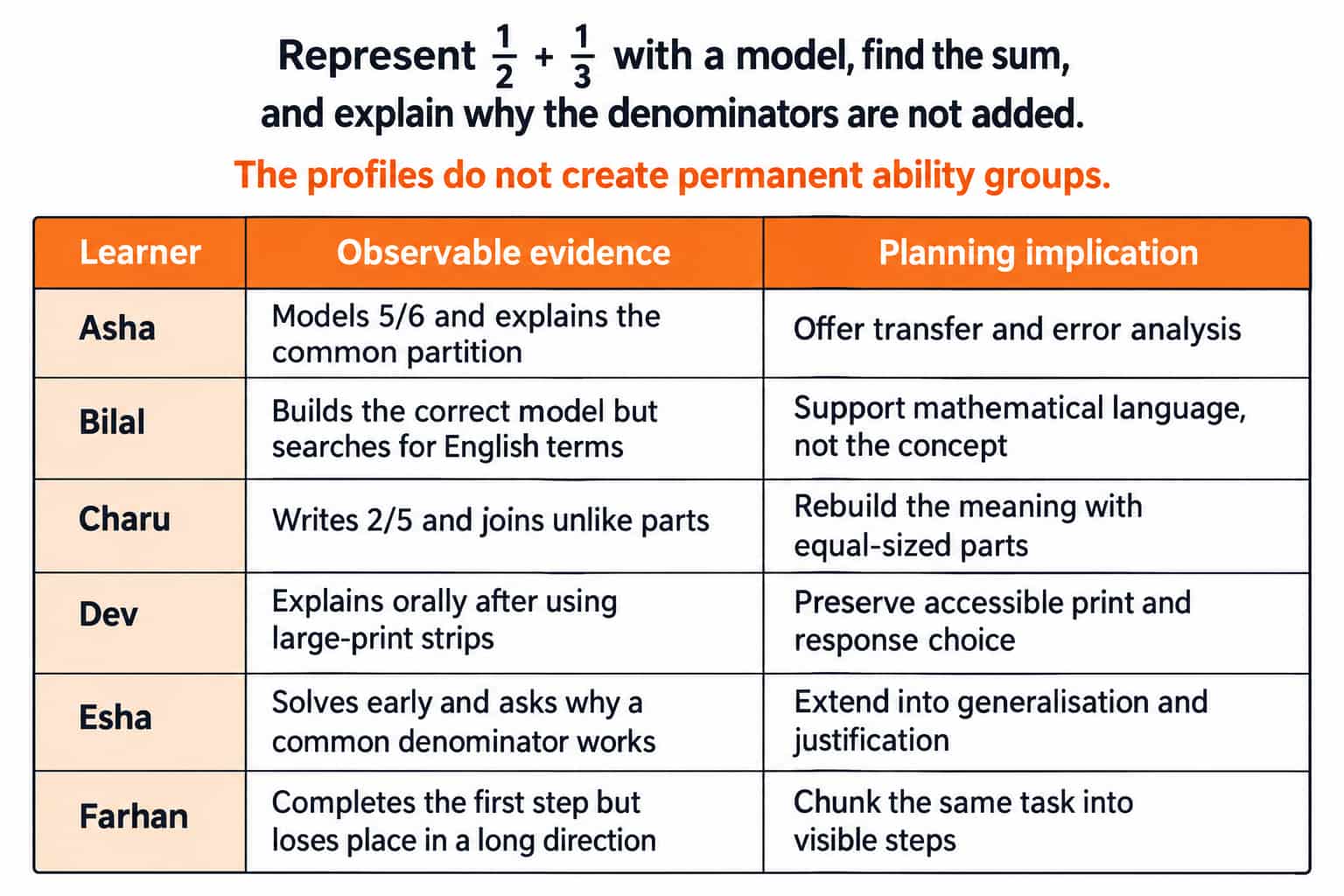
A Class VI fraction lesson has one objective: “Represent 1/2 + 1/3 with a model, find the sum, and explain why the denominators are not added.” A short independent probe produces six different kinds of evidence:
Learner | Observable evidence | Planning implication |
|---|---|---|
Asha | Models 5/6 and explains the common partition | Offer transfer and error analysis |
Bilal | Builds the correct model but searches for English terms | Support mathematical language, not the concept |
Charu | Writes 2/5 and joins unlike parts | Rebuild the meaning with equal-sized parts |
Dev | Explains orally after using large-print strips | Preserve accessible print and response choice |
Esha | Solves early and asks why a common denominator works | Extend into generalisation and justification |
Farhan | Completes the first step but loses place in a long direction | Chunk the same task into visible steps |
The profiles do not create permanent ability groups. Charu needs concept reconstruction for this objective; Bilal needs language access; Dev needs an accessible format; Farhan needs task organisation; Asha and Esha need greater depth. A different topic can produce a different grouping.
Differentiated instruction: work the fraction lesson from diagnosis to reassessment
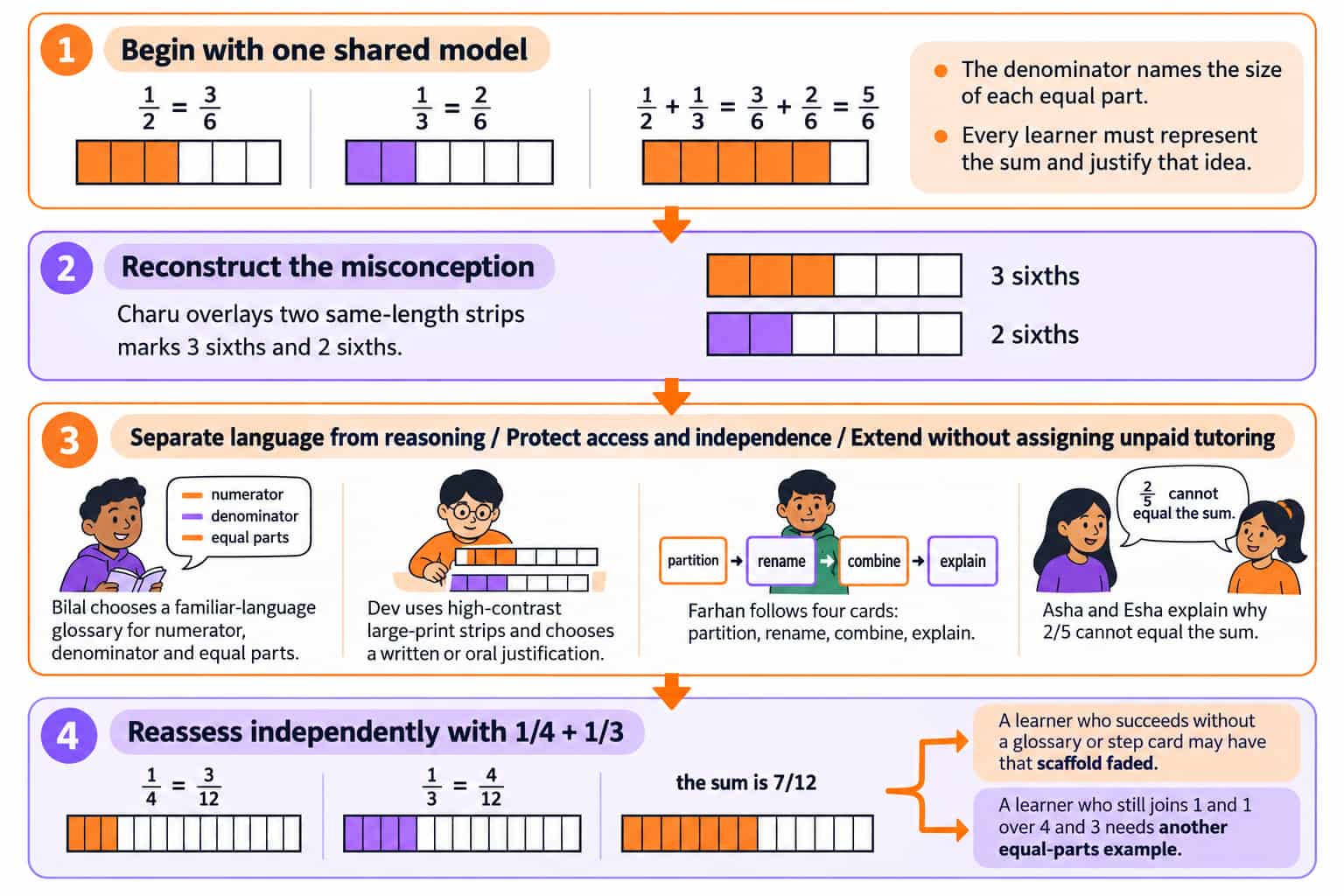
Begin with one shared model. Divide equal strips into sixths: 1/2 = 3/6 and 1/3 = 2/6, so 1/2 + 1/3 = 3/6 + 2/6 = 5/6. The denominator names the size of each equal part; adding two collections of sixths does not create fifths. Every learner must represent the sum and justify that idea.
Reconstruct the misconception. Charu overlays two same-length strips, marks 3 sixths and 2 sixths, then explains why both addends need one common part size.
Separate language from reasoning. Bilal chooses a familiar-language glossary for numerator, denominator and equal parts, then gives the final explanation with the mathematical symbols visible.
Protect access and independence. Dev uses high-contrast large-print strips and chooses a written or oral justification. Farhan follows four cards: partition, rename, combine, explain.
Extend without assigning unpaid tutoring. Asha and Esha explain why 2/5 cannot equal the sum, then compare the strip method with an equivalent-fractions method.
Reassess independently with 1/4 + 1/3. The common partition is twelfths: 1/4 = 3/12 and 1/3 = 4/12, so the sum is 7/12. A learner who succeeds without a glossary or step card may have that scaffold faded. A learner who still joins 1 and 1 over 4 and 3 needs another equal-parts example, not a permanent low label. Reassessment changes the next response; it does not prove that one brief lesson caused every improvement.
Inclusive teaching strategies: vary route, support and expression
Use four levers, each tied to evidence and reviewed after a fresh attempt:
Lever | What may vary | What stays common |
|---|---|---|
Representation | Spoken explanation, symbols, strip or diagram | The fraction relationship |
Process | Prompting, chunking, guided practice or grouping | The reasoning demand |
Expression | Written, oral or model-based justification | The evidence criteria |
Challenge | Practice, transfer, error analysis or generalisation | Participation and dignity |
Fade a scaffold deliberately. A four-card sequence can become a two-word prompt, then an independent attempt. Multiple representations improve access and conceptual connections; they do not prove that a learner has one fixed “learning style”. Flexible grouping follows the task and the newest evidence.
Diverse-learner misconceptions: reject labels, segregation and lowered goals
Tempting claim | What goes wrong | Better response |
|---|---|---|
Identical work is always fair | Sameness can preserve an access barrier | Keep the goal and vary justified access |
One poor answer proves low ability | One sample becomes a total judgement | Collect another form of evidence and reassess |
A language gap is a concept gap | Expression is mistaken for understanding | Support language and check the concept separately |
A diagnosis dictates one strategy | The learner and current task disappear | Ask what access helps and review its effect |
Fast learners need more of the same | Volume replaces depth | Use transfer, critique and generalisation |
Flexible grouping means fixed levels | A temporary response hardens into identity | Regroup when the topic or evidence changes |
Formal assessment and specialised support belong with qualified processes. A classroom teacher observes tasks, responses and useful supports, preserves confidentiality, and collaborates without diagnosing from a single caselet clue.
Understanding diverse learners in exam caselets: apply four filters
Evidence: What did the teacher actually observe?
Goal: Does the response preserve a meaningful objective?
Fit: Does the support address the observed barrier?
Flexibility: Will fresh evidence change the scaffold or group?
Suppose a teacher sees the six fraction responses above. The strongest option keeps the addition objective, provides equal-parts modelling, language access, readable materials, visible steps and extension as needed, then gives everyone a new independent item. Permanent low grouping fails flexibility. Repeating one explanation to all ignores different evidence. Lowering the objective for selected learners fails the goal filter.
For CTET syllabus and notification details, use the official CBSE CTET website rather than remembered pattern claims. A structured school-teaching route is available through the CTET Paper 1 Course 2026.
Understanding diverse learners: the short version and next step
Describe evidence without fixing identity.
Keep a meaningful learning goal common.
Match access, scaffold, practice and challenge to the barrier.
Reassess independently and change the response when evidence changes.
School TET learners can continue with the CTET route above. For NET teaching aptitude, use the NTA UGC NET Paper 1 Course. In either route, practise by naming the evidence, unchanged goal, targeted support and reassessment in each caselet.
Go deeper with the full courseCTET Paper 1 2026 — प्राथमिक शिक्षक (कक्षा 1–5)
Keep learning

Curriculum and School Environment for Teaching Exams: Concepts, Caselets and Worked Examples
Learn to separate curriculum from syllabus, diagnose school conditions, audit alignment with numbers, and solve teaching-exam caselets logically.
Updated 26 Oct 20266 min readCTET & UPTET
Learners and Learning Process for Teaching Exams: Concepts, Examples and Traps
Learn how learner characteristics, theories, motivation, feedback and transfer fit together, then apply the model to classroom scenarios and original practice items.
Updated 26 Aug 20265 min readCTET & UPTET
Principles of English Language Teaching: CTET Notes with Classroom Examples
Turn language-teaching principles into classroom decisions. Follow a library timetable lesson, understand purposeful error correction, and practise matching an activity to its learning objective.
Updated 18 Nov 20265 min readCTET & UPTET
Inclusive Education and Special Needs for Teaching Exams: Concepts, Classroom Cases and MCQ Traps
Learn to separate inclusion from integration and accommodation from modification. Then apply a barrier-to-support method to classroom scenarios and MCQs.
Updated 8 Nov 20266 min readCTET & UPTET