GATE Verbal Aptitude and Logical Reasoning: Question Types with Solved Examples
Learn to identify recurring GATE aptitude question types, apply a fixed method to each, and check the answer through four worked examples.
KnowledgeGate Team
Exam prep & CS education
Updated 30 Jul 20266 min read
General Aptitude is easy to postpone when technical subjects are waiting. The real problem is usually not difficulty but unfamiliarity: a para-jumble or syllogism looks slow until you recognise its template. Learn to name the question type first, then apply its fixed method instead of improvising under pressure.
GATE aptitude repeats a small set of question types
General Aptitude is common to every GATE paper, so the same preparation counts whichever subject paper you sit. Verbal aptitude questions repeatedly use analogy, vocabulary, sentence completion, grammar, sentence rearrangement and reading inference. Logical reasoning repeatedly uses number and letter series, syllogisms, directions, seating arrangements and statement-conclusion problems.
That finite set is useful. You do not need a fresh technique for every question. You need a small collection of reliable moves:
State the relationship in an analogy.
Find mandatory links in a para-jumble.
Test differences before ratios in a series.
Ask whether a syllogism conclusion is forced, not merely possible.
This is also why aptitude practice should be mixed. Solving twenty questions of one type builds a method, but a mixed set trains the first and most important decision: identifying the type quickly.
Verbal analogy: state the relationship, then keep its direction
Consider this analogy:
Cobbler : Leather :: Carpenter : ?
Options: (a) Wood (b) Tools (c) Chair (d) Nails
Do not scan the options first. Put the given relationship into a sentence: a cobbler is a worker who works on a material, and that material is leather. Apply the same sentence to carpenter. A carpenter works on wood, so the answer is (a) Wood.
Why not Tools? Tools are instruments used by a worker, not the material worked on. Why not Chair? A chair is a possible product, the output rather than the input. Why not Nails? Nails are fittings a carpenter joins wood with, not the material the trade shapes. All three sit near carpentry, and none of them preserves the exact relationship.
Direction matters just as much as relation. “Doctor : Hospital” runs from worker to workplace. “School : Teacher” runs from workplace to worker, so it reverses the direction even though the words belong together. Read the given pair from left to right before judging any option.
Sentence rearrangement: find the mandatory pair first
A para-jumble becomes easier when you stop trying every complete order. First find an independent opening sentence. Then connect pronouns and linking words to the sentence they depend on.
Take these four sentences:
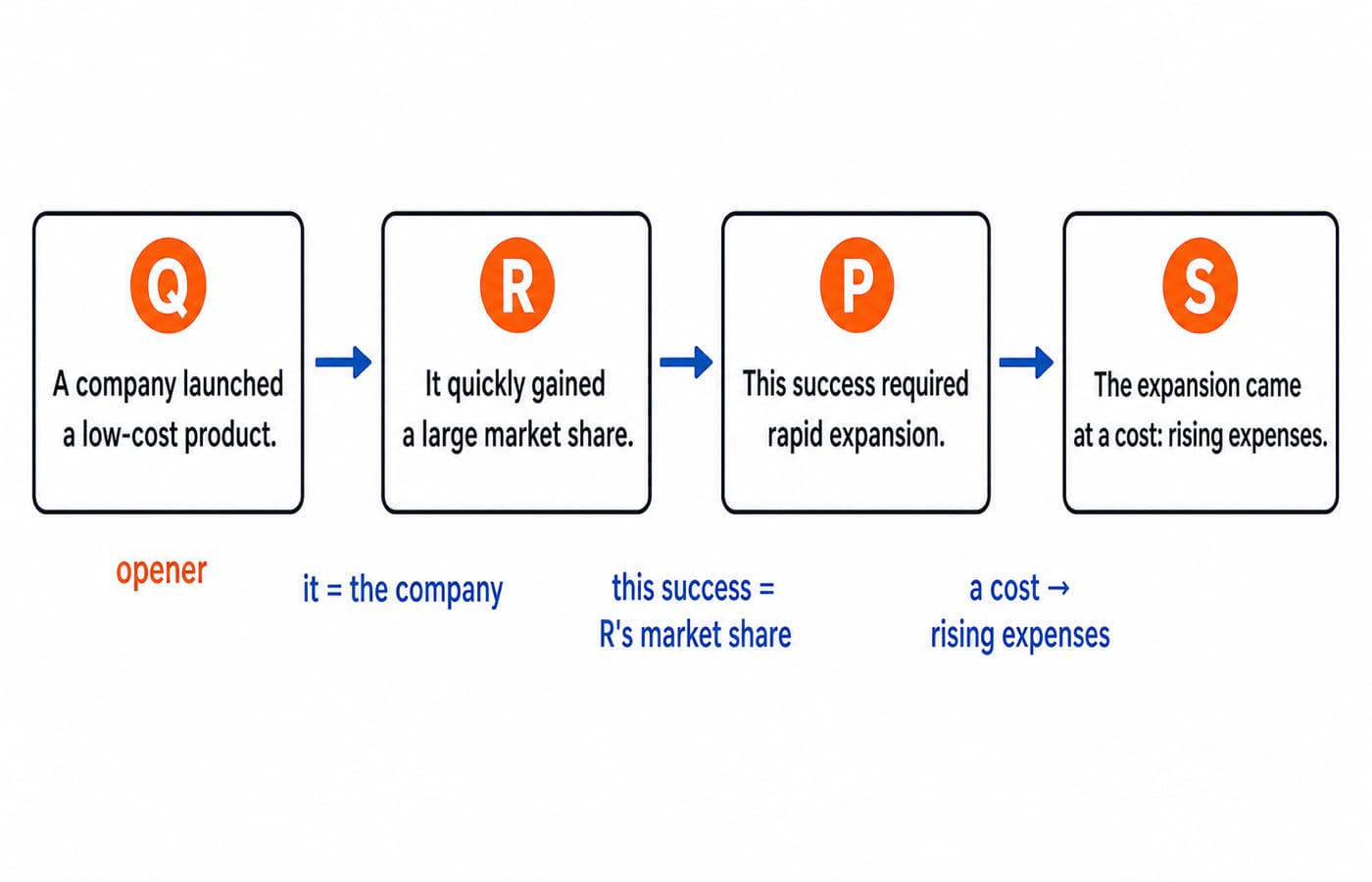
P: However, this success came at a cost.
Q: The company launched its new product in 2019.
R: Within months, it captured a large market share.
S: Rising production expenses eroded its profits.
Q is the only clean opener because it introduces the company and product. R must follow: “it” refers to the company, and the captured market share is the success. P must follow R because “this success” needs that market-share result. S then explains the cost mentioned in P.
The order is Q, R, P, S. Notice that we did not compare all 24 possible arrangements. We built three mandatory links.
Words such as “however”, “therefore”, “this” and “such” rarely open a paragraph because they point backward. Treat them as connection clues.
Number and letter series: test pattern families in order
For a number series, check successive differences first, then ratios, then squares, cubes or alternating sub-series. This order prevents random pattern hunting.
Find the next term:
2, 6, 12, 20, 30, ?
The successive differences are:
6 - 2 = 4
12 - 6 = 6
20 - 12 = 8
30 - 20 = 10
The differences rise by 2, so the next difference is 12. Therefore the next term is 30 + 12 = 42.
Now verify rather than stopping at the first fit. The nth term is n(n + 1): 1 x 2 = 2, 2 x 3 = 6, 3 x 4 = 12, 4 x 5 = 20, 5 x 6 = 30 and 6 x 7 = 42. Both methods agree.
If one pattern does not cover every gap, split odd and even positions. For 2, 5, 4, 9, 6, 13, the odd-position terms are 2, 4, 6 while the even-position terms are 5, 9, 13. It is two simple series interleaved.
Letter series behave the same way once you replace each letter with its alphabet position (A = 1 up to Z = 26). In C, F, I, L the positions are 3, 6, 9 and 12, a constant difference of 3, so the next position is 15 and the next letter is O. Write the positions down instead of counting letters on your fingers against the clock.
Syllogisms: test what every valid diagram forces
Suppose the premises are:
All engineers are graduates.
Some graduates are teachers.
Conclusion (a), “Some engineers are teachers”, does not follow. The teachers can overlap the graduate set entirely outside the engineer set. The overlap is possible, but it is not forced.
Conclusion (b), “Some graduates are engineers”, follows under the common aptitude-test convention that the named engineer class is non-empty: every engineer lies inside the graduate set. Under strict predicate logic, a universal statement alone does not prove that any engineer exists, so an exam that uses strict formal semantics must provide existence separately. Read the stated convention when existential conclusions appear.
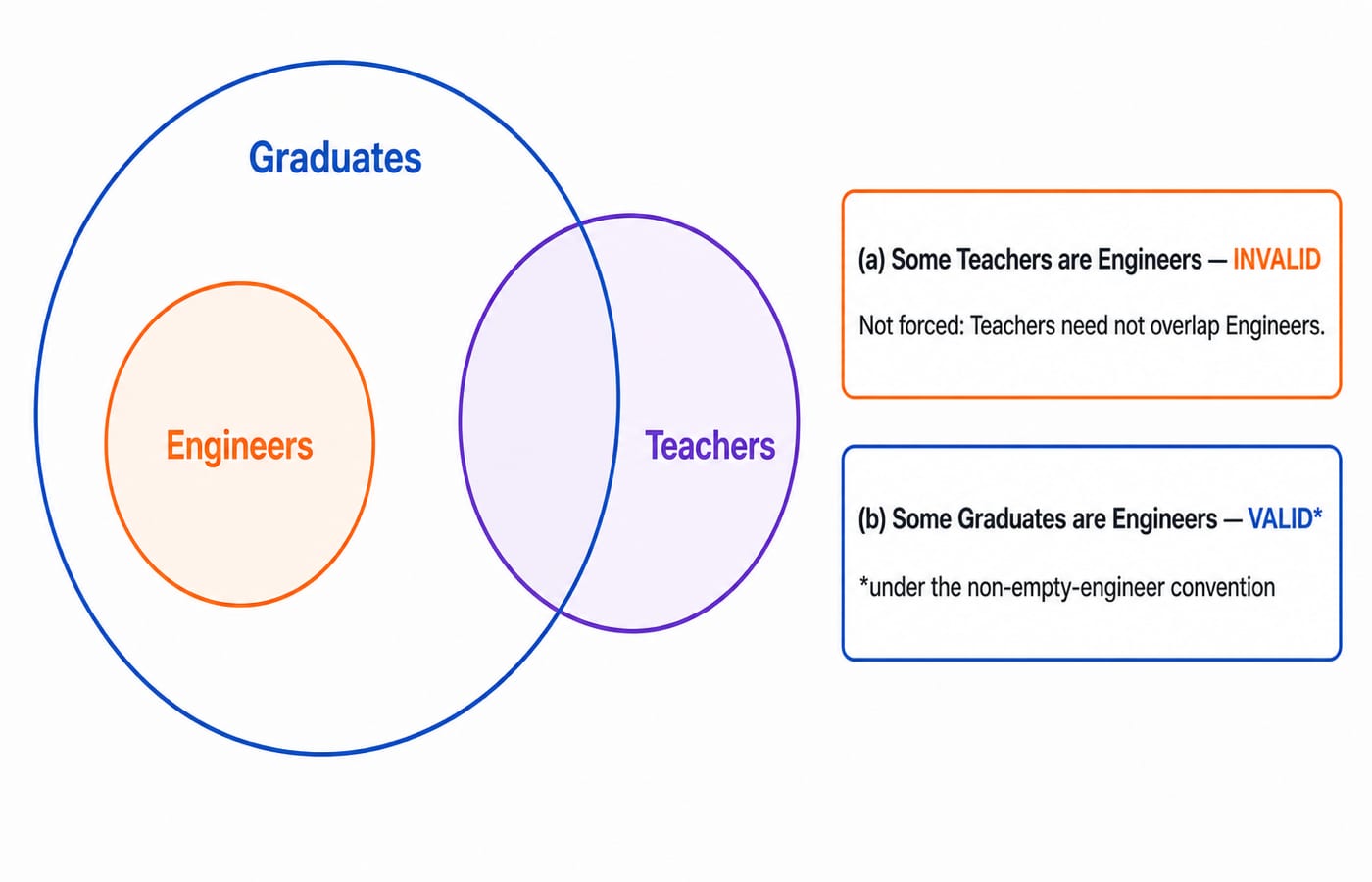
The safe habit is to draw only what the premises require. Do not improve the diagram with a convenient overlap, and do not reject “does not follow” merely because it feels unsatisfying.
Common mistakes in GATE aptitude questions
These are the mistakes that turn a known method into a wrong answer:
Reversing “some” into “all”, or treating a possible syllogism arrangement as necessary.
Accepting a series pattern after two gaps without checking every supplied term.
Letting an intervening phrase control a verb. It is “the box of chocolates was”, because box is the subject.
Choosing a reading-inference option that is true in real life but is neither stated nor implied by the passage.
Solving before identifying the type, which encourages unnecessary calculation.
After a wrong answer, record the failed rule, not just the question. “Missed pronoun link” is a reusable note. “Got question 14 wrong” is not.
How GATE tests verbal aptitude and reasoning
Expect compact analogy, grammar or series items as well as longer reasoning, inference and rearrangement problems. Because General Aptitude shares the paper with your technical subjects, the aim is to finish it quickly and accurately rather than leave it for the last ten minutes. The marks it carries and the number of questions it uses are set by the organising institute, so read them on the official GATE syllabus page.
For broader planning, use GATE CS Subject Weightage: Where Your Study Hours Actually Pay Off to balance aptitude with the technical subjects. For more worked walkthroughs of these templates, browse the Aptitude & Reasoning blog hub.
The short version and the next step
Name the type before solving. Preserve relationship direction in analogies, build para-jumbles from mandatory pairs, test series systematically, and accept a syllogism conclusion only when every valid diagram forces it.
KnowledgeGate's question bank carries over 6,000 logical-reasoning questions and a similar number of verbal-ability questions. Use the Aptitude for GATE course to learn each method in sequence, then return to the GATE preparation category to fit aptitude drills into your full plan. Recognition comes first, but timed mixed practice is what makes that recognition fast.
Keep learning
Mensuration and Geometry for Competitive Exams: Formulas, Shortcuts and Solved Examples
Learn how to choose the right mensuration formula, avoid common geometry traps, and solve 2D path and 3D recasting problems step by step.
Updated 6 Oct 20266 min readAptitude & Reasoning

Age Comparison and Multiple-Condition Problems: 12 Solved MCQs
Practise 12 age-problem MCQs with equations, timelines, back-checks, relation chains, changing ratios, birth years, and family conditions.
1 Oct 20268 min readAptitude & Reasoning
True, False and Cannot Say Questions: 10 Solved Passage MCQs
Learn how to separate contradictions from missing evidence, then apply the method to 10 previous-year passage MCQs with concise, evidence-led solutions.
26 Sep 20268 min readAptitude & Reasoning

TCS Aptitude Questions: High-Yield Quant and Reasoning Topics, Solved Step by Step
Learn the first move for common quant and reasoning question families through solved examples on ratios, work, trains, data, remainders, and seating.
Updated 25 Sep 20266 min read104 viewsAptitude & Reasoning