Scope and Importance of International Business: UGC NET Commerce Examples
Exports, licensing and foreign investment cross borders in different ways. Separate their roles, compare entry modes and work through the opportunity-cost arithmetic behind comparative advantage.
KnowledgeGate Team
Exam prep & CS education
Updated 13 Oct 20266 min read
Exports, foreign investment and licensing all cross borders, but they describe different business activities. Confusing them makes a straightforward Commerce question harder than it needs to be. Separate scope, importance, drivers and entry modes first, then use comparative advantage to understand how trade can expand consumption opportunities even for a country that produces both goods less efficiently.
What international business includes, and how it differs from trade
International business covers business activities spanning national boundaries. International trade, the exchange of goods and services, is part of it. Cross-border investment, licensing and coordinated overseas production extend its scope.
Consider these invented examples:
Activity | Classification |
|---|---|
An Indian textile firm ships 100 shirts overseas | Goods export |
An Indian consultancy remotely delivers a report to a foreign client | Service export |
A firm permits another to use its patented process abroad | Licensing |
A firm owns and operates an overseas production subsidiary | Foreign direct investment |
Scope asks what activities are included. Importance asks why those activities matter. Drivers explain what enables or motivates expansion. Entry modes describe how a firm participates.
One firm can export products, license technology and own overseas operations simultaneously. International business does not require a factory abroad.
Why firms expand internationally: drivers versus benefits
Technological drivers include digital communication and logistics coordination. Policy changes can reduce barriers where applicable, but every border is not becoming more open. Business motives include seeking markets, resources and production efficiencies.
Diversification is a possible benefit. Suppose a firm initially sells 100 units in market A, then changes its sales mix to 60 in A and 40 in B. Assume comparable units and unchanged demand in B when A falls by 20%:
A sales become 60 × 0.80 = 48 units.
Total sales become 48 + 40 = 88 units.
The decline is (100 − 88)/100 × 100 = 12%, versus 20% with all sales in A.
This concerns sales volume, not revenue or profit. Correlated shocks can remove the protection.
Digital transaction systems support overseas orders, as the EDI and e-commerce worked examples illustrate. E-commerce describes electronic transactions; trade describes exchange; globalisation describes wider international integration.
Choosing an entry mode: ownership and control
Ask what crosses the border and who owns the operation.
Mode | What crosses the border | Overseas ownership | Principal trade-off |
|---|---|---|---|
Exporting | Goods or services | No foreign operation required | Home production; delivery challenges |
Licensing | Specified intellectual-property rights | Licensee owns its operation | Low equity commitment; rights protection |
Franchising | Brand and operating format | Franchisee owns its business | Replication; consistency monitoring |
Contract manufacturing | Production specifications and orders | Supplier owns production operation | Capacity access; quality dependence |
Equity joint venture | Capital and agreed contributions | Partners share ownership | Shared resources; shared decisions |
Wholly owned subsidiary | Investment and business capabilities | Parent has full ownership | Ownership control; resource commitment |
A firm wants to retain home production, test overseas demand and avoid equity investment abroad. Exporting fits. A 50:50 equity joint venture entails shared ownership; a 100%-owned subsidiary entails full ownership. Licensing can reduce equity commitment, but granting rights is different from exporting products.
Greenfield investment builds a new operation; acquisition purchases an existing business. These are establishment routes. Control and contractual rights depend on the arrangement, so entry modes have no universal risk ranking.
Comparative advantage: the numerical reason trade can help
Three theory summaries help: Adam Smith's absolute advantage compares productivity; David Ricardo's comparative advantage compares opportunity cost; Heckscher–Ohlin relates trade patterns to relative factor abundance and factor intensity.
Take two hypothetical countries with these unit labour requirements:
Country | Hours per cloth | Hours per wheat |
|---|---|---|
A | 2 | 4 |
B | 6 | 8 |
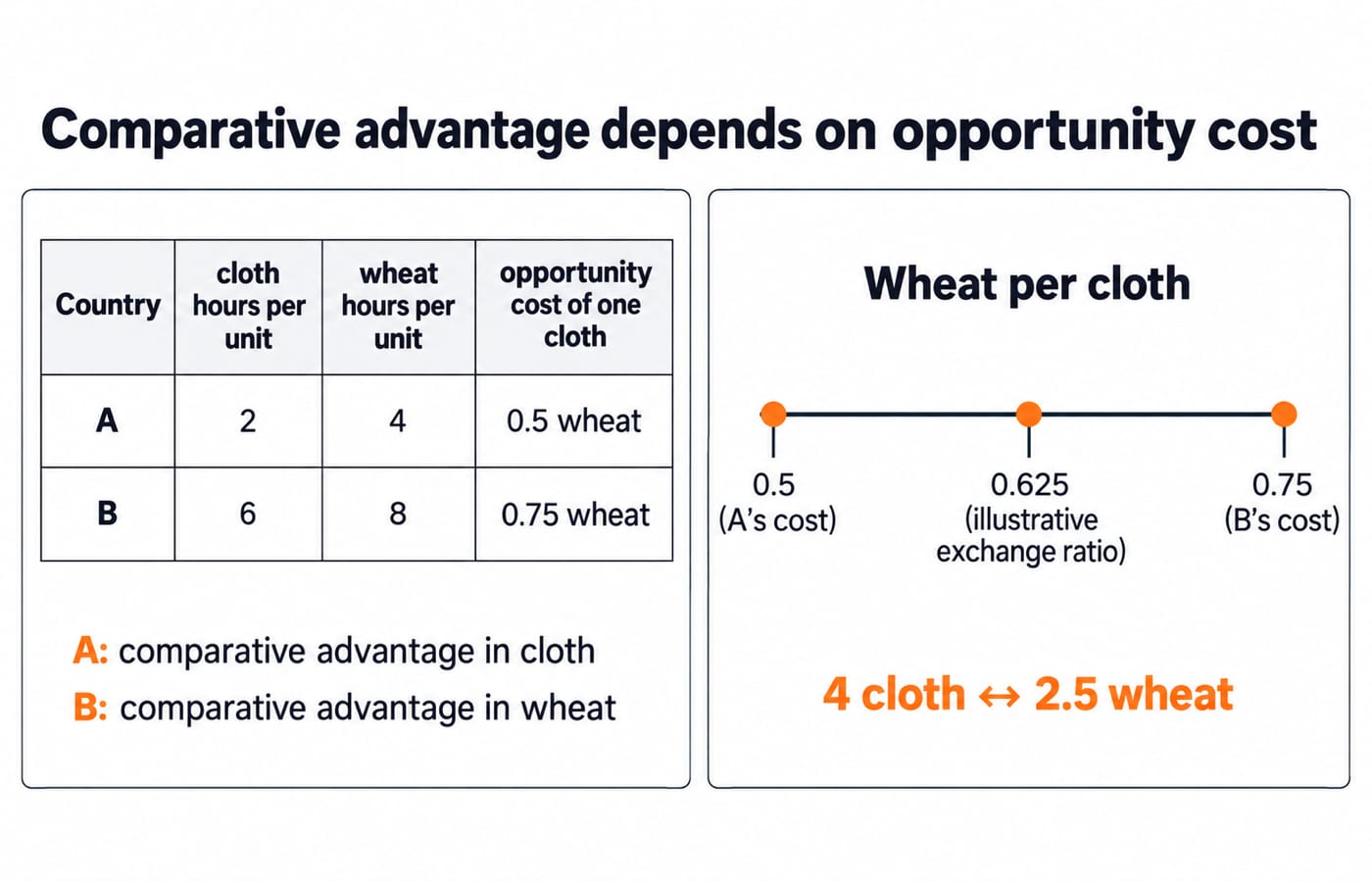
A has absolute advantage in both goods. Opportunity costs give a different comparison:
One cloth costs A 2/4 = 0.5 wheat, and B 6/8 = 0.75 wheat. A has comparative advantage in cloth.
One wheat costs A 4/2 = 2 cloth, and B 8/6 = 4/3 cloth. B has comparative advantage in wheat.
Each country has 24 labour hours. Assume constant unit requirements, divisible goods, and no transport costs or trade barriers.
Before trade, A makes 6 cloth and 3 wheat: 6×2 + 3×4 = 24 hours. B makes 2 cloth and 1.5 wheat: 2×6 + 1.5×8 = 24 hours. World totals are 8 cloth and 4.5 wheat.
With full specialisation, A makes 24/2 = 12 cloth; B makes 24/8 = 3 wheat. Exchange 4 cloth for 2.5 wheat. The ratio, 2.5/4 = 0.625 wheat per cloth, lies strictly between 0.5 and 0.75.
A consumes 8 cloth and 2.5 wheat; B consumes 4 cloth and 0.5 wheat. Producing these bundles domestically would require:
A: 8×2 + 2.5×4 = 26 hours.
B: 4×6 + 0.5×8 = 28 hours.
Both exceed 24 hours, proving expanded consumption opportunities. Both goods have not increased against the initial allocation. Welfare gains depend on preferences; these bundles alone do not prove them. B's absolute disadvantage does not prevent comparative advantage.
Economic importance, with the limitations kept visible
Specialisation and competition can improve efficiency. Export demand can support jobs; investment can add productive capacity and transfer know-how. Imports can widen access to inputs and finished products.
These are channels, not guarantees. Effects differ across industries and workers: domestic employment and welfare need not rise in every sector. Gross exports are not net foreign-exchange gains because imported inputs and outward payments matter. FDI involves a lasting investment relationship and significant influence or control, unlike buying a small portfolio holding.
Four traps to correct:
“International business means only exports.” It also includes imports, investment and contractual arrangements.
“Licensing means owning a foreign subsidiary.” It grants specified rights; equity ownership is a separate matter.
“Absolute disadvantage rules out comparative advantage.” B has lower opportunity cost in wheat despite needing more hours for both goods.
“More foreign sales necessarily reduce risk.” Markets exposed to the same shocks can decline together.
How to practise this UGC NET Commerce topic
UGC's Commerce syllabus places international-business scope, globalisation drivers, entry modes and trade theories in Unit 1. Consult the Commerce download through the official UGC syllabus index. The following are original practice checks, not authenticated previous-year questions or predictions. The Paper 1 versus Paper 2 distinction helps place this topic within subject preparation.
Check 1. Which arrangement grants patented-process rights without equity in the foreign producer?
(a) Exporting
(b) Licensing
(c) Equity joint venture
(d) Wholly owned subsidiary
Answer: (b). Licensing grants rights; it does not itself establish equity ownership.
Check 2. Using A's cloth/wheat hours of 2/4 and B's 6/8, who has comparative advantage in wheat?
(a) A
(b) B
(c) Both equally
(d) Neither
Answer: (b). B sacrifices 8/6 = 4/3 cloth per wheat, less than A's 4/2 = 2 cloth.
Finish with a matching drill: Smith → absolute productivity; Ricardo → relative opportunity cost; Heckscher–Ohlin → relative factor endowments.
Short revision route and the next step
Retrieve four answers: what activities cross borders, why firms expand, which ownership arrangement they choose, and whose opportunity cost is lower. Reproduce the 0.5 and 0.75 wheat costs without notes, then explain licensing versus equity ownership.
For broader preparation, the NET course category currently has offerings oriented towards CS and common Paper 1. The optional shared UGC NET Paper 1 course supports the common paper. It is separate from Commerce Paper 2 coverage and does not provide international-business topic coverage.
Keep learning
FEMA Explained: Objectives, Key Provisions and UGC NET Commerce Examples
Two equal overseas payments can fall into different FEMA categories. Learn to classify transactions, apply an exporter checklist and calculate a penalty ceiling without counting the first day twice.
Updated 9 Oct 20265 min readNET Strategy & Updates
CSIR NET Normalization: Percentile and Normalised Marks Worked Out
Can 120 and 130 raw marks mean the same percentile? Follow a two-shift example from raw marks to percentile and normalised marks, then check which number belongs beside a cutoff.
Updated 5 Oct 20265 min readNET Strategy & Updates

UGC NET Eligibility for CA Holders: Equivalence, Marks and Subject Choice
Completed CA but have no MCom certificate? Understand the equivalence route, check the percentage requirement and resolve marks or subject-entry doubts before applying for NET.
30 Sep 20264 min readNET Strategy & Updates
UGC NET CS Attempt Strategy Without Negative Marking: A Three-Pass Plan
Use a rehearsed 180-minute clock to answer quick recalls first, protect time for technical work, and leave disciplined elimination and guesses until the final pass.
Updated 4 Sep 20265 min readNET Strategy & Updates