FEMA Explained: Objectives, Key Provisions and UGC NET Commerce Examples
Two equal overseas payments can fall into different FEMA categories. Learn to classify transactions, apply an exporter checklist and calculate a penalty ceiling without counting the first day twice.
KnowledgeGate Team
Exam prep & CS education
Updated 9 Oct 20265 min read
Remembering FEMA's full form will not help you distinguish a trade payment from an overseas investment. For UGC NET Commerce, you need transaction classification, a usable section map and accurate penalty calculations. This guide works through all three; while organising broader study, the NET preparation resources also include options for your separate Paper 1 preparation.
What FEMA does and why it followed FERA
FEMA stands for Foreign Exchange Management Act, 1999. The Enforcement Directorate's statutory-functions overview describes its objectives as facilitating external trade and payments and supporting the orderly development and maintenance of India's foreign-exchange market.
The word management matters. Trade and investment need workable foreign-exchange channels, but facilitation operates within rules. It does not mean that any person can send money abroad for any purpose.
The Department of Revenue's ED overview records the transition from the Foreign Exchange Regulation Act, 1973, to FEMA, which became effective on 1 June 2000. Keep the Act's year, 1999, separate from its commencement date.
For revision, associate FERA with the preceding regulation regime and FEMA with the management framework. ED describes FEMA as a civil law. That description helps explain its approach to contraventions, but it is not a shortcut for concluding that enforcement has no serious consequences.
Current account or capital account? Follow the purpose
RBI's forex FAQs define a capital-account transaction by changes to assets or liabilities, including contingent liabilities: outside India for an Indian resident, or in India for a person resident outside India. Current-account transactions are transactions other than capital-account transactions; service payments and interest on loans are examples.
Apply that distinction to two separate remittances by an Indian resident through an authorised bank. Use an assumed classroom rate of 80 rupees per USD:
A, completed overseas consultancy: USD 2,000 × 80 rupees per USD = 1,60,000 rupees. This pays for a service, so it is a current-account transaction.
B, overseas company shares: USD 2,000 × 80 rupees per USD = 1,60,000 rupees. This acquires a foreign financial asset, so it is a capital-account transaction.
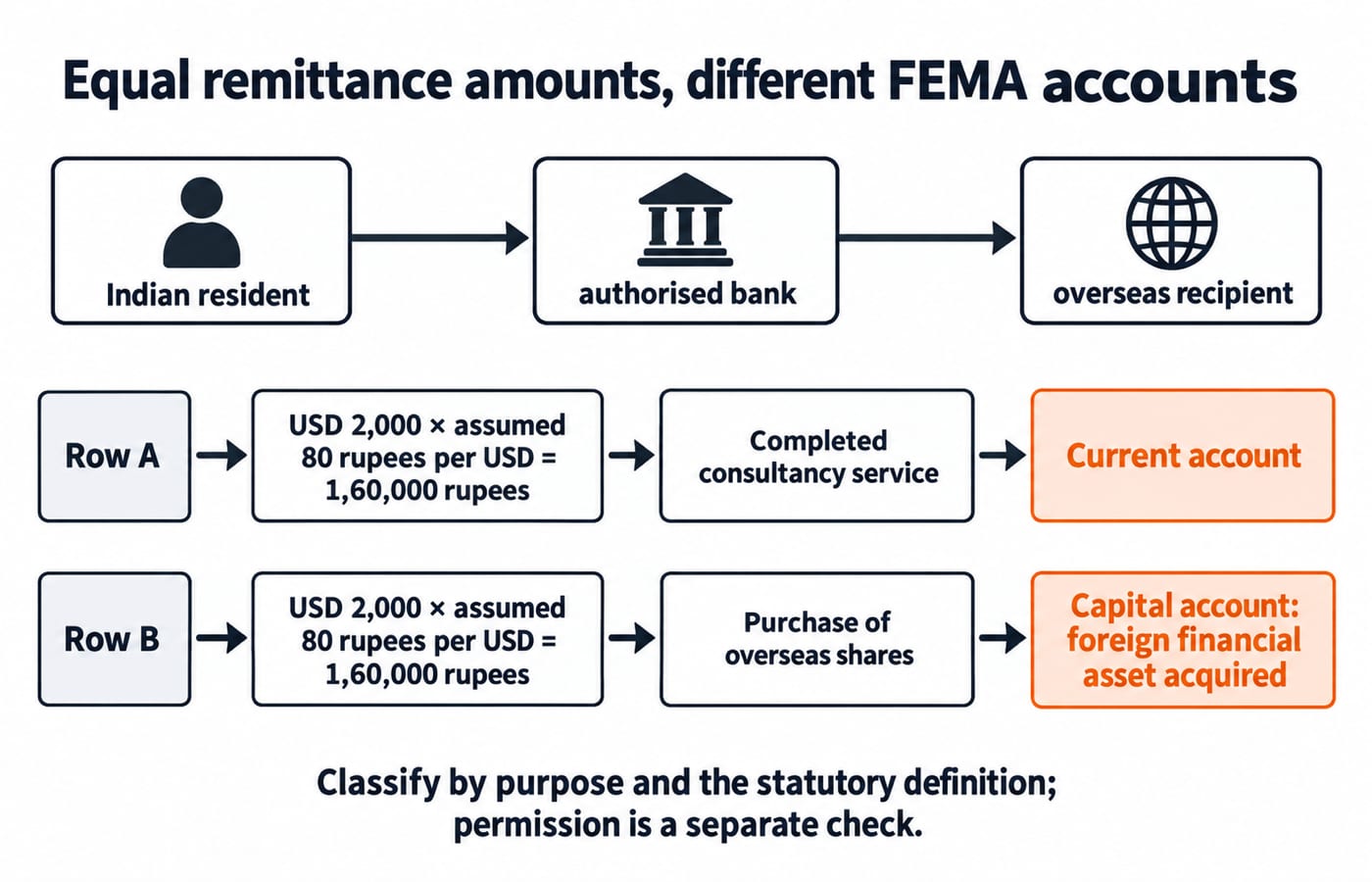
Both payments reduce a bank balance. That alone does not make both capital-account transactions. Their purposes distinguish them. Similarly, interest paid on an overseas loan is a current-account example, unlike acquiring foreign shares.
These are classification exercises, not permission to make a particular remittance. Authorised channels, applicable restrictions and transaction-specific conditions still need checking; the assumed rate is not a market quote or remittance limit.
Key provisions as a transaction checklist
Use the Department of Revenue's broad FEMA scheme as a section map, with current-account rules read alongside RBI's explanation:
Section | Revision meaning |
|---|---|
3 | Dealings and payment channels are subject to statutory permissions. |
4 | Residents' overseas holdings are restricted, with permitted exceptions. |
5 | Current-account transactions generally use authorised persons, subject to applicable restrictions. |
6 | Capital-account transactions are allowed within the permitted framework. |
7 | Export declarations establish details including full export value. |
8 | Foreign exchange due must be realised and repatriated as applicable. |
10 | Authorised persons provide recognised foreign-exchange channels. |
Suppose an Indian exporter is due USD 5,000 for a completed export. At the same assumed rate, 5,000 × 80 rupees = 4,00,000 rupees. Follow this order:
Section 7: Was the export declared with its full value?
Section 8: Has the USD 5,000 been realised and repatriated to India within the applicable requirements?
Section 10: Did the receipt move through an authorised person, such as the exporter's bank?
The export receipt is a current-account transaction. Its classification does not remove documentation or repatriation obligations.
Keep institutional roles separate: RBI authorises persons and performs regulatory functions; ED investigates contraventions and undertakes enforcement and adjudication functions. ED does not process an exporter's routine bank receipt.
Work out the penalty ceiling, not an automatic fine
RBI's Directions on Compounding of Contraventions explain section 13(1): upon adjudication, the penalty can be up to three times a quantifiable sum, or up to 2 lakh rupees where the amount is not directly quantifiable. A continuing contravention can attract a further penalty up to 5,000 rupees for each day after the first.
Suppose the adjudicated quantifiable sum is 80,000 rupees and the contravention continues for four days in total:
Base ceiling = 3 × 80,000 rupees = 2,40,000 rupees.
Additional days = 4 − 1 = 3 days.
Additional ceiling = 3 × 5,000 rupees = 15,000 rupees.
Combined illustrative ceiling = 2,40,000 rupees + 15,000 rupees = 2,55,000 rupees.
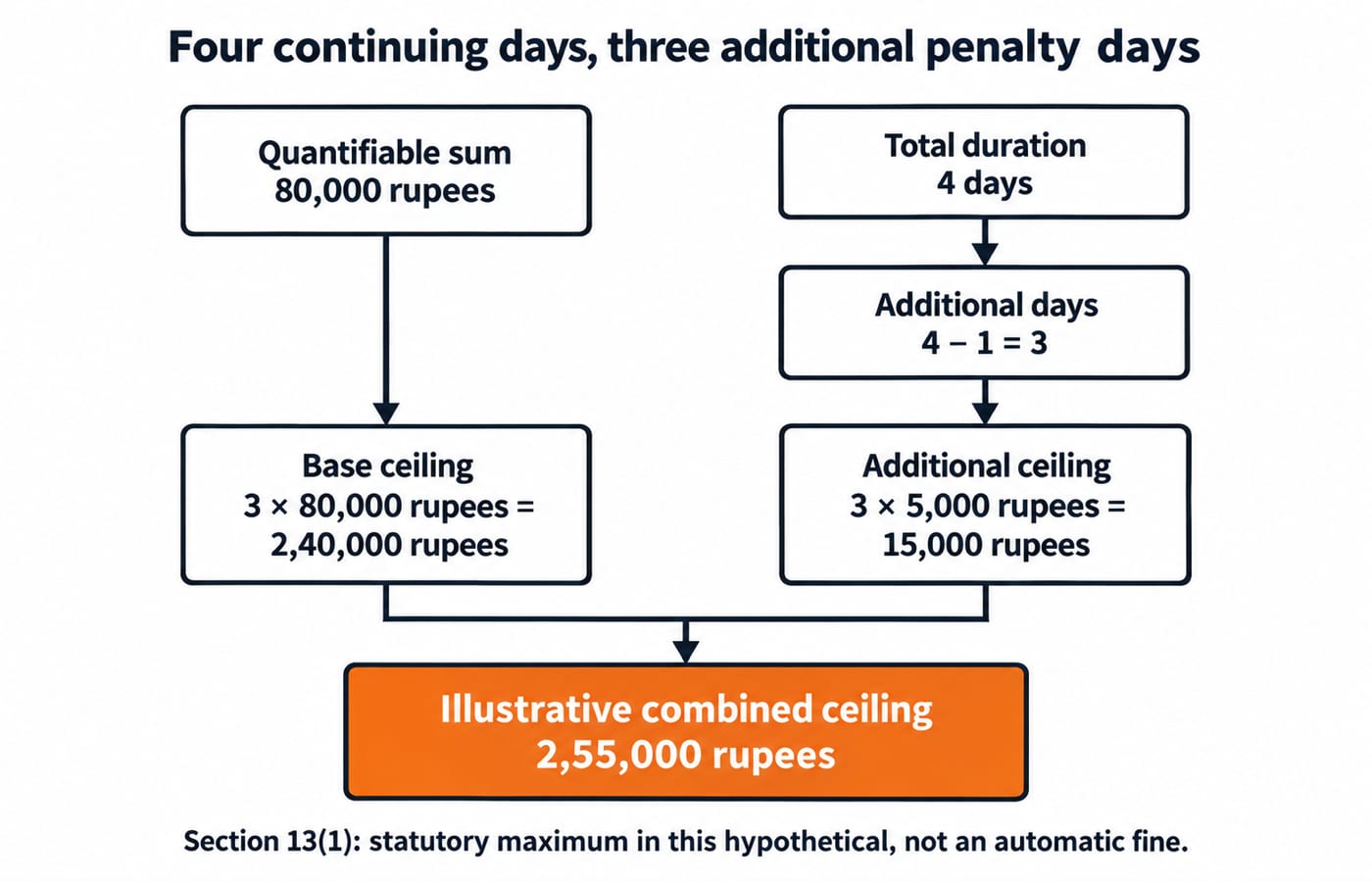
A total of 2,60,000 rupees would wrongly charge the additional daily amount for all four days. The calculation isolates this subsection's ceiling, not every possible legal consequence or the final penalty order.
For a separate non-quantifiable case, the base ceiling is 2 lakh rupees, not 6 lakh rupees. Do not multiply that branch by three or add it to the quantifiable branch.
Section 15 compounding is an application-based mechanism subject to eligibility. It does not promise automatic forgiveness or acceptance of every application.
Five traps that turn a correct definition into a wrong answer
Watch the exact claim in a statement question:
“FEMA commenced in 1999.” That is the Act's year. The commencement date is 1 June 2000.
“Every outward remittance is capital account.” The consultancy payment is outward but current account. Identify its purpose.
“Current account means unlimited permission.” Classification does not cancel authorised-channel requirements or applicable restrictions.
“Every contravention costs exactly three times the sum.” The provision gives a ceiling. Quantifiability and adjudication matter.
“Four continuing days mean 20,000 rupees extra.” Exclude day one. Three additional days give a ceiling of 15,000 rupees here.
Underline words such as every, exactly and unlimited. They can turn an otherwise familiar statement into an incorrect one. Then state the precise correction, rather than relying on a vague memory that FEMA is a management law.
How to practise FEMA for UGC NET Commerce
The UGC Commerce syllabus places FEMA in Unit 1, Business Environment and International Business, under the legal environment. Keep that subject revision distinct from common-paper study: Paper 1 and Paper 2 serve different purposes.
Try these author-created checks with the explanations above covered:
Classify both USD 2,000 remittances and justify each answer.
Choose FEMA's commencement from “1999” and “1 June 2000”.
Calculate the four-day penalty ceiling before checking the result: 2,40,000 rupees + 15,000 rupees = 2,55,000 rupees.
Match sections 7, 8 and 10 to declaration, realisation/repatriation and the authorised channel in the USD 5,000 export example.
Use statement evaluation, section-purpose matching and short transaction cases as practice formats. Write a one-sentence reason for every answer. That checks whether you understand the rule, rather than simply recognising an amount or section number.
Short version and the next revision step
For each FEMA problem, identify the transaction, find the relevant rule or authority, and distinguish a penalty ceiling from a final order.
Take five minutes now: two minutes to classify the payment examples, two to recalculate the penalty, and one to recall FEMA's objectives and commencement date. Explain each answer aloud without reading the worked solution.
Alongside Commerce subject revision, you can support your separate common-paper preparation with the NTA UGC NET Paper 1 course.
Keep learning
CSIR NET Normalization: Percentile and Normalised Marks Worked Out
Can 120 and 130 raw marks mean the same percentile? Follow a two-shift example from raw marks to percentile and normalised marks, then check which number belongs beside a cutoff.
Updated 5 Oct 20265 min readNET Strategy & Updates

UGC NET Eligibility for CA Holders: Equivalence, Marks and Subject Choice
Completed CA but have no MCom certificate? Understand the equivalence route, check the percentage requirement and resolve marks or subject-entry doubts before applying for NET.
30 Sep 20264 min readNET Strategy & Updates
UGC NET CS Attempt Strategy Without Negative Marking: A Three-Pass Plan
Use a rehearsed 180-minute clock to answer quick recalls first, protect time for technical work, and leave disciplined elimination and guesses until the final pass.
Updated 4 Sep 20265 min readNET Strategy & Updates
UGC NET Paper 1 Higher Education Timeline: Institutions, Commissions, Policies and Digital Initiatives
Turn disconnected Higher Education dates into a classified timeline. Learn the ancient centres, modern bodies, policies and digital initiatives through worked ordering drills.
Updated 3 Sep 20266 min readNET Strategy & Updates