TPSC Assistant Technical Officer (CS) Syllabus and Exam Pattern, Decoded
Turn the TPSC ATO (CS) syllabus into practical subject clusters, understand the expected technical depth, and confirm every official paper detail at the source.
KnowledgeGate Team
Exam prep & CS education
Updated 11 Sep 20265 min read110 views
TPSC Assistant Technical Officer (CS) preparation has two jobs: keep Paper 1 active beside the broader Paper 2 technical syllabus, and verify the official rules before building an attempt strategy. Paper 1 covers English, reasoning, general knowledge and current affairs; Paper 2 carries Computer Science and IT.
1. TPSC ATO exam pattern: Paper 1 and Paper 2
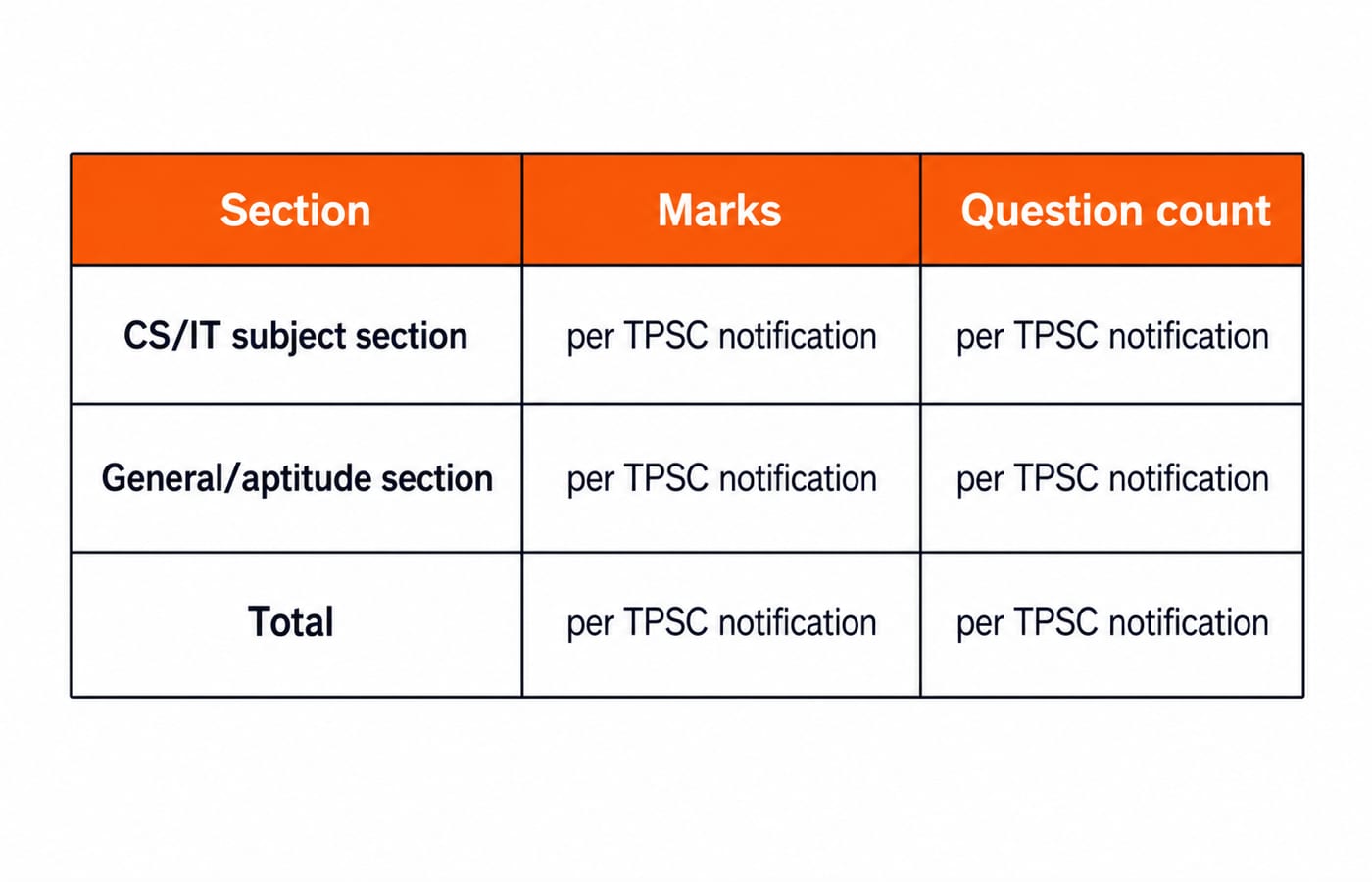
The TPSC course and test-series structure separates preparation into Paper 1 and Paper 2. Paper 1 groups English, general mental ability and logical reasoning, plus general knowledge and current affairs. Paper 2 contains the technical Computer Science and IT syllabus. This division is the stable preparation map; question counts, marks, duration, language rules and negative marking belong to the current recruitment notification.
Paper | Preparation boundary | What to confirm officially |
|---|---|---|
Paper 1 | English; general mental ability and logical reasoning; general knowledge and current affairs | Questions, marks, duration, qualifying rules and language |
Paper 2 | Computer Science and IT, including theory, procedures, code tracing and standard numericals | Questions, marks, duration, topic wording and marking rules |
Selection scheme | Prepare the two written-paper components as separate tracks | Any screening, interview, document or stage rule in the current notice |
Confirm those official specifics on the Tripura Public Service Commission portal. If an older scheme or a secondary summary conflicts with the current notice, follow the current notice.
2. TPSC ATO Paper 2 syllabus: the CS and IT blocks
Paper 2 is not one undifferentiated list. Five study blocks cover the technical breadth shown in the TPSC course curriculum and make dependencies easier to manage.
Study block | Named areas | Objective-question readiness |
|---|---|---|
Logic and architecture | Digital logic; computer organisation and architecture | Simplify logic, follow datapaths, handle number representation and solve standard hardware numericals |
Programming and algorithms | C; C++; Java; data structures; algorithms and complexity | Trace code, select structures, compare algorithms and predict output |
Systems and data | Compiler design; operating systems; DBMS; computer networks | Apply standard procedures, distinguish models and solve familiar protocol, scheduling and database cases |
Software and applied IT | Software engineering; information systems; internet and web technologies | Connect lifecycle, testing, web, protocol and information-system concepts |
Security and quantitative support | Cyber security; emerging technologies; cloud technology; probability and statistics | Recognise core security and cloud ideas and execute standard probability or statistics methods |
The TPSC Assistant Technical Officer (ATO - CS) 2026 course provides one coverage spine across both papers. Use its Paper 2 labels to keep notes aligned with the technical blocks instead of switching sources whenever the subject changes.
The TPSC Computer Science prerequisite-order syllabus map answers a different planning question: it sequences the Paper 2 subjects by dependency. The Paper 1/Paper 2 map above separates the exam components; the prerequisite map decides which technical block should come next.
3. TPSC ATO Paper 1: English, reasoning and current affairs
Paper 1 needs three separate routines because the skills decay differently. English improves through short, frequent work on vocabulary, grammar, comprehension and sentence handling. Mental ability and logical reasoning need timed problem sets plus an error log. General knowledge and current affairs need bounded revision notes, not unlimited daily reading.
English: practise comprehension, vocabulary, sentence correction, completion and rearrangement in short sessions.
Reasoning and mental ability: rotate arithmetic, data interpretation, series, coding, arrangements and other notified areas, then classify every error by method.
General knowledge and current affairs: revise from a fixed source and keep only facts that survive spaced recall.
The TPSC ATO (CS) exam-preparation category keeps the course and test series together. Use it as the TPSC-specific starting point instead of a broad government-exam category.
4. TPSC ATO syllabus depth: what objective readiness means
Breadth is useful only when every topic reaches a testable level. For each Paper 2 subject, reach three concrete abilities:
State the classic definitions and distinguish easily confused terms.
Execute the standard algorithm, procedure or derivation on a small example.
Recognise the common numerical, code-output or scenario pattern under time pressure.
For Operating Systems, that includes scheduling, synchronisation, deadlocks and memory management. DBMS needs keys, relational algebra, SQL, transactions and normalisation. Networks needs layered models, protocols, addressing and performance basics. Programming needs code tracing and data-structure operations, while digital logic and architecture need number systems, circuits, memory and processor fundamentals.
Do not mistake objective depth for memorising isolated facts. A candidate who can name a scheduling algorithm but cannot trace a short schedule is not ready; neither is a candidate who recalls normal forms but cannot identify a dependency violation.
5. TPSC ATO preparation map: sequence, practice and revision
Paper 2 should receive the larger share of study sessions because its technical breadth is much wider. Keep Paper 1 alive through shorter recurring sessions, then rebalance after a mixed diagnostic rather than copying an assumed marks split.
Choose one Paper 2 block and finish its prerequisites before mixing unrelated subjects.
Learn from one fixed source and compress each topic into a concept sheet.
Solve an untimed set immediately, then write the reason for every wrong answer.
Return after a gap with a timed mixed set and record whether the error was conceptual, procedural or careless.
Move repeated errors into a compact revision queue and retest them before beginning a new block.
The TPSC Assistant Technical Officer (ATO - CS) Test Series has unit tests for topic-level diagnosis and full-length mocks for paper-level decisions. Use unit tests while coverage is growing; reserve full mocks for question selection, pacing and recovery after a difficult section.
6. TPSC ATO official checks: notification before attempt strategy
Create a one-page notification sheet before setting mock targets. Record the advertisement number, paper names, topic annexure, question count, marks, duration, marking rule, permitted language, stage sequence, exam date and document instructions exactly as the current TPSC notice states them. Keep blanks where the notice is silent; do not fill them from another commission.
The UP Police Computer Operator syllabus guide illustrates the boundary: overlapping CS subjects do not make two recruitment patterns interchangeable. Use another exam only for extra topic practice, never for TPSC marks, timing or stage rules.
7. TPSC ATO syllabus and exam pattern: the short version
Treat TPSC ATO (CS) as two preparation tracks. Paper 1 covers English, reasoning, general knowledge and current affairs. Paper 2 covers the Computer Science and IT core, including programming, algorithms, systems, data, architecture, software, web, security, cloud and quantitative support.
Begin with one Paper 2 block, keep Paper 1 in short recurring sessions and verify every official number against the current TPSC notification. Use the course for coverage and the test series for diagnosis, then let your error log decide the next revision block.
Keep learning
Browsers and Search Engines MCQs: 9 Solved Questions with Explanations
Solve nine published browser and search engine questions, check each answer, and rebuild the browser, cache, crawler and indexing distinctions that exam distractors blur.
Updated 6 Oct 20267 min readTeaching Recruitment (Computer Science)
IT Act, 2000 Explained: Key Sections, Digital Signatures and Worked Exam Examples
Build an exam-ready map of the IT Act, then apply it to an exact digital-signature walkthrough and a section 43, 66, 66C and 66D caselet.
Updated 2 Oct 20266 min readTeaching Recruitment (Computer Science)
Emerging Trends Introduction MCQs: 12 Solved Questions with Explanations
Solve 12 Emerging Trends Introduction questions with clear answer logic, exam-year labels and a compact trap check for focused revision.
Updated 27 Sep 20268 min readTeaching Recruitment (Computer Science)
MS Word Basics MCQs with Answers: 12 Solved Questions Explained
Work through 12 MS Word questions covering everyday commands, page layout, formatting, links, file features and mail merge. Each answer explains the decisive clue and the closest distractor.
Updated 25 Sep 20267 min readTeaching Recruitment (Computer Science)