IBPS SO IT Officer Interview Preparation: A 14-Day Technical and Banking Plan
Turn written-stage knowledge into clear spoken answers with a 28-hour plan, two scored mocks, worked technical scenarios, and a practical correction log.
KnowledgeGate Team
Exam prep & CS education
Updated 15 Sep 20265 min read
Clearing professional knowledge shows that you can derive an answer. An interview requires you to explain that reasoning aloud, handle follow-ups and connect it to a bank's systems. Over 14 days, turn CS revision, project evidence, banking technology, security and role fit into concise spoken answers built on reasoning, not memorised replies. Verify cycle-specific stages and instructions in current official IBPS material.
1. Build the five-lane IBPS SO IT Officer interview matrix
Prepare five lanes: core CS, resume and projects, banking technology, information security, and HR plus role fit. The IBPS SO IT Interview course covers them through technical, banking-awareness, HR, and mock practice.
Create one sheet with exactly five columns and seed one row per lane:
Question | 60-second answer | One concrete example | Likely follow-up | Gap action |
|---|---|---|---|---|
Core CS: Protect a transfer? | Draft | Transfer | Separate databases? | Revise atomicity |
Project: Your improvement? | Draft | Real project | Measured how? | Check evidence |
Banking technology: Reconcile failure? | Draft | Payment | Source of truth? | Map flow |
Security: Handle suspicious access? | Draft | Login alert | Preserve what? | Learn order |
HR and role fit: Why bank IT? | Draft | Motivation | Why this role? | Remove clichés |
The earlier IBPS PO Interview Preparation: A 14-Day Bank-Awareness and Personal-Fit Plan owns general banking-awareness and personal-fit practice; this IT Officer matrix adds CS transactions, project trade-offs, security incidents and technical follow-ups.
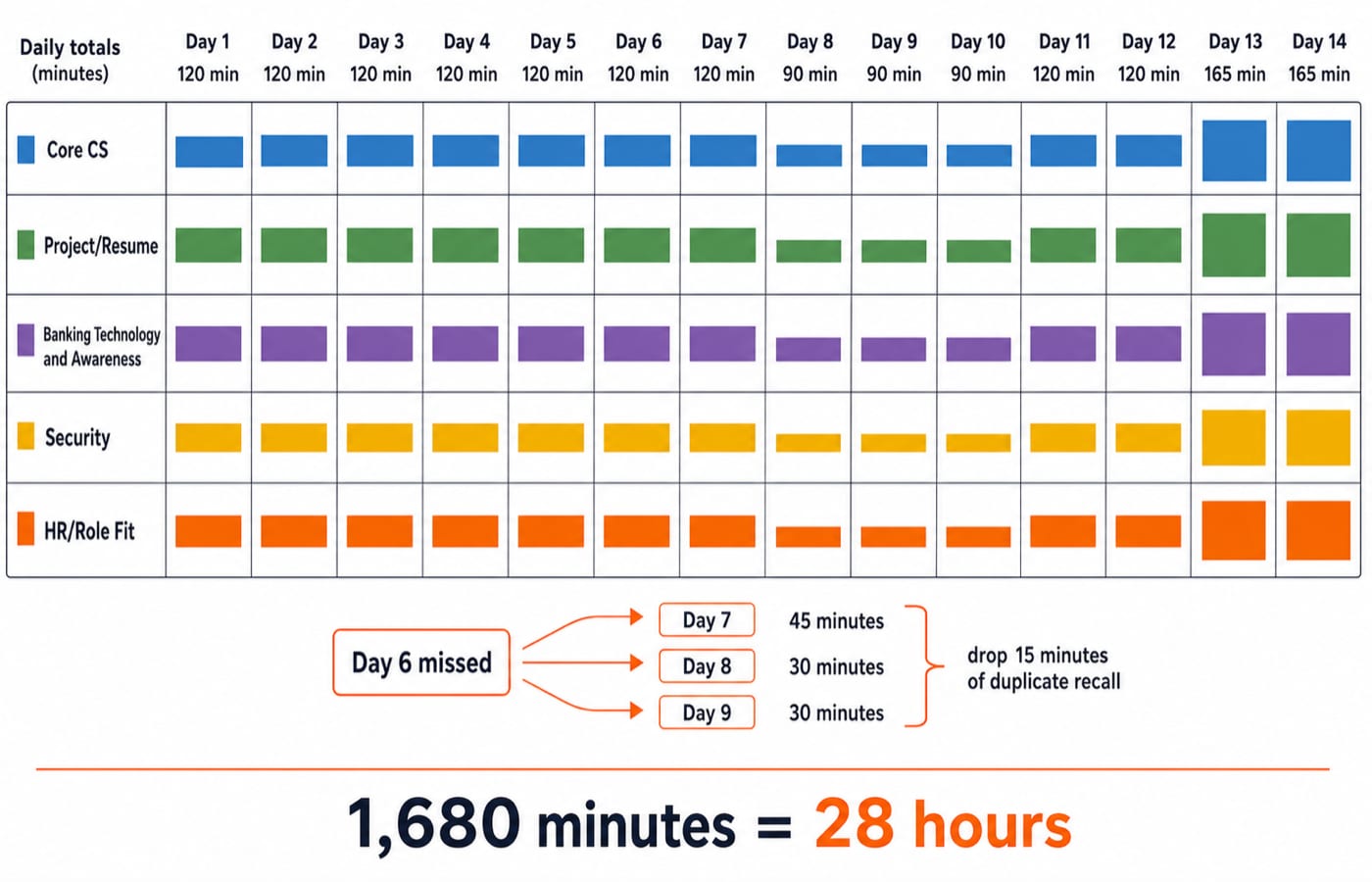
2. Follow a 14-day, 28-hour plan that survives one missed day
Total: 1,680 minutes.
Days | Daily split | Phase total |
|---|---|---|
1 to 4 | 60 CS + 30 project or resume + 30 oral recall | 480 min |
5 to 7 | 45 banking technology + 30 security + 30 banking awareness + 15 recall | 360 min |
8 to 10 | 45 project answers + 30 role fit + 15 recording | 270 min |
11 to 12 | 45 banking awareness + 30 current-issue verification + 30 HR + 15 follow-ups | 240 min |
13 to 14 | 45 mock + 120 correction across all four weakness areas | 330 min |
Check: 480 + 360 + 270 + 240 + 330 = 1,680 minutes, and 1,680 ÷ 60 = 28 hours.
If Day 6 is lost, move its 45-minute banking-technology block to Day 7, its 30-minute security block to Day 8, and its 30-minute awareness block to Day 9. Drop only the duplicated 15-minute recall. Do not double the next day or cut mock correction.
3. Convert core CS revision into banking-facing spoken answers
Prioritise DBMS transactions and indexing, operating systems, networks, data structures, OOP, software engineering, and security. Audit coverage with the IBPS SO IT Professional Knowledge topic map. Use the IBPS SO IT Mains course for deeper revision of weak subjects.
Account A starts at 4,000 units and B at 6,500. A 500-unit transfer uses idempotency key TXN-4821. The debit response is recorded, but the client times out before seeing the credit.
Assume the ledger is authoritative, the key identifies one logical transfer, and a timeout does not prove failure. In one database, put debit and credit in one atomic transaction. Keep the client status pending until the authoritative outcome is known. Retry with the same key and reconcile any unmatched ledger entry. If committed, A = 4,000 - 500 = 3,500 and B = 6,500 + 500 = 7,000, with one transfer reference. If rolled back, both stay 4,000 and 6,500. Never let a blind retry create another transfer.
Separate databases may have no shared transaction boundary. Use durable state, idempotent steps, reconciliation, and suitable compensation. Rehearse: Where is the transaction boundary?, What changes if services use separate databases?, Why is idempotency not the same as a database lock?, and What would you log without exposing sensitive data?
4. Turn every resume project into evidence, trade-offs, and follow-ups
Answer each project as problem, personal action, measured result, and trade-off. Use truthful evidence. An unmeasured result is safer than an invented metric.
Hypothetical example: A Java and Spring Boot ticketing API held 30,000 rows. A filtered query had p95 latency of 920 ms. An index on (user_id, created_at) reduced p95 to 210 ms across 500 repeated requests, at the cost of storage and slightly slower writes. Expect questions about column order, the query plan, why 500 requests are not production proof, and when the index hurts.
For each of six resume lines, prepare one primary question and two follow-ups:
Resume line | Primary question | Two follow-ups |
|---|---|---|
Degree | What did you learn best? | Why? Where applied? |
Strongest subject | Explain one concept. | Trade-off? Bank use? |
Weakest subject | What is the gap? | Impact? Correction? |
Final-year project | What did you own? | Evidence? Limitation? |
Internship or work | What did you change? | Measurement? Your part? |
Achievement | Why does it matter? | Verification? Lesson? |
5. Study banking technology and security as systems
Build 12 cards, three per cluster: core banking and channels; payment flow and reconciliation; identity, access, and fraud controls; availability, backup, and incident response. Each needs a definition, bank use, failure mode, and control. Re-verify changing limits, dates, or policies near the interview.
A privileged account logs in from a new device, followed by 200 failed customer-record lookups in 10 minutes. First revoke sessions and isolate the identity. Preserve time-stamped logs, open an incident, check whether any lookup succeeded, rotate credentials, and enforce or validate MFA. Then investigate root cause and prevention. Evidence preservation and least privilege matter as much as containment.
A useful answer names the signal, first action, risk being contained, and evidence that changes the next decision. Buzzword dumping does not.
6. Rehearse HR and role-fit answers with strict time boxes
Build a 75-second introduction: 15 seconds for context, 25 for technical evidence, 20 for banking technology and role fit, and 15 for a closing link. Use your real degree, project, employer, and achievements.
Prepare four families: why banking after CS, why IT Officer, willingness across locations or functions, and a genuine weakness with a correction plan. Ban I am a perfectionist. Name the gap, impact, and improvement routine.
Practise a 45-second disagreement answer using situation, action, and outcome. Show calm escalation, documentation, and respect for process without blame.
7. Run two mocks and correct answers by evidence
Each 45-minute mock has 30 minutes of questions and 15 of notes. Ask exactly eight questions: three technical, two banking-technology, one security, one project, and one HR or role-fit. Day 13 is diagnostic. Day 14 retests the three lowest scores.
Score technical accuracy, structure, bank IT relevance, evidence, and concision from 0 to 2 each, totalling 10. Rewrite and record anything below 7. Keep answers within 60 to 90 seconds unless a walkthrough is requested.
Use this correction log:
question | score/10 | missing fact | unclear phrase | follow-up failed | next rehearsal |
|---|---|---|---|---|---|
For cycle-specific facts, check the current IBPS Specialist Officers index and write, the current IBPS notice states.... Memory, coaching sites, and future documents are not official.
8. Short version and next step
Build the five-lane matrix, complete 28 hours, prepare one example per lane, run two mocks, and keep one correction log. Today, create five rows and record one 60-second technical answer.
Choose the interview course for practice, or the Mains course to repair CS gaps. The Banking & Insurance category leads to related preparation.
Keep learning
IBPS PO Preparation Mistakes: 7 Errors That Cost Final Selection
Hard work is not enough when attempt counts, new resources and rigid timetables hide weak accuracy. Replace seven common errors with measurable habits.
Updated 4 Oct 20265 min readIBPS Exams
IBPS PO Last 60 Days Plan: Revision, Mocks and Error Repair
Turn the final 60 days into a measured cycle of diagnosis, revision, mocks, retests and tapering, with worked schedules for a realistic 14-hour week.
Updated 29 Sep 20264 min readIBPS Exams
IBPS PO Cutoff Trends: Set a Defensible Target Score
Learn how to separate IBPS PO cutoff history by cycle, stage, category and denominator, then turn comparable Main values into a transparent practice target.
Updated 25 Sep 20265 min readIBPS Exams
IBPS PO Previous Year Analysis: Recurring Question Formats and Attempt Priorities
See what genuinely recurs across IBPS PO papers, solve representative format drills, and turn your own accuracy and speed into a practical attempt priority.
Updated 24 Sep 20265 min readIBPS Exams