TPSC ATO (CS) Preparation: Subject Weightage and a Study Plan
Prioritise the TPSC ATO technical syllabus, organise ten weeks into four phases, and protect mock practice with a clear missed-day recovery rule.
KnowledgeGate Team
Exam prep & CS education
Updated 11 Aug 20266 min read65 views
Studying every TPSC Assistant Technical Officer (CS) topic at the same intensity feels thorough, but it delays the subjects that build most of your usable score. You need a priority order, a weekly rhythm and enough timed practice to convert coverage into correct answers. A ten-week cycle of about 150 study hours splits into three subject tiers, a capped general slice and timed practice that is never the first thing cut.
1. Topic weightage tiers for the CS/IT paper
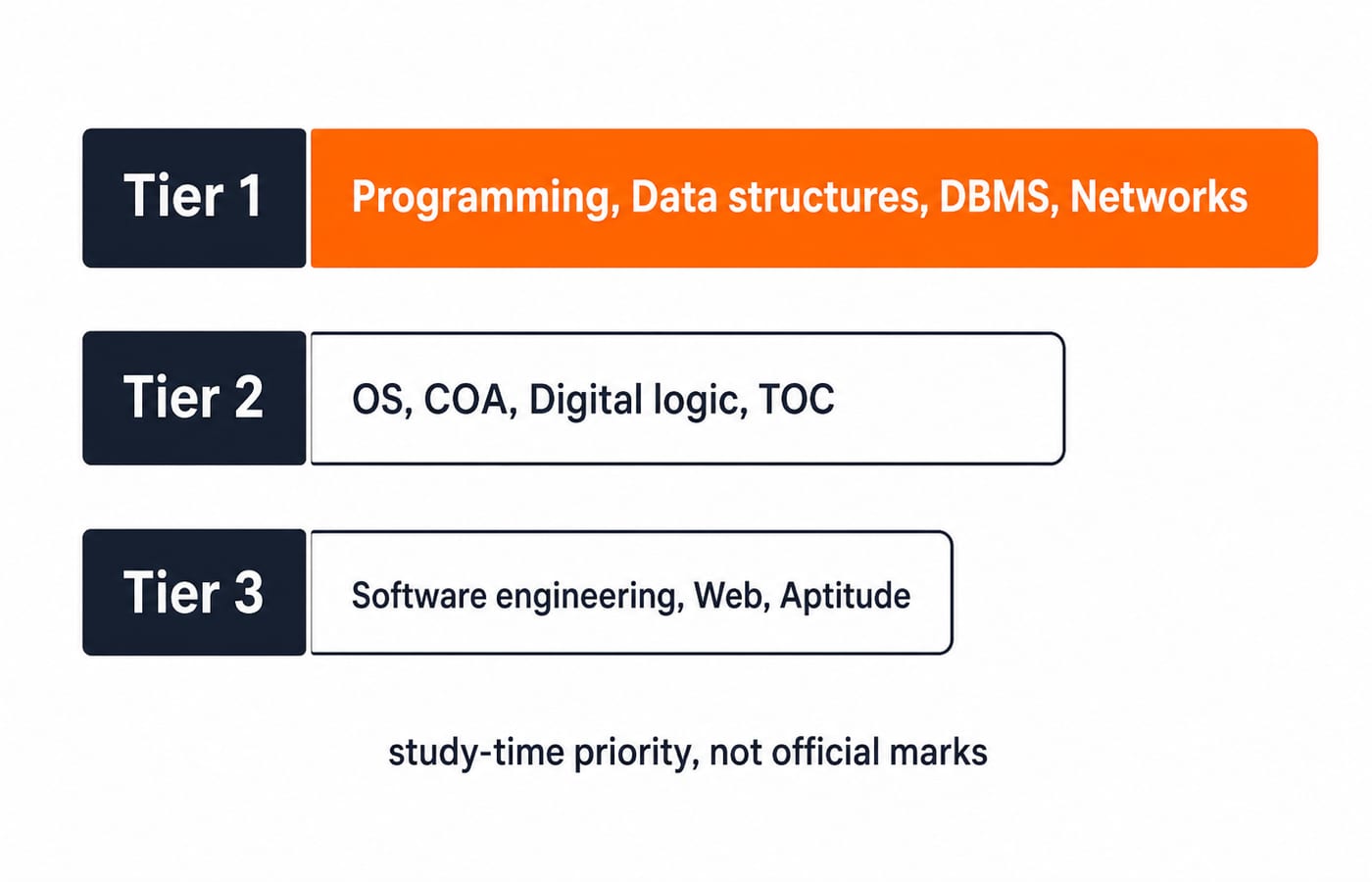
Start by reading the degree-level technical syllabus in three priority tiers:
Priority | Subjects | Share of 150 hours | Preparation aim |
|---|---|---|---|
Tier 1 | Computer and IT fundamentals, DBMS, Computer Networks, Operating Systems | About 60 hours (40 percent) | Build first, revise throughout, practise most often |
Tier 2 | Programming and data structures, digital electronics, computer organisation | About 36 hours (24 percent) | Add after the base, with output and numerical drills |
Tier 3 | Software engineering, web technologies, a light theory pass | About 18 hours (12 percent) | Cover reliably, but cap advanced detail |
Tiers 1 to 3 take 114 of the 150 hours. The remaining 36 split into about 15 hours for the general and Tripura-specific slice and about 21 for timed papers and their analysis: 60 + 36 + 18 + 15 + 21 = 150. These are study-time shares; the official structure, mark split and dates sit in the current notification on the Tripura Public Service Commission portal. To rank topics inside a tier against real papers, work through TPSC Computer Science weightage: rank high-return topics.
2. The study plan at a glance
A workable model is roughly 14 to 16 hours each week for about ten weeks. Using 15 hours as a planning midpoint gives about 150 study hours across the cycle: 15 hours x 10 weeks = 150 hours. Ten weeks is compressed. With a longer runway, the TPSC Computer Science 14-week study plan runs the same material at 12 hours a week.
Divide the ten weeks into four phases:
Phase | Weeks | Main job |
|---|---|---|
Foundation | 1 to 4 | Tier 1 concepts and first question sets |
Breadth plus programming | 5 to 7 | Tier 2, Tier 3 and continued Tier 1 recall |
Previous years and mocks | 8 to 9 | Timed papers, analysis and general slice |
Final revision | 10 | Notes, error log and selected retests |
The arithmetic also checks the calendar: 4 + 3 + 2 + 1 = 10 weeks. Keep two buffer days available inside each phase. They are recovery capacity, not extra content days to fill in advance.
Protect one longer weekend block for timed work from the middle of the plan onward. During the early weeks, that block can hold a mixed subject test. In the final phases, use it for a full-length test in the currently notified format.
3. Phase 1 (Weeks 1-4): foundation
Begin with Tier 1. Cover computer and IT fundamentals first so common terminology stops slowing you down. In DBMS, move through models, keys, relational ideas, SQL, transactions and normalisation. In Networks, build from layered models to core protocols and addressing. In Operating Systems, cover processes, scheduling, synchronisation, deadlocks and memory.
For every sub-topic, make one compact page that holds definitions, standard procedures, formulas and your own error warnings. Then solve 25 to 30 MCQs for the subject on its planned practice day. Review immediately, because an unanswered doubt carried for a week becomes a repeated error.
Use an error log with four columns: topic, your wrong reasoning, the correct rule and a retest date. Merely copying the correct option does not change the reasoning that produced the miss.
4. Phase 2 (Weeks 5-7): breadth plus programming
Add Tier 2 subjects. Programming and data structures need active tracing, not passive reading. Practise output questions, standard operations, data-structure choice and basic time complexity. Pair digital electronics with computer organisation so number systems, logic, memory and processor ideas reinforce one another.
Give Tier 3 a dependable first pass. Learn the standard software-development models, web basics and the central results from theory. Stop before rare variations consume time needed by the higher tiers.
Keep a 20-minute Tier 1 recall drill each day. Use short questions or blank-page recall rather than rereading. There are roughly 18,000 Computer Science questions available across the core subjects, so the issue is not supply. It is selecting questions that match the planned cluster and recording what they reveal.
The TPSC Assistant Technical Officer course can anchor coverage. Keep one course sequence, one notes system and one question log instead of restarting from a new source whenever a topic feels difficult.
5. Phase 3 (Weeks 8-9): previous years, mocks and the general slice
Now shift from learning mode to performance mode. Alternate test days with analysis days. On a test day, follow the official time and marking rules. On the next day, classify every miss as a concept gap, recall gap, calculation error, reading error or time-management problem.
Re-solve missed questions without the answer visible. A question is not corrected until you can produce the method independently.
Bring the general and Tripura-specific slice to exam readiness inside its slot of about 1.5 hours a week, the 15 hours budgeted for it. Focus on the notified scope. Do not try to compensate for weak technical preparation by allowing general reading to take over the schedule.
The TPSC ATO Test Series belongs here as a diagnostic tool. Track accuracy and error type by tier so each following revision session has a precise job.
6. Missed-day recovery
When you miss a day, use one buffer day and continue the phase. Do not double the next day's workload, because compressed study usually removes the practice or review that made the session valuable.
If the lost time exceeds your buffer, reduce scope in this order:
Trim advanced Tier 3 details.
Reduce duplicate question sets on already stable topics.
Keep Tier 1 revision and weak Tier 2 work.
Preserve the Phase 3 timed mocks and their analysis.
Timed practice is the final activity to sacrifice. It shows whether you can retrieve and apply knowledge under the conditions that matter.
7. How TPSC tests it
Prepare for a subject-led objective paper at degree-level CS/IT depth, alongside the general slice stated in the scheme. That means clear fundamentals, standard applications and fast elimination matter across a wide technical range.
Before week 1, and again before the mock phase, confirm the live notification. Check the syllabus, stages, paper structure, marking rule and dates. If it moves a subject up or down, shift hours between tiers and hold the 150-hour total.
Other state technical and teaching recruitments run on similar objective patterns, so the government teaching jobs category is worth a scan when you decide how many exams to prepare in parallel.
8. The short version and your next step
Work Tier 1 first at about 60 of your 150 hours, add Tier 2 at 36 and a capped Tier 3 pass at 18, and keep the general slice inside its 15. Use four weeks for foundation, three for breadth, two for previous years and mocks, and one for revision. Buffer days protect the plan; they do not replace test analysis.
Download the current notification, mark the subjects into the three tiers and schedule your first 15-hour week. Start the test series once the foundation is usable, then let its error pattern decide what you revise next.
Keep learning

Mensuration and Geometry for Competitive Exams: Formulas, Shortcuts and Solved Examples
Learn how to choose the right mensuration formula, avoid common geometry traps, and solve 2D path and 3D recasting problems step by step.
Updated 6 Oct 20266 min readAptitude & Reasoning
Age Comparison and Multiple-Condition Problems: 12 Solved MCQs
Practise 12 age-problem MCQs with equations, timelines, back-checks, relation chains, changing ratios, birth years, and family conditions.
1 Oct 20268 min readAptitude & Reasoning
True, False and Cannot Say Questions: 10 Solved Passage MCQs
Learn how to separate contradictions from missing evidence, then apply the method to 10 previous-year passage MCQs with concise, evidence-led solutions.
26 Sep 20268 min readAptitude & Reasoning
TCS Aptitude Questions: High-Yield Quant and Reasoning Topics, Solved Step by Step
Learn the first move for common quant and reasoning question families through solved examples on ratios, work, trains, data, remainders, and seating.
Updated 25 Sep 20266 min read104 viewsAptitude & Reasoning