IBPS SO IT Officer Interview: Technical and HR Questions to Expect
Prepare for the technical and HR halves of the IBPS SO IT Officer interview, including core CS, banking technology, specialist-fit answers, and mixed mocks.
KnowledgeGate Team
Exam prep & CS education
8 Aug 20265 min read132 views
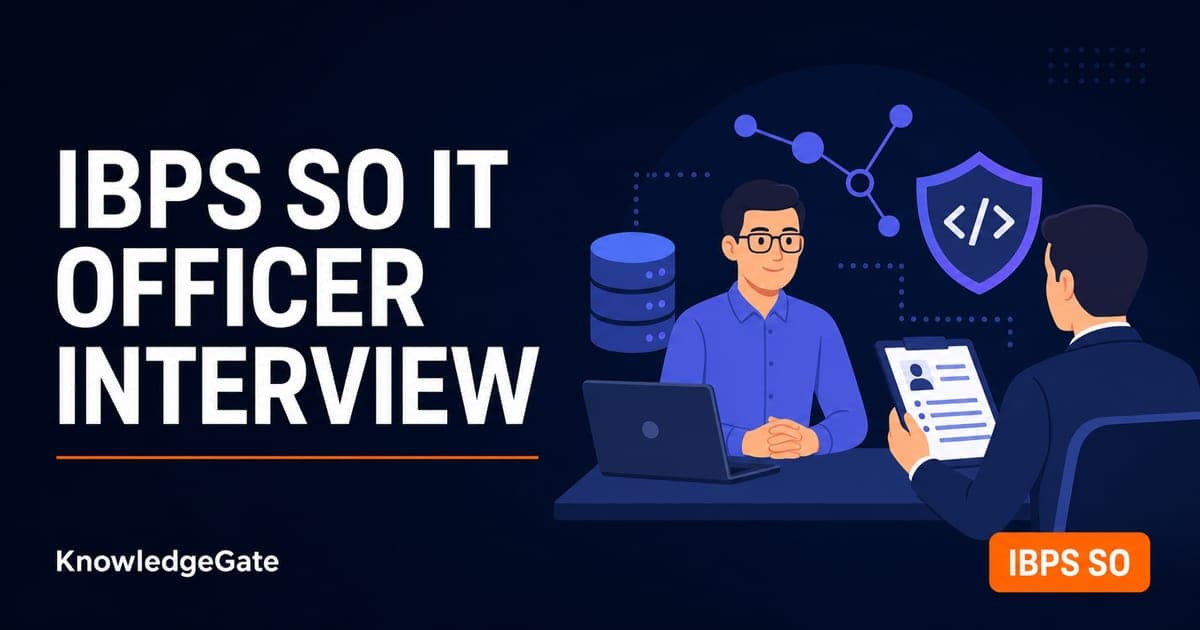
The IBPS SO IT Officer interview is unusual for a bank exam because the panel can move from core computer science to standard HR questions without warning. Candidates who prepared only for the written professional-knowledge paper often know the theory but struggle to explain it in one clean line or connect it to a bank. Prepare the technical and specialist-fit halves together, and the conversation becomes far more manageable.
Why the IBPS SO IT Officer interview is half technical, half HR
An IT Officer is being hired as a specialist. The panel therefore needs evidence that your CS foundations are usable, not merely remembered, and that you understand why technology matters inside a bank. It can test a definition, ask for a small example, then pivot to why you prefer banking IT to a product company.
Interview depth is different from written-exam depth. You are less likely to need a long derivation and more likely to need a precise definition, a practical example, and a clear follow-up. A candidate strong in theory but vague about motivation has prepared only half the task. The reverse is equally weak.
Exact interview weightage, minimum qualifying marks, call-letter details, and schedules belong to the current notification. Verify them through the SO notification and your call letter on the official IBPS website. The Banking and Insurance preparation category carries the written-stage Prelims and Mains material this interview follows.
IBPS SO IT professional knowledge: the areas the panel probes
Three core subjects deserve first priority.
DBMS
Prepare normalisation, keys, ACID properties, joins, transactions, indexing, and basic SQL. For "What is normalisation?", begin with: normalisation organises relational tables to reduce redundancy and avoid update anomalies. Then add that the progression through normal forms applies increasingly strict dependency rules. Stop unless the panel asks for a decomposition.
Computer Networks
Revise OSI versus TCP/IP, IPv4 addressing, routing basics, DNS, HTTP and HTTPS, TCP versus UDP, and common network devices. Practise contrast questions in a two-column form. For TCP versus UDP, state connection and reliability first, then give one suitable use case for each.
Operating Systems
Know processes versus threads, CPU scheduling, deadlock, virtual memory, paging, and synchronisation. A useful one-line answer defines the concept before naming an example. For deadlock, explain that processes wait indefinitely for resources held within the same waiting set, then mention circular wait only if asked about conditions.
Data structures and the software development life cycle form the next layer. Be ready to choose an array, linked list, stack, queue, tree, or hash table for a basic situation. For SDLC, explain stages and why controls, testing, and change management matter in a regulated environment.
The IBPS SO IT professional-knowledge topic map helps you order the wider syllabus. If DBMS is your weak area, the DBMS interview questions for freshers set drills the answers a panel actually asks for.
The KnowledgeGate question bank carries about 2,300 Computer Networks questions, about 2,100 DBMS questions and about 2,000 Operating Systems questions. Use them to expose gaps, then convert each corrected concept into a one-line spoken explanation.
The banking-technology layer beyond the CS syllabus
The panel can bridge CS to banking through payment systems, core banking, cybersecurity, and current technology. Prepare these clusters:
NEFT, RTGS, IMPS, and UPI at a conceptual level
Core banking solutions and centralised customer access
Phishing, multi-factor authentication, encryption, access control, and incident response
Digital payments, fraud monitoring, artificial intelligence, and basic blockchain awareness
For "NEFT versus RTGS", use a comparison rather than a history lesson. NEFT processes transfers through scheduled settlement batches, while RTGS settles each transaction individually in real time and is designed for high-value transfers. The current minimum threshold or operating detail must be checked against live RBI information before the interview.
Then connect the concept to operations. A bank cares about availability, correctness, security, traceability, and recovery. If asked about phishing, do not stop at "a fake message". Explain the social-engineering attempt, the credential risk, one user control, and one institutional control.
For a core banking solution, say that it connects branches and channels to centralised systems so customers can access services beyond a single branch. A follow-up may ask why this raises availability and cybersecurity requirements. That bridge from definition to bank impact is what makes a specialist answer convincing.
The HR questions built for a specialist
Prepare direct answers to three questions:
Why an IT Officer role in a bank rather than an IT company?
How will your CS skills help banking operations and customers?
Where do you see technology changing banking?
A strong answer does not insult product companies or claim that banking is easy. It connects your background to dependable, secure systems used at scale. For example: "My CS foundation fits work where reliability and security directly affect customers. Banking IT lets me apply that foundation to payment systems, data, and service continuity while learning a regulated domain."
Make the language yours. Add a project, internship, or subject that proves the connection. If your project involved databases, explain what it taught you about integrity or access control. If you are changing fields, state what you are carrying forward.
IBPS SO IT interview: a 3 to 4 week plan from the Mains result
Week 1: core CS at interview depth
Revise DBMS, Computer Networks, and Operating Systems. Build cards with a definition on the front and a one-line example on the back. Speak every answer. Reading silently hides unclear language.
Week 2: connect CS to banking
Cover payment systems, core banking, and cybersecurity basics. Draft your "why banking IT" narrative and prepare follow-ups from your application form. Check live thresholds and current developments against primary sources, with a date on each note.
Weeks 3 and 4: mix the question types
Complete four to five mock interviews that alternate technical, banking-technology, and HR questions. Ask reviewers to stop answers that run too long. Refine pace and body language, and prepare documents against the call letter. Do not try to relearn an entire subject in the final week.
What loses marks
Going too deep too early: Give the one-line answer first and expand only when invited.
Missing the CS-to-banking bridge: Add the operational or customer consequence.
Quoting a stale payment threshold: Check RBI-owned values close to the interview.
Giving a weak reason for banking: Build an honest specialist narrative with evidence from your background.
Hiding uncertainty: State what you know, mark the limit, and do not invent the rest.
Concise answers are not shallow when the definition is accurate and the example is well chosen.
The short version and next step
Expect DBMS, Networks, and Operating Systems at interview depth, then payment systems, cybersecurity, and HR built around "why banking IT". Prepare one-line definitions, attach one example to each, and run about five mixed mocks.
Target this stage with the IBPS SO IT Interview Preparation course. For the full specialist journey, use the IBPS IT Officer Scale I track.
Keep learning
NABARD Grade A Finance Preparation: Resources and an 8-Week Plan
Build a Finance specialist study plan around accounting, calculations and management applications. Use a 12-hour weekly schedule, a worked project appraisal and an error-based review routine.
5 Oct 20265 min readBanking Exams
LIC AAO Preparation for Repeat Attempts: A Six-Week Reset Plan
Familiar chapters need a sharper review method. Use your previous attempt and recent errors to plan six weeks of focused repair, protected mains work and manageable retests.
30 Sep 20265 min readBanking Exams
RBI Grade B Preparation Strategy: A 16-Week Phase-by-Phase Plan
A working aspirant must build early-stage speed without leaving economics, finance, management and writing cold. This plan turns 15 hours a week into foundations, timed practice, mock repair and a post-Phase-I bridge.
Updated 27 Aug 20265 min readBanking Exams
RBI Grade B Syllabus 2026: Phase 1 and Phase 2 Decoded
Separate RBI's official General Cadre syllabus from practical study buckets, then use diagnostics and worked examples to build a balanced weekly plan.
Updated 26 Aug 20265 min read56 viewsBanking Exams