

Testing APIs in Node.js: Jest and Supertest Tutorial with Runnable Examples
Build a small Express task API and test its routes, validation, headers, JSON responses and state changes without opening a fixed server port.
KnowledgeGate Team
Exam prep & CS education
Updated 25 Nov 20266 min read
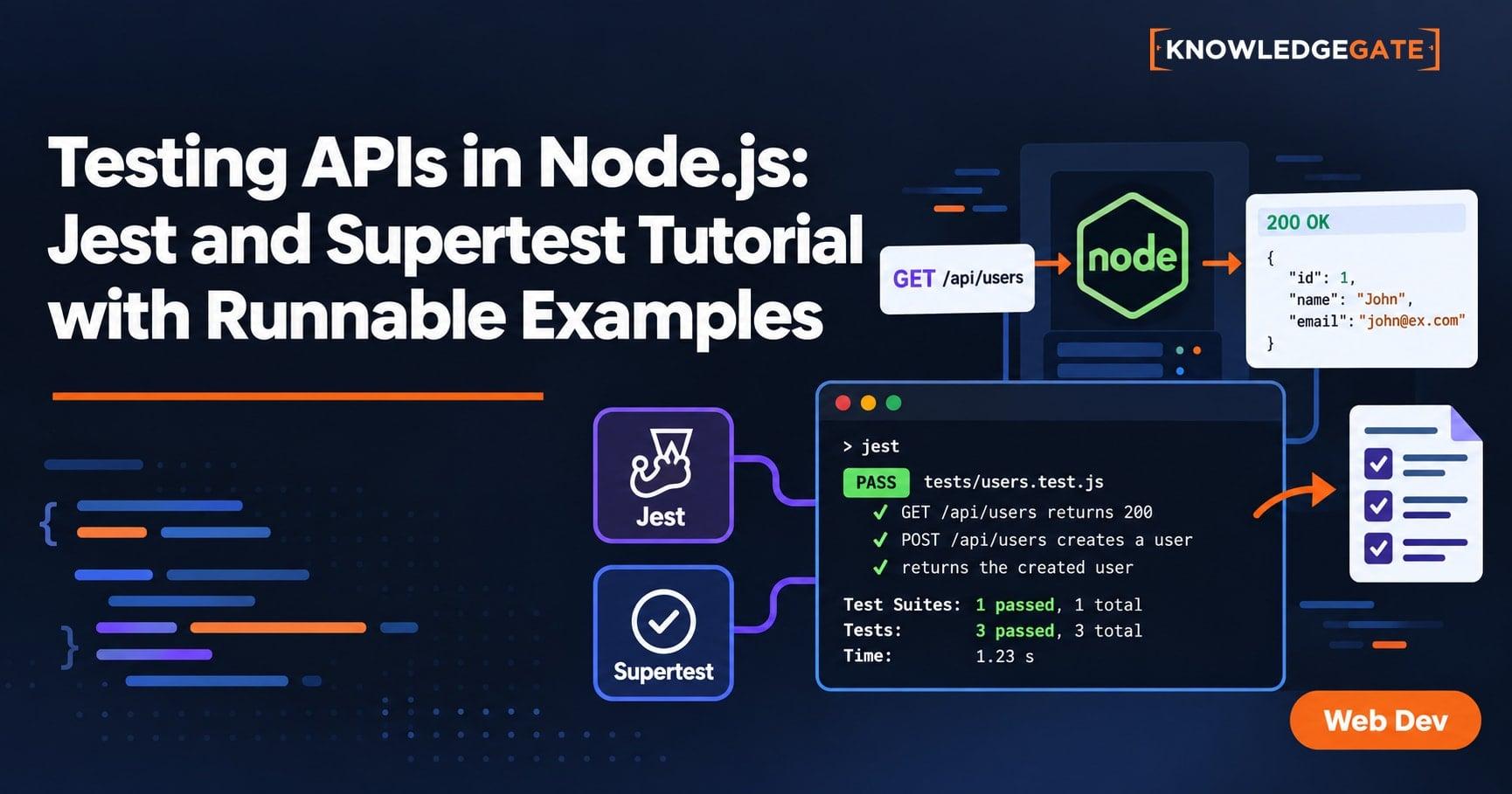
An Express route can look correct in a browser while a validation change, wrong status code or altered response shape silently breaks its clients. A Jest plus Supertest suite proves the HTTP contract of a runnable task API without starting a server on a fixed port. Each test gets a fresh in-memory Map, not MongoDB or production data. That isolates deterministic state, success and failure assertions, and the boundary where a real database needs its own integration test.
Testing APIs in Node.js: choose the boundary before the tool
A unit test might call a title validator directly. An API integration test sends an HTTP-shaped request through Express JSON middleware and routes with Supertest. An end-to-end test instead calls a separately running service with its real dependencies. Supertest gives us the middle boundary, not full end-to-end coverage.
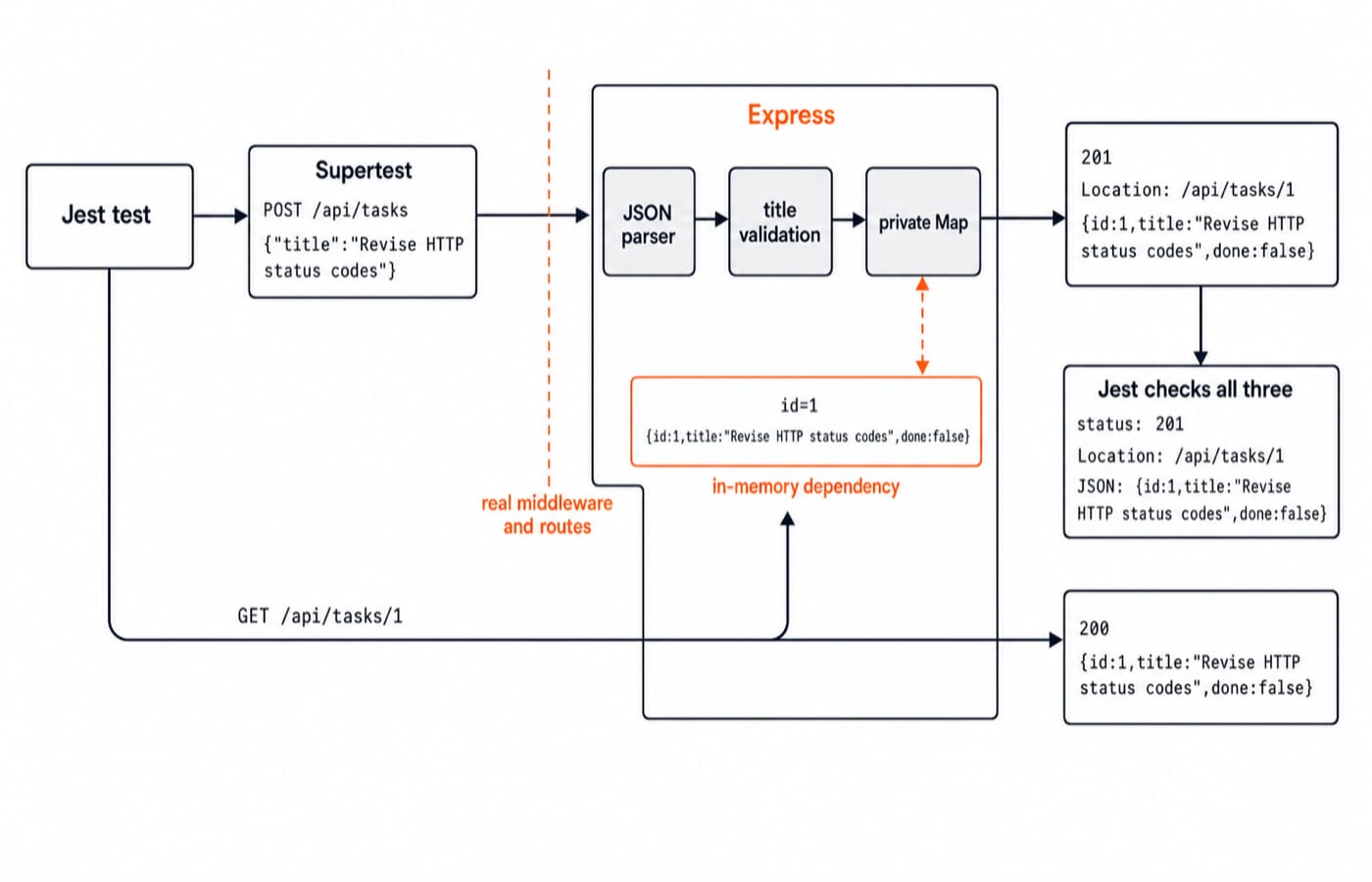
Here, a contract means method, path, input, status, headers, JSON body and state change. For POST /api/tasks, the valid input {"title":"Revise HTTP status codes"} must produce status 201, Location: /api/tasks/1 and {"id":1,"title":"Revise HTTP status codes","done":false}. The Application Layer Protocols: DNS and HTTP Guide explains the HTTP ideas behind methods, status codes and headers.
Tests import the Express app, not listen(3000). Supertest exercises it directly, avoiding port conflicts and open-handle cleanup.
Set up the Node.js API test project with Jest and Supertest
Create a CommonJS project so module-format setup does not distract from the test boundary:
mkdir node-api-test-demo
cd node-api-test-demo
npm init -y
npm install express
npm install --save-dev jest supertest
Change the package.json test script to:
"test": "jest --runInBand"Create app.js, server.js and app.test.js. The application factory owns the routes and private state:
// app.js
const express = require("express");

function createApp() {
  const app = express();
  app.use(express.json());

  const tasks = new Map();
  let nextId = 1;

  app.post("/api/tasks", (req, res) => {
    const title =
      typeof req.body?.title === "string" ? req.body.title.trim() : "";

    if (!title) {
      return res.status(400).json({ error: "title is required" });
    }

    const task = { id: nextId++, title, done: false };
    tasks.set(task.id, task);
    return res
      .status(201)
      .location("/api/tasks/" + task.id)
      .json(task);
  });

  app.get("/api/tasks/:id", (req, res) => {
    const task = tasks.get(Number(req.params.id));
    if (!task) {
      return res.status(404).json({ error: "task not found" });
    }
    return res.status(200).json(task);
  });

  return app;
}

module.exports = { createApp };
The state is inside createApp(), so every new app has an empty store and starts numbering at 1.
Build one small Express API whose contract is observable
POST /api/tasks trims title only when the incoming value is a string. A missing body, three spaces or the number 42 therefore reaches the same controlled branch: status 400 with {"error":"title is required"}. That branch returns before nextId changes or the Map receives a record.
A valid title creates { id: nextId++, title, done: false }, stores it under its numeric ID and returns 201 with the location and JSON task. The first valid request gets ID 1. GET /api/tasks/:id converts the parameter with Number, reads the key and returns status 200 with the task. An absent key such as 99 returns 404 with {"error":"task not found"}.
POST and GET are enough to expose validation, creation, retrieval, headers, missing-record handling and state isolation. Update, delete, list and pagination add REST-design decisions, but they do not change the Jest and Supertest boundary.
Keep manual server startup separate:
// server.js
const { createApp } = require("./app");

const PORT = process.env.PORT || 3000;
const app = createApp();

app.listen(PORT, () => {
  console.log(`Task API listening on port ${PORT}`);
});
Use node server.js only for manual smoke tests. npm test needs no background server. Timestamps, random IDs, authentication and a database would hide the lesson behind unrelated setup.
Write the first Node.js API test from request to exact response
The test imports createApp, never server.js. beforeEach gives every test a fresh application, while the two requests inside the success test share one instance:
// app.test.js
const request = require("supertest");
const { createApp } = require("./app");

describe("tasks API", () => {
  let app;

  beforeEach(() => {
    app = createApp();
  });

  test("creates a task and reads it back", async () => {
    const created = await request(app)
      .post("/api/tasks")
      .send({ title: "Revise HTTP status codes" });

    expect(created.status).toBe(201);
    expect(created.headers["content-type"]).toMatch(/json/);
    expect(created.headers.location).toBe("/api/tasks/1");
    expect(created.body).toEqual({
      id: 1,
      title: "Revise HTTP status codes",
      done: false,
    });

    const fetched = await request(app).get("/api/tasks/1");
    expect(fetched.status).toBe(200);
    expect(fetched.body).toEqual(created.body);
  });

  test("rejects a blank title", async () => {
    const rejected = await request(app)
      .post("/api/tasks")
      .send({ title: "   " });
    expect(rejected.status).toBe(400);
    expect(rejected.body).toEqual({ error: "title is required" });

    const created = await request(app)
      .post("/api/tasks")
      .send({ title: "Write four API tests" });
    expect(created.status).toBe(201);
    expect(created.body).toEqual({
      id: 1,
      title: "Write four API tests",
      done: false,
    });
  });

  test("rejects a missing title", async () => {
    const response = await request(app).post("/api/tasks");
    expect(response.status).toBe(400);
    expect(response.body).toEqual({ error: "title is required" });
  });

  test("rejects a non-string title", async () => {
    const response = await request(app)
      .post("/api/tasks")
      .send({ title: 42 });
    expect(response.status).toBe(400);
    expect(response.body).toEqual({ error: "title is required" });
  });

  test("returns 404 for a missing task", async () => {
    const response = await request(app).get("/api/tasks/99");
    expect(response.status).toBe(404);
    expect(response.body).toEqual({ error: "task not found" });
  });
});
Status and body both matter: 200 on creation is wrong, as is 201 with a missing location or wrong schema. The first POST changes the Map from 0 records to 1; GET creates none. Always await or return each Supertest chain.
Test validation, missing data and test isolation
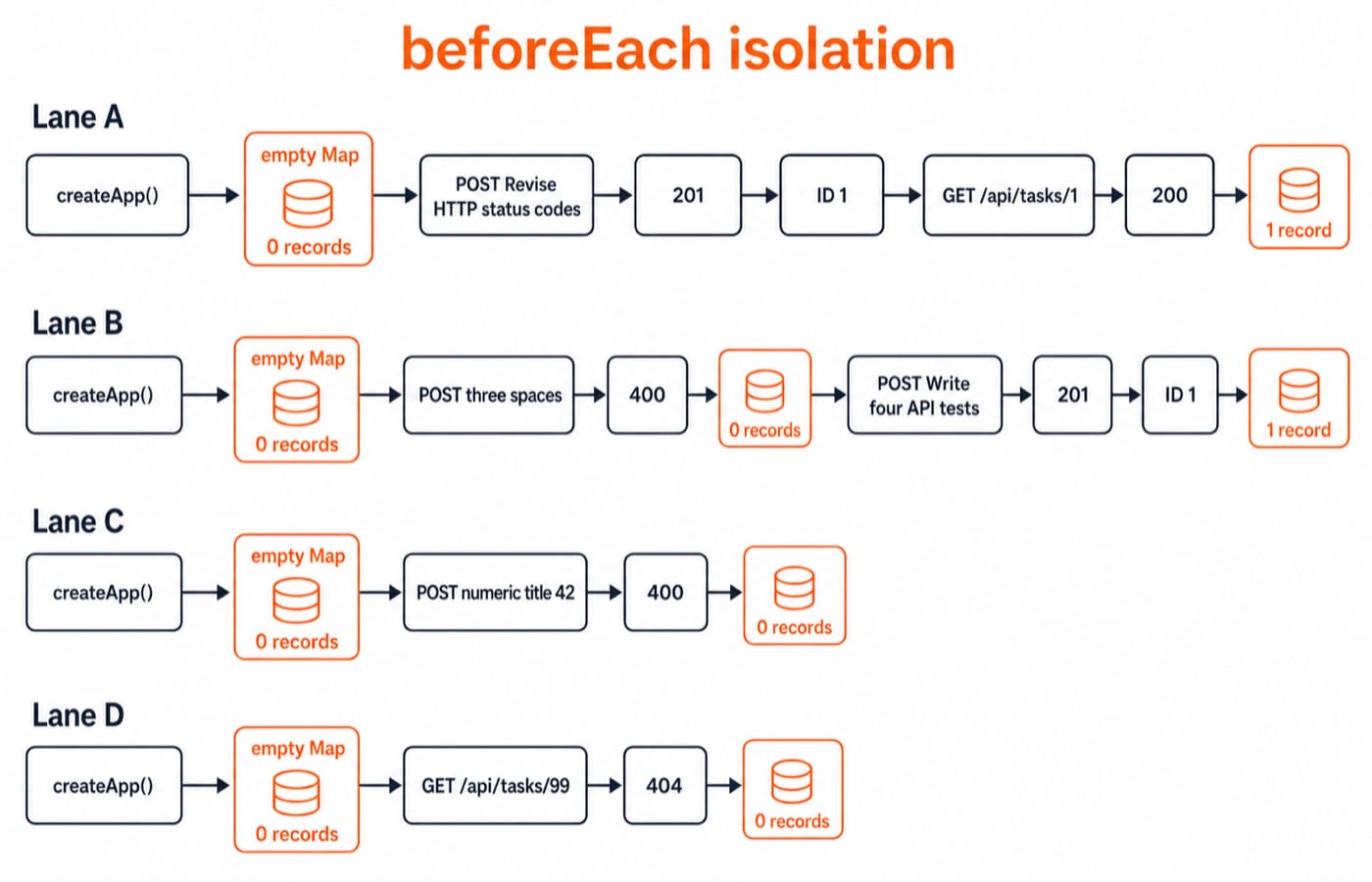
rejects a blank title leaves 0 records and nextId at 1, so its following valid POST creates ID 1, not ID 2. An omitted body and a numeric title also return 400; GET 99 returns 404.
Each test starts with 0 records because beforeEach calls createApp(). The first two tests each finish with 1 record in separate Maps; the other three finish with 0. Order cannot leak records or IDs.
Separate API route tests from real-database integration tests
The next architectural step is to put Map operations behind a taskStore interface and inject it through createApp({ taskStore }). Most route-contract tests can use a deterministic fake while still exercising Express, JSON parsing, routing and response formatting. A fake that returns a task does not prove MongoDB persistence.
Test persistence separately with a disposable test database. Create only test-owned data, await setup and cleanup, and never target production. Cover schema validation, one create-and-read path and relevant database errors. Mongoose Schemas and Models is the next concept for schemas and validation, though it is not a ready-made test environment.
Place external APIs behind injected clients and stub them deterministically. Routine tests should not depend on the public internet, time of day or another team's live service.
Common Node.js API testing mistakes and assessment prompts
Mistake | What goes wrong | Repair |
|---|---|---|
Importing a module that calls | Jest can retain an open server handle | Export the app and start it only in |
Sharing one | Records and IDs leak across tests | Call |
Omitting | Jest can report a false pass | Await or return every Supertest chain |
Asserting only status | Header and body regressions go unseen | Check the complete HTTP contract |
Mocking | Express parsing and routing are bypassed | Keep an HTTP-boundary test with Supertest |
Three useful interview, lab or code-review prompts follow directly from the suite:
What ID follows a blank title and one valid POST? ID 1, because rejection does not increment
nextId.Why can
GET /api/tasks/1return404after a successful POST? A newly created app owns a different emptyMap.Why does
201with the wrongLocationfail? The header is part of the promised client contract.
Testing APIs in Node.js: the short version and next step
Define the HTTP contract, export the Express app, keep listen separate, start every test with fresh state, assert status, headers, body and state, and reserve real dependencies for explicit integration tests. In this fixture, success means 201, /api/tasks/1 and task ID 1; controlled failures return 400 or 404.
Continue with the Node.js, Express.js & MongoDB Course. For a broader full-stack route, use the MERN Stack Course, or browse Skill Development Courses. The in-memory fixture proves its chosen boundary, not production readiness.
Keep learning
CommonJS vs ESM in Node.js: Modules Tutorial with Runnable Examples
Learn how Node.js classifies CommonJS and ESM files, run both module formats, fix loader errors, and migrate across explicit boundaries.
Updated 11 Nov 20265 min readWeb Development

Node.js File System Tutorial: Read, Write and Manage Files with Runnable Examples
Build one path-safe Node.js lab that reads attempt records, calculates accuracy, creates an output directory, writes a JSON summary, and appends an audit log.
Updated 9 Nov 20266 min readWeb Development
Node.js EventEmitter Tutorial: Events, Listeners and Runnable Examples
Build a precise mental model of Node.js events with three runnable programs. Trace listener order, nested emits, removal, return values and common mistakes.
Updated 8 Nov 20265 min readWeb Development
Node.js Routing and Controllers Tutorial: Build a Runnable Express API
Build a small Express users API from scratch, separate routes from controllers, and test successful and failed requests against predictable responses.
Updated 3 Sep 20266 min readComputer Networks