SOP and POS Canonical Forms Explained: Minterms, Maxterms and Worked Conversions
Learn how canonical SOP and POS encode the same Boolean function. Follow one three-variable truth table through minterms, maxterms, conversions and exam-style checks.
KnowledgeGate Team
Exam prep & CS education
Updated 21 Sep 20265 min read66 views
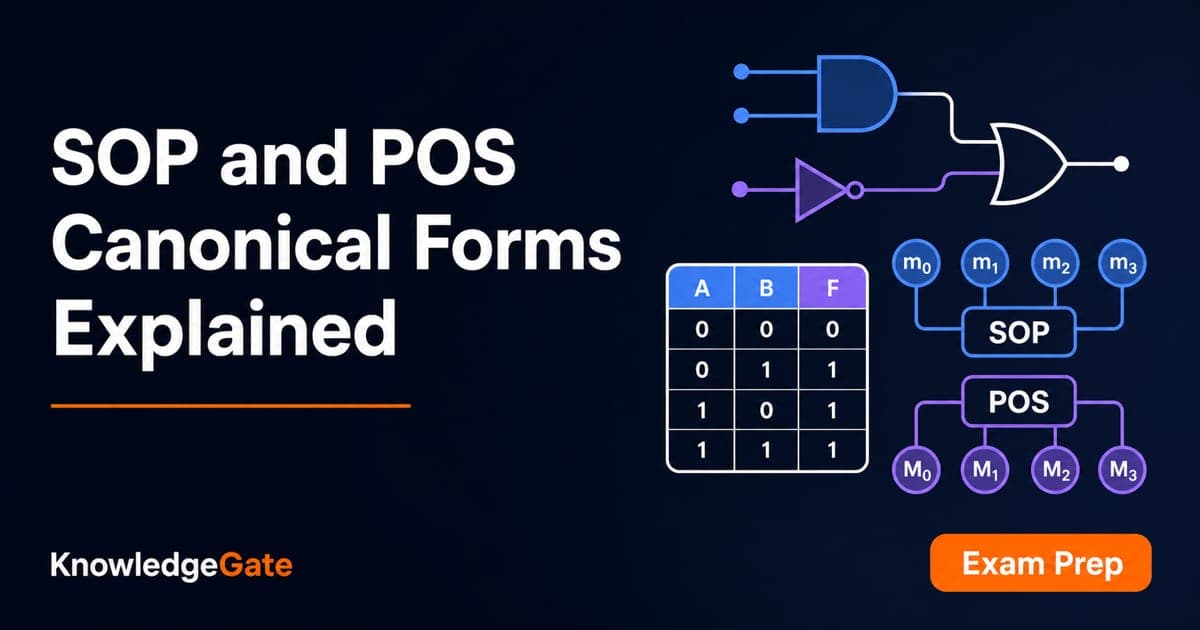
You may recognise an SOP or POS expression and still reverse the minterm and maxterm literal rules, select the wrong truth-table rows, or call a simplified expression canonical. These errors look small but change the function. Canonical forms follow from a three-variable function's truth-table rows, and missing variables can be introduced to expand a non-canonical expression. Consistent row indices and literal rules let you move among a truth table, binary row numbers, expanded literals, Sigma m notation and Pi M notation without guessing.
Related reading: Ex-OR and Ex-NOR truth tables and K-map minimisation.
SOP and POS canonical forms: what canonical means
A literal is a variable or its complement, such as A or A'. A product term ANDs literals, while a sum term ORs them. An SOP expression ORs product terms. A POS expression ANDs sum terms.
Canonical adds one strict condition. For a function of A, B, C, every canonical term must contain A, B and C exactly once, complemented or uncomplemented.
Form | Example | Canonical? | Reason |
|---|---|---|---|
SOP |
| No | Its terms omit variables |
POS |
| No | Its factors omit variables |
Canonical SOP | Sum of minterms | Yes | Every minterm contains every variable |
Canonical POS | Product of maxterms | Yes | Every maxterm contains every variable |
Minterm m_i equals 1 on exactly row i. Maxterm M_i equals 0 on exactly row i. We write a sum of selected minterms as F = Sigma m(...) and a product of selected maxterms as F = Pi M(...). The CS Fundamentals for Exams & Placements route places these ideas within the wider digital-logic sequence.
Minterm and maxterm indices: the literal rule
Fix the variable order as A, B, C, with A as the most significant bit. The row index is i = 4A + 2B + C.
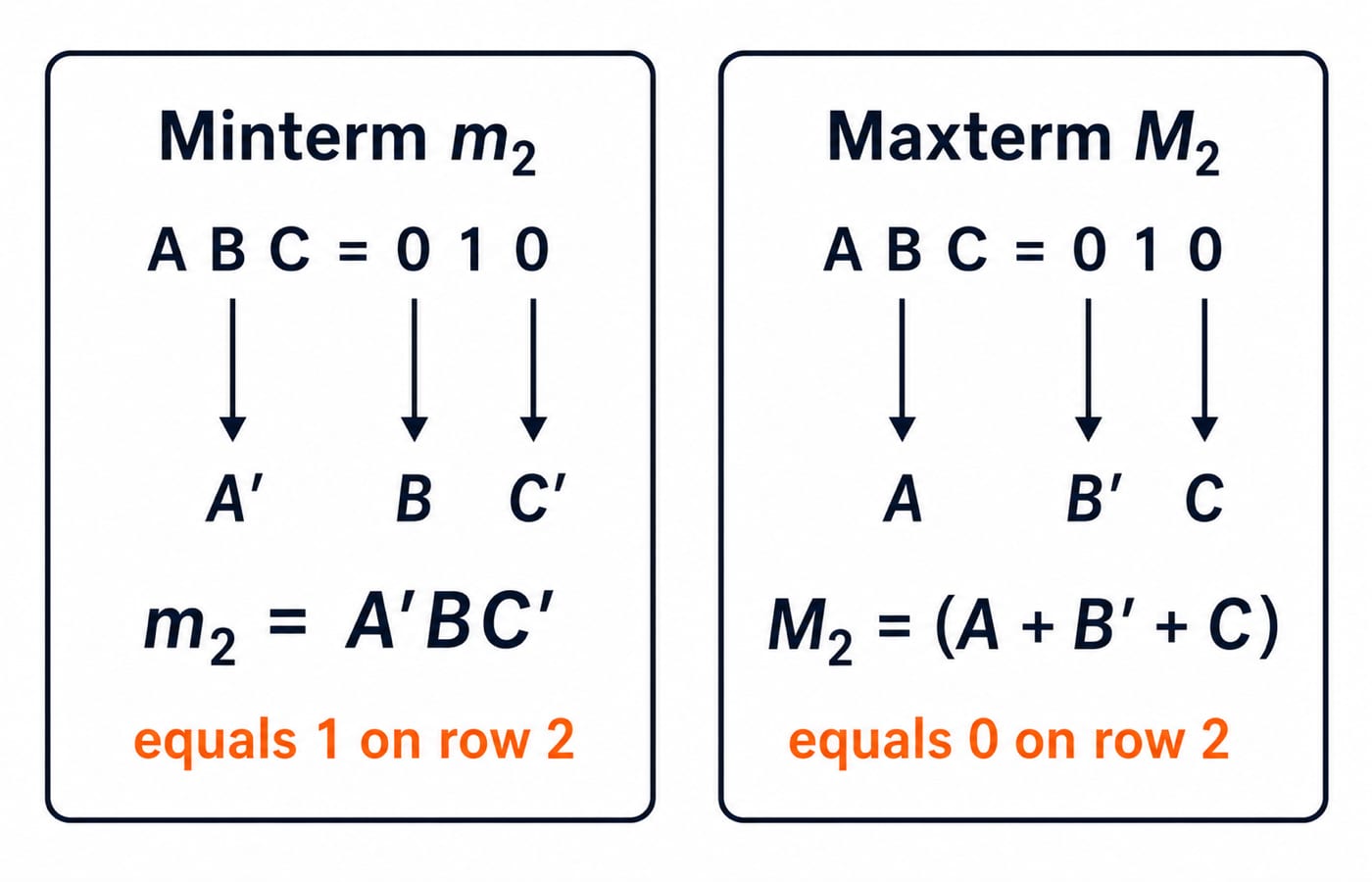
For a minterm, bit 0 gives a complemented literal and bit 1 gives an uncomplemented literal. For a maxterm, reverse the polarity so that the sum becomes 0 on that row.
i | ABC | minterm | maxterm |
|---|---|---|---|
0 | 000 |
|
|
1 | 001 |
|
|
2 | 010 |
|
|
3 | 011 |
|
|
4 | 100 |
|
|
5 | 101 |
|
|
6 | 110 |
|
|
7 | 111 |
|
|
Check row 010. Here m_2 = A'BC' = 1·1·1 = 1. The corresponding maxterm is M_2 = (A + B' + C) = 0 + 0 + 0 = 0.
Canonical SOP worked example from a truth table
Define F(A,B,C) by this complete truth table:
i | A | B | C | F |
|---|---|---|---|---|
0 | 0 | 0 | 0 | 0 |
1 | 0 | 0 | 1 | 1 |
2 | 0 | 1 | 0 | 1 |
3 | 0 | 1 | 1 | 0 |
4 | 1 | 0 | 0 | 0 |
5 | 1 | 0 | 1 | 1 |
6 | 1 | 1 | 0 | 0 |
7 | 1 | 1 | 1 | 1 |
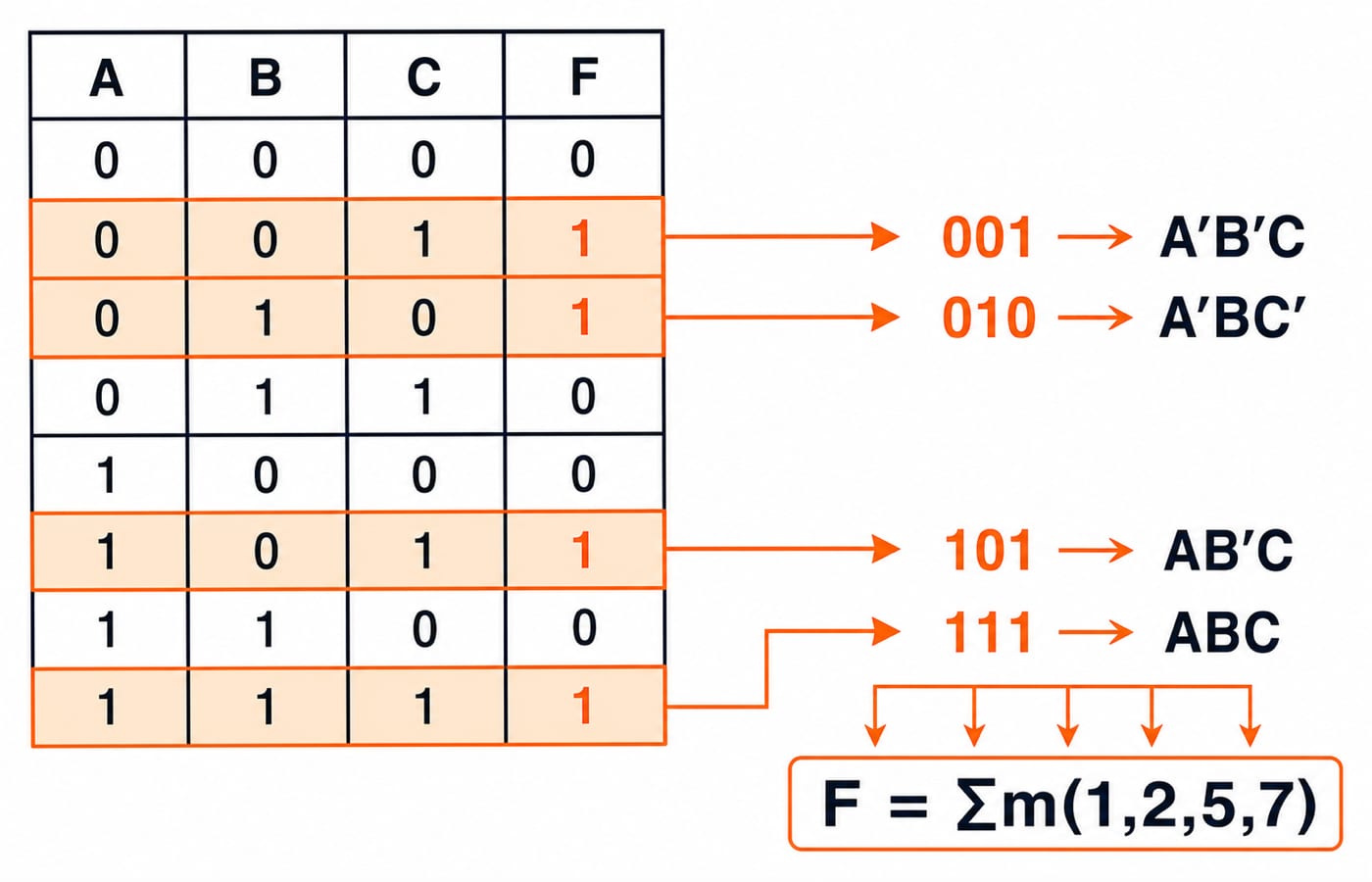
Select the output-1 rows and translate each binary row:
001 -> A'B'C, 010 -> A'BC', 101 -> AB'C, 111 -> ABC.
Therefore:
F = Sigma m(1,2,5,7) = A'B'C + A'BC' + AB'C + ABC.
At ABC=101, the term AB'C = 1·1·1 = 1, so the OR is 1. At rejected row ABC=100, the four minterms evaluate to 0, 0, 0, 0, so F=0.
Canonical POS worked example for the same function
Now select the output-0 rows 0, 3, 4, 6. Their maxterms are M_0=(A+B+C), M_3=(A+B'+C'), M_4=(A'+B+C) and M_6=(A'+B'+C).
Thus:
F = Pi M(0,3,4,6) = (A+B+C)(A+B'+C')(A'+B+C)(A'+B'+C).
At ABC=011, factor M_3 becomes 0+0+0=0, so the product is 0. At ABC=101, the four factors evaluate respectively to 1, 1, 1, 1, so the product is 1. Canonical SOP and canonical POS describe the same truth table using complementary row sets.
Converting SOP to POS and expanding an expression
For n variables, the row universe is U={0,...,2^n-1}. If F=Sigma m(S), then F=Pi M(U-S). Here {1,2,5,7} and {0,3,4,6} are complements inside {0,1,2,3,4,5,6,7}.
For a reverse drill, let G(A,B,C)=Pi M(1,2,4,7). Its one-set is the remaining indices, so:
G=Sigma m(0,3,5,6)=A'B'C' + A'BC + AB'C + ABC'.
This converts two representations of the same G. Finding G' would be a different operation.
Now expand H(A,B,C)=A+BC, an SOP that is not canonical:
A=A(B+B')(C+C')=ABC+ABC'+AB'C+AB'C'
BC=(A+A')BC=ABC+A'BC
After removing duplicate ABC and ordering terms by index:
H=Sigma m(3,4,5,6,7).
Its zero rows are 0,1,2, so:
H=Pi M(0,1,2)=(A+B+C)(A+B+C')(A+B'+C).
SOP and POS canonical-form traps
Wrong move | Why it fails | Repair |
|---|---|---|
Write | Minterm polarity is reversed | Use |
Use | SOP selects ones, POS selects zeros | Use |
Change variable order midway | The same bits produce different indices | Declare |
Drop variables but call the result canonical | Canonical terms contain every variable | Expand missing variables with |
Call every minimal form canonical | Minimisation combines rows and drops literals | Check variable coverage term by term |
For example, B'C + AC + A'BC' is a valid smaller SOP for the main function, but it is not canonical because its first two terms omit a variable. A K-map can merge adjacent rows to minimise the expression, while a canonical form preserves one full term per selected row. Boolean Expressions in Digital Electronics: Laws, Canonical Forms and Worked Simplification carries one function through Boolean laws, truth tables, simplification and gate mapping. Canonical SOP/POS conversion instead stays with row indices, literal polarity and complementary one/zero sets.
How questions test SOP and POS canonical forms
Question tasks include building terms from an index, converting index sets, counting maxterms and recognising the form:
Build terms from an index. With order
A,B,C, index5is101. Thereforem_5=AB'C, while the reversed maxterm polarity givesM_5=(A'+B+C').Convert the index set.
Sigma m(0,3,6,7)uses four of the eight rows. The complementary zero-set is{1,2,4,5}, so the result isPi M(1,2,4,5).Count maxterms. Four variables give
2^4=16rows. If six are listed minterms, then16-6=10rows output0, so the canonical POS has ten maxterms.Recognise the form. An expression can be SOP without being canonical. A K-map result can also be correct and minimal without being canonical.
Use Boolean Algebra and K-Map MCQs: 12 Solved (GATE) as a timed self-check. Canonical SOP also maps naturally to an AND-OR structure, while canonical POS maps to an OR-AND structure. Continue that hardware connection with Combinational Circuits: MUX, Decoders, Adders.
SOP and POS canonical forms: the short version and next step
Output
1rows give minterms and canonical SOP.Output
0rows give maxterms and canonical POS.Binary index order controls the literal pattern.
The two index lists for one function are complementary.
Now reproduce the output vector 0,1,1,0,0,1,0,1 without looking. Derive Sigma m(1,2,5,7) and Pi M(0,3,4,6), then check every expanded literal. For a sequenced Digital Logic path, continue with GATE Guidance by Sanchit Sir.
Keep learning

Functional Completeness in Digital Logic: NAND, NOR and Worked Examples
Learn what makes a Boolean operator set complete, how NAND and NOR recover a standard basis, and how to verify a four-gate NAND construction.
Updated 2 Oct 20266 min readDigital Logic
Boolean Function Counts: Formulas, Worked Examples and Exam Traps
Build the master Boolean-function formula from output choices, then learn how common restrictions change the count through combinations, pairing and inclusion-exclusion.
Updated 27 Sep 20266 min readDigital Logic

Analog-Digital Conversion Basics: ADC, DAC, Worked Examples and Exam Patterns
Build ADC and DAC basics from one consistent transfer model, then practise code selection, reconstruction error, flash and SAR conversion, and bit-depth calculations.
Updated 25 Sep 20266 min readDigital Logic

Universal Realization with NAND and NOR Gates: Concepts, Worked Example and Exam Patterns
Learn why NAND and NOR are universal, then implement one three-variable function using four NAND gates and four NOR gates with verified input traces.
Updated 23 Sep 20265 min readDigital Logic