Soil for Teaching Exams: Complete EVS Notes with Worked Examples
Connect soil formation, profiles, texture, water movement, fertility, and conservation. Then use two solved experiments and a fair classroom investigation to test the ideas.
KnowledgeGate Team
Exam prep & CS education
Updated 6 Sep 20266 min read

Soil questions mix daily observations, scientific terms, calculations, and pedagogy, so lists of soil types leave gaps. Soil study links weathering, horizons, texture, water movement, fertility, conservation, and inquiry. Sedimentation and drainage experiments provide concrete comparisons.
Soil formation and profile: from parent rock to topsoil
Soil is a natural body containing mineral particles, organic matter, water, air, and organisms. Rock is weatherable parent material. Humus is only the dark, decomposed organic component.
Physical weathering breaks material without changing mineral identity. Chemical weathering alters or dissolves minerals. Biological weathering results from roots and organisms. Five controls interact: parent material, climate, organisms, relief or slope, and time.
On two slopes with the same parent rock and rainfall, a steep bare slope loses more loosened material through runoff. A gentler grass-covered slope retains more material and organic input. No single control determines the final soil.
Horizon | What is usually found | Exam distinction |
|---|---|---|
O | Surface organic litter, where present | Not the whole profile |
A | Mineral topsoil mixed with humus and many roots | Main topsoil layer |
B | Subsoil where clay or iron compounds may accumulate | Not bedrock |
C | Partly weathered parent material | Beneath developed soil |
R | Consolidated bedrock | Parent rock beneath the profile |
Real profiles need not show every horizon as a neat, equally thick band.
Soil texture and types: sand, silt, clay, and loam
The particle-size order is sand > silt > clay. Sandy soil commonly has larger connected pores and faster drainage. Clayey soil commonly has many small pores, slower drainage, and greater retention. Silt feels smoother than sand. Loam is a mixture, not a fourth mineral particle.
Soil | Feel | Aeration | Drainage | Water retention | Handling caution |
|---|---|---|---|---|---|
Sandy | Gritty | Commonly high | Commonly fast | Commonly low | Organic matter and compaction can alter it |
Clayey | Sticky when wet | Commonly low | Commonly slow | Commonly high | High retention does not guarantee fertility |
Loamy | Mixed, often crumbly | Usually balanced | Usually moderate | Usually moderate | Its behaviour still depends on structure |
Texture is the share of sand, silt, and clay. Structure describes particle aggregates. Fertility is the capacity to support growth through nutrients and suitable conditions. Two samples may each contain 60% sand, 25% silt, and 15% clay yet drain differently if one is compacted and the other has stable crumb aggregates.
Soil texture worked example: reading a sedimentation jar
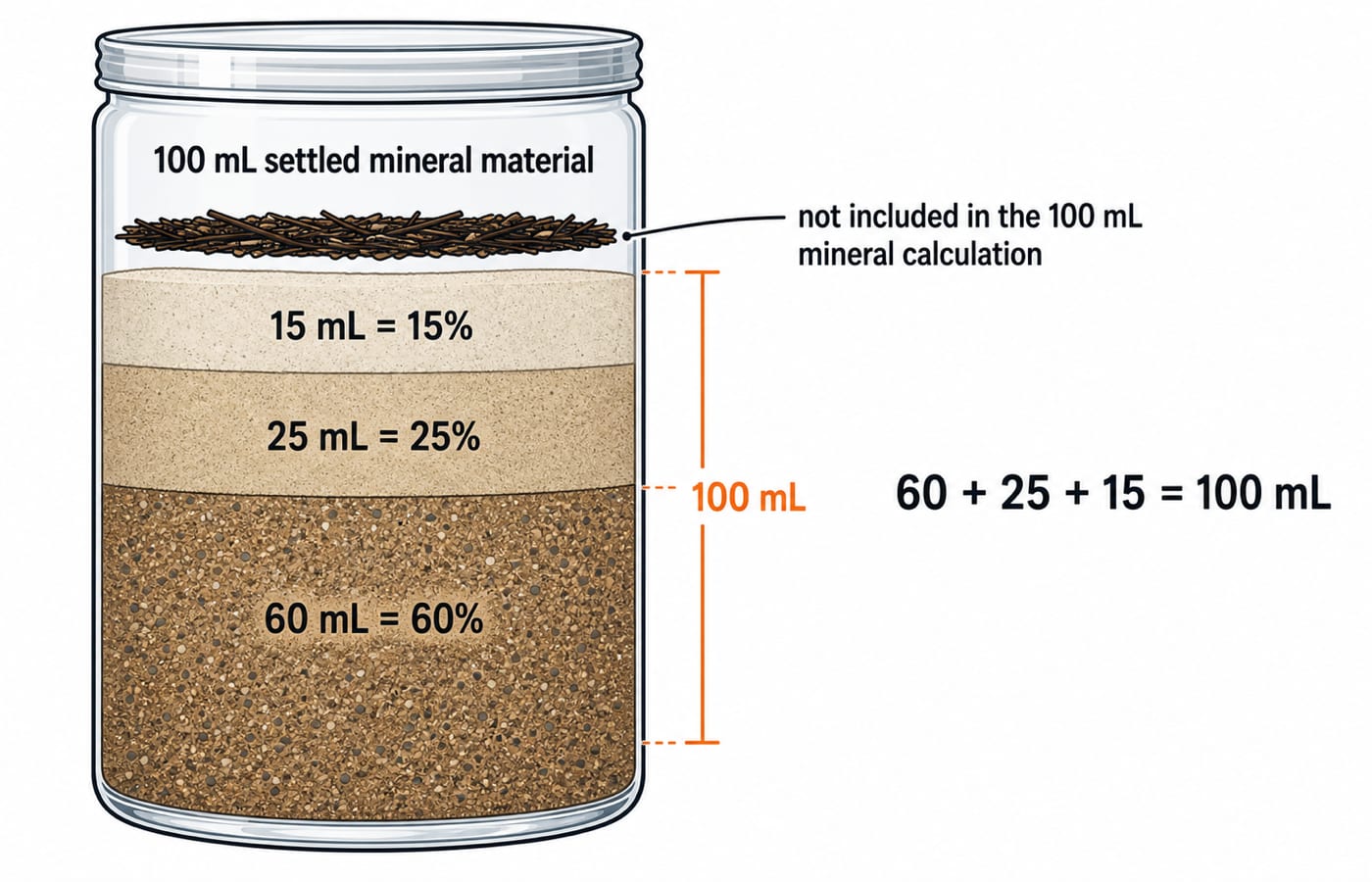
Shake soil with water in a transparent jar, let it settle, and measure the mineral layers. The total mineral material is 100 mL: sand 60 mL, silt 25 mL, and clay 15 mL. Exclude floating organic fragments. Check: 60 + 25 + 15 = 100 mL.
Sand
= 60 ÷ 100 × 100 = 60%Silt
= 25 ÷ 100 × 100 = 25%Clay
= 15 ÷ 100 × 100 = 15%
Sand dominates. If a simplified question offers only sandy, clayey, or loamy, sandy is best supported. This is not a formal texture-triangle classification or pure sand because silt plus clay form 25% + 15% = 40%.
Soil water movement worked example: percolation and retention
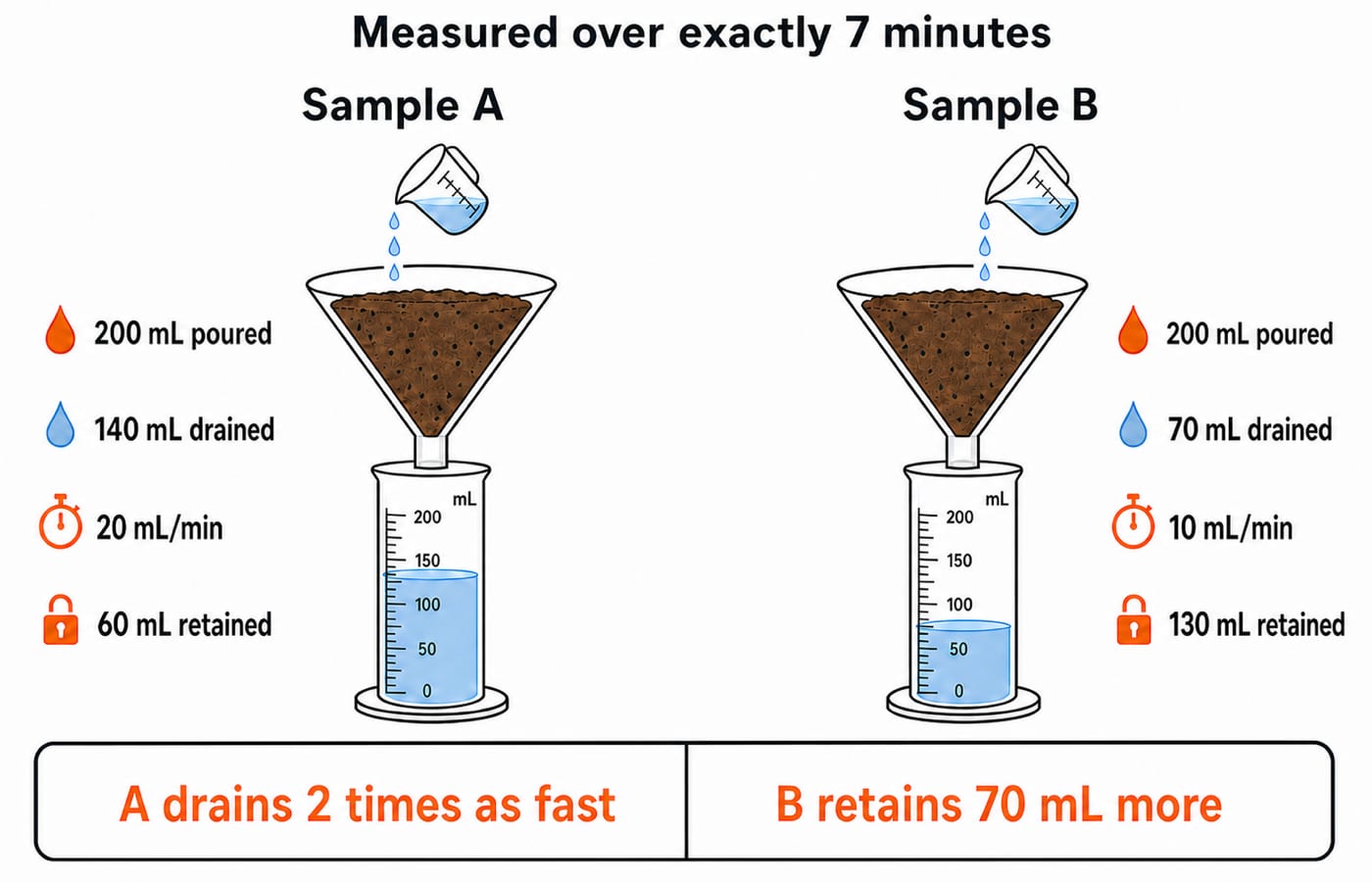
Infiltration is water entering the surface. Percolation is downward movement through pores. Retention is water remaining after drainage. Percolation rate is volume drained ÷ time in mL/min; retention is volume poured - volume drained.
Equal samples receive the same water and drain for the same time:
Sample | Calculation of rate | Calculation of retention | Result |
|---|---|---|---|
A |
|
| Faster drainage |
B |
|
| Greater retention |
A drains 20 ÷ 10 = 2 times as fast. B retains 130 - 60 = 70 mL more water. Do not identify either texture from drainage alone. Compaction, cracks, and organic matter are alternative explanations unless the setup controls them.
Soil fertility and conservation: follow matter through the system
Bacteria and fungi decompose dead matter into humus, which can support aggregation, water holding, and nutrient supply. Earthworms help mix soil, but no organism alone measures fertility. Roots need water and oxygen, so maximum retention is not automatically ideal.
Process | What happens |
|---|---|
Weathering | Parent material breaks or alters |
Erosion | Soil particles are removed |
Deposition | Transported particles are laid down |
Leaching | Dissolved substances move downward with water |
In a teaching example, rain detaches particles from a bare 20 m × 10 m plot, runoff carries them downslope, and slower water deposits them at the field edge. Its area is 20 × 10 = 200 m², not a measured erosion rate.
Match protection to cause. Plant cover and mulch reduce impact and exposure. Contour ploughing and terraces slow downslope flow. Shelter belts reduce wind speed. Careful irrigation limits runoff and waterlogging. No method suits every slope, soil, and crop.
Soil pedagogy for teaching exams: design a fair investigation
Good EVS pedagogy moves through predict, observe, measure, compare, and explain. Put three equal 150 g dry samples in identical funnels, add 100 mL water, and collect drainage for exactly 5 min. Keep funnel size, filter, initial dryness, mass, volume, and time constant. Vary only the sample.
Suppose X drains 72 mL, Y drains 38 mL, and Z drains 55 mL. The drainage order is X > Z > Y. Retained water is X 100 - 72 = 28 mL, Y 100 - 38 = 62 mL, and Z 100 - 55 = 45 mL.
Students should record these values and visible observations before proposing a texture. Their hypothesis must then be checked by touch or sedimentation evidence. Asking for evidence is stronger than declaring X sandy from drainage alone. The broader CTET EVS Pedagogy: Concepts & Pattern approach likewise treats a prediction as testable, not correct or incorrect before observation.
Soil questions in teaching exams: recognise the frame and traps
Common frames ask you to arrange horizons, match properties, calculate percolation or retention, choose erosion control, or select a classroom activity. A content item asks which sample drained faster. A pedagogy item asks which variables must remain constant.
Trap | Why it fails | Better test |
|---|---|---|
Humus equals soil | Humus is one component | Name all major components |
Smaller particles mean larger pores | The usual trend is the reverse | Link particle size to pore behaviour |
Highest retention is always best | Roots also need oxygen | Consider aeration and plant needs |
Weathering equals erosion | One forms or alters, the other removes | Track whether material moves |
B horizon is bedrock | R is bedrock in this profile | Recall |
One observation proves texture | Other variables affect drainage | Combine evidence under controls |
Use CTET & UPTET Teaching Eligibility Test Prep to find relevant preparation paths. If you are deciding where primary-level EVS fits, read CTET Paper 1 vs Paper 2: Which to Attempt. Check your own exam's current official notification for pattern specifics.
Soil revision: the short version and next step
Components: minerals, organic matter, water, air, and organisms.
Formation: parent material, climate, organisms, relief, and time.
Profile:
O-A-B-C-R.Particle order:
sand > silt > clay.Texture, structure, and fertility are different ideas.
Infiltration is entry, percolation is downward movement, retention is what remains.
Conservation must match the cause of soil loss or damage.
Self-check: What dominates a 60:25:15 sample? Sand. What is 140 ÷ 7? 20 mL/min. Why is 130 mL retained not automatically best? Aeration and plant needs also matter.
For a structured CTET primary-level path that includes Environmental Studies, use CTET Paper 1 2026. The corresponding UPTET route that includes EVS is UPTET Paper 1 2026. Their current exam patterns need not be identical, so follow the notification for the exam you will attempt.
Keep learning

सामान्य अशुद्धियाँ (Samanya Ashuddhiyaan): Complete Hindi Grammar Notes for CTET and TET Exams
Learn to identify and correct Hindi word-form, agreement, pronoun and redundancy errors through exact examples, a worked MCQ and a scored diagnostic.
Updated 6 Oct 20266 min readCTET & UPTET

Universities and Learning Programmes for Teaching Exams: Types, Modes and Solved Examples
Separate university status, delivery mode and programme purpose with a repeatable method, then test it on five UGC NET-style classification cases.
Updated 2 Oct 20265 min readCTET & UPTET

National Education Policy (NEP) 2020 Notes for Teaching Exams: 5+3+3+4, Reforms and MCQ Traps
Build an exam-ready map of NEP 2020, from the age-stage structure to pedagogy, language, PARAKH, B.Ed. routes and reliable distractor elimination.
Updated 26 Sep 20265 min readCTET & UPTET

Miscellaneous Pedagogy Topics for Teaching Exams: Complete Notes and Worked Examples
Turn a loose syllabus label into a five-part concept map, then use classroom evidence to distinguish sound pedagogy from attractive but incomplete options.
Updated 25 Sep 20266 min readCTET & UPTET