Air Pollution Notes for Teaching Exams: Pollutants, Smog, Control Methods and Worked Examples
Build air-pollution answers through the complete source-to-effect chain. Revise key distinctions, solve a data question, and evaluate a safe classroom activity.
KnowledgeGate Team
Exam prep & CS education
Updated 5 Sep 20265 min read
Air-pollution questions test a chain: source, pollutant, atmospheric change, effect and control. Following that chain prevents source, concentration, exposure and control from being treated as interchangeable.
Related reading: noise pollution and waste management and environmental conventions.
Air pollution basics: follow the source-to-effect chain
Air pollution is solid particles, liquid droplets, gases or biological material in air at a concentration and duration capable of harm or undesirable change.
An emission leaves a source. Ambient concentration is measured nearby. Exposure reaches a person over time; dose enters or interacts with the body. They differ.
Classify sources independently:
Natural or human-made: dust storms and wildfires versus vehicle exhaust and fuel combustion. Natural can harm; human-made covers many sectors.
Stationary or mobile: stacks and generators versus cars and buses.
Incomplete combustion in a poorly ventilated room releases carbon monoxide. Inhalation reduces blood's oxygen-carrying capacity. Remove or vent the source, not mask the smell: carbon monoxide is colourless and odourless. Pollutants are not always detectable.
Major air pollutants: form, source, effect and control
Pollutant | Particle or gas | Typical source or formation | Main exam distinction | Control direction |
|---|---|---|---|---|
Particulate matter | Particle | Combustion, dust, abrasion, formation in air | Reaches respiratory system; size matters | Reduce; capture |
Carbon monoxide | Gas | Incomplete combustion | Disrupts oxygen transport | Improve combustion; vent |
Sulphur dioxide | Gas | Sulphur-containing fuel | Primary; forms secondary products | Reduce sulphur; scrub |
Nitrogen oxides | Gases | Hot combustion | Ozone and nitrate precursors | Improve combustion; treat exhaust |
Volatile organic compounds | Gases | Fuels, solvents | Some form secondary pollutants | Substitute; contain |
Ground-level ozone | Gas | Atmospheric reactions | Secondary pollutant | Reduce precursors |
PM10 has aerodynamic diameter up to 10 micrometres. PM2.5 is its finer subset up to 2.5 micrometres. An 8 micrometre particle is PM10 only; a 1.5 micrometre particle fits both.
Pollutant and climate driver are not exclusive. Carbon dioxide drives the greenhouse effect but differs from PM and carbon monoxide locally. Ground-level ozone is both pollutant and short-lived climate forcer. Follow the named process.
Primary and secondary pollution: smog, ozone and inversion
A primary pollutant is emitted directly, such as carbon monoxide, sulphur dioxide or particles. A secondary pollutant forms in air, such as ozone or secondary sulphate and nitrate particles. This concept pathway is not a balanced equation: nitrogen oxides + VOCs + sunlight -> photochemical oxidants including ozone.
Sulphurous smog | Photochemical smog |
|---|---|
Smoke, sulphur dioxide, cool humid conditions, fuel combustion | Sunlight reacts nitrogen oxides and VOCs into ozone and other oxidants |
Stratospheric ozone absorbs much ultraviolet radiation; ground-level ozone is harmful. Oxidised sulphur dioxide and nitrogen oxides contribute to sulphuric and nitric acids and acid deposition.
A temperature inversion puts warm air above cool surface air, suppressing mixing. It does not create pollution; it restricts dispersion near the ground.
Air-pollution data worked example
Use hypothetical data from the same site, calibrated monitor and averaging method. They are not current readings, standards or AQI categories.
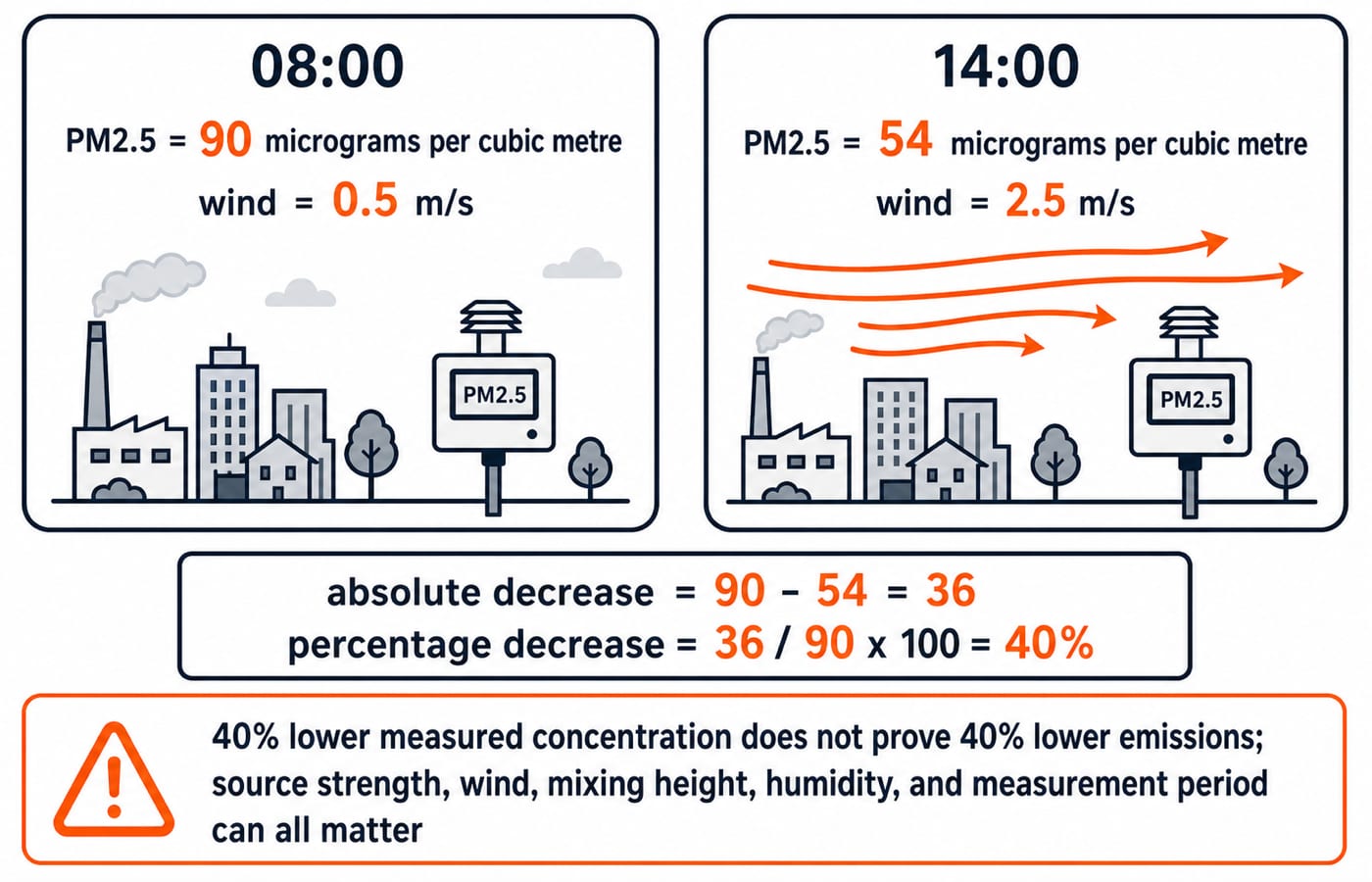
At 08:00, PM2.5 is 90 micrograms per cubic metre and wind is 0.5 m/s. At 14:00, they are 54 micrograms per cubic metre and 2.5 m/s.
Absolute decrease
= 90 - 54 = 36 micrograms per cubic metre.Percentage decrease from the morning value
= 36 / 90 x 100 = 40%.Afternoon concentration
= 54 / 90 x 100 = 60%of the morning value.
Measured concentration was 40% lower at 14:00. Wind may affect dispersion, but two observations cannot prove it caused the change or emissions fell 40%.
Effects and controls: match the method to the source
Human health: carbon monoxide reduces oxygen delivery; PM and reactive gases affect respiration. Plants and ecosystems: ozone injures plants; acid deposition alters soils and waters. Materials: acid deposition can damage them. Pollutant, concentration and exposure matter; brief and long-term exposure differ.
Control hierarchy: avoid or reduce at source -> capture or convert before release -> improve process and maintenance -> reduce residual exposure.
A cyclone uses centrifugal motion and generally suits larger particles. A bag filter traps particles in fabric; an electrostatic precipitator charges and collects them. A suitable scrubber transfers selected pollutants into liquid. A catalytic converter converts selected vehicle-exhaust gases. No device removes everything.
Indoors, use smoke-free spaces, cleaner cooking energy, maintained exhausts and source removal. Ventilation helps when outside air is cleaner; a traffic-side window can bring pollution in.
Air-pollution pedagogy: a safe investigation
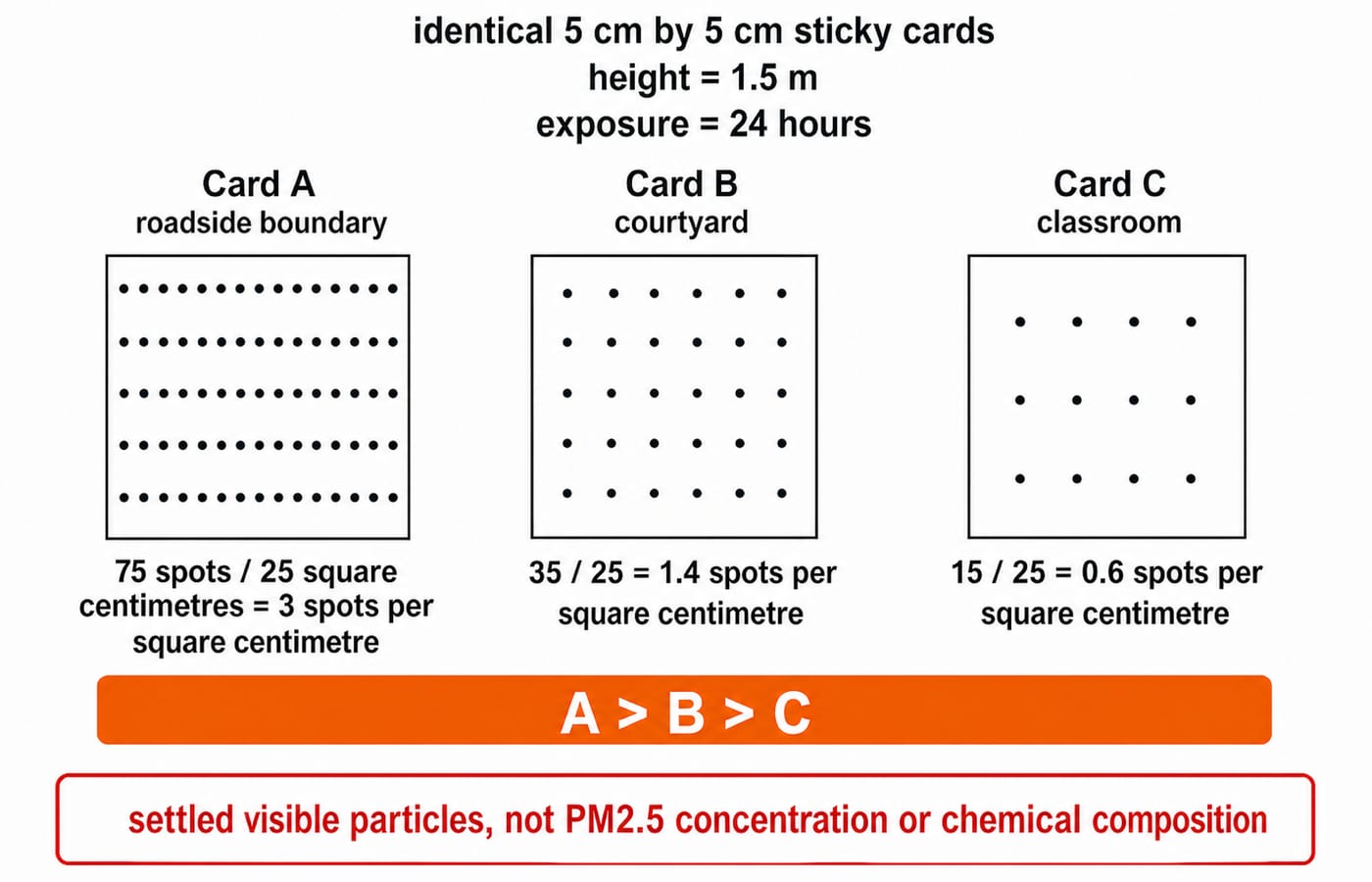
Without burning, an adult places three identical sticky cards safely. Each is 5 cm x 5 cm = 25 square centimetres, 1.5 m high, for exactly 24 hours. A is by a roadside boundary, B in a courtyard, C in a classroom away from an open window. Keep material, coating, area, height, time and counting constant. Keep children from traffic.
Visible deposited spots are A = 75, B = 35 and C = 15:
A:
75 / 25 = 3 spots per square centimetreB:
35 / 25 = 1.4 spots per square centimetreC:
15 / 25 = 0.6 spots per square centimetre
The order is A > B > C. It shows different visible settled-particle deposition, not PM2.5, composition or proof that traffic caused every spot. CTET EVS Pedagogy: 6 Themes and How It Is Tested applies predict-observe-measure-explain to classroom questions.
Air-pollution questions in teaching exams
Frames match source and pollutant, separate primary and secondary, classify PM, identify poor dispersion, choose a control, or judge a conclusion. Content asks for 40%; pedagogy asks why this cannot prove 40% lower emissions.
Trap | Why it fails | Better distinction |
|---|---|---|
All visible smoke is PM2.5 | Sight cannot establish size | Visible material has varied sizes |
PM10 and PM2.5 never overlap | PM2.5 is within PM10 | Fine particles fit both |
Ozone is always beneficial | Location matters | Atmospheric level changes its role |
Secondary means less harmful | Formation does not set safety | It means formed in air |
Inversion produces pollution | It restricts mixing | Sources pollute; inversion traps |
AQI is a simple average | Methods and official breakpoints vary by pollutant | Use the official method |
More wind solves pollution | Dispersion is not source control | Control emissions |
Use the CTET & UPTET Teaching Eligibility Test Prep category for preparation resources and CTET Paper 1 vs Paper 2: Which to Attempt to place EVS in the primary-level route. Confirm the current CTET syllabus and pattern on the official CTET website; another exam's pattern may differ.
Air pollution revision: the short version and next step
Emission is released; ambient concentration is measured.
Classify sources as natural or human-made, and stationary or mobile.
Separate particles and gases.
PM2.5 is within PM10.
Primary is emitted; secondary forms in air.
Sulphurous and photochemical smog differ.
Stratospheric ozone protects; ground-level ozone pollutes.
Match control to source and pollutant.
Self-check: classify 1.5 micrometres; find the fall from 90 to 54; find B's density; explain why A is not PM2.5. Answers: PM2.5 and therefore also PM10; 40%; 1.4 spots per square centimetre; visible deposits are not size-resolved airborne mass.
More than 40 Air Pollution practice questions are available on KnowledgeGate, which reflects practice depth rather than exam frequency or weightage. CTET Paper 1 Course 2026 includes Environmental Studies in a structured primary-level route. UPTET Paper 1 2026 includes EVS for UPTET preparation. The two exams may use different patterns.
Keep learning

Guidance, Counselling and Mental Health for Teaching Exams: Concepts, Cases and Exam Traps
Learn to separate guidance, counselling and mental-health support, then apply the distinctions to learner cases without crossing a teacher's professional boundaries.
Updated 23 Oct 20266 min readCTET & UPTET

Classroom Management and Communication for Teaching Exams: Complete Notes and Worked Scenarios
Connect classroom management, communication, feedback, discipline, and teacher immediacy, then practise an exam-style vignette with a step-by-step solution.
Updated 19 Oct 20266 min readCTET & UPTET

Teaching-Learning Aids and ICT Integration for Teaching Exams: Notes with Worked Classroom Examples
Learn how to select and sequence teaching-learning aids, recognise genuine ICT integration, and solve classroom scenarios with worked calculations.
Updated 15 Oct 20265 min readCTET & UPTET

Nature, Objectives and Characteristics of Teaching: Concept Notes for Teaching Exams
Learn to separate what teaching is, what change it seeks and how an effective teaching process operates. A worked fraction lesson connects every concept.
Updated 10 Oct 20265 min readCTET & UPTET