CTET EVS pedagogy: the concepts, themes and testing pattern
A CTET Environmental Studies pedagogy guide for Paper 1: the six syllabus themes, the integrated approach, activities, and how EVS is actually tested.
KnowledgeGate Team
Exam prep & CS education
Updated 14 Jul 20265 min read65 views
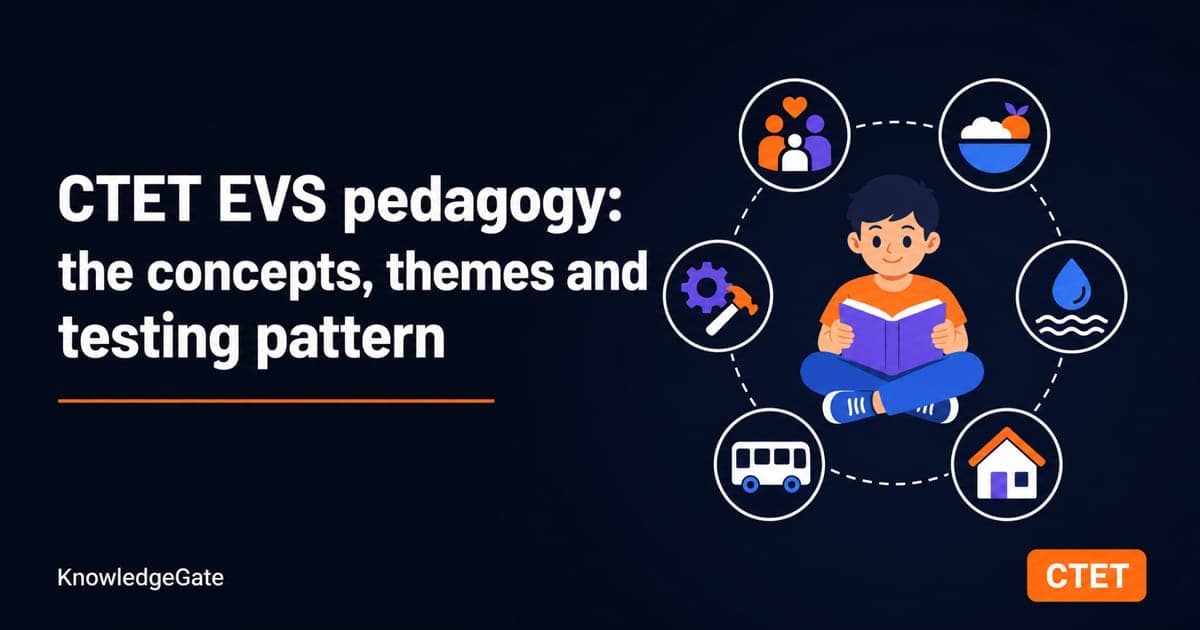
Environmental Studies is a Paper 1 section, and it is one of the most under-prepared parts of CTET because candidates assume it is "general knowledge". It is not. EVS at the primary level has a specific philosophy, a defined set of themes, and a pedagogy that the exam tests directly. Get those three right and EVS becomes one of the safest scoring parts of Paper 1, because its questions run on a value system you can predict.
Primary-level EVS methodology is settled practice, so learn it as fact. The exact question count and marking scheme are in the official notification at ctet.nic.in.
What EVS is at the primary level
EVS in classes 1 to 5 is deliberately integrated. It does not teach science, social studies, and environmental awareness as separate silos; it weaves them together around the child's immediate world.
It is child-centred and experience-based. Learning starts from what the child sees, family, water, food, shelter, travel, and moves outward.
It is integrated, not compartmentalised. A single theme like water pulls in science (states of water), social studies (water and community), and environmental concern (conservation) at once.
It builds attitudes, not just facts. Sensitivity toward the environment and other people is an explicit goal, not a by-product.
Holding this philosophy in mind resolves a large share of EVS pedagogy questions, because the "correct" approach is nearly always the integrated, experiential one.
The syllabus themes
The primary EVS syllabus is organised around a small set of themes drawn from the child's life. Knowing them as a group helps you place any question. For where the EVS section sits alongside the other four Paper 1 sections, see CTET Syllabus 2026 Decoded.
Family and Friends, including relationships, animals, plants, and work and play.
Food, its sources, and how it reaches us.
Water, its sources, uses, and conservation.
Shelter, houses, and how people live.
Travel, journeys and means of transport.
Things We Make and Do, everyday work and crafts.
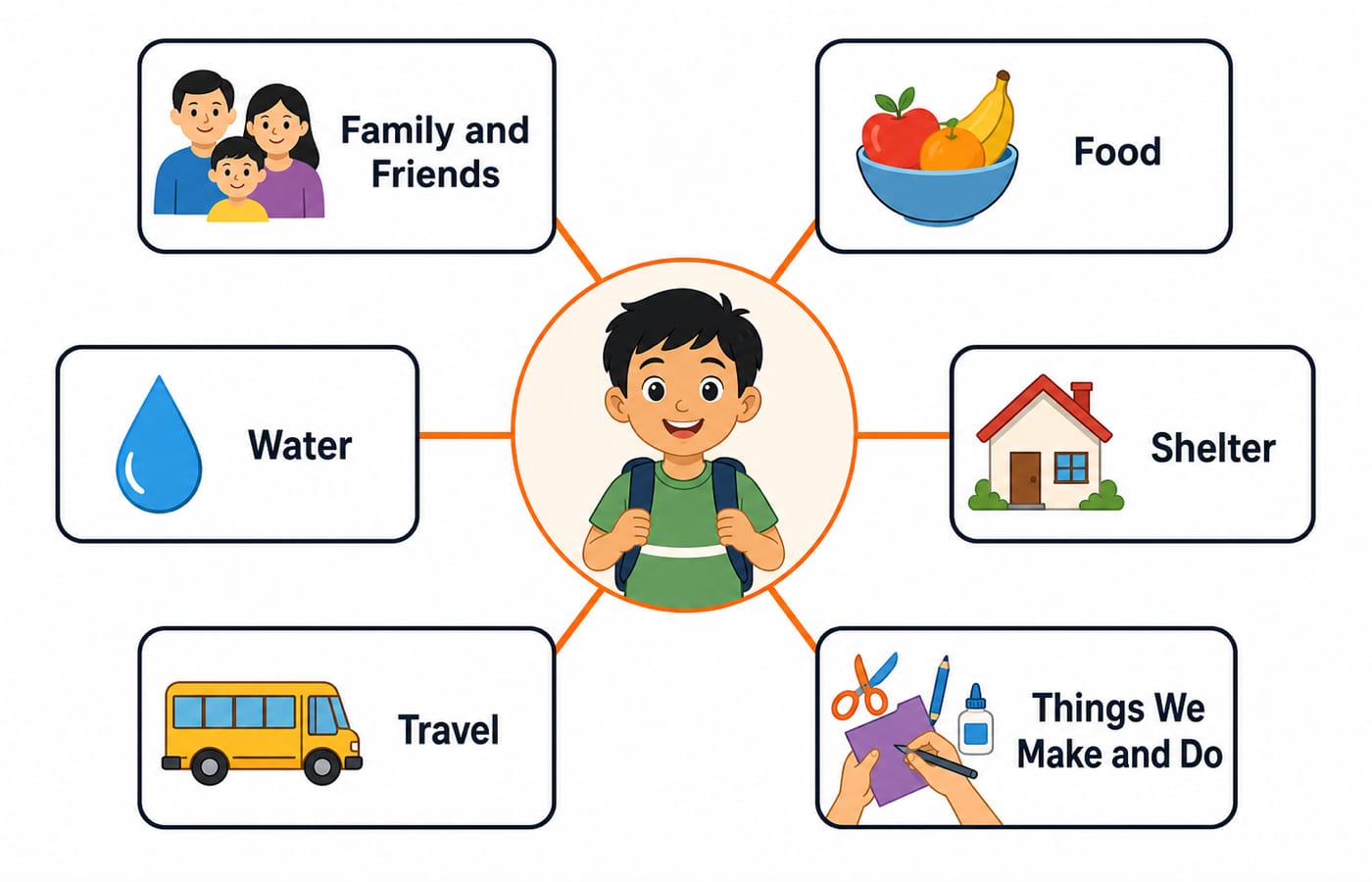
The spoke layout is the point: every theme radiates from the child's own experience, which is exactly why EVS pedagogy favours starting from a learner's context rather than a textbook definition.
The pedagogy EVS rewards
The methodology questions cluster around a consistent set of values.
The integrated approach over subject-wise teaching. An answer that keeps science, social studies, and environment joined is usually right.
Activity, observation, and exploration over lecturing. Nature walks, surveys, collecting and classifying, and discussion are all favoured.
Concept mapping and thematic organisation as planning tools that mirror the integrated syllabus.
Local and contextual content, using the child's own surroundings as the primary teaching resource.
Assessment through observation and projects, not only written tests, in line with continuous and comprehensive evaluation.
A worked scenario, reasoned step by step
CTET EVS pedagogy questions arrive as classroom situations, not definitions. Take one in the form you will meet it. A Class 4 teacher wants her children to learn about water. Which approach is most appropriate?
(a) Dictate notes on the water cycle and ask children to copy them.
(b) Ask children to memorise a labelled diagram of the water cycle.
(c) Teach the textbook chapter and then give a test of factual recall.
(d) Ask children to find out where the water used in their home comes from, compare it with what their neighbours use, report their findings, and discuss the different sources in class.
Eliminate option (a) first. Dictation makes children passive recipients, which is the opposite of the EVS preference for activity and observation. Option (b) reduces learning to memorising a diagram, so it drops both the experiential route and the link to the child's own life. Option (c) tests isolated facts after textbook teaching, ignoring contextual learning and the EVS preference for assessment through observation and projects. Option (d) is the answer. Children investigate something familiar, gather evidence, and compare experiences, so the task is child-centred and experiential. It also integrates science (where water comes from and how it reaches the house) with family and community life, and you can assess it through observation and discussion rather than a written test alone.
The transferable rule is simple. The option that turns the child into an investigator of their own surroundings beats the option that treats the child as a recipient of facts.
How EVS is actually tested
The CTET EVS section has two halves: content items and pedagogy items. A pedagogy item presents a teaching method, a classroom activity, or an assessment choice, then asks you to identify the sound option. Read every one of them as a question about how a primary teacher should help children learn, not as a question about facts.
The content half asks you to recognise the six themes at a primary level, not to master specialist detail. Give it one careful pass, followed by practice with previous-year questions, until the themes and the child's everyday world feel familiar. Return to the pedagogy several times, until its preference for integrated, experiential, contextual and child-centred learning is automatic.
The discriminator that separates EVS pedagogy from science or social-studies pedagogy is integration. A sound EVS lesson connects the dimensions of one theme, such as the science of water, the social life around water, and the concern for conserving it. So while eliminating options, reject the choices that shut the theme inside a single subject and prefer the ones that join experience, environment and social context.
Your next step
Prepare CTET EVS as a real section with a real philosophy, not as general awareness. Learn the six themes as a connected set, internalise the integrated and experiential pedagogy, and practise scenario questions until the value system is automatic.
Our sequenced EVS coverage sits inside the CTET Paper 1 course, and the complete two-paper path is in the CTET 2026 (Paper 1 and 2) bundle. You can see the full teaching-eligibility line-up on the CTET category page. Confirm the EVS weightage on the official notification at ctet.nic.in before you decide how much time it deserves.
Keep learning
सामान्य अशुद्धियाँ (Samanya Ashuddhiyaan): Complete Hindi Grammar Notes for CTET and TET Exams
Learn to identify and correct Hindi word-form, agreement, pronoun and redundancy errors through exact examples, a worked MCQ and a scored diagnostic.
Updated 6 Oct 20266 min readCTET & UPTET
Universities and Learning Programmes for Teaching Exams: Types, Modes and Solved Examples
Separate university status, delivery mode and programme purpose with a repeatable method, then test it on five UGC NET-style classification cases.
Updated 2 Oct 20265 min readCTET & UPTET
National Education Policy (NEP) 2020 Notes for Teaching Exams: 5+3+3+4, Reforms and MCQ Traps
Build an exam-ready map of NEP 2020, from the age-stage structure to pedagogy, language, PARAKH, B.Ed. routes and reliable distractor elimination.
Updated 26 Sep 20265 min readCTET & UPTET
Miscellaneous Pedagogy Topics for Teaching Exams: Complete Notes and Worked Examples
Turn a loose syllabus label into a five-part concept map, then use classroom evidence to distinguish sound pedagogy from attractive but incomplete options.
Updated 25 Sep 20266 min readCTET & UPTET