

Software Process and Generic Process Model MCQs: 10 Solved Questions on Framework Activities and Patterns
Test the boundaries that make software-process questions tricky. Each MCQ includes its answer, cue words, distractor repair, and a concrete help-desk example.
KnowledgeGate Team
Exam prep & CS education
Updated 21 Nov 20267 min read

Software-process MCQs use familiar words, but often test an exact boundary: framework activity versus umbrella activity, linear flow versus feedback, or process model versus supporting tool. Framework activities form the flow, umbrella activities span it, feedback changes the path, prototypes expose uncertainty, patterns package reusable solutions, and tools support the work. Use Software Process Models in Software Engineering for a weighted model-selection walkthrough and Spiral risk calculation. Use Prescriptive Process Models MCQs for Waterfall, Spiral and Incremental cues; stay here for framework activities, umbrella work, prototypes, Unified Process, process patterns and supporting tools.
How to use this 10-question process-model set
Continue on the verified software-process and generic-process-model topic page after this set. The topic hub groups related practice; use the question headings here to track any misses.
Keep three scratch columns: chosen option, cue word, and why the nearest distractor fails. After Question 10, redraw the five framework activities and write two umbrella activities from memory. For broader study, use UGC NET CS preparation.
Framework flow and umbrella work, Questions 1 and 2
Question 1 (RPSC 2024)
A generic process framework for software engineering defines five framework activities. A __________ executes each of these five framework activities in sequence.
A. evolutionary flow
B. parallel process flow
C. linear process flow
D. iterative flow
Answer: C, linear process flow. The decisive phrase is in sequence. Iterative flow repeats work, evolutionary flow produces a more complete version, and parallel flow overlaps components.
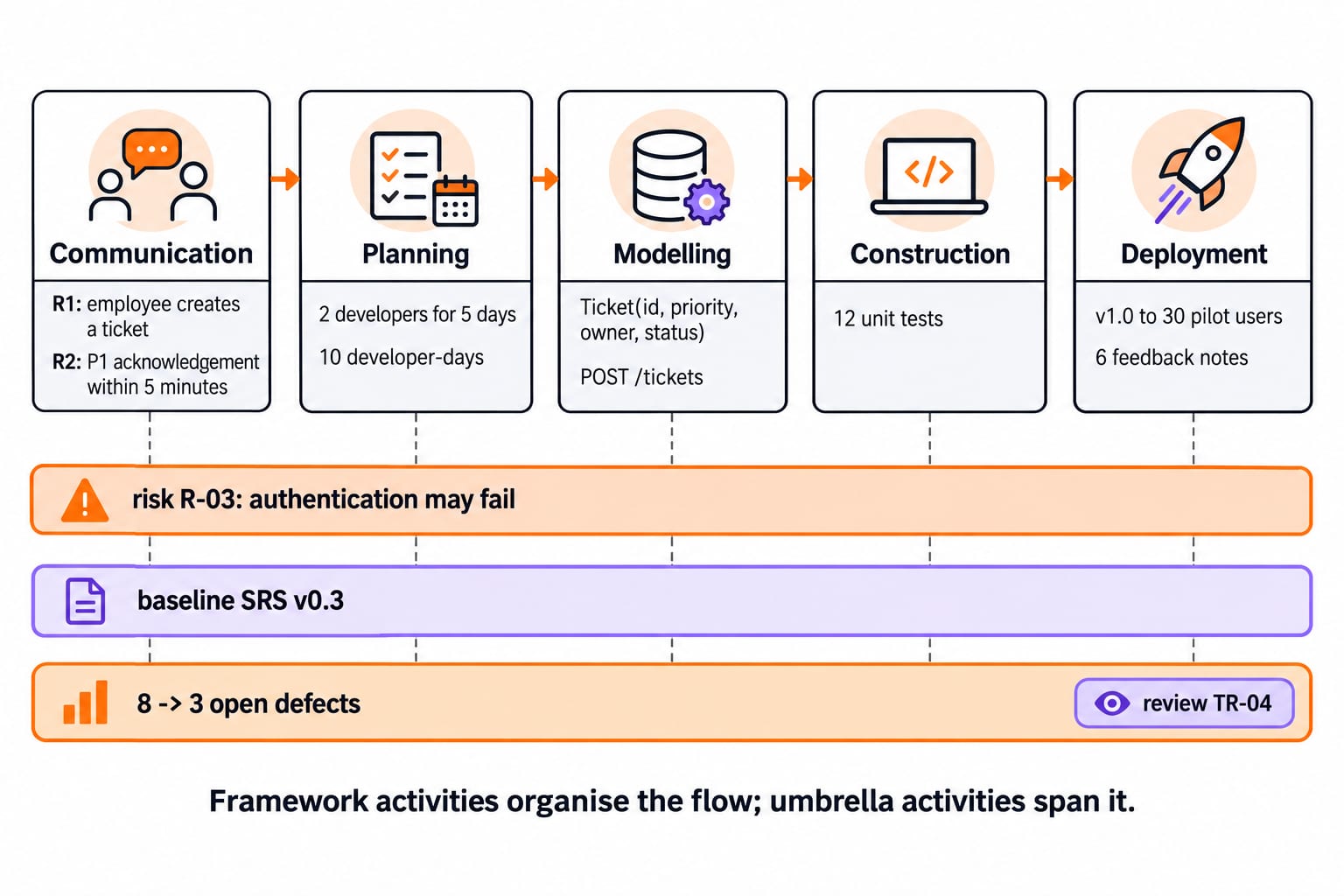
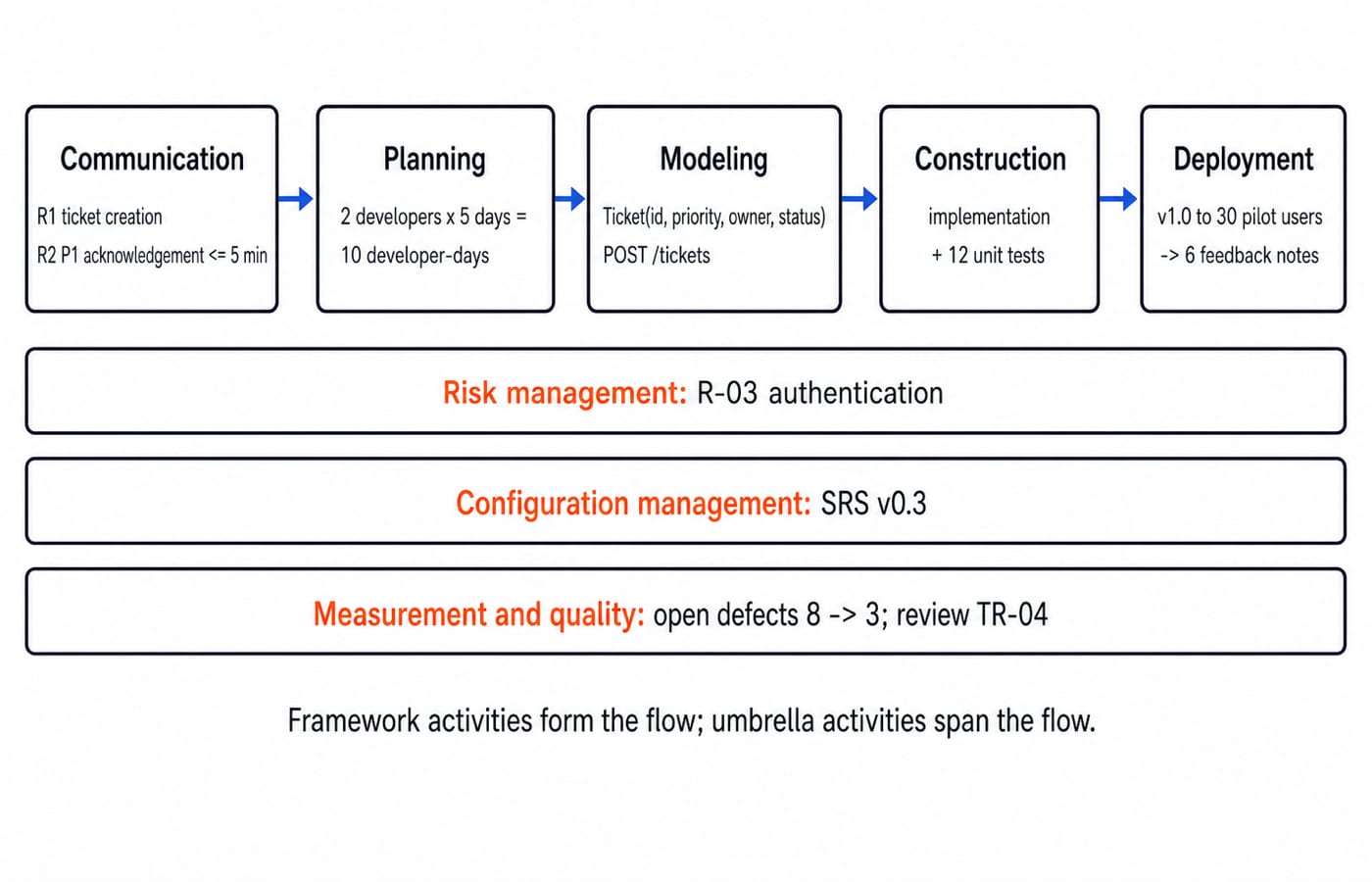
In a hypothetical help-desk release, communication records R1: employee creates a ticket and R2: P1 acknowledgement within 5 minutes. Planning assigns 2 developers for 5 days, or 10 developer-days. Modelling defines Ticket(id, priority, owner, status) and POST /tickets. Construction implements the endpoint and adds 12 unit tests. Deployment sends v1.0 to 30 pilot users and collects 6 feedback notes.
Question 2 (UGC NET 2014)
__________ are applied throughout the software process.
A. Framework activities
B. Umbrella activities
C. Planning activities
D. Construction activities
Answer: B, Umbrella activities. Framework activities organise the flow; umbrella activities span it. Across stages, the team tracks risk R-03: authentication may fail, baseline SRS v0.3, 8 -> 3 open defects, and review TR-04. Planning and construction are narrower. Cue on throughout.
Feedback paths and prototypes, Questions 3 and 4
Question 3 (BEL 2023)
Which change did the iterative waterfall model introduce to the classical waterfall model?
A. Addition of feedback paths
B. Easy to accommodate change request
C. Efficient error correction
D. Overlapping of phases
Answer: A, Addition of feedback paths. The process may return to an earlier phase. Easier change handling and error correction are consequences, while overlapping phases is not the defining change.
Suppose design D1 omits R3: users may cancel a ticket until work starts. Review sends the team to analysis, where it adds R3. Design D2 gains a CANCELLED state and tests T13-T15. That is feedback, not a restart; the changed requirement propagates into design and tests.
Question 4 (TPSC 2025)
What is the purpose of a software prototype?
A. To test all functionalities
B. To create the final version of the software
C. To provide a preliminary version of the system for feedback and iteration
D. To remove all bugs and errors
Answer: C, To provide a preliminary version of the system for feedback and iteration. Build 4 clickable screens without a production database. Of 5 users, 3 cannot find Reassign ticket. Move it beside Owner and retest. The result is clearer requirements, not a final system. The distractors promise completeness.
Prototyping order and the Unified Process, Questions 5 and 6
Question 5 (UGC NET 2023)
The prototyping model has the sequence:
(A) Customer Evaluation
(B) Quick design
(C) Requirements
(D) Implement
(E) Design
Choose the correct answer from the options below:
A. (C) -> (A) -> (D) -> (B) -> (E)
B. (B) -> (C) -> (A) -> (D) -> (E)
C. (C) -> (B) -> (D) -> (A) -> (E)
D. (E) -> (B) -> (C) -> (D) -> (A)
Answer: C, (C) -> (B) -> (D) -> (A) -> (E). Identify requirements, sketch a quick design, implement the prototype, obtain customer evaluation, then feed that learning into design. Implement here does not mean shipping production software.
Start with 3 tasks: create, assign, close ticket. Sketch 4 screens and implement P1. Testing by 6 users produces 4 requests for a visible priority filter, so design D1 adds the filter and its acceptance rule.
Question 6 (BEL 2023)
Name the phase of the unified process model where customer communication and planning take place.
A. Construction phase
B. Elaboration phase
C. Transition phase
D. Inception phase
Answer: D, Inception phase. Inception establishes scope, stakeholders, major use cases, broad estimates, and major risks. Elaboration stabilises architecture, construction builds, and transition moves the release to users.
Inception can define 4 major use cases, 30 pilot users, an 8-week horizon, and risk R-03: authentication integration. These give direction without implying detailed architecture or finished code.
CASE tools and process patterns, Questions 7 and 8
Question 7 (DSSSB 2021)
What is the full form of CASE tool in software engineering?
A. Computer Aided Software Engineering
B. Computer Application Software Engineering
C. Control Application Software Engineering
D. Code Aided Software Engineering
Answer: A, Computer Aided Software Engineering. CASE tools support or automate work such as requirements repositories, diagrams, consistency checks, code generation, and test management. They are broader than code assistance and do not replace engineering judgement.
A repository can store 12 requirements, link 7 design components, and flag 2 requirements without test references. The tool exposes gaps; the team judges each link.
Question 8
Consider the statements regarding process pattern,
(S1) It is a consistent method for describing problem solutions within the context of the software process
(S2) It is a consistent pattern for describing problem within the context of the software process
Which statement is not true?
A. Only S1
B. Only S2
C. Both S1 and S2
D. None of the above
Answer: B, Only S2. S1 describes a reusable solution to a recurring process problem in context. S2 stops at the problem and misses the solution. Notice that the stem asks which statement is not true.
Example: Name: Requirements Review Checkpoint; Context: 12 drafted requirements; Problem: contradictions reach design; Solution: 45-minute analyst-developer-tester review; Exit rule: each requirement has an owner and test criterion, with at most 2 unresolved issues. It qualifies as a process pattern because it names the context, problem, solution and exit rule.
RUP, PSP, JAD, Agile, CASE, and components, Questions 9 and 10
Question 9 (TPSC 2026)
What do RUP and PSP stand for?
A. Rational Unified Process and Personal Software process
B. Rational Unified Process and Project Software process
C. Real-time Unified Process and Personal Software process
D. Real-time Unified Process and Project Software process
Answer: A, Rational Unified Process and Personal Software Process. RUP organises iterative project development. PSP focuses on an engineer's planning, measurement, and quality practices.
A team uses RUP phase goals for an 8-week release. A developer's PSP log compares 6 estimated hours with 7.5 actual hours, a 1.5-hour difference, and records 3 defects before review.
Question 10 (UGC NET 2015)
Match each item in List I with its description in List II.
List I | List II |
|---|---|
(a) Joint Application Design (JAD) | (i) Delivers functionality in rapid iterations measured in weeks, with frequent communication, development, testing and delivery |
(b) Computer Aided Software Engineering | (ii) Reusable applications with one specific function, linked to web services and service-oriented architecture |
(c) Agile development | (iii) Tools that automate many SDLC tasks |
(d) Component Based Technology | (iv) A group-based tool for collecting user requirements and creating system designs, mostly during analysis and design |
Codes:
A. (a)-(i), (b)-(iii), (c)-(ii), (d)-(iv)
B. (a)-(iv), (b)-(iii), (c)-(i), (d)-(ii)
C. (a)-(iii), (b)-(iv), (c)-(i), (d)-(ii)
D. (a)-(iii), (b)-(i), (c)-(iv), (d)-(ii)
Answer: B, (a)-(iv), (b)-(iii), (c)-(i), (d)-(ii). Match by meaning. JAD is group-based requirements and design, so (a)-(iv). CASE tools support SDLC tasks, so (b)-(iii). Agile uses rapid iterations with frequent communication and delivery, so (c)-(i). Component-based technology uses reusable components, so (d)-(ii).
One project can use all four. A 90-minute JAD session produces 12 prioritised stories; CASE stores 2 linked models; a 2-week Agile iteration delivers 3 stories; and reusable NotificationAdapter v2 serves TicketService and AuditService.
Answer key, trap repair, and what to study next
Key: 1-C, 2-B, 3-A, 4-C, 5-C, 6-D, 7-A, 8-B, 9-A, 10-B. On a second attempt, classify each miss as sequence, scope, role or tool confusion. Redraw the five framework activities, place umbrella work across them, and explain one process pattern aloud before returning to the missed questions.
The short version is that framework activities form the flow, umbrella activities span it, feedback and prototypes reduce misunderstanding, patterns package reusable process solutions, and tools support the work. Continue with NTA-UGC-NET Paper - 2 for guided study, then repeat only the questions whose cue you misclassified.
Go deeper with the full courseSoftware-Engineering
Keep learning
Types of Software Interview Questions and Answers: Model Answers with Examples
Learn to classify system, application, utility, programming and firmware examples by primary purpose, then defend the difficult boundary cases aloud.
Updated 20 Nov 20266 min readComputer Organization & Architecture
Basic Introduction to Software Engineering MCQs and Short Answers: 10 Solved Questions
Attempt eight objective questions and two structured short answers, then use the worked reasoning to find exactly which software engineering distinctions need revision.
Updated 13 Nov 20267 min readUGC NET Computer Science
C++ Template Specialisation and Deduction: Predict Which Case Wins
Predict which C++ template definition wins by separating class specialisation, function overload resolution, ordinary deduction, and C++17 CTAD.
Updated 30 Oct 20265 min readC++

Job and Activity Selection: Greedy Rules, Worked Examples and Exam Traps
Learn why activity selection sorts by finish time while unit-time job sequencing sorts by profit. Trace both algorithms, test their invariants, and avoid the standard traps.
Updated 23 Nov 20266 min readDSA & Algorithms