

Basic Introduction to Software Engineering MCQs and Short Answers: 10 Solved Questions
Attempt eight objective questions and two structured short answers, then use the worked reasoning to find exactly which software engineering distinctions need revision.
KnowledgeGate Team
Exam prep & CS education
Updated 13 Nov 20267 min read
These ten questions drill distinctions that broad notes often blur: process quality versus product quality, coding versus production, flexible software versus effortless change, and testing versus design. Attempt each item before reading its explanation. For a full SDLC and process-model walkthrough, use Software Engineering Basics Explained to trace an SDLC change from requirement to release. Then choose among the exam options below, justify each choice and work the cost equality.
1. How to use this 10-question software engineering set
Use three scratch columns: question, chosen answer, reason in one sentence. Attempt Questions 7 and 8 in four bullets, one per sub-part.
Eight objective questions and two short-answer prompts make up the set. Named exam and year attributions identify the sourced questions; Questions 7 and 8 are unattributed practice prompts. Use UGC NET CS learning and practice routes for broader study.
2. Questions 1-2: process quality and software characteristics
Question 1
Exam source: BPSC 2023, Computer Science. See the solved question.
Which one of the following is not a software process quality?

A. Visibility
B. Timeliness
C. Portability
D. More than one of the above
E. None of the above
Correct answer: C. Portability.
Visibility and timeliness describe how development work can be observed and delivered. Portability describes whether the software product can run across environments, so it is a product quality rather than a process quality.
Question 2
Exam source: TPSC 2025, Computer Science, Assistant Programmer.
Which of the following is NOT a characteristic of software ?

A. Software is intangible
B. Software is easy to modify
C. Software is not prone to wear and tear
D. Software has limited scalability
Correct answer: D. Software has limited scalability.
Software is intangible, does not wear mechanically and is modifiable, though change is not automatically cheap or safe. Scalability depends on architecture, resources and workload. Redesigning version 1.0 from 5,000 profiles to version 1.1 at 50,000 changes design and deployment, not physical material. Study such quality attributes beyond simple feature count.
3. Questions 3-4: delivery constraints and a worked total-cost equality
Question 3
Exam source: UGC NET 2012, Computer Science, Paper 2 (June).
Main aim of software engineering is to produce:

A. program
B. software
C. within budget
D. software within budget in the given schedule
Correct answer: D. software within budget in the given schedule.
A and B omit constraints; C is not a complete product objective. In a 12-week payroll release with 800 budgeted hours, using 640 hours by week 8 leaves 800 - 640 = 160 hours. Re-estimate remaining work, reduce scope or revise the approved plan.
Question 4
Exam source: Indian Space Research Organization 2016, Computer Science.
A company needs to develop a strategy for software product development for which it has a choice of two programming languages L1 and L2.

The number of lines of code (LOC) developed using L2 is estimated to be twice the LOC developed using L1.

The product will have to be maintained for 5 years.

The parameters are given below:

Parameter | Language L1 | Language L2
Man years needed for development | LOC / 10000 | LOC / 10000
Development cost per man year | 10,00,000 rupees | 7,50,000 rupees
Maintenance time | 5 years | 5 years
Maintenance cost per year | 1,00,000 rupees | 50,000 rupees

Total project cost includes both development and maintenance costs.

Find the LOC for L1 for which the total project cost using L1 equals the total project cost using L2 ?

A. 10,000
B. 5,000
C. 7,500
D. 75,000
Correct answer: B. 5,000.
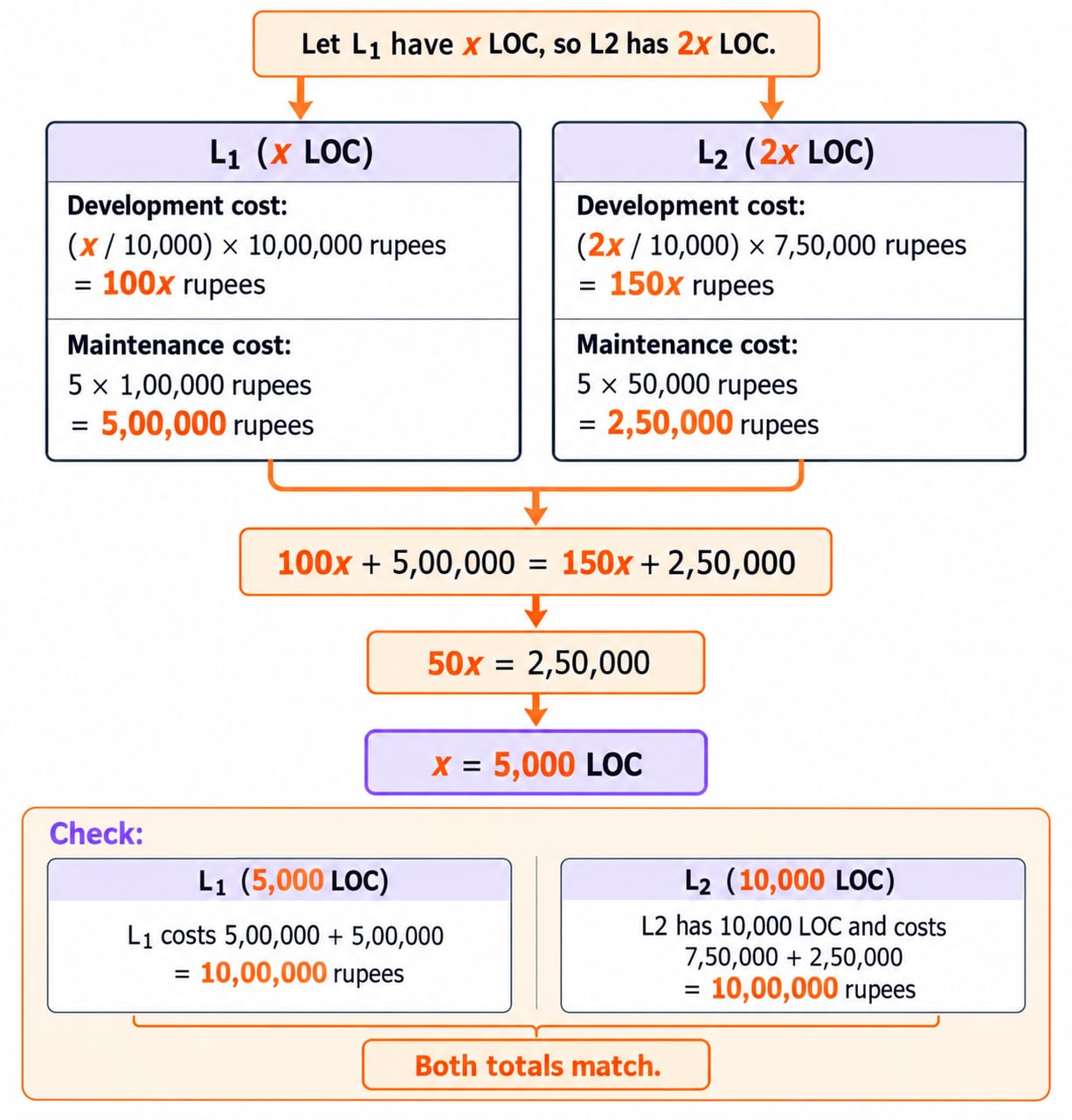
Let L1 have x LOC, so L2 has 2x LOC.
L1: development =
(x / 10,000) x 10,00,000 rupees = 100x rupees; maintenance =5 x 1,00,000 rupees = 5,00,000 rupees.L2: development =
(2x / 10,000) x 7,50,000 rupees = 150x rupees; maintenance =5 x 50,000 rupees = 2,50,000 rupees.
Equality gives 100x + 5,00,000 = 150x + 2,50,000, then 50x = 2,50,000, so x = 5,000 LOC.
Check: L1 costs 5,00,000 + 5,00,000 = 10,00,000 rupees. L2 has 10,000 LOC and costs 7,50,000 + 2,50,000 = 10,00,000 rupees. Both totals match.
4. Questions 5-6: testing focus versus system design
Question 5
Exam source: BEL 2023, Computer Science, Probationary Engineer.
_____ begins at the vortex of the spiral and concentrate on each component of the software as implemented in source code.

A. Integration testing
B. Validation testing
C. System testing
D. Unit testing
Correct answer: D. Unit testing.
Unit testing starts with source-code components. Integration checks interactions, validation checks requirements, and system testing examines the whole system. Test calculateTotal(2, 500) for 1000, integrate CartRepository, validate the total, then run checkout with the application, database and payment stub.
Question 6
Exam source: HTET 2023, Computer Science.
The __________ phase of the system decides how the system will operate in terms of hardware, software and network infrastructure.

A. Analysis
B. Design
C. Implementation
D. Planning
Correct answer: B. Design.
Analysis states what is needed; design decides how; implementation builds it; planning organises work. Analysis states a required workload for an emergency-alert system. Design chooses the deployment topology, database layout and network interfaces; implementation configures them; load testing checks the requirement.
5. Question 7: why mission-critical work needs process, methods and tools
Unattributed short-answer practice prompt.
A startup plans to develop a mission-critical healthcare system under strict deadlines and evolving requirements.

(a) Define software engineering and explain why ad-hoc programming would fail in this scenario.
(b) Identify and explain the fundamental characteristics of software as a product.
(c) Analyze how software engineering principles ensure reliability and maintainability in such systems.
(d) Illustrate the relationship between process, methods, and tools in this context.
A strong four-part answer would say:
Software engineering disciplines production. Ad-hoc work loses traceability, repeatability and controlled verification.
Software is intangible, engineered, free from mechanical wear and continually evolved.
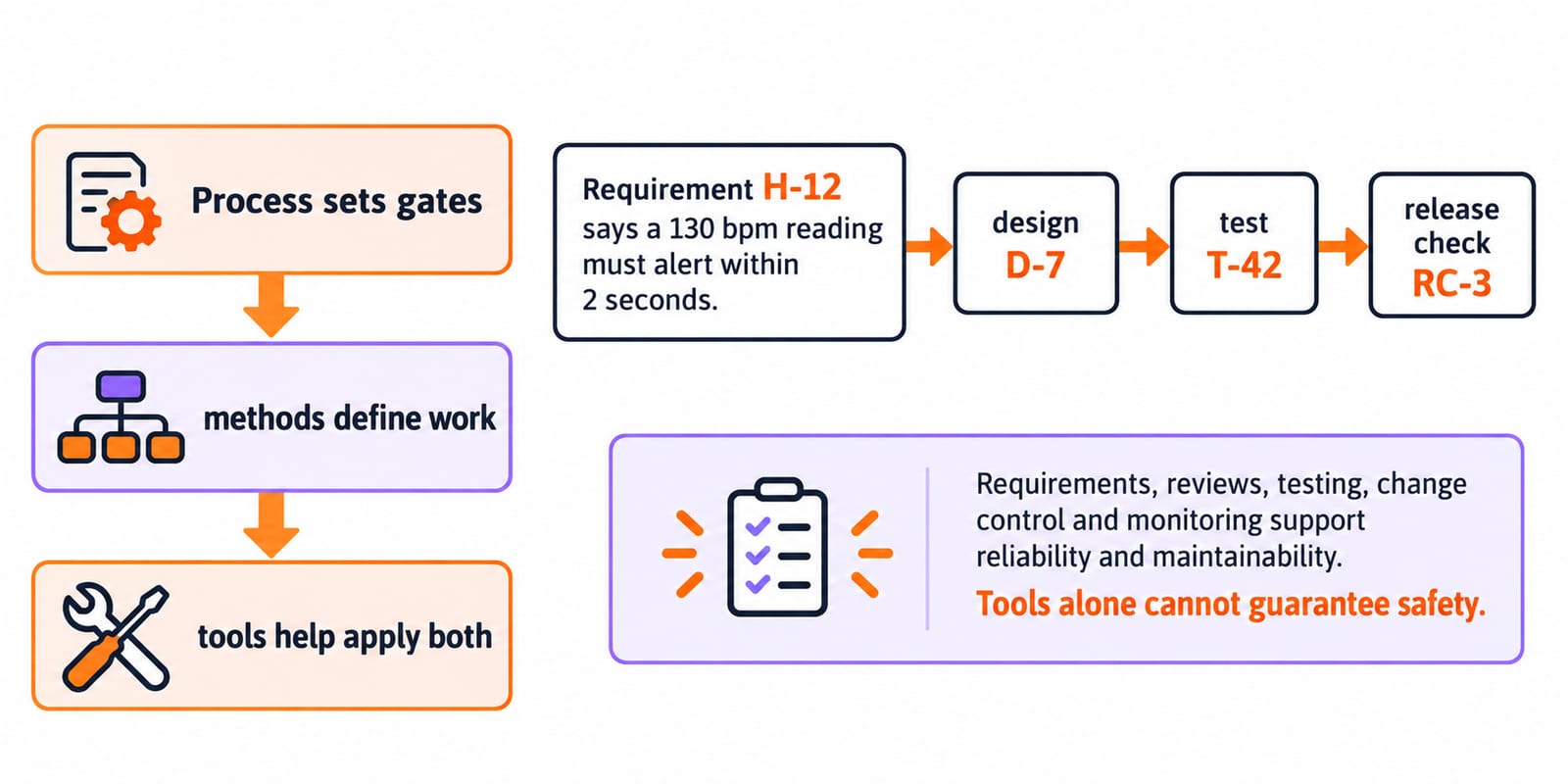
Requirements, reviews, testing, change control and monitoring support reliability and maintainability.
Process sets gates, methods define work, and tools help apply both.
Requirement H-12 says a 130 bpm reading must alert within 2 seconds. Process supplies review and release gates; methods supply state, interface and test designs; tools supply version control, tests and issue tracking. Trace H-12 -> design D-7 -> test T-42 -> release check RC-3. Tools alone cannot guarantee safety.
6. Questions 8-9: evolution, maintenance and software myths
Question 8
Unattributed short-answer practice prompt.
Consider a large-scale e-commerce platform that frequently updates its features based on user behavior.

(a) Differentiate between generic and customized software with examples.
(b) Analyze how software evolution differs from hardware evolution.
(c) Explain why software does not "wear out" but still requires maintenance.
(d) Propose how engineering discipline handles continuous change.
A complete response separates the four parts:
A generic product serves a market; customised software serves one customer's needs.
Software changes with requirements, environments, dependencies and defects; hardware also ages physically.
Execution does not wear code away, but correction, adaptation, enhancement and prevention remain necessary.
Discipline baselines requirements, records architecture, plans migrations and maintains regression tests.
Suppose release 1 handles 10,000 orders/day under C-1; release 2 targets 50,000 orders/day and adds R-8. Engineers update requirements, architecture, migration and regression tests, then check error rate and latency against the release criteria.
Question 9
Exam source: UGC NET 2012, Computer Science, Paper 2 (December).
Which one of the following is not a software myth?

A. Once we write the program and get it to work, our job is done
B. Project requirements continually change, but change can be easily accommodated because software is flexible
C. If we get behind schedule, we can add more programmers and catch up
D. If an organization does not understand how to control software projects internally, it will invariably struggle when it outsources software projects
Correct answer: D. The internal-control statement is a management warning; A, B and C are software myths.
Running code still needs validation, operation and maintenance. Flexibility does not make change free, and late additions require onboarding and communication. If six experienced members each spend five total hours onboarding four newcomers, 6 x 5 = 30 experienced-person hours are diverted before the team sees any benefit.
7. Question 10, answer key and the next practice step
Question 10
Exam source: UGC NET 2017, Computer Science, Paper 2 (January).
Software Engineering is an engineering discipline that is concerned with :

A. how computer systems work.
B. theories and methods that underlie computers and software systems.
C. all aspects of software production
D. all aspects of computer-based systems development, including hardware, software and process engineering.
Correct answer: C. all aspects of software production.
A and B are narrower concerns. D includes hardware and all computer-based system engineering. Software engineering covers requirements, design, implementation, verification, deployment, operation and evolution. A successful compile covers implementation only; requirements traceability, reviews, tests, deployment checks and maintenance planning still remain.
Question | Answer |
|---|---|
Q1 | C |
Q2 | D |
Q3 | D |
Q4 | B ( |
Q5 | D |
Q6 | B |
Q7 | Disciplined lifecycle plus process, method and tool trace |
Q8 | Generic versus customised software plus controlled evolution |
Q9 | D |
Q10 | C |
Score 8/10 or better? Move to process-model comparisons. Below 8, revisit code versus production, modifiable versus effortless change, and unit test versus design choice.
Use the NTA-UGC-NET Paper 2 course for guided learning and the NTA UGC NET Paper 2 Test Series for practice. Attempt a fresh set first, so the next score measures reasoning.
Go deeper with the full courseUGC NET Computer Science (Paper 1 + Paper 2)
Keep learning
Software Engineering Basics Explained: SDLC, Process Models and Worked Example
Learn how software engineering extends beyond coding, how major process models differ, and how to choose and apply one in a constructed student portal project.
Updated 30 Oct 20266 min readUGC NET Computer Science
Software Maintenance MCQs: 11 Solved Re-engineering and Reverse Engineering Questions
Attempt 11 published Software Maintenance MCQs, then use the worked explanations to separate reverse engineering, refactoring, re-engineering and perfective maintenance.
Updated 19 Nov 20267 min readUGC NET Computer Science
Software Testing in Software Engineering: Black-Box, White-Box and Cyclomatic Complexity with a Worked Example
Turn one precise score-classifier requirement into black-box test cases, basis paths, a cyclomatic-complexity calculation and a focused regression suite.
Updated 16 Aug 20266 min readUGC NET Computer Science
Software Requirements in Software Engineering: SRS, Elicitation and Validation with a Worked Example
Turn vague stakeholder needs into precise, testable software requirements. Follow one mock-test portal from elicitation and SRS writing to acceptance tests and traceability.
Updated 14 Aug 20266 min readUGC NET Computer Science