

Software Maintenance Types MCQs: 12 Solved Questions on Corrective, Adaptive, Perfective and Preventive Maintenance
Classify software maintenance by its trigger, then practise 12 solved questions on platform changes, defect repair, performance, refactoring and matching.
KnowledgeGate Team
Exam prep & CS education
Updated 20 Nov 20268 min read
Software maintenance labels get slippery the moment a question names a platform change, a performance gain, a defect or a restructure. The reliable move is to classify the trigger: failure, environment, user need or future risk. Use the NET Computer Science revision route for wider software-engineering context. Reverse engineering, re-engineering and refactoring are transformation techniques in the earlier Software Maintenance MCQ set on re-engineering and reverse engineering; corrective, adaptive, perfective and preventive label the trigger for a change.
Software maintenance types: build the four-way decision rule
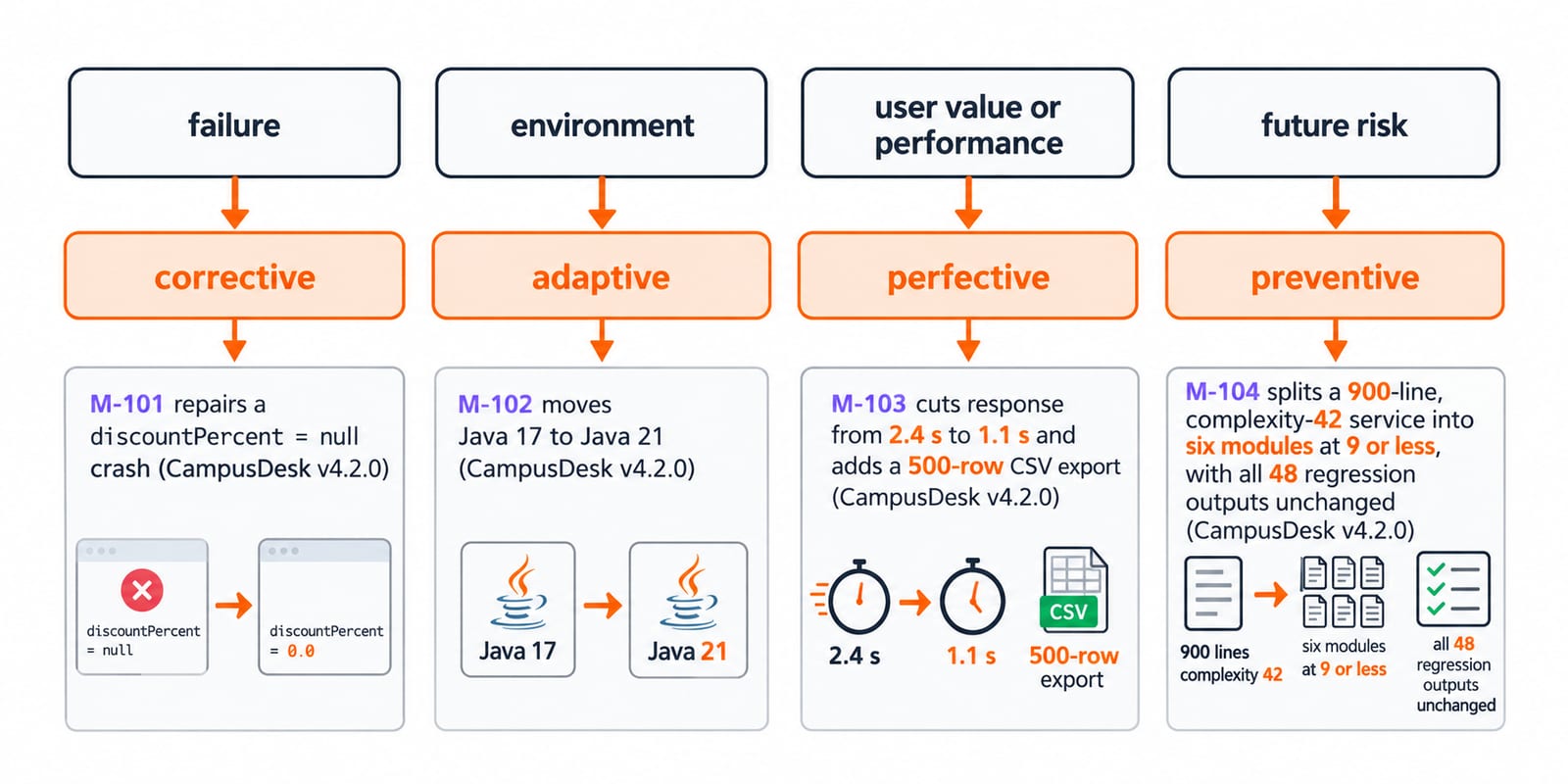
Four CampusDesk v4.2.0 tickets show the categories. M-101 repairs a discountPercent = null crash (corrective); M-102 moves Java 17 to Java 21 (adaptive); M-103 cuts response from 2.4 s to 1.1 s and adds a 500-row CSV export (perfective); M-104 splits a 900-line, complexity-42 service into six modules at 9 or less, with all 48 regression outputs unchanged (preventive).
Use failure -> corrective, environment -> adaptive, user value or performance -> perfective, and future risk -> preventive.
Individual question pages and the topic hub are currently unavailable. Use the UGC NET Computer Science and Applications Test Series for follow-up practice.
Question 1
Asked in TPSC 2025
Which of the following is a type of software maintenance?
A. Corrective maintenance
B. Adaptive maintenance
C. Perfective maintenance
D. All of the above
Answer: D. All of the above.
Corrective, adaptive and perfective are standard categories, making Option D correct. Preventive is the fourth category used here but is not listed separately, making this a taxonomy check rather than an exhaustive list. Practise this question.
Question 2
Asked in UGC NET June 2016
Match the software maintenance activities in List I with their meanings in List II.
List I:
a. Corrective
b. Adaptive
c. Perfective
d. Preventive
List II:
i. Reduces software complexity, improves program understandability, and increases maintainability.
ii. Fixes errors that are observed when the software is in use.
iii. Modifies software so that it remains usable in a new hardware or software environment.
iv. Modifies software to meet changing user requirements.
Codes:
A. a-iv, b-i, c-ii, d-iii
B. a-ii, b-iii, c-iv, d-i
C. a-iv, b-ii, c-i, d-iii
D. a-i, b-iii, c-iv, d-ii
Answer: B. a-ii, b-iii, c-iv, d-i.
Corrective fixes observed errors (a-ii), adaptive preserves operation in a changed environment (b-iii), perfective meets changed user requirements (c-iv), and preventive improves structure (d-i). Tickets M-101 through M-104 repeat this sequence. Practise this question.
Corrective maintenance versus debugging
CampusDesk v4.2.0 crashes at line 218 when discountPercent = null. Locating the null dereference is debugging; releasing v4.2.1 is corrective maintenance.
Question 3
Asked in Bihar STET 2025
Which maintenance process model focuses on fixing defects as they are identified?
A. Waterfall Model
B. Corrective Maintenance
C. Perfective Maintenance
D. Adaptive Maintenance
Answer: B. Corrective Maintenance.
Fixing defects identifies corrective maintenance. Waterfall is a development process model, perfective improves useful qualities or functionality, and adaptive responds to a changed operating environment. Practise this question.
Question 4
Asked in MPPSC 2025
One overriding objective to find and correct the cause of a software error, is known as
A. testing
B. debugging
C. maintenance
D. design
Answer: B. debugging.
Debugging corrects an error's cause; testing exposes failures, while maintenance is the wider post-delivery context. Finding the line-218 null dereference is debugging, and releasing v4.2.1 is corrective maintenance. Practise this question.
Adaptive maintenance: recognise an environmental change
Java 17 -> 21, PostgreSQL 14 -> 16, and Ubuntu 22.04 -> 24.04 are adaptive when behaviour stays unchanged; a new bulk export is perfective.
Question 5
Asked in UGC NET June 2019
Software products need adaptive maintenance for which of the following reasons?
A. To rectify bugs observed while the system is in use
B. When the customers need the product to run on new platform
C. To support the new features that users want it to support
D. To overcome wear and tear caused by the repeated use of the software
Answer: B. When the customers need the product to run on new platform.
A new platform changes the environment, so the answer is adaptive maintenance, as in Java 17 -> 21. The other options describe corrective work, perfective work and an inapplicable physical-wear analogy. Practise this question.
Question 6
Asked in UGC NET June 2015
Adaptive maintenance is a maintenance which _____ .
A. correct errors that were not discovered till testing phase
B. is carried out to port the existing software to a new environment
C. improves the system performance
D. both B and C
Answer: B. is carried out to port the existing software to a new environment.
Porting to a new environment is adaptive. Escaped defects are corrective, while improving response from 2.4 s to 1.1 s is perfective, so Option D wrongly combines two categories. Practise this question.
Question 7
Asked in ISRO May 2017
In software maintenance tackling the changes in the hardware or software environment where the software works, is
A. Corrective maintenance
B. Perfective maintenance
C. Adaptive maintenance
D. Preventive maintenance
Answer: C. Adaptive maintenance.
Operating-environment changes identify adaptive maintenance. A server migration with unchanged application inputs and outputs fits; a feature request or defect repair does not. Practise this question.
Perfective maintenance: improve performance or meet new needs
Cutting the correct dashboard's median response from 2.4 s to 1.1 s, a 1.3 s improvement, is perfective; so is adding a 500-row CSV export.
Question 8
Asked in UGC NET 2013
Improving processing efficiency or performance or restructuring of software to improve changeability is known as
A. Corrective maintenance
B. Perfective maintenance
C. Adaptive maintenance
D. Code maintenance
Answer: B. Perfective maintenance.
This question treats efficiency, performance and improved changeability as perfective, matching 2.4 s -> 1.1 s. Some textbooks file maintainability-focused restructuring under preventive instead, so answer from the definitions the question itself states. Practise this question.
The earlier re-engineering set uses this stem to distinguish feature work from restructuring. Here, the 500-row export makes new user value the trigger, so the change is perfective.
Question 9
Asked in UGC NET December 2018
Software products need perfective maintenance for which of the following reasons?
A. To rectify bugs observed while the system is in use
B. When the customers need the product to run on new platforms
C. To support new features that users want it to support
D. To overcome wear and tear caused by repeated use of the software
Answer: C. To support new features that users want it to support.
The new 500-row CSV export is perfective. Observed bugs are corrective, new platforms are adaptive, and software does not suffer physical wear. Practise this question.
Preventive maintenance, refactoring and software deterioration
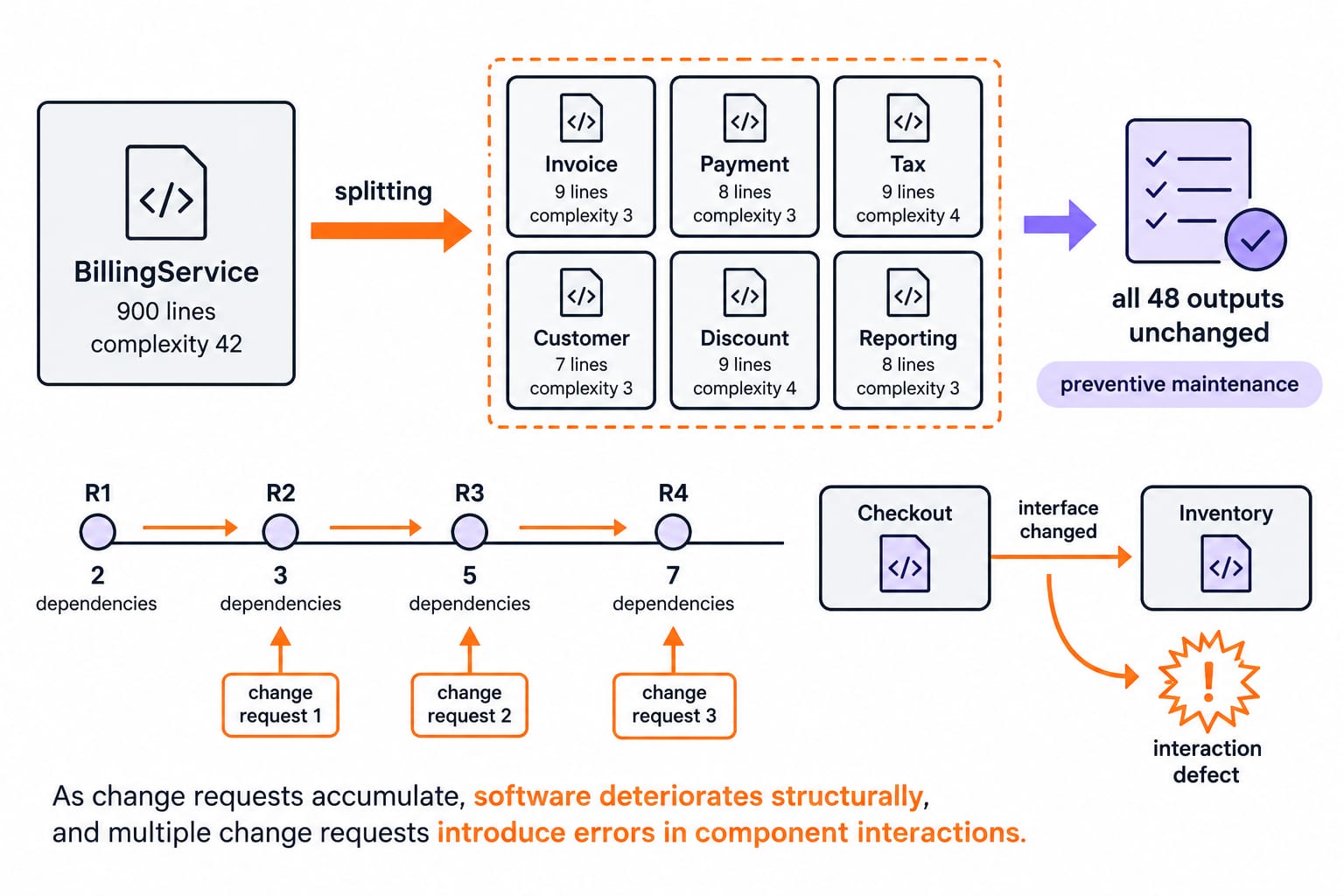
Splitting a 900-line, complexity-42 BillingService into six modules at 9 or less with all 48 outputs unchanged reduces future risk: preventive maintenance.
Software deteriorates structurally. Three changes raise dependencies from two in R1 to seven by R4; a changed Checkout-Inventory interface can create an interaction defect.
The earlier set uses this refactoring stem to separate internal change from feature addition. Here, 48 unchanged outputs preserve behaviour, while six smaller modules replace one 900-line service to reduce future risk.
Question 10
Asked in UGC NET July 2018
Which of the following statements is/are True ?
P : Refactoring is the process of changing a software system in such a way that it does not alter the external behavior of the code yet improves the internal architecture.
Q : An example of refactoring is adding new features to satisfy a customer requirement discovered after a project is shipped.
Code :
A. P only
B. Q only
C. Both P and Q
D. Neither P nor Q
Answer: A. P only.
Statement P correctly describes behaviour-preserving refactoring. Statement Q changes visible functionality, so it is feature enhancement, not refactoring; 48 of 48 unchanged outputs make the preserved behaviour measurable. Practise this question.
Question 11
Asked in UGC NET November 2017
Software does not wear-out in the traditional sense of the term, but software does tend to deteriorate as it evolves, because :
A. Software suffers from exposure to hostile environments.
B. Defects are more likely to arise after software has been used often.
C. Multiple change requests introduce errors in component interactions.
D. Software spare parts become harder to order.
Answer: C. Multiple change requests introduce errors in component interactions.
Software does not physically wear out. Changes can break component assumptions, as dependencies rising 2 -> 7 across R1-R4 shows; hostile environments and spare parts are hardware analogies. Practise this question.
Software maintenance matching: classify before reading the codes
Pre-solve: T1 patches a production crash (corrective), T2 cuts report generation from 8 s to 3 s (perfective), and T3 ports to Ubuntu 24.04 (adaptive). Translate these to I-3; II-1; III-2 before reading the options.
Question 12
Asked in BEL Probationary Engineer 2023
Match the following type of software maintenance to the situation where it carried out.
Maintenance | Situation |
|---|---|
I. Corrective | 1. Carried out to improve the performance of the system or to enhance the functionalities of the system |
II. Perfective | 2. Usually required for porting the software to work in new environment |
III. Adaptive | 3. Carried out to correct errors that were not discovered during the product development phase |
A. I - 1; II - 2; III - 3
B. I - 3; II - 2; III - 1
C. I - 1; II - 3; III - 2
D. I - 3; II - 1; III - 2
Answer: D. I - 3; II - 1; III - 2.
Corrective maps to errors (I-3), perfective to performance or functionality (II-1), and adaptive to porting (III-2). The T1, T2, T3 sequence yields Option D and prevents a definition being paired with the wrong numeral. Practise this question.
Software maintenance types: diagnose errors and choose the next step
Corrective maintenance differs from debugging; environment changes are adaptive, performance and new features are perfective, and refactoring and software evolution address future structural risk.
Before retaking, reclassify M-101 through M-104 using failure, environment, user value, future risk. Then solve Questions 2 and 12 without the codes: a-ii, b-iii, c-iv, d-i and I-3; II-1; III-2.
Use Software Quality in Software Engineering for maintainability, Software Engineering for CS Teaching Exams for wider revision, and the UGC NET Computer Science and Applications Test Series for your structured practice.
Go deeper with the full courseUGC NET Computer Science (Paper 1 + Paper 2)
Keep learning

Software Maintenance MCQs: 11 Solved Re-engineering and Reverse Engineering Questions
Attempt 11 published Software Maintenance MCQs, then use the worked explanations to separate reverse engineering, refactoring, re-engineering and perfective maintenance.
Updated 19 Nov 20267 min readUGC NET Computer Science
Agile Process Models MCQs: 12 Solved Questions on XP, Scrum and Adaptive Development
Solve 12 published agile process model MCQs, then use the explanations to separate Scrum roles, XP practices, adaptive planning, FDD order and agile values.
Updated 29 Oct 20267 min readUGC NET Computer Science
Security, Risk Management and Maintenance in System Analysis and Design: A Worked Risk Register
Follow one university registration system from testable security requirements through risk ranking, maintenance classification, and a controlled production change.
Updated 7 Nov 20266 min readGATE Strategy & Roadmap
Software Development Life Cycle MCQs: 12 Solved Questions on SDLC Stages
Solve 12 published SDLC MCQs with direct explanations, stage cues, and a worked campus clinic portal that connects requirements, design, testing, and maintenance.
Updated 17 Nov 20267 min readUGC NET Computer Science