

Black-Box Testing MCQs: 12 Solved Questions on Equivalence Partitioning and BVA
Work through 12 black-box testing MCQs with explanations and a two-variable boundary example covering equivalence partitions, BVA, the 4k + 1 rule and limitations.
KnowledgeGate Team
Exam prep & CS education
Updated 22 Nov 20267 min read
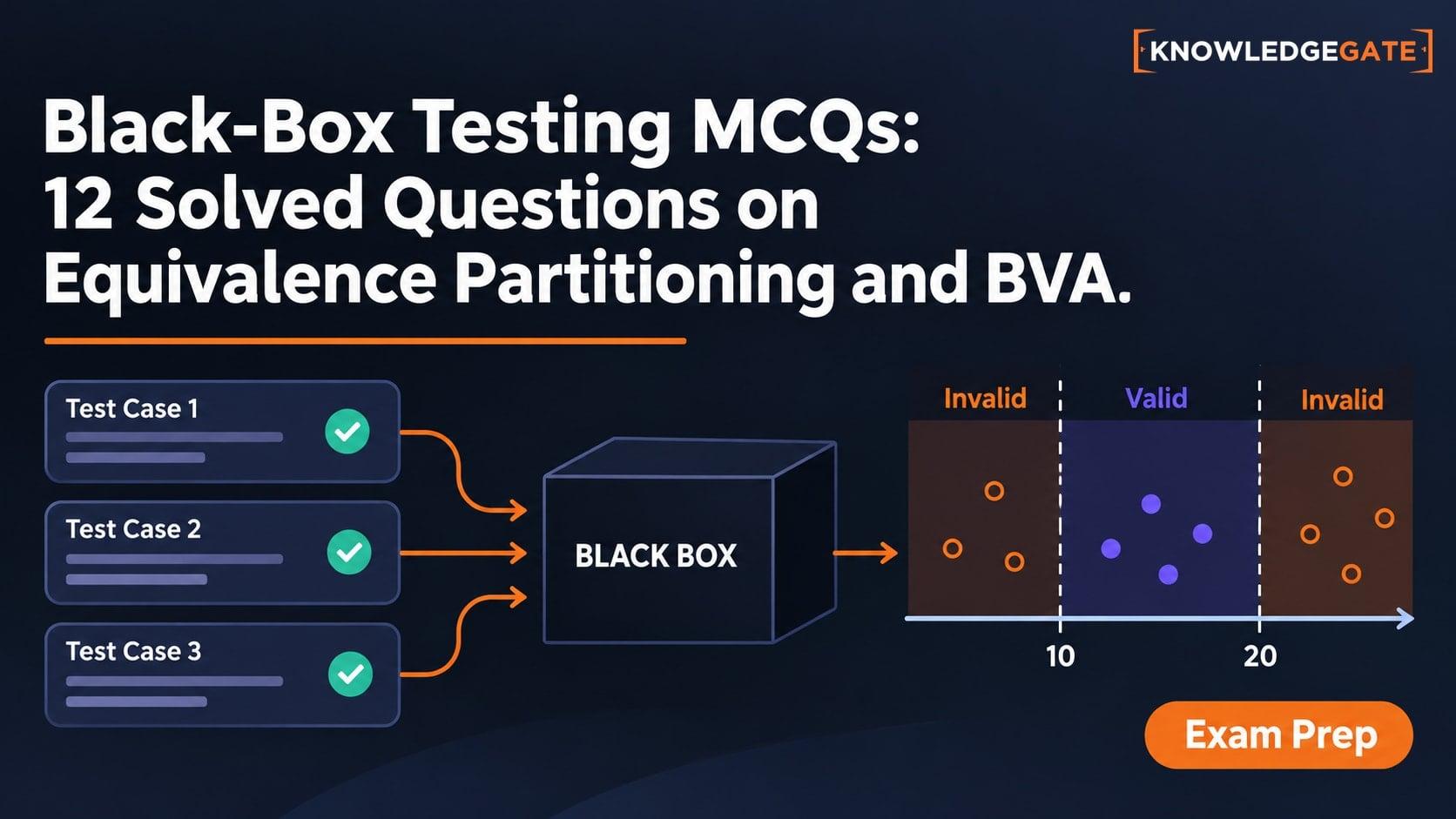
Equivalence partitioning and boundary value analysis both reduce test effort but select inputs differently. One samples behavioural classes; the other stresses defect-prone edges. Twelve MCQs test definitions, edge cases, the 4n + 1 rule, technique classification and limitations. Solve each before reading the explanation, and write the valid range or input classes beside numerical items. The Black-Box Testing, Equivalence Partitioning and Boundary Value Analysis topic page holds the wider practice pool. Use that hub after the explanations because it is the reliable route to this question group.
Black-box testing, equivalence partitions and boundaries in one model
Black-box testing uses specified input-output behaviour, not internal control flow. Equivalence partitioning groups inputs expected to behave alike. Boundary value analysis, or BVA, probes edges and their immediate neighbours. Partitions describe behaviour groups; boundary points come from their edges. The earlier Software Testing in Software Engineering guide follows one score classifier through black-box partitions, white-box paths, cyclomatic complexity and regression. These questions stay with black-box recognition, equivalence partitioning and boundary analysis.
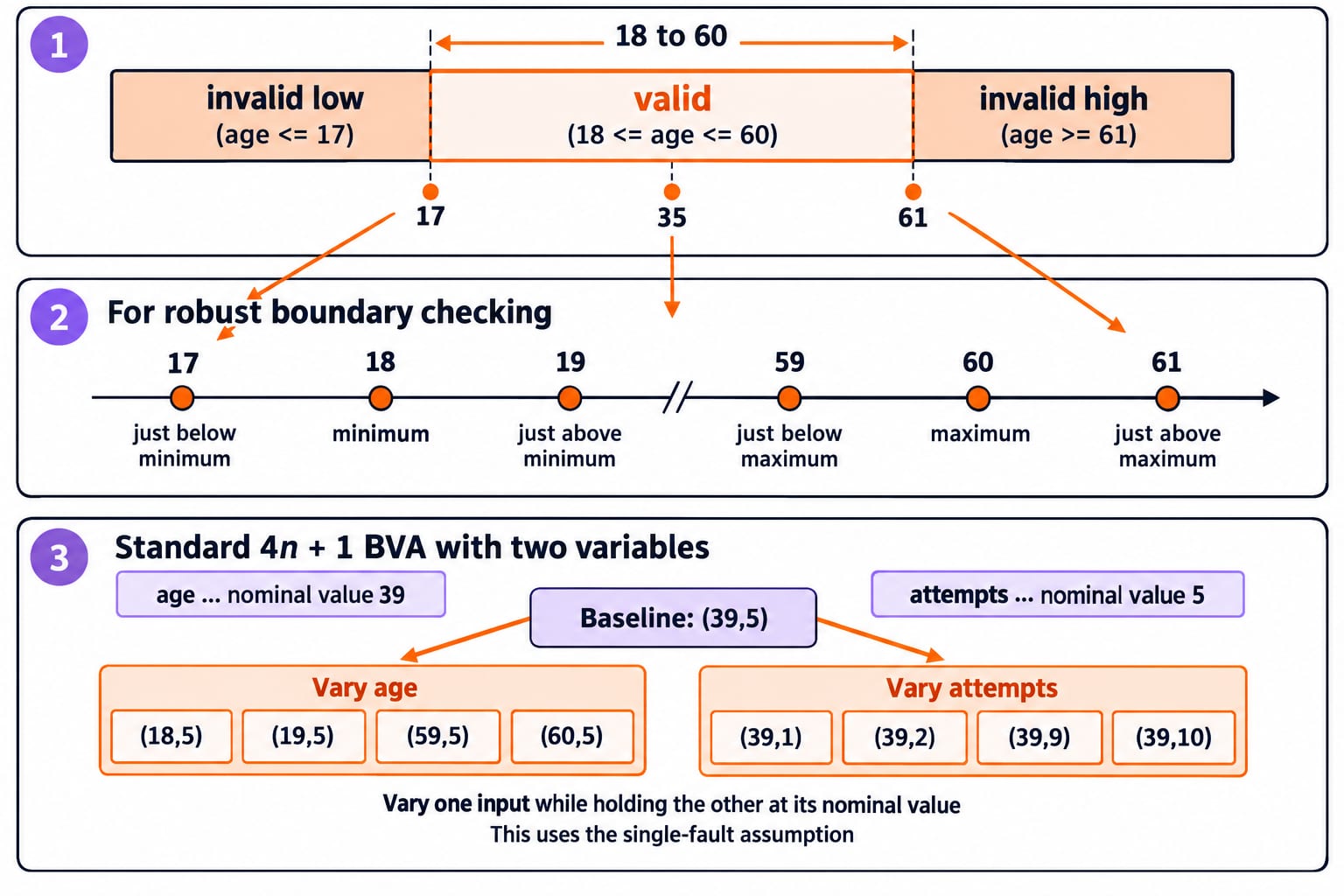
Suppose an inclusive accepted age range is 18 to 60. Its equivalence classes are invalid low (age <= 17), valid (18 <= age <= 60), and invalid high (age >= 61). Representative tests could be 17, 35, and 61. For robust boundary checking, use 17, 18, 19, 59, 60, 61: just below minimum, minimum, just above minimum, just below maximum, maximum, and just above maximum.
For standard 4n + 1 BVA with two variables, let age be 18..60 with nominal value 39, and attempts be 1..10 with nominal value 5. The nine tests are:
Baseline:
(39,5)Vary age:
(18,5),(19,5),(59,5),(60,5)Vary attempts:
(39,1),(39,2),(39,9),(39,10)
This uses the single-fault assumption. Vary one input while holding the other at its nominal value.
Black-box testing MCQs 1-3: meaning, focus and requirements
Question 1, TPSC 2025
What does the term “black-box testing” refer to?
A. Testing without knowledge of the internal workings of the software
B. Testing by looking at the software’s code
C. Testing the software in a simulated environment
D. Testing only the user interface
Answer: A. Testing without knowledge of the internal workings of the software.
Black-box testing supplies inputs and checks observable outputs against requirements. It is not restricted to a user interface or a simulated environment. Looking at the code describes a structural, or white-box, perspective.
Question 2, ISRO 2011
Black Box Software Testing method focuses on the
A. Boundary condition of the software
B. Control structure of the software
C. Functional requirement of the software
D. Independent paths of the software
Answer: C. Functional requirement of the software.
Black-box testing checks what the system must do, so functional requirements are its main focus. Boundary conditions provide particular black-box cases, but are only one technique. Control structures and independent paths require implementation knowledge.
Question 3, TPSC 2024
What type of testing verifies the system's functional requirements based on user stories?
A. Black-box testing
B. White-box testing
C. Unit testing
D. Integration testing
Answer: A. Black-box testing.
A user story expresses required behaviour from the user's perspective. Test it through inputs and observable outcomes without inspecting implementation. Unit and integration are testing levels, not the behavioural viewpoint asked for here.
Equivalence partitioning MCQs 4-6: definition, purpose and test type
Question 4, MPPSC 2025
A black-box testing method that divides the input domain of a program into classes of data from which test cases can be derived is known as
A. Class Partitioning
B. Equivalence Partitioning
C. Data Partitioning
D. Text Partitioning
Answer: B. Equivalence Partitioning.
The key is “classes of data” whose members should trigger the same behaviour. Equivalence partitioning selects a representative from each valid and invalid class instead of testing every input. The other labels are not the named method.
Question 5, UGC NET 2013
Equivalence class partitioning approach is used to divide the input domain into a set of equivalence classes, so that if a program works correctly for a value, then it will work correctly for all the other values in that class. This is used ______.
A. to partition the program in the form of classes.
B. to reduce the number of test cases required.
C. for designing test cases in white box testing.
D. all of the above.
Answer: B. to reduce the number of test cases required.
The technique partitions the input domain, not the program. One representative stands for members expected to behave alike, reducing the test set while retaining behavioural coverage. It is black-box, so C and D are false.
Question 6, DSSSB 2021
Equivalence partitioning is a ________.
A. White box testing method
B. Black box testing method
C. Comparison testing method
D. Loop testing method
Answer: B. Black box testing method.
Equivalence partitioning derives cases from the specified input domain and expected behaviour, making it black-box. Loop testing examines internal loop structure and is white-box.
Boundary value analysis MCQs 7-9: edge values, the 4n + 1 rule and method recognition
Question 7, DSSSB 2021
In boundary value analysis testing method, if we want to design a test case that computes the square root of integer values in the range from 1 to 4000, then the test case must include what values?
A. {0, 1, 3999, 4000}
B. {1, 2, 3999, 4000}
C. {0, 1, 4000, 4001}
D. {1, 2, 4000, 4001}
Answer: C. {0, 1, 4000, 4001}.
The valid interval is [1,4000]. This bank item uses the robust four-point convention: minimum minus one, minimum, maximum, and maximum plus one. Option C therefore gives 0, 1, 4000, 4001. Standard normal BVA also checks the inside values 2 and 3999; a full robust suite uses all six boundary-neighbour values.
Question 8, UGC NET 2016
For a program of k variables, boundary value analysis yields ______ test cases.
A. 4k – 1
B. 4k
C. 4k + 1
D. 2k – 1
Answer: C. 4k + 1.
In standard normal BVA, each variable contributes four edge tests, min, min+, max-, and max, while others stay nominal. Add one all-nominal baseline: 4k + 1. With the two variables above, 4(2) + 1 = 8 + 1 = 9.
Question 9, TPSC 2026
Which of the following is the method of black box testing?
A. Boundary value analysis
B. Basic path testing
C. Code path testing
D. None of these
Answer: A. Boundary value analysis.
BVA comes from the external input domain and expected behaviour, so it is black-box. Basic path and code path testing require control-flow knowledge and are structural techniques.
Black-box technique MCQs 10-12: classification and limitations
Question 10, UGC NET 2020
Which of the following is/are behavioral testing technique(s)?
(A) Equivalence Partitioning
(B) Graph-Based Testing Method
(C) Boundary Value Analysis
(D) Data flow Testing
(E) Loop Testing
Choose the correct answer from the options given below:
A. (B) and (D) Only
B. (A), (B) and (C) Only
C. (D) and (E) Only
D. (A), (C) and (E) Only
Answer: B. (A), (B) and (C) Only.
Classify each item. Equivalence partitioning, graph-based testing, and BVA use externally visible requirements or input relations. Data-flow and loop testing inspect program structure, so D and E are white-box techniques.
Question 11, ISRO 2017
Consider the following:
A. Condition Coverage
B. Equivalence Class Partitioning
C. Volume Testing
D. Beta Testing
Match the following:
p. Black Box Testing
q. System Testing
r. White Box Testing
s. Performance Testing
Matching A, B, C, D in the same order gives:
A. r, p, s, q
B. p, r, q, s
C. s, r, q, p
D. q, r, s, p
Answer: A. r, p, s, q.
Condition coverage inspects Boolean outcomes in code, so A -> r. Equivalence class partitioning is behavioural, so B -> p. Volume testing uses large data loads, so C -> s. Beta testing evaluates a near-final system with external users, so D -> q.
Question 12, UGC NET 2013
One weakness of boundary value analysis and equivalence partitioning is
A. they are not effective.
B. they do not explore combinations of input circumstances.
C. they explore combinations of input circumstances.
D. none of the above.
Answer: B. they do not explore combinations of input circumstances.
Both techniques reduce a large input space, but basic use treats classes or boundaries independently. It can miss an interaction such as age=18 with attempts=10. Add decision-table or pairwise tests when interactions matter.
The four traps these black-box testing MCQs expose
Trap | Questions to revisit |
|---|---|
External behaviour versus internal paths | 1-3 and 9 |
Partition the input, not the code | 4-6 |
Normal edge values versus just-outside values | 7-8 |
Single-input coverage versus interactions | 10-12 |
Under time pressure, write the valid interval, then label valid and invalid classes. For BVA, write min, min+, nominal, max-, max; add outside values only for robust testing. For classification, mark each technique behavioural or structural before checking the combinations.
Software Engineering for CS Teaching Exams places black-box testing within wider teaching and recruitment revision; this set stays on equivalence partitions, boundaries and black-box technique recognition.
Black-box testing MCQs: the next practice step
Redo Questions 5, 7, 8, 10, and 12 without looking. Review case reduction, outside boundary values, 4n + 1, behavioural versus structural techniques, and missed input interactions. Mark each miss by concept and retest it tomorrow. For sequenced study, use NTA-UGC-NET Paper - 2. For timed revision, use the UGC NET CS Test Series - Paper 1 + Paper 2.
Go deeper with the full courseMP SET Computer Science (Paper 1 + Paper 2)
Keep learning
Software Testing in Software Engineering: Black-Box, White-Box and Cyclomatic Complexity with a Worked Example
Turn one precise score-classifier requirement into black-box test cases, basis paths, a cyclomatic-complexity calculation and a focused regression suite.
Updated 16 Aug 20266 min readUGC NET Computer Science

Regression, Alpha, Beta and Performance Testing MCQs: 12 Solved Questions
Build a four-way testing map, then solve 12 MCQs on regression, alpha, beta and performance testing with clear explanations tied to one release case.
Updated 27 Nov 20267 min readUGC NET Computer Science
Levels of Testing MCQs: 12 Solved Questions on Unit, Integration, System and Acceptance Testing
Solve 12 testing-level MCQs while learning how scope, interfaces and the source of the expected result separate unit, integration, system and acceptance testing.
Updated 31 Oct 20268 min readMCQ Practice
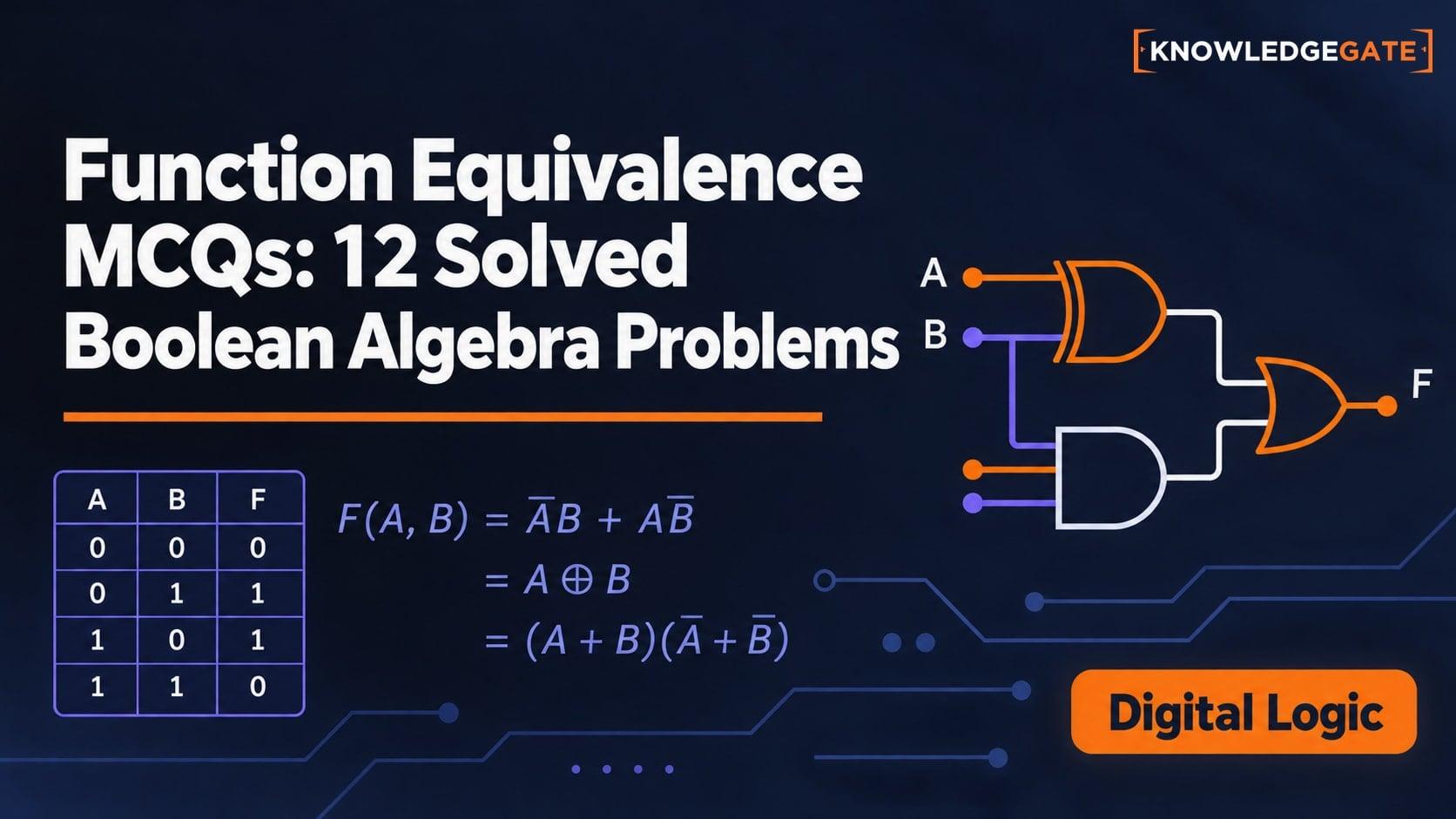
Function Equivalence MCQs: 12 Solved Boolean Algebra Problems
Solve 12 function-equivalence questions step by step, from De Morgan's law and absorption to minterm sets, counterexamples and a four-option MSQ.
Updated 30 Oct 20268 min read52 viewsDigital Electronics MCQs