

Prescriptive Process Models MCQs: 12 Solved Questions on Waterfall, Spiral and Incremental Models
Solve 12 MCQs on Waterfall, Spiral and Incremental models. Use sequence, risk, change and release cues to distinguish the models under exam pressure.
KnowledgeGate Team
Exam prep & CS education
Updated 16 Nov 20267 min read
Waterfall, Spiral and Incremental questions reuse words such as phase, iteration and release, but each model follows a different decision rule. Learners lose marks when they call every repeated cycle Spiral, treat every staged plan as Waterfall, or overlook risk as the decisive Spiral cue. Choose an option and name whether sequence, risk, feedback or a usable release settles it before reading the explanation. Software Process Models in Software Engineering owns model selection, weighted comparison and a full Spiral cycle; this set owns 12 question-by-question clue checks.
Waterfall, Spiral and Incremental models: the decision map before the MCQs
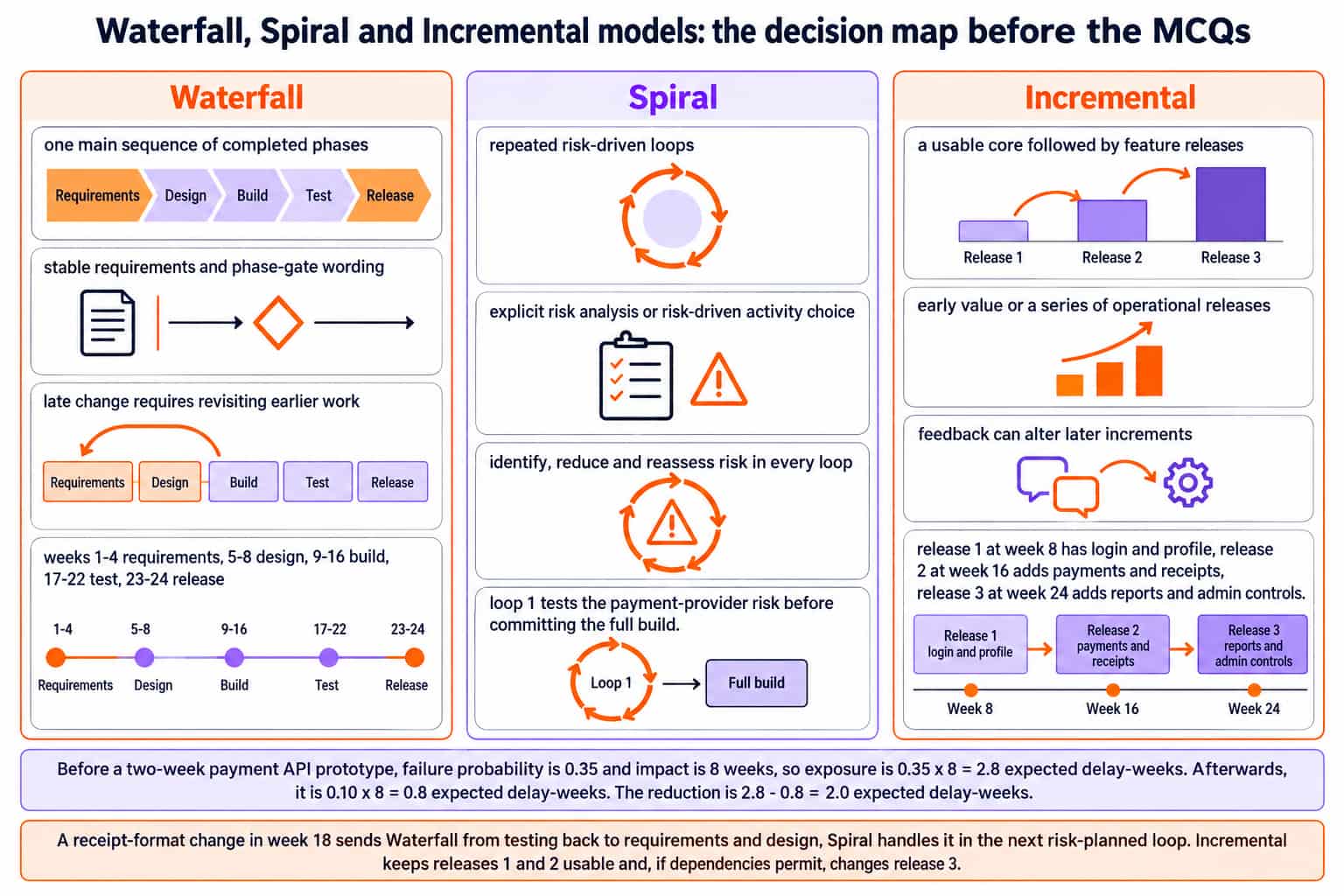
Model | Flow | Best clue in an MCQ | Change or risk handling | Exact 24-week example |
|---|---|---|---|---|
Waterfall | one main sequence of completed phases | stable requirements and phase-gate wording | late change requires revisiting earlier work | weeks 1-4 requirements, 5-8 design, 9-16 build, 17-22 test, 23-24 release |
Spiral | repeated risk-driven loops | explicit risk analysis or risk-driven activity choice | identify, reduce and reassess risk in every loop | loop 1 tests the payment-provider risk before committing the full build |
Incremental | a usable core followed by feature releases | early value or a series of operational releases | feedback can alter later increments | release 1 at week 8 has login and profile, release 2 at week 16 adds payments and receipts, release 3 at week 24 adds reports and admin controls |
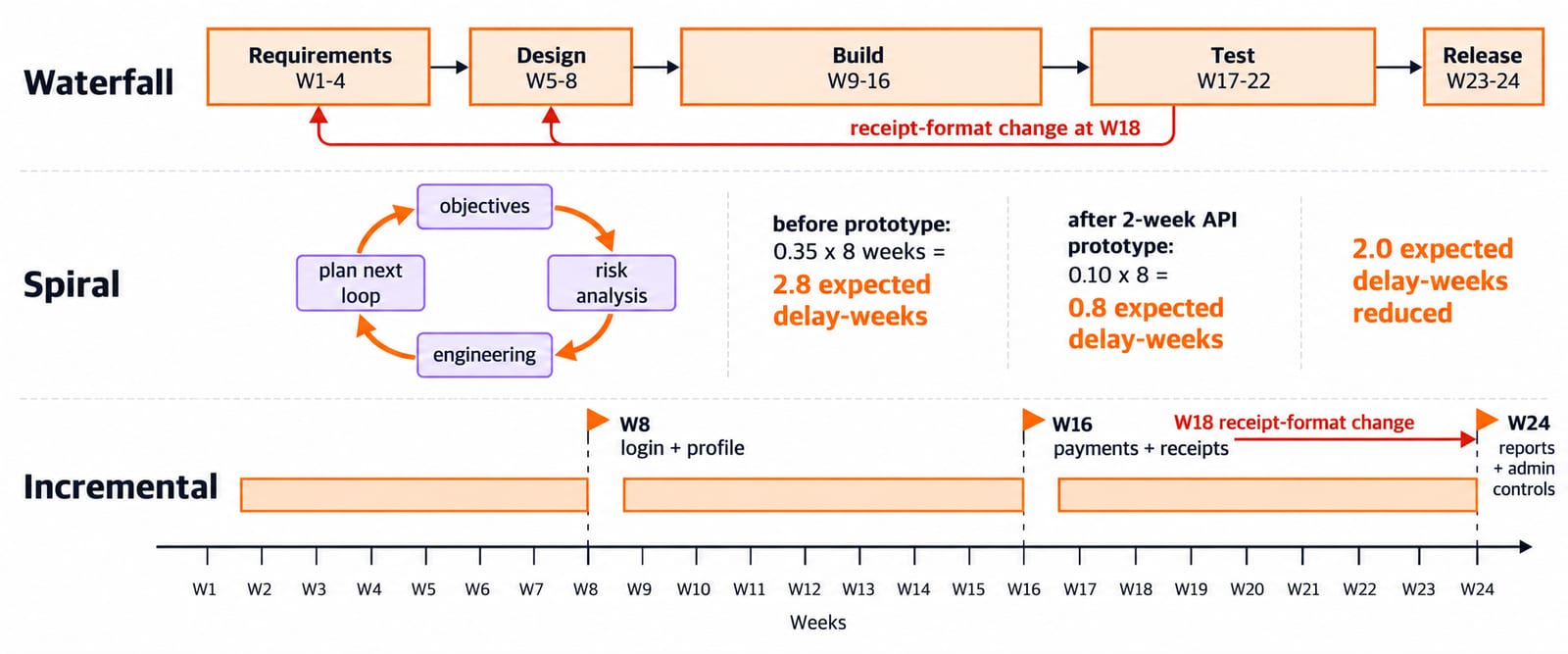
Before a two-week payment API prototype, failure probability is 0.35 and impact is 8 weeks, so exposure is 0.35 x 8 = 2.8 expected delay-weeks. Afterwards, it is 0.10 x 8 = 0.8 expected delay-weeks. The reduction is 2.8 - 0.8 = 2.0 expected delay-weeks. Risk exposure estimates the expected delay associated with a stated probability and impact; it does not select a process model by itself.
A receipt-format change in week 18 sends Waterfall from testing back to requirements and design. Spiral handles it in the next risk-planned loop. Incremental keeps releases 1 and 2 usable and, if dependencies permit, changes release 3. Use the NTA-UGC-NET Paper - 2 course for a structured route within UGC NET CS Exam Preparation.
Waterfall MCQs 1-3: classic sequence, change resistance and risk analysis
Question 1 (TPSC 2026)
Classic life cycle model is
A. Spiral Model
B. Waterfall Model
C. UML
D. PSP
Correct answer: B. Waterfall Model.
Classic life cycle is the traditional linear-sequential label for Waterfall. Spiral is risk-driven, UML is a modelling language, and PSP is a personal process framework.
Question 2 (RPSC 2024)
The __________ approach of system development is not suitable for accommodating changes as it follows all sequential steps.
A. Agile
B. Prototyping
C. Waterfall
D. Rapid Application Development (RAD)
Correct answer: C. Waterfall.
All sequential steps identifies Waterfall. A week 18 change may reopen earlier phases. Agile, prototyping and RAD use feedback more directly.
Question 3 (UGC NET 2016)
Which of the following is not included in waterfall model ?
A. Requirement analysis
B. Risk analysis
C. Design
D. Coding
Correct answer: B. Risk analysis.
Requirement analysis, design and coding are Waterfall phases. Explicit risk analysis identifies Spiral. Projects still manage risk, but this MCQ asks about textbook phases.
Waterfall MCQs 4-5: backtracking cost and project fit
Question 4 (TPSC 2025)
Which of the following is a major disadvantage of the Waterfall model?
A. It is easy to manage
B. It is suitable for smaller projects
C. It is difficult to go back to any stage once it's completed
D. It allows changes at any time during development
Correct answer: C. It is difficult to go back to any stage once it's completed.
Returning to a signed-off phase creates rework. The week 18 change sends testing backwards. A can be an advantage, B is not the major disadvantage, and strict Waterfall lacks D.
Question 5 (IBPS 2023)
A software company is developing a banking application where all requirements are finalized before development begins, and client involvement after the requirement phase is minimal. The development process follows a strictly linear sequence in which each phase must be completed before the next phase starts. Which software development model is most suitable for this project?
A. Agile
B. Waterfall
C. Spiral
D. V-Model
E. Prototyping
Correct answer: B. Waterfall.
Finalised requirements, minimal later involvement and linear phases identify Waterfall. This does not apply to every banking project. The alternatives require feedback, risk loops, or a V-Model verification cue.
Spiral MCQs 6-8: risk management, incremental development and anchor points
Question 6 (UPLT 2026)
Which is the most important feature of spiral model ?
A. Risk management
B. Performance management
C. Task management
D. Information management
Correct answer: A. Risk management.
Prototyping cuts payment risk from 2.8 to 0.8 expected delay-weeks. The other management activities occur elsewhere, but risk-driven loops distinguish Spiral.
Question 7 (Bihar STET 2025)
Which model considers risk assessment and incremental development in software projects?
A. Waterfall Model
B. Agile Model
C. Prototype Model
D. Spiral Model
Correct answer: D. Spiral Model.
Risk assessment plus progressive development identifies Spiral. Waterfall lacks risk loops, Agile is not defined by formal risk assessment, and prototyping clarifies uncertainty. Others assess risk, but Spiral is the textbook match.
Question 8 (UGC NET 2025)
Identify the correct statements about the Spiral model.
A. The Spiral model is an incremental process model.
B. The Spiral model is a risk-driven process model.
C. The Spiral model is an acyclic balancing approach.
D. The Spiral model involves a set of anchor-point milestones.
Choose the correct answer from the options given below:
A. A & B Only
B. B & C Only
C. A & D Only
D. B & D Only
Correct answer: D. B & D Only.
B is true because risk drives each loop, and D is the statement about anchor-point milestones. C is false because Spiral is cyclic. Here A is false because Spiral is classified as risk-driven, not as the named Incremental Process Model.
Spiral MCQs 9-10: the cost trade-off and when the loops stop
Question 9 (TPSC 2025)
Which of the following is a disadvantage of using the Spiral Model ?
A. It is suitable for large projects
B. It allows iterative refinement of software
C. It requires constant user feedback and involvement
D. It can be expensive due to frequent risk analysis
Correct answer: D. It can be expensive due to frequent risk analysis.
Large-project suitability and iterative refinement are benefits. Frequent risk analysis costs time and effort. The two-week prototype is worthwhile only when its risk reduction justifies that effort.
Question 10 (ISRO 2014)
For a software project, the spiral model was employed. When will the spiral stop?
A. When the software product is retired
B. When the software product is released after Beta testing
C. When the risk analysis is completed
D. After completing five loops
Correct answer: A. When the software product is retired.
Spiral stops neither after five loops nor after one analysis or beta release. Later loops cover maintenance, so the textbook endpoint is retirement.
Incremental and mixed-model MCQs 11-12: releases, core product and model matching
Question 11 (DSSSB 2021)
In ______ model, software is developed in a series of incremental releases.
I. Spiral
II. Sequential
A. Only I
B. Only II
C. Both I and II
D. Neither I nor II
Correct answer: A. Only I.
Spiral loops can produce successive releases, so I fits. A sequential model has one phase sequence, not increments. The Incremental lane delivers at weeks 8, 16 and 24.
Question 12 (UGC NET 2025)
Match List I with List II.
List I: A. V-Model; B. Incremental process model; C. Spiral Model; D. Concurrent Model.
List II: I. Trigger transition; II. Classic life cycle; III. Risk driven; IV. Core product.
Choose the correct answer from the options given below:
A. A-IV, B-I, C-III, D-II
B. A-II, B-III, C-IV, D-I
C. A-II, B-I, C-III, D-IV
D. A-II, B-IV, C-III, D-I
Correct answer: D. A-II, B-IV, C-III, D-I.
Lock C-III, Spiral Model -> Risk Driven, and B-IV, Incremental process model -> Core product. V-Model gives A-II and Concurrent gives event-triggered D-I. Only D matches all four. Release 1 is the example's core product.
The five traps to review, then a 12-question re-test
Clue or trap | Best decision | Questions |
|---|---|---|
linear or sequential wording | Waterfall | 1, 2 and 5 |
late change or backtracking | Waterfall disadvantage | 2 and 4 |
explicit risk analysis or risk-driven | Spiral | 3, 6, 7, 8, 9 and 12 |
series of releases or core product | incremental development | 11 and 12 |
iteration alone | insufficient clue, ask whether the stem stresses risk, feedback, a prototype or a usable release | varies |
Re-test without options: (1) fixed requirements, one W1-24 sequence, change at W18; (2) dependency risk is 0.35 x 8 = 2.8 expected delay-weeks, then a prototype lowers it to 0.8; (3) usable releases at W8, W16 and W24.
The sequence is Waterfall; Spiral; Incremental.
In 12 minutes, give each question 45 seconds and mark S for sequence, R for risk or I for increment. That takes 9 minutes. Use the final 3 on misses, then repeat after 48 hours without answer letters.
Study Software Quality in Software Engineering next. The IBPS SO IT Officer guide is adjacent practice, not proof for this set.
The short version
Waterfall is sequential, Spiral is risk-driven, and Incremental delivers a core product through usable releases. Continue with the course above or use the NTA UGC NET Paper - 2 Test Series, then re-solve misses after 48 hours.
Go deeper with the full courseUGC NET Computer Science (Paper 1 + Paper 2)
Keep learning
McCall’s and ISO 9126 Quality Factors MCQs: 12 Solved Questions with Explanations
Solve 12 published MCQs on McCall’s model, ISO 9126, software measures and the ISO 25010 trap. Each answer includes a direct exam-focused explanation.
Updated 18 Nov 20267 min readUGC NET Computer Science
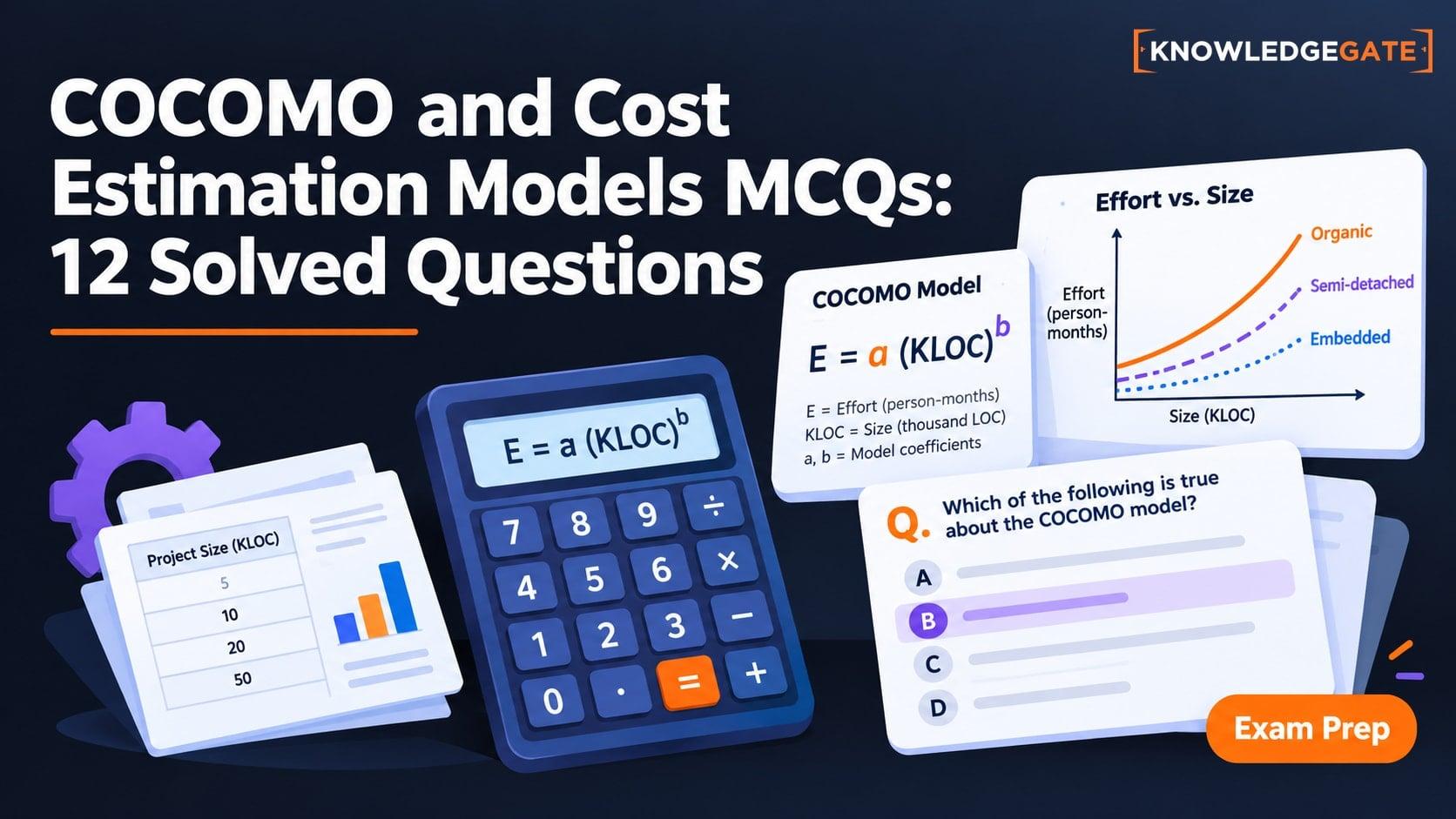
COCOMO and Cost Estimation Models MCQs: 12 Solved Questions
Test your COCOMO basics with 12 solved MCQs. Each answer explains model levels, effort and duration equations, unit conversion, cost drivers and common traps.
Updated 11 Nov 20267 min readUGC NET Computer Science
Agile Process Models MCQs: 12 Solved Questions on XP, Scrum and Adaptive Development
Solve 12 published agile process model MCQs, then use the explanations to separate Scrum roles, XP practices, adaptive planning, FDD order and agile values.
Updated 29 Oct 20267 min readUGC NET Computer Science
DBMS Data Models, Architecture and Components MCQs: 12 Solved Questions
Test whether you can separate data models, abstraction levels, catalogs, schemas and metadata. These 12 MCQs include concise explanations and a diagnostic review plan.
Updated 29 Oct 20267 min read158 viewsDBMS MCQs