Software Engineering for GATE: Syllabus Status, Weightage Reality and Preparation Priority
Software Engineering is common in CS courses, but the completed GATE 2026 CS syllabus does not list it separately. Use these evidence checks and worked hour plans to set the right priority.
KnowledgeGate Team
Exam prep & CS education
Updated 12 Aug 20265 min read
Many Computer Science courses teach Software Engineering, so a GATE aspirant may assume it has a separate slot and predictable weightage. The completed GATE 2026 CS syllabus does not name it as a standalone section. Weightage tables still circulate with a percentage next to it, and the gap between an official list and a retrospective claim is what decides whether the subject earns any of your revision hours.
Software Engineering in GATE CS: what the official syllabus actually lists
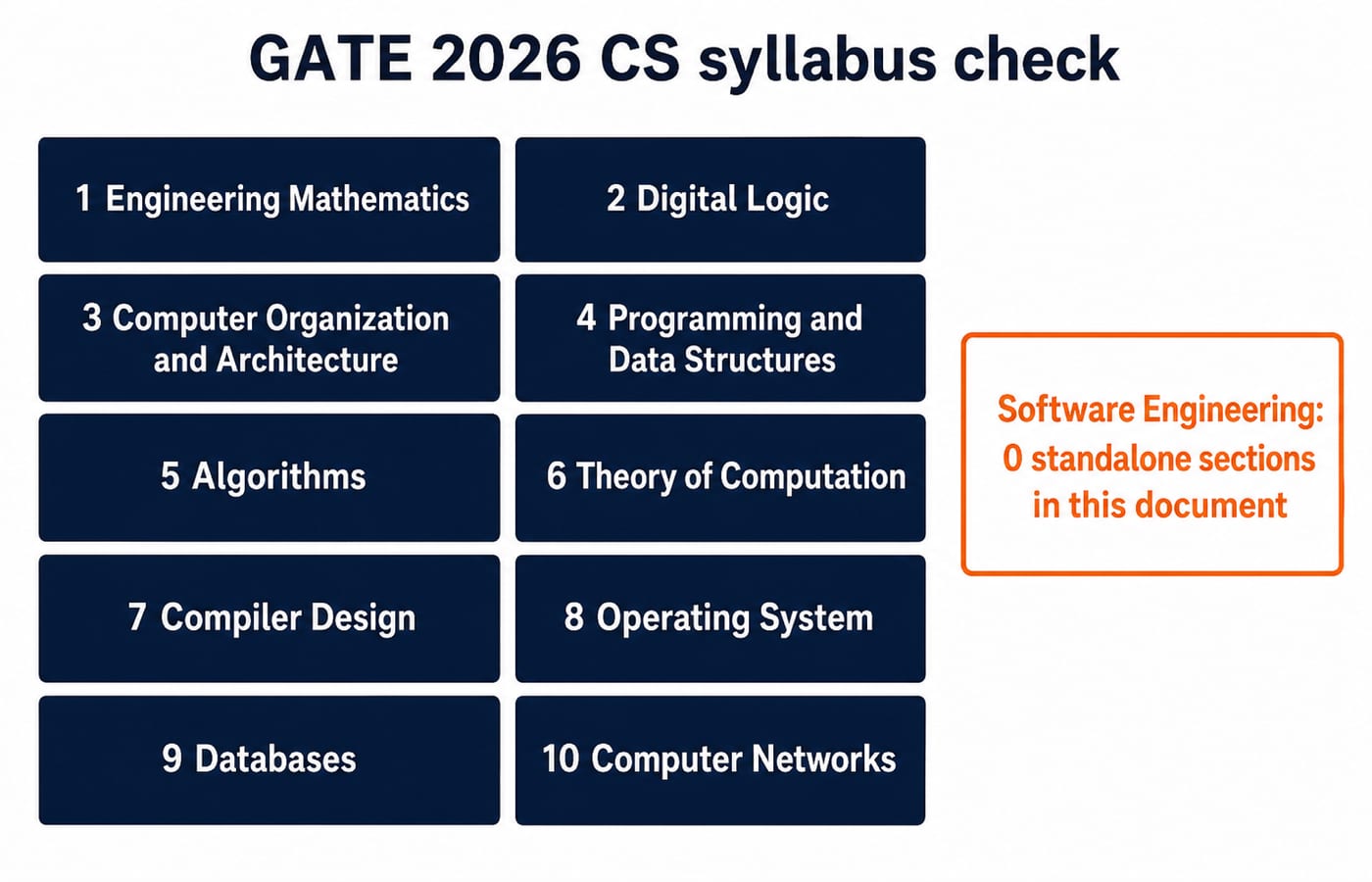
The completed-cycle GATE 2026 Computer Science and Information Technology syllabus lists 10 subject-level sections:
Engineering Mathematics
Digital Logic
Computer Organization and Architecture
Programming and Data Structures
Algorithms
Theory of Computation
Compiler Design
Operating System
Databases
Computer Networks
Software Engineering is neither an eleventh section nor a named subtopic in that document. That absence is specific to the completed 2026 syllabus, so reopen the official syllabus for your own attempt cycle before freezing a plan.
Software Engineering weightage for GATE: why a fixed number would be misleading
Do not mix three different things: an officially listed syllabus area, a retrospective count from selected papers, and a coaching platform's preparation priority. Software Engineering is not a standalone area in the 2026 syllabus, so no official weightage exists for it. That does not guarantee zero marks in a future paper.
Suppose you have a 100-hour revision budget and a circulating weightage table reserves 5% for Software Engineering:
Reserved time = 100 × 0.05 = 5 hours.
Times Software Engineering is named in the official 10-section syllabus = 0.
Times it is named as a subject in the GATE Guidance curriculum = 0.
Times it is named as a subject in the GATE Test Series curriculum = 0.
Sources supporting those 5 hours = 0 + 0 + 0 = 0.
Reclaim those 5 hours for your weakest officially listed area. This is a time-allocation decision, not a five-mark forecast. GATE CS Subject Weightage: Where Hours Pay Off explains the broader principle that marks from individual years are not a permanent entitlement.
GATE CS syllabus areas to prepare instead of a phantom subject
Map preparation to the named syllabus before adding adjacent CS subjects:
Official 2026 syllabus group | Named sections | What the official syllabus lists inside them |
|---|---|---|
Mathematics | Engineering Mathematics | Discrete mathematics, linear algebra, calculus, probability and statistics |
Hardware | Digital Logic; Computer Organization and Architecture | Boolean minimization, combinational and sequential circuits, number representation, addressing modes, pipelining and hazards, memory hierarchy |
Programming | Programming and Data Structures; Algorithms | Programming in C, recursion, linear structures, trees, heaps, graphs, searching and sorting, complexity, greedy, dynamic programming, divide and conquer |
Formal systems | Theory of Computation; Compiler Design | Finite automata, context-free grammars and push-down automata, pumping lemma, Turing machines, undecidability, lexical analysis, parsing, syntax-directed translation, data flow analyses |
Systems | Operating System; Databases; Computer Networks | Processes, threads, concurrency, deadlock, scheduling, virtual memory, file systems, relational algebra, SQL, normal forms, indexing, transactions, layering, routing, IP addressing, TCP and UDP |
Not one entry in that table is Software Engineering. The GATE Guidance curriculum mirrors these named CS areas and adds aptitude preparation, while the GATE Test Series practises the same core. That is a coverage map, not an official marks table. Use the GATE CS Exam category to compare subject, mathematics, aptitude and testing paths.
Software Engineering topics and the exams that do list them
Process models, requirements, design, estimation, quality and testing are examined, just not inside GATE CS. Software Engineering sits in the IBPS SO IT Officer professional knowledge paper and in computer science teaching recruitment papers, and IBPS SO IT Officer Software Engineering: SDLC to Testing shows the depth those papers ask for. Confirm the listing in your own exam's notification before you spend hours on it.
Requirements-style precision can improve problem reading, while testing discipline can improve solution checking. Those habits do not turn Software Engineering into an official GATE 2026 CS subject. If you are writing two exams, keep the Software Engineering hours in a separate block labelled with the second exam, its source document and its hour count, so a GATE week never absorbs them by accident.
Software Engineering preparation priority: two worked plans
Both candidates have 12 hours per week for 8 weeks, so each has 12 × 8 = 96 hours.
Allocation | Candidate A: GATE only | Candidate B: GATE plus a second exam that lists Software Engineering |
|---|---|---|
Listed GATE technical areas | 60 hours | 48 hours |
Mathematics and aptitude | 16 hours | 16 hours |
PYQs or mocks | 12 hours | 12 hours |
GATE revision and error log | 8 hours | 8 hours |
Software Engineering under second-exam track | 0 hours | 12 hours |
Total | 60 + 16 + 12 + 8 + 0 = 96 hours | 48 + 16 + 12 + 8 + 12 = 96 hours |
Candidate B gives up 12 GATE-core hours, a trade-off justified only when the second exam's completed notification explicitly includes Software Engineering.
If only 6 of Candidate A's planned 12 hours survive, keep 3 hours for the weakest official technical area, 1 hour for mathematics or aptitude, 1.5 hours for a timed set plus review, and 0.5 hour for error-log revision. The check is 3 + 1 + 1.5 + 0.5 = 6 hours. Candidate B postpones the optional Software Engineering block first unless the second exam is nearer. Neither candidate adds a subject the syllabus does not name.
GATE Software Engineering claims: test the plan against evidence
Open the current official syllabus, compare it with the course curriculum, then test only listed subjects through PYQs and mocks. The GATE Test Series supports subject-wise and full-mock practice without turning a practice result into an exam-wide claim.
After a 30-question mixed set, suppose you have 18 correct and 12 wrong. Practice accuracy is 18 ÷ 30 × 100 = 60%. Classify the 12 errors as 5 concept gaps, 4 calculation slips and 3 time-pressure misses, with 5 + 4 + 3 = 12.
Allocate the next 6 study hours as 3 hours for the 5 concept gaps, 2 hours to recalculate the 4 slips, and 1 hour for a timed redo of the 3 slow questions. The allocation closes at 3 + 2 + 1 = 6 hours. Let this personal diagnostic re-rank listed subjects, not resurrect an unlisted one.
Software Engineering for GATE: the short answer and next step
The completed GATE 2026 CS syllabus has 10 named sections and no standalone Software Engineering section. No honest fixed Software Engineering weightage follows from that absence. A GATE-only aspirant should finish listed weak areas, PYQs, mocks and revision before adding unrelated coverage, while the official syllabus for the current cycle remains the controlling source if it changes.
For a structured path across the listed GATE subjects, use GATE Guidance by Sanchit Sir. It helps you plan from supported subject coverage instead of an unsupported list, without promising marks or rank.
Keep learning
ICT in Education MCQs: 12 Solved Questions on Digital Learning Tools
Solve 12 ICT in Education MCQs, then use clear explanations and a five-layer model to separate files, tools, platforms and public initiatives.
Updated 3 Oct 20268 min readUGC NET Computer Science
Requirements Elicitation Techniques and Use Case Development: Worked Library Example
Follow a fictional library reservation from interviews and observation through testable requirements, a UML use-case model, UC-07, and acceptance checks.
Updated 28 Sep 20266 min readUGC NET Computer Science
Quality Factors: McCall’s and ISO 9126 Models with a Worked Scoring Example
Build both quality models around one maintainability audit. This guide maps their vocabulary, calculates McCall-style and ISO-style scores, and ends with exam-focused checks.
Updated 25 Sep 20265 min readUGC NET Computer Science
Cohesion and Coupling MCQs: 10 Solved Questions on Functional Independence
Practise 10 solved MCQs on cohesion, coupling, functional independence, module dependencies, and the distinctions that make closely matched options easier to separate.
Updated 24 Sep 20267 min readUGC NET Computer Science