SBI PO English Preparation: Objective and Descriptive Plan
Build objective English accuracy and typed descriptive communication together with a practical 7.5-hour weekly routine, worked drills, feedback rules and combined simulations.
KnowledgeGate Team
Exam prep & CS education
Updated 14 Aug 20266 min read
Many candidates spend every English session on reading comprehension, cloze and grammar because prelims comes first. They then discover that clear typed writing cannot be built in the short gap before mains. This six-week routine keeps objective accuracy primary while protecting time for descriptive communication every week from day one.
1. Start With the Current SBI PO English Demands
According to SBI's 2026 notification CRPD/PO/2026-27/09, prelims English has 40 questions in 20 minutes. Mains English has 40 questions for 20 marks in 40 minutes, while the mains descriptive communication test has three tasks for 30 marks in 30 minutes: an e-mail, a situation analysis, and either a report or a precis. For objective questions, a wrong answer loses one-fourth of the marks assigned to that question, while an unanswered question has no penalty.
SBI publishes the applicable advertisement on State Bank of India Careers; confirm the numbers for your own cycle there before you build a timetable on them. SBI PO Syllabus and Exam Pattern 2026 sets out how prelims, mains and the interview stage feed into the final merit list.
Older essay-and-letter exercises can still improve sentence control, but they are not the current task list; an essay plan will not teach you to compress a situation analysis into ten minutes. The SBI PO Mains Preparation Course runs English Language and descriptive practice on one timetable.
2. Use One 7.5-Hour Weekly Plan for Both Tracks
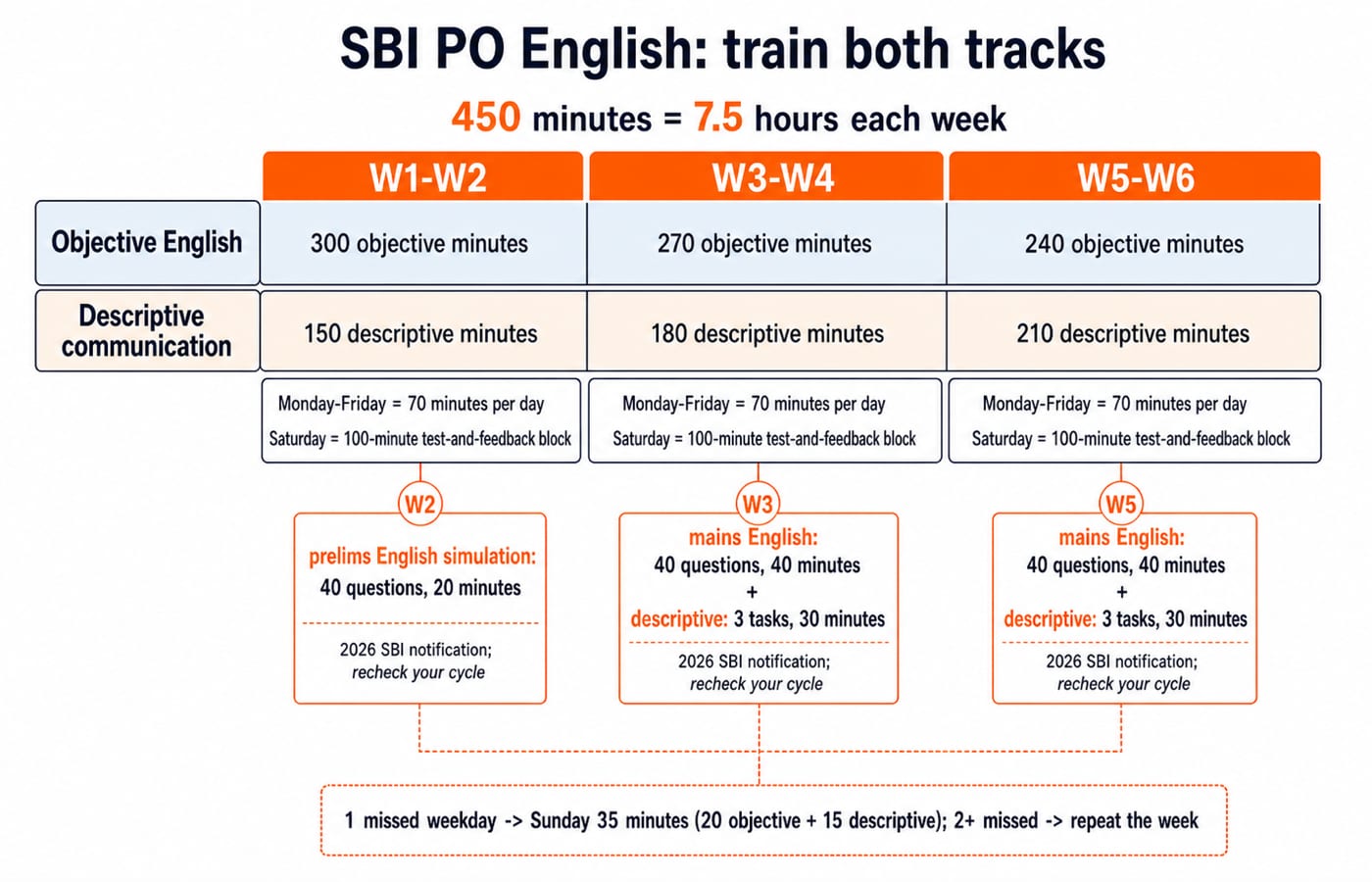
Commit 450 minutes weekly for six weeks. Shift gradually towards descriptive work without dropping objective practice.
Phase | Monday to Friday, 70 minutes daily | Saturday test and feedback, 100 minutes | Weekly total |
|---|---|---|---|
Weeks 1-2 | 50 objective + 20 descriptive | 50 objective + 50 descriptive | 300 objective + 150 descriptive |
Weeks 3-4 | 45 objective + 25 descriptive | 45 objective + 55 descriptive | 270 objective + 180 descriptive |
Weeks 5-6 | 40 objective + 30 descriptive | 40 objective + 60 descriptive | 240 objective + 210 descriptive |
Each week, produce five objective micro-sets, one timed English simulation, two short descriptive drafts and one revised draft. From week 3, add one 30-minute descriptive simulation. The ratio changes because prelims needs speed and accuracy, while mains demands a switch to clear typed communication.
If you miss one weekday, do not double the next session. Recover 35 minutes on Sunday, split 20 objective and 15 descriptive. After two or more missed sessions, repeat the week's targets instead of compressing them.
3. Turn Objective Practice Into Decisions, Not Question Counts
Rotate four skill families: reading comprehension and inference; cloze and contextual vocabulary; grammar and sentence correction; sequencing and paragraph logic. SBI publishes no fixed topic split inside the English section, so let your last three mocks set the mix: give the weakest family two of the five weekly micro-sets and one each to the other three. Bank PO English: RC-First Strategy for IBPS and SBI works through the reading-comprehension drill sequence in detail.
Take a 20-question, one-mark-per-question training set. In 15 minutes, you record 16 correct, 3 wrong and 1 blank. Applying the one-fourth penalty:
Corrected score =
16 - (3 x 0.25) = 16 - 0.75 = 15.25.Attempted questions =
16 + 3 = 19.Attempted accuracy =
16 / 19 x 100 = 84.2%, rounded to one decimal place.
Review all three errors first. Reduce the same set type from 15 to 13 minutes only after two consecutive attempts reach at least 90% accuracy.
Grammar retry: “The committee, along with two external advisers, ___ the revised policy before noon.” Options: (A) review, (B) reviews, (C) are reviewing, (D) have review, (E) were review. Answer: (B) reviews. The head subject “committee” is singular; the intervening phrase does not control agreement.
4. Practise the Current Descriptive Tasks Under a Clock
Use this e-mail drill: “As an SBI PO trainee, write to the branch manager after three ATMs in your service area repeatedly ran out of cash over a weekend. Summarise 18 customer complaints, note a 6-hour replenishment delay, and propose two safeguards.”
Give yourself 10 minutes: 2 to plan, 6 to type and 2 to revise. That leaves 20 minutes of the 30-minute block for the other two tasks. Use the subject line Preventing weekend ATM cash outages. State the 18 complaints and 6-hour delay once, propose an 80% replenishment trigger and a 4-hour backup-vendor escalation, then request approval before Friday.
Situation analysis needs a different shape. Drill: “Your branch has run a single-teller counter for two weeks after a transfer. Queue times at 11 am have doubled and two customers have written to the regional office.” In 10 minutes, write four short paragraphs: what is happening, why, two options with the cost of each, and the one you recommend with a date. A busy reader should be able to act on it without one follow-up question.
For precis practice, reduce a 180-word passage on digital-payment fraud awareness to 60 words in 10 minutes. Retain the three facts the passage carries: the bank held 12 workshops, reached 840 customers and recorded a 25% fall in reported phishing clicks over the next month. Cut every example, adjective and repeated fact.
Use one process for every descriptive task:
Identify the purpose and audience.
List the indispensable facts.
Draft in neutral, professional English.
Remove repetition, then check names, figures and verb tense.
Avoid decorative openings, invented data and memorised quotations. Every sentence needs a job.
5. Make Feedback Improve Both Objective and Descriptive English
Keep one error ledger with the columns date | task | error | rule | retry. A useful entry is:
W2 Tue | cloze Q7 | wrote "despite of the delay" | despite takes no of | "Despite the delay, service resumed."
Require that construction in Saturday's e-mail revision, turning an objective error into a writing improvement.
Score your own drafts out of 10: 0 to 2 points each for task completion, structure, grammar, concision and proofreading. For example, 2 + 1 + 1 + 1 + 2 = 7/10. Next week, target the missing structure point by separating problem, evidence and action into three short paragraphs.
Choose no more than three corrections, rewrite within 48 hours and compare both versions. Feedback must produce a second draft.
6. Run Combined Simulations Before Mains
From week 3, alternate two official-shape checkpoints: prelims English, 40 questions in 20 minutes; and mains, 40 English questions in 40 minutes followed by three descriptive tasks in 30 minutes.
Suppose the first descriptive attempt uses 12 minutes for the e-mail, 9 for situation analysis and 14 for the report or precis. The total is 12 + 9 + 14 = 35 minutes, 5 over the block. Next time, use 8 + 9 + 13 = 30 minutes. Keep revision inside each allocation.
Record four results: objective attempted accuracy, objective corrected score, descriptive tasks completed out of 3, and minutes used. Compare each week against the previous week's four numbers.
7. Avoid the Five Traps, Then Choose the Next Step
Postponing writing: do two drafts weekly.
Treating essay and letter as current: follow the SBI task list.
Chasing attempts under negative marking: protect accuracy first.
Saving vocabulary lists: use each word in a cloze retry and sentence.
Writing without revision: return a corrected draft within 48 hours.
The short version is 7.5 hours a week for six weeks, both tracks every week, and a Saturday that always ends in a corrected draft.
For objective speed and the descriptive block on one timetable, the SBI PO preparation bundle carries the prelims and mains courses together. If you only need the writing half, take the mains course on its own. SBI PO Exam Preparation lists the rest of the SBI material.
Keep learning
SBI SO Cutoffs: Check Corrections and Build a Practice Target
A cutoff becomes useful only when its post, category and score basis match your comparison. Work through a real SBI correction and a hypothetical target-setting exercise to plan your next mocks.
5 Oct 20264 min readSBI Exams
SBI SO Syllabus: Section-by-Section Study Map for IT Aspirants
Build an IT/System study map around your exact SBI post. Use a historical exam table, original worked exercises and an eight-hour sample week to turn topic lists into practice.
1 Oct 20265 min readSBI Exams
SBI SO Preparation Strategy: A 12-Week Role-Specific Plan
Build an SBI SO plan around the exact Specialist Cadre Officer post you are targeting. This guide gives an 11-hour weekly calendar, diagnostics, repair loops and separate written-test and interview branches.
Updated 24 Sep 20266 min readSBI Exams
SBI SO Exam Pattern and Marking Scheme: Post-Wise Routes Explained
There is no single SBI SO paper pattern. Use this guide to identify your post's route, understand qualifying and merit components, and build a timetable from the official notice.
Updated 22 Sep 20264 min readSBI Exams