

SBI Clerk Syllabus: Prelims and Mains Topics by Section
Separate the SBI Clerk Prelims syllabus from the extra Mains study blocks. Use practical topic maps, worked examples and a 10-hour weekly plan.
KnowledgeGate Team
Exam prep & CS education
Updated 11 Sep 20264 min read
The official notice supplies the stage structure; the topic map below groups the preparation work and turns it into a study split.
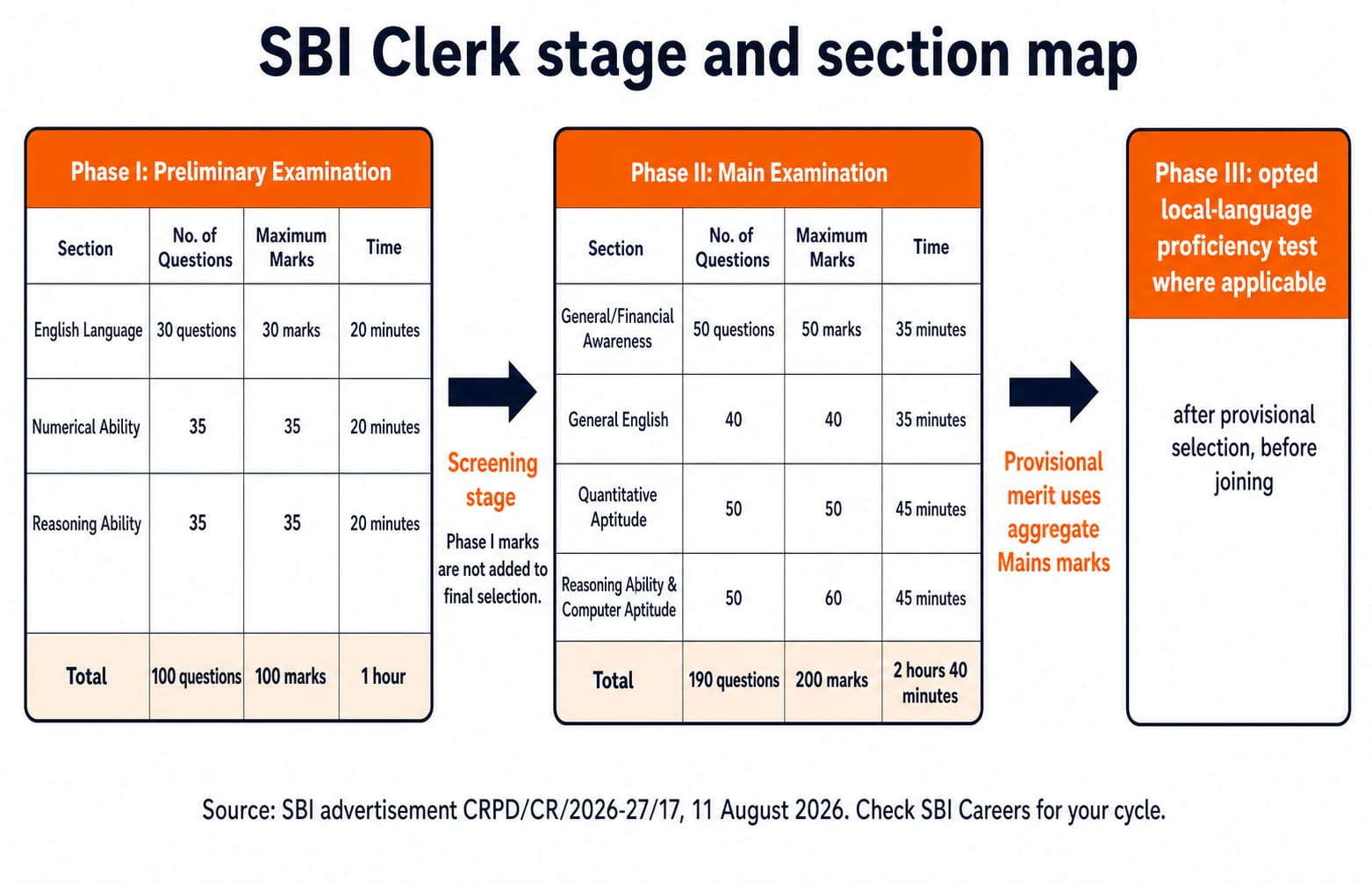
SBI's 11 August 2026 advertisement supplies the stage names, section totals, timings and marking rules. Confirm the notice for your cycle before applying those official details; the topic groupings and examples below are study aids.
Related reading: SBI Clerk pattern and marking rules and Clerk paper analysis.
1. SBI Clerk syllabus at a glance: three stages, two written maps
SBI Junior Associates advertisement CRPD/CR/2026-27/17, 11 August 2026:
Stage | Section | Questions | Marks | Time |
|---|---|---|---|---|
Phase I | English Language | 30 | 30 | 20 minutes |
Numerical Ability | 35 | 35 | 20 minutes | |
Reasoning Ability | 35 | 35 | 20 minutes | |
Total | 100 | 100 | 1 hour | |
Phase II | General/Financial Awareness | 50 | 50 | 35 minutes |
General English | 40 | 40 | 35 minutes | |
Quantitative Aptitude | 50 | 50 | 45 minutes | |
Reasoning Ability and Computer Aptitude | 50 | 60 | 45 minutes | |
Total | 190 | 200 | 2 hours 40 minutes |
Prelims is the three-section speed layer. Mains adds awareness and computer depth. Phase I marks do not enter final selection. Provisional merit uses aggregate Mains marks, subject to eligibility and an applicable opted language test. SBI Clerk Pattern: How Sections Shift Prelims to Mains owns timing, marking and the transition between stages; this post owns the syllabus topic map and the weekly study split.
2. English, Numerical Ability and Reasoning: the Prelims topic map
Prelims practice topics
Section | Topic families to practise |
|---|---|
English | Reading comprehension, cloze test, error detection, sentence improvement, fill in the blanks, para jumbles, vocabulary and grammar |
Numerical Ability | Number system, simplification, percentages, ratio and proportion, profit and loss, averages, time and work, time-speed-distance, simple and compound interest, data interpretation, algebra and mensuration |
Reasoning | Puzzles, seating arrangement, syllogism, inequality, coding-decoding, blood relations, direction sense, series, alphanumeric reasoning and logical reasoning |
These families tell you what to practise; the official 20-minute section limit tells you how to perform it. SBI Clerk Prelims structures all three blocks.
3. Quant grows from direct arithmetic to data interpretation
Both stages share number system, percentages, ratios, profit and loss, averages, time and work, speed-distance and algebra. The Mains course adds or emphasises data interpretation, probability and data sufficiency.
Consider this branch table:
Day | Branch A | Branch B |
|---|---|---|
Monday | 240 | 160 |
Tuesday | 300 | 200 |
Monday total = 240 + 160 = 400. Tuesday total = 300 + 200 = 500. The increase = 500 - 400 = 100. Therefore, percentage increase = 100 / 400 x 100 = 25%.
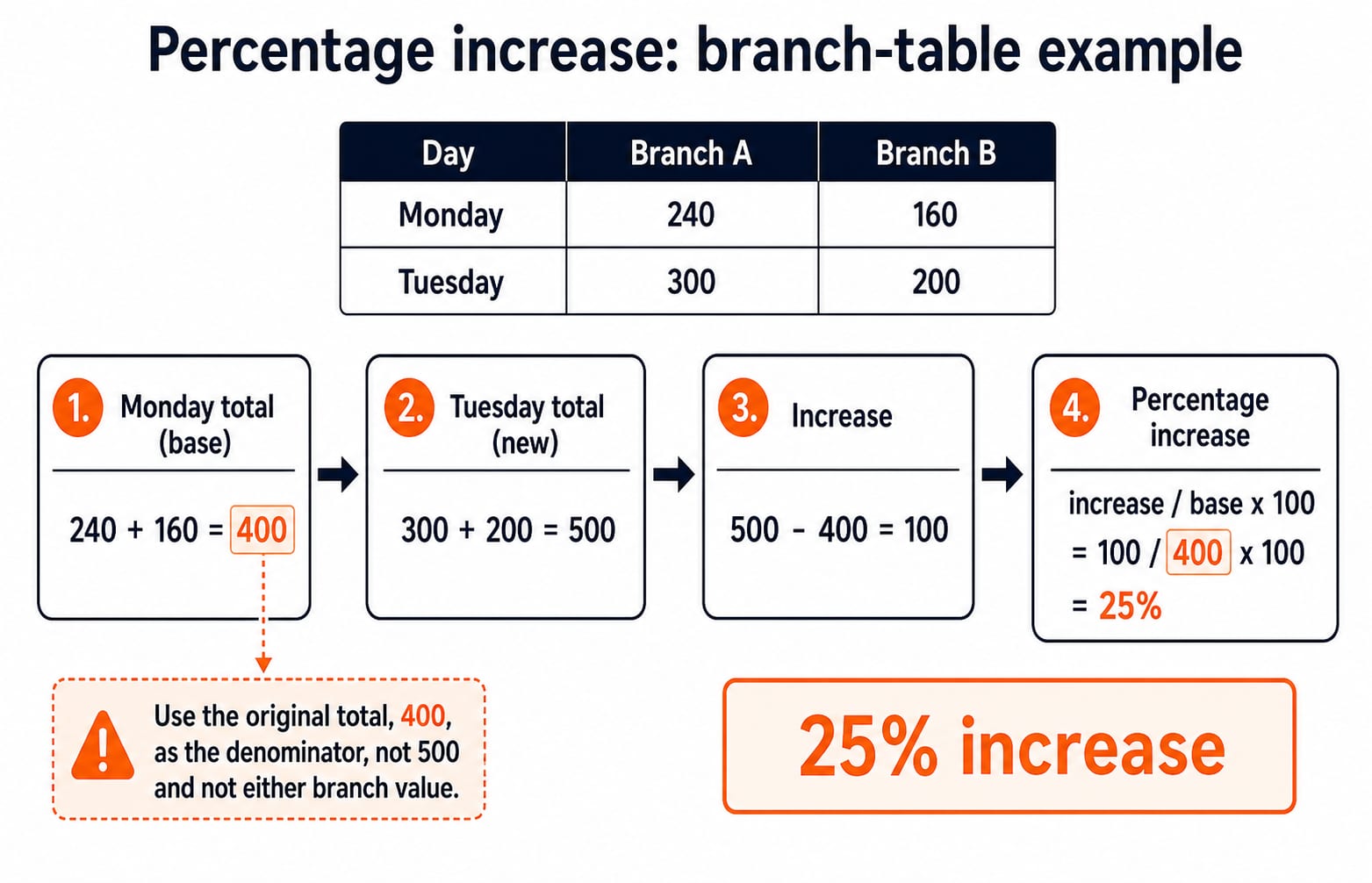
The wrong row or denominator wastes time even when you know the formula. The SBI Clerk Quant six-week calculation speed routine trains extraction and calculation.
4. Reasoning expands into longer sets, then meets Computer Aptitude
Shared Reasoning practice covers puzzles, seating arrangement, syllogism, inequality, coding-decoding, data sufficiency and logic. The Mains course adds computer fundamentals, operating systems, internet and networking, MS Office, security and awareness.
Number five seats left to right: 1, 2, 3, 4, 5. Given R = 1 and P = 3, Q immediately left of P gives Q = 2. S immediately right gives S = 4. The remaining seat gives T = 5. Final order: R-Q-P-S-T.
Number positions, place fixed clues, apply immediate-neighbour clues, then fill the remaining slot. SBI Clerk Reasoning: A Six-Week Timed Prep Route develops that method into timed puzzle sets.
5. General and Financial Awareness is a Mains-only study stream
The dated SBI notice assigns General/Financial Awareness 50 questions, 50 marks and 35 minutes in Mains. The course then organises preparation into current affairs, banking awareness, financial awareness, RBI and the banking system, government schemes, Indian economy, banking terms, financial institutions, and important national and international events.
Do not treat this stream like a one-time Quant chapter. Keep a dated weekly current-affairs file beside a stable static-banking file, and revise both. This separates changing facts from concepts that remain useful across cycles. The SBI Clerk Mains course gives a structured route for this block along with General English, Quantitative Aptitude, Reasoning and Computer Aptitude.
6. Worked weekly split: cover the full map without abandoning Mains
A 600-minute practice model:
Quant: 3 x 50 = 150 minutes
Reasoning: 3 x 50 = 150 minutes
English: 2 x 50 = 100 minutes
General/Financial Awareness: 5 x 20 = 100 minutes
Computer Aptitude: 1 x 50 = 50 minutes
Mixed error review: 1 x 50 = 50 minutes
Total: 150 + 150 + 100 + 100 + 50 + 50 = 600 minutes = 10 hours. Replace the next mixed-review block with any missed 50-minute block; never double or delete it. Spread five awareness sessions across the week because this material is time-sensitive.
Under the notice's one-mark setup and one-fourth penalty: 82 attempted, 72 correct, 10 wrong and 18 unattempted. Accuracy = 72 / 82 x 100 = 87.8%. Score = 72 - (10 x 0.25) = 72 - 2.5 = 69.5.
7. The short version: build two checklists and verify one official notice
Copy the three Prelims rows into a checklist. Add the Mains-only awareness and computer blocks. Mark every topic family as learn, practise or time. Then reopen SBI Careers and copy the pattern from the notice governing your cycle.
Browse the SBI exam catalogue for the two stage-specific courses, then keep the Prelims and Mains topic lists on separate study pages.
Your immediate action is simple: create separate Prelims and Mains pages today, then place every shared topic on both instead of treating the syllabus as one flat list.
Keep learning
SBI SO Cutoffs: Check Corrections and Build a Practice Target
A cutoff becomes useful only when its post, category and score basis match your comparison. Work through a real SBI correction and a hypothetical target-setting exercise to plan your next mocks.
Updated 30 Oct 20265 min readSBI Exams
SBI SO Syllabus: Section-by-Section Study Map for IT Aspirants
Build an IT/System study map around your exact SBI post. Use a historical exam table, original worked exercises and an eight-hour sample week to turn topic lists into practice.
Updated 30 Oct 20265 min readSBI Exams
SBI SO Preparation Strategy: A 12-Week Role-Specific Plan
Build an SBI SO plan around the exact Specialist Cadre Officer post you are targeting. This guide gives an 11-hour weekly calendar, diagnostics, repair loops and separate written-test and interview branches.
Updated 30 Oct 20265 min readSBI Exams
SBI SO Exam Pattern and Marking Scheme: Post-Wise Routes Explained
There is no single SBI SO paper pattern. Use this guide to identify your post's route, understand qualifying and merit components, and build a timetable from the official notice.
Updated 30 Oct 20264 min readSBI Exams