

REET Science Solved Questions: Explain the Concept and Eliminate Traps
Work through five original science questions, explain why the distractors fail, and turn each answer into a classroom explanation. Includes pressure and efficiency calculations.
KnowledgeGate Team
Exam prep & CS education
Updated 17 Nov 20265 min read
Recognising a science answer is easier than explaining why the other options fail. These five original practice questions build that explanation habit through living processes, matter, force and energy, followed by a classroom misconception. Use them for concept revision. Attempt each question before reading its solution, then explain it as if teaching a pupil.
How this practice connects to REET Level-II science
BSER's hosted Level-II syllabus lists plant nutrition and respiration, force and motion including pressure and speed, energy conservation, matter and separation, and science teaching methods, evaluation and remedial teaching. See BSER's hosted Level-II Mathematics and Science syllabus, English science section on page 4. This undated archival document is a topic reference; check the Board's current notices for your examination cycle's requirements.
The revision groups are living world, matter, force and energy. For each question, identify the governing principle, eliminate distractors and explain the answer aloud. The classroom applications are practice in reasoning.
If you are comparing examinations, the wider teaching-eligibility preparation options provide cross-exam navigation.
Living world: plants respire even when photosynthesis stops
Q1. A healthy green plant is kept in darkness for six hours. Which statement is correct?
(a) Both photosynthesis and respiration stop.
(b) Photosynthesis stops, but respiration continues.
(c) Photosynthesis continues, but respiration stops.
(d) Respiration occurs only in the roots.
Answer: (b). Photosynthesis requires light. Cellular respiration releases usable energy from available food substrates in living plant cells and continues in darkness.
Option (a) treats two different processes as having the same requirements. Option (c) reverses their dependence on light. Option (d) wrongly confines respiration to roots: living cells in other plant parts respire too. Respiration here means a cellular process, not breathing movements.
For a classroom explanation, consider a germinating seed. Before it develops green leaves, it can use stored food through respiration to support growth. Ask the learner to explain where that energy comes from. This checks understanding more effectively than asking whether plants are living things.
Matter: dissolved salt has not disappeared
Q2. In a closed container, 5 g of salt dissolves completely in 95 g of water. Nothing enters or leaves. What is the mass of the solution?
(a) 95 g
(b) 100 g
(c) 90 g
(d) 5 g
Answer: (b). Add the masses of the substances present:
Mass of solution = mass of water + mass of salt = 95 g + 5 g = 100 g.
Salt particles disperse throughout the water; becoming invisible does not remove their mass. Option (a) ignores the salt, (c) subtracts it, and (d) ignores the water. A clear solution can still contain dissolved matter. Adding masses does not imply that liquid volumes always add exactly.
Ordinary filtration will not recover dissolved salt. Evaporation can leave the salt behind, while distillation can recover water by condensing its vapour.
To demonstrate conservation, weigh the same closed assembly before and after dissolving. Keep the container and all contents on the balance in both readings. The 100 g is the contents mass, not the balance reading including the container.
Force and motion: the same force can produce different pressure
Q3. A stationary block on a horizontal table exerts a normal force of 60 N. Face A has contact area 0.03 m2; face B has contact area 0.01 m2. What pressure does each face produce? Assume no additional vertical forces on the block besides gravity and the table's support.
(a) A: 2,000 Pa; B: 6,000 Pa
(b) A: 6,000 Pa; B: 2,000 Pa
(c) Both: 60 Pa
(d) A: 1.8 Pa; B: 0.6 Pa
Answer: (a). Pressure is normal force divided by contact area. The force is already given, so no mass-to-weight conversion is needed.
Face A: 60 / 0.03 = 6,000 / 3 = 2,000 N/m2 = 2,000 Pa.
Face B: 60 / 0.01 = 6,000 / 1 = 6,000 N/m2 = 6,000 Pa.
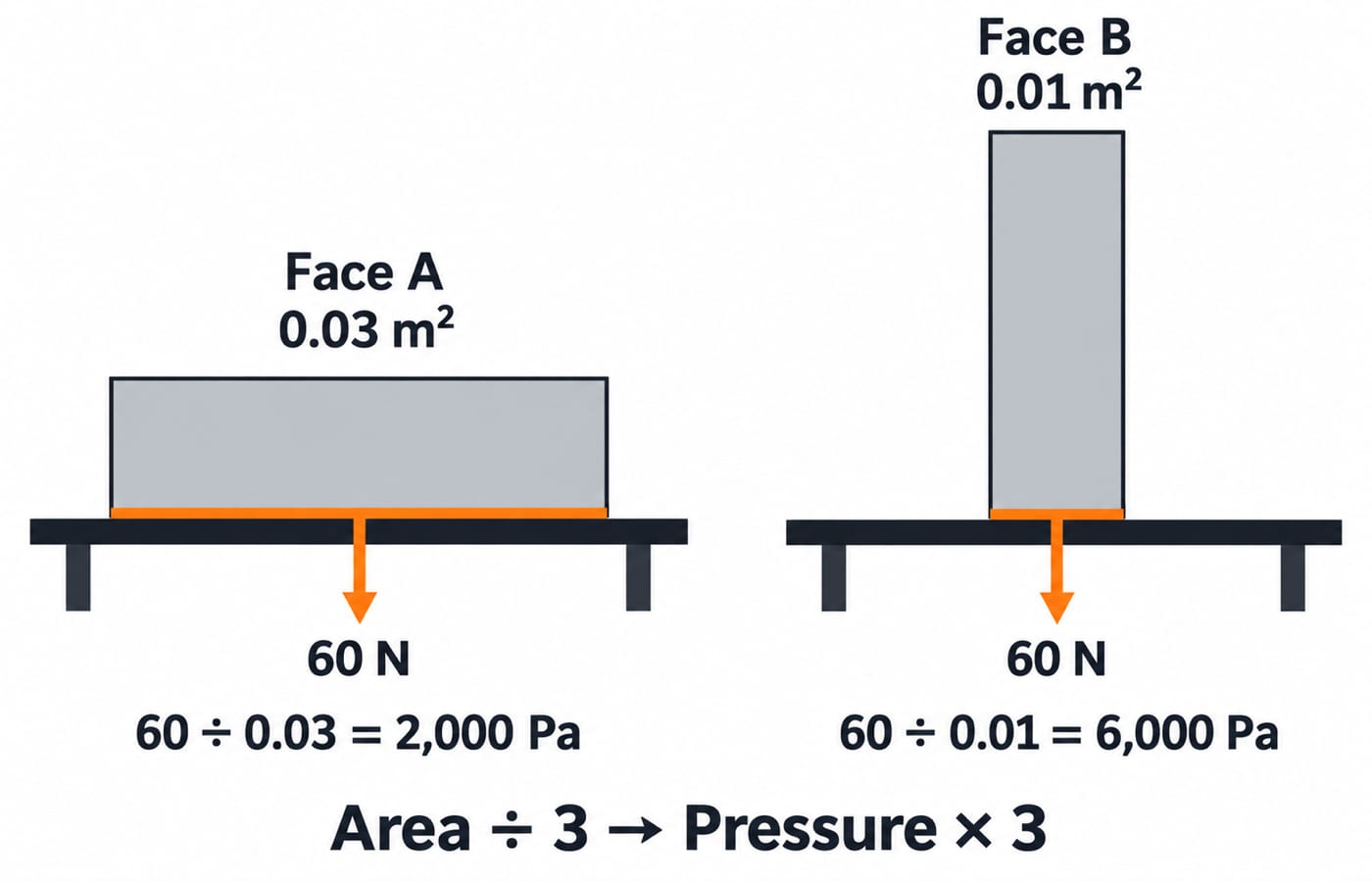
Area falls to one third, so pressure triples. Option (b) reverses this relation. Option (c) confuses force with pressure; (d) multiplies force by area instead of dividing.
Wide bag straps apply this principle: spreading a given load over a larger contact area reduces pressure.
Energy: efficiency does not mean missing energy
Q4. A lamp receives 100 J of electrical energy. In a simplified account, 20 J leaves as useful visible light and 80 J as heat. What is its useful-light efficiency?
(a) 20%
(b) 80%
(c) 100%
(d) 120%
Answer: (a). Efficiency = useful output / input x 100% = 20 / 100 x 100% = 20%.
Conservation still holds: 20 J + 80 J = 100 J. Heat is not useful for the stated lighting purpose, but it remains energy.
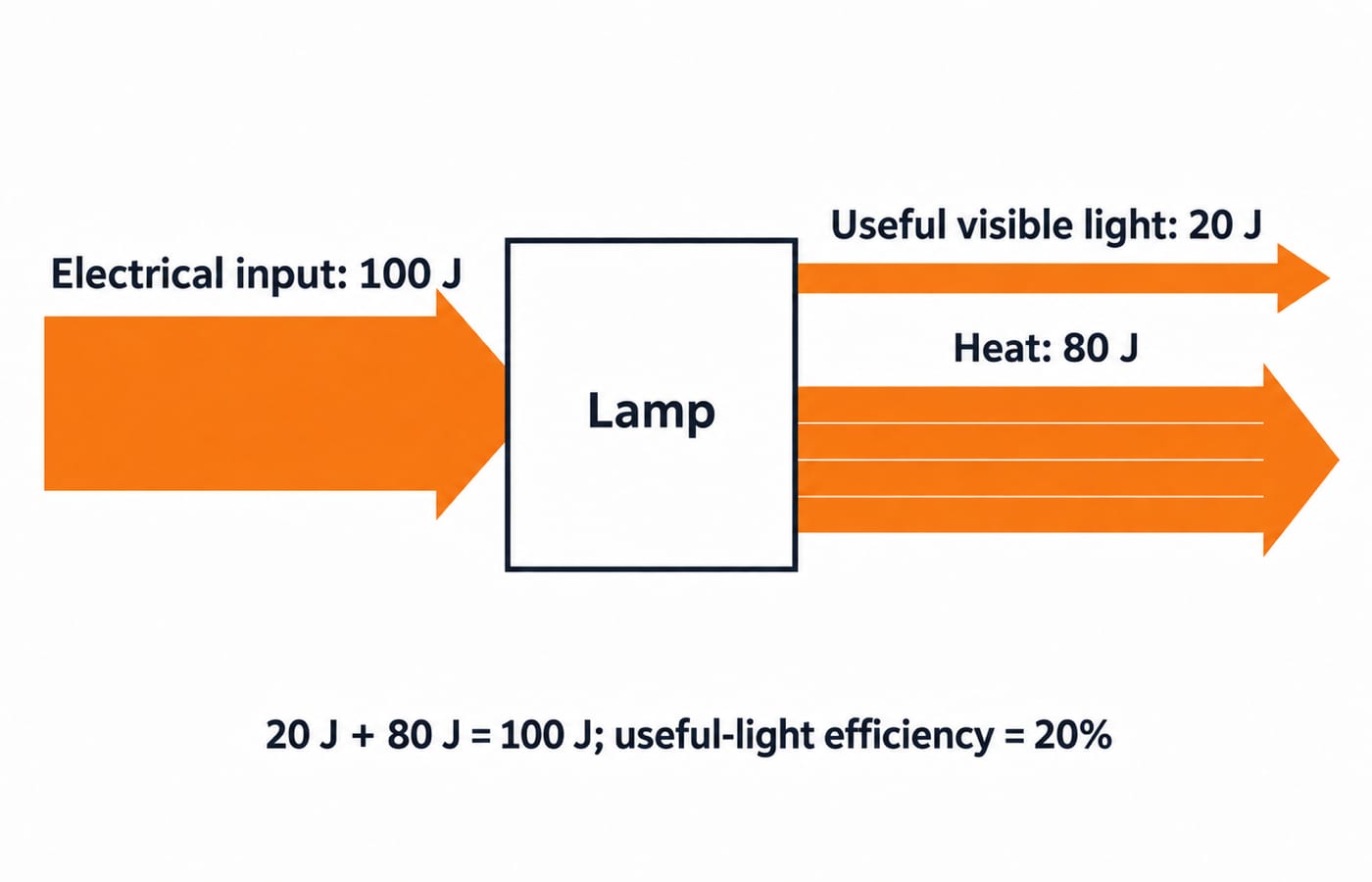
Option (b) uses the heat fraction; (c) confuses conservation with useful efficiency; (d) adds input to useful output. For biological energy transfer, continue with the ecosystem and energy-flow notes.
Pedagogy and common traps: diagnose before correcting
Q5. A pupil says dissolved salt has vanished. Which response best tests and addresses the misconception?
(a) Ask the pupil to memorise the definition of a solution.
(b) Ask for a prediction, compare the closed assembly's mass before and after dissolving, then discuss the result.
(c) Mark the answer wrong and move on.
(d) Filter the solution and promise all the salt will remain on ordinary filter paper.
Answer: (b). A prediction exposes the pupil's thinking; measurement supplies evidence to discuss. With 95 g water and 5 g salt, the contents remain 100 g. The container adds the same constant mass to both balance readings.
Options (a) and (c) miss the diagnosis. Option (d) teaches an incorrect separation method. Follow observation with explanation and a fresh check: "Would dissolved sugar still contribute mass?" The experiential pedagogy examples develop this connection between experience and reflection.
Keep these corrections beside your error notes:
Darkness stops photosynthesis, not all plant metabolism.
Invisible dissolved salt still contributes mass.
Force is measured in newtons; pressure in pascals.
Energy transferred as unwanted heat is not destroyed.
Short revision loop and the next practice step
Recall each reason: Q1 (b), respiration continues; Q2 (b), masses total 100 g; Q3 (a), dividing force by area gives 2,000 and 6,000 Pa; Q4 (a), useful light is 20% of input; Q5 (b), prediction plus evidence tests the misconception.
Try a 15-minute study routine: five minutes to reattempt, five to explain two rejected options per question, and five to retest your weakest concept.
For transfer, keep force at 60 N and double 0.01 m2 to 0.02 m2. Pressure = 60 / 0.02 = 3,000 Pa, half the earlier 6,000 Pa.
Use the Board's syllabus to choose your next uncovered REET topic. If you are also preparing for CTET, inspect the CTET Paper 2 course and compare its listed coverage with your needs.
Go deeper with the full courseCTET Paper 1 2026 — प्राथमिक शिक्षक (कक्षा 1–5)
Keep learning
Simplification of CFG: Eliminate Epsilon, Unit and Useless Productions Step by Step
Learn the safe order for simplifying a context-free grammar. One example tracks every production through epsilon removal, unit closure, and useless-symbol removal.
Updated 27 Aug 20266 min read58 viewsTheory of Computation
EVS in CTET: Scope and Relation to Science and Social Studies, with a Worked Example
Understand integrated EVS through its six themes, three contributing lenses and a four-household water inquiry that separates evidence from assumption.
Updated 14 Nov 20266 min readCTET & UPTET

Computer Science pedagogy for teacher recruitment exams: what it tests and how to score it
Computer Science pedagogy for teacher exams: how students learn programming, teaching methods, classroom assessment, CS misconceptions, and how it is tested.
Updated 14 Jul 20265 min readCTET & UPTET

UGC NET Computer Science Machine Learning Revision Map: Topics, Calculations and Traps
Connect the data-mining and neural-network topics in UGC NET Computer Science through a practical revision map, four worked examples and a focused seven-session schedule.
Updated 31 Oct 20265 min readML & Data Science