Experiential Pedagogy for Teaching Exams: Complete Notes, Kolb Cycle and Classroom Examples
Learn how experience, reflection, concept formation and transfer work together. Two complete classroom lessons make the cycle easy to recognise in scenario questions.
KnowledgeGate Team
Exam prep & CS education
Updated 19 Sep 20265 min read

Experiential pedagogy is often reduced to the slogan "learning by doing". That makes any busy, activity-filled classroom look correct in a scenario question, even when learners never think about what happened. Use a stricter test: the learner acts, reflects on evidence, forms or revises a concept, and tries that concept in a new decision.
Experiential pedagogy: meaning, purpose and boundaries
Experiential pedagogy is a planned process: learners engage with a task or situation, examine what happened, build meaning from evidence and use it in later action. Physical activity alone is neither necessary nor sufficient. A simulation, role-play or data investigation can qualify; a field trip without reflection may remain only exposure.
John Dewey emphasised experience plus reflection. David Kolb described a four-part learning cycle. It is a diagnostic model, not a rigid lesson sequence.
Approach | Starting point | Reflection required? | Typical output | Transfer explicit? |
|---|---|---|---|---|
Experiential pedagogy | Meaningful experience | Yes | Principle tested in action | Yes |
Activity-based learning | Activity | Optional | Task or product | Optional |
Inquiry learning | Question or problem | Usually | Evidence-based explanation | Sometimes |
Project-based learning | Extended problem | Usually | Product or presentation | Often |
Teacher demonstration | Teacher model | Optional | Observation or procedure | Optional |
Kolb experiential learning cycle: four stages in a scenario
Concrete experience: learners encounter a meaningful task. The teacher sets safe conditions and purpose.
Reflective observation: learners compare results and notice patterns. The teacher focuses questions on evidence.
Abstract conceptualisation: learners name a defensible principle or revise an idea. The teacher helps connect observations without giving the conclusion too early.
Active experimentation: learners use the principle in a fresh trial, prediction or decision. The teacher creates the opportunity.
For an MCQ, find the missing stage. Handling materials proves only experience. Copying a rule after an activity does not prove reflection. Explaining a pattern without reusing it leaves experimentation incomplete. For the wider distinction among pedagogy, its maxims and major theorists, use Concept of Pedagogy: Meaning, Types, Maxims and Theorists. The narrower test here is whether an experience proceeds through reflection, conceptualisation and transfer.
Experiential pedagogy worked example: a two-trial water-filter lesson
Class VI has 36 learners in six groups of six. Each group gets a cut plastic bottle, cotton, gravel, clean sand, a 250 mL cup, a stopwatch and muddy water marked not for drinking.
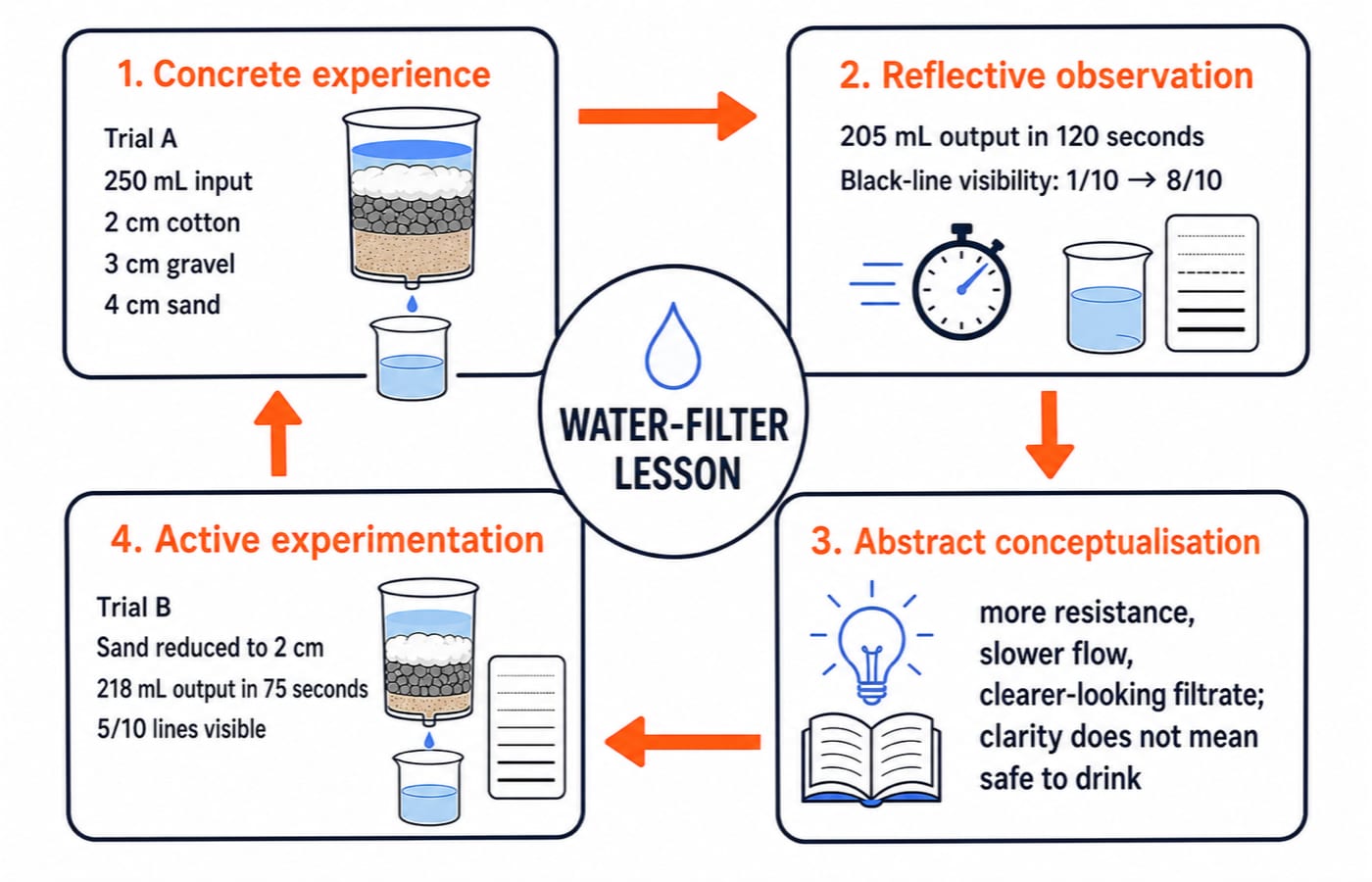
Trial A uses 2 cm cotton, 3 cm gravel and 4 cm sand. Learners pour 250 mL and collect 205 mL in 120 seconds. Visibility changes from 1 of 10 black test lines before filtering to 8 of 10 afterwards.
Follow the cycle:
Experience: build and run Trial A.
Reflection: compare 250 mL input with 205 mL output, a difference of 45 mL. Record 120 seconds and the visibility change from 1/10 to 8/10.
Concept: infer that the layers trapped suspended particles. This is an inference from the visible evidence, not proof that the water is microbiologically safe.
Experimentation: reduce only the sand layer from 4 cm to 2 cm. Hold cotton, gravel, input volume and method constant. Trial B yields 218 mL in 75 seconds, but only 5 of 10 lines are visible.
The evidence supports this learner claim: The 4 cm sand layer filtered more slowly but produced clearer-looking water than the 2 cm layer. Trial B recovered 13 mL more and flowed faster, but had lower visible clarity. Neither filtrate is safe to drink.
A second classroom example: equivalent fractions with paper strips
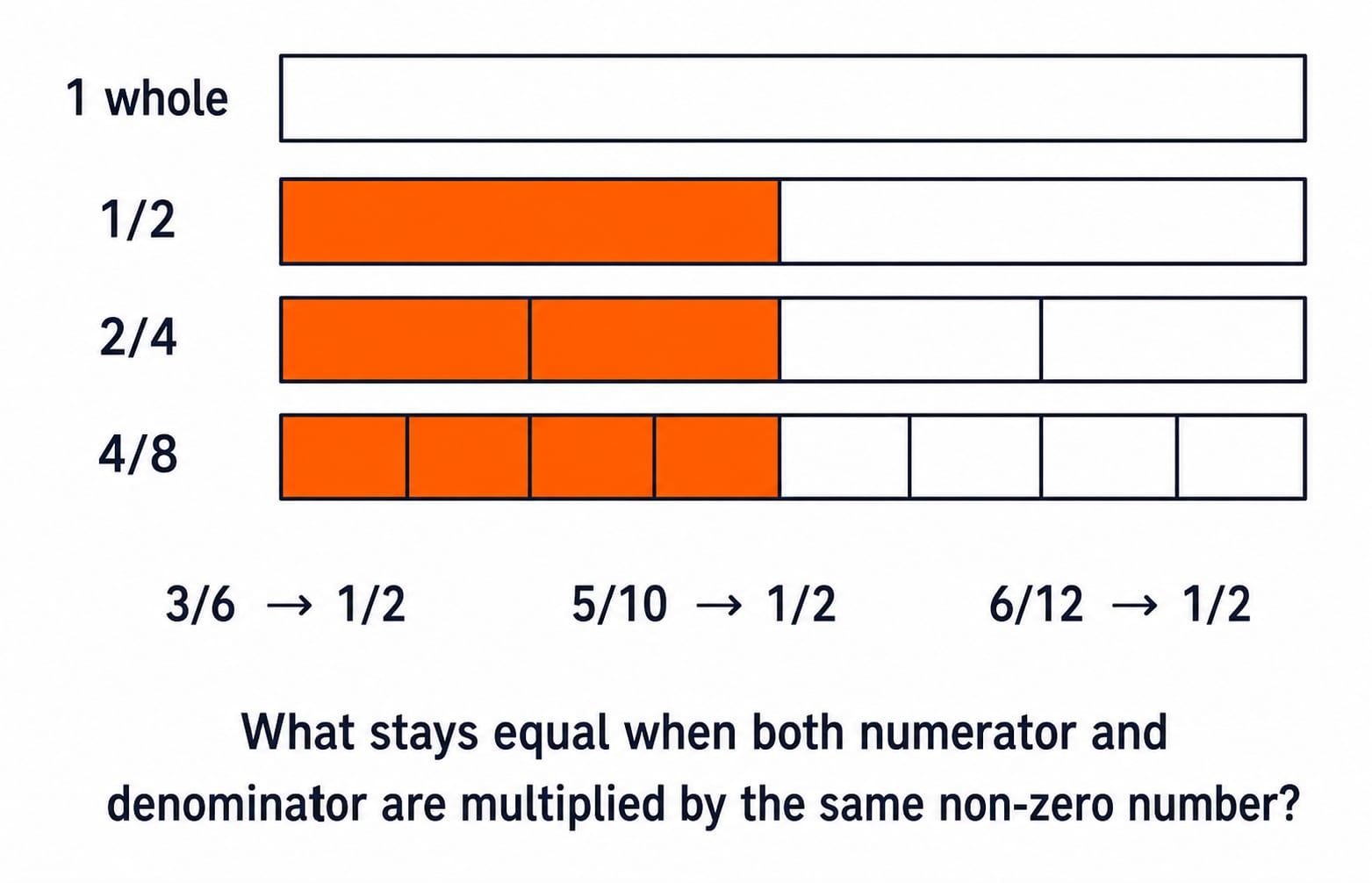
Arrange 24 learners into six groups of four. Each group folds identical strips to show one whole, 1/2, 2/4 and 4/8, then aligns the coloured lengths. The match is the observation. Learners generalise 1/2 = 2/4 = 4/8, then test 3/6 and 5/10.
Merely folding and pasting is an activity. Learners complete the experiential cycle when they explain why the lengths match, state that multiplying numerator and denominator by the same non-zero number gives an equivalent fraction, predict whether 6/12 matches, and verify that prediction.
Teacher role, learner role, assessment and inclusion
In each six-learner filter group, rotate six roles: materials manager, measurer, timer, recorder, safety monitor and reporter. The teacher asks, "What evidence supports that?" and "What will you change while holding the other variables constant?" This is active facilitation, not withdrawal.
A six-point formative assessment can score:
evidence recorded accurately, 0 to 2;
concept explained from evidence, 0 to 2;
transfer prediction justified, 0 to 2.
A one-minute exit ticket asks learners to name the changed variable, one controlled variable and one safety limitation. Assessment covers process and reasoning, not only a polished product.
Plan inclusion from the start with large-print tables, tactile labels and an oral-recording option. Keep materials within reach, allow role choice or rotation, and supply teacher-prepared data when handling is unsafe. These adaptations preserve observing, reasoning and transferring.
Experiential pedagogy in teaching-exam scenarios
Consider this question: "A teacher gives 24 pupils fraction strips, asks them to form 1/2 and 2/4, discuss why the lengths match, write a rule, and then predict whether 6/12 is equivalent before checking with another strip. Which pedagogy is most clearly represented?"
The answer is experiential pedagogy. Forming the fractions is the experience, discussing the match is reflection, writing the rule is conceptualisation, and predicting then checking 6/12 is experimentation. "Learning by doing" alone is an incomplete justification.
Other items may test a missing Kolb stage, reflection versus recall, transfer evidence, learner-centred responses, or whether a visit, project or role-play completes the cycle. Explore CTET & UPTET Teaching Eligibility Test Prep. For subject-specific transfer, use Computer Science Pedagogy for Teacher Exams.
Experiential pedagogy traps: test the tempting option
Tempting claim | Why it fails | Better test |
|---|---|---|
Every hands-on task is experiential | Action may stop without reflection or transfer | What evidence was examined and used again? |
The teacher must remain passive | Learners may need questions, safety support and scaffolding | Did support preserve learner reasoning? |
Reflection means recalling the procedure | Recall says what happened, not what the evidence means | Did learners interpret results? |
Group work automatically makes learning experiential | Seating arrangement does not create a learning cycle | Did each stage serve a purpose? |
An enjoyable activity proves learning | Enjoyment is not evidence of concept formation | Can learners justify and transfer the idea? |
Direct experience does not remove teacher scaffolding. Learner-centred does not mean learning-objective-free. Explicit instruction can come before or after an activity when it helps learners interpret evidence and apply a concept independently.
Use four elimination questions:
What did learners do?
What evidence did they examine?
What concept did they form?
Where did they test it next?
An option missing two or more is unlikely to show a complete experiential cycle.
Experiential pedagogy: the short version and next step
Experience supplies evidence. Reflection examines it. Conceptualisation turns it into a principle. Experimentation tests that principle in a new action. In the filter lesson, less sand increased speed and recovery but reduced visible clarity. In the fraction lesson, equal shaded lengths supported 1/2 = 2/4 = 4/8 and transfer to new equivalent fractions.
Paper I aspirants can place this topic inside the CTET Paper 1 Course 2026. Paper II aspirants can use the CTET Paper 2 Course 2026.
For active revision, take any classroom vignette, label E, R, C and T for experience, reflection, concept and transfer, then repair the first missing stage.
Keep learning

सामान्य अशुद्धियाँ (Samanya Ashuddhiyaan): Complete Hindi Grammar Notes for CTET and TET Exams
Learn to identify and correct Hindi word-form, agreement, pronoun and redundancy errors through exact examples, a worked MCQ and a scored diagnostic.
Updated 6 Oct 20266 min readCTET & UPTET

Universities and Learning Programmes for Teaching Exams: Types, Modes and Solved Examples
Separate university status, delivery mode and programme purpose with a repeatable method, then test it on five UGC NET-style classification cases.
Updated 2 Oct 20265 min readCTET & UPTET

National Education Policy (NEP) 2020 Notes for Teaching Exams: 5+3+3+4, Reforms and MCQ Traps
Build an exam-ready map of NEP 2020, from the age-stage structure to pedagogy, language, PARAKH, B.Ed. routes and reliable distractor elimination.
Updated 26 Sep 20265 min readCTET & UPTET

Miscellaneous Pedagogy Topics for Teaching Exams: Complete Notes and Worked Examples
Turn a loose syllabus label into a five-part concept map, then use classroom evidence to distinguish sound pedagogy from attractive but incomplete options.
Updated 25 Sep 20266 min readCTET & UPTET