

EVS in CTET: Scope and Relation to Science and Social Studies, with a Worked Example
Understand integrated EVS through its six themes, three contributing lenses and a four-household water inquiry that separates evidence from assumption.
KnowledgeGate Team
Exam prep & CS education
Updated 14 Nov 20266 min read
Aspirants often revise EVS as biology facts on one side and geography or civics facts on the other. They then miss why CTET calls the area integrated. For your CTET preparation, CTET EVS links six theme families with the child's surroundings and relates Science, Social Studies and Environmental Education through evidence from a classroom inquiry. A four-household water dataset makes the relationships visible and keeps every conclusion tied to measured values.
What the scope of EVS means in CTET
CBSE's February 2026 CTET information bulletin lists Concept and scope of EVS, Significance of EVS, integrated EVS, Environmental Studies & Environmental Education, and Scope & relation to Science & Social Science. Searches use Social Studies, but it is not another unit.
Scope connects the child's natural, physical, biological, social and cultural surroundings, including living beings, materials, places, work, institutions and resources. It exceeds pollution lists.
NCERT primary EVS draws from Sciences, Social Sciences and Environmental Education around the child's world. Integrated means one connecting theme or question, not adjacent facts.
The six theme families that organise primary EVS
NCERT moves from self and family towards neighbourhood, locality, country and wider world through Family and Friends, with Relationships, Work and Play, Animals and Plants as sub-themes; Food; Shelter; Water; Travel; and Things We Make and Do.
Theme | Science contribution | Social Studies contribution |
|---|---|---|
Family and Friends | Bodies, plants, animals and observation | Relationships, work, play and social roles |
Food | Plant parts, digestion, spoilage and preservation | Farming, food practices, work and unequal access |
Shelter | Materials, ventilation and response to weather | Homes, location, occupations and differences in living conditions |
Water | Sources, quantity, quality and changes of state | Access, sharing, labour and public services |
Travel | Terrain, distance and means of movement | Maps, migration, transport and changing journeys |
Things We Make and Do | Material properties, tools and processes | Crafts, occupations, technology and dignity of labour |
The earlier EVS for CTET: Environmental Studies vs Environmental Education with Worked Examples owns the EVS-versus-Environmental-Education distinction and the lived-situation audit. This post focuses on the six themes' Science and Social Studies contributions, then works through per-resident quantities, sources and collection times. See how the six themes become pedagogy questions. They overlap, so one journey can involve water, shelter, work and family.
Science, Social Studies and Environmental Education are three contributions
Science: patterns, measurement, classification, processes and evidence.
Social Studies: people, place, work, institutions, access and change.
Environmental Education: informed participation and evidence-based action.
Ask: How does water reach different homes, how much is available, and what does that change for the people who collect and use it? Quantity and quality are scientific; source, access, collection time and decisions are social; evidence-based action adds Environmental Education.
Defining evaporation is a science fragment; repeating save water is a slogan. Integrated EVS measures use, compares access, examines work and evaluates responses, without automatically proving waste, unfairness or contamination.
Worked example: a four-household water inquiry
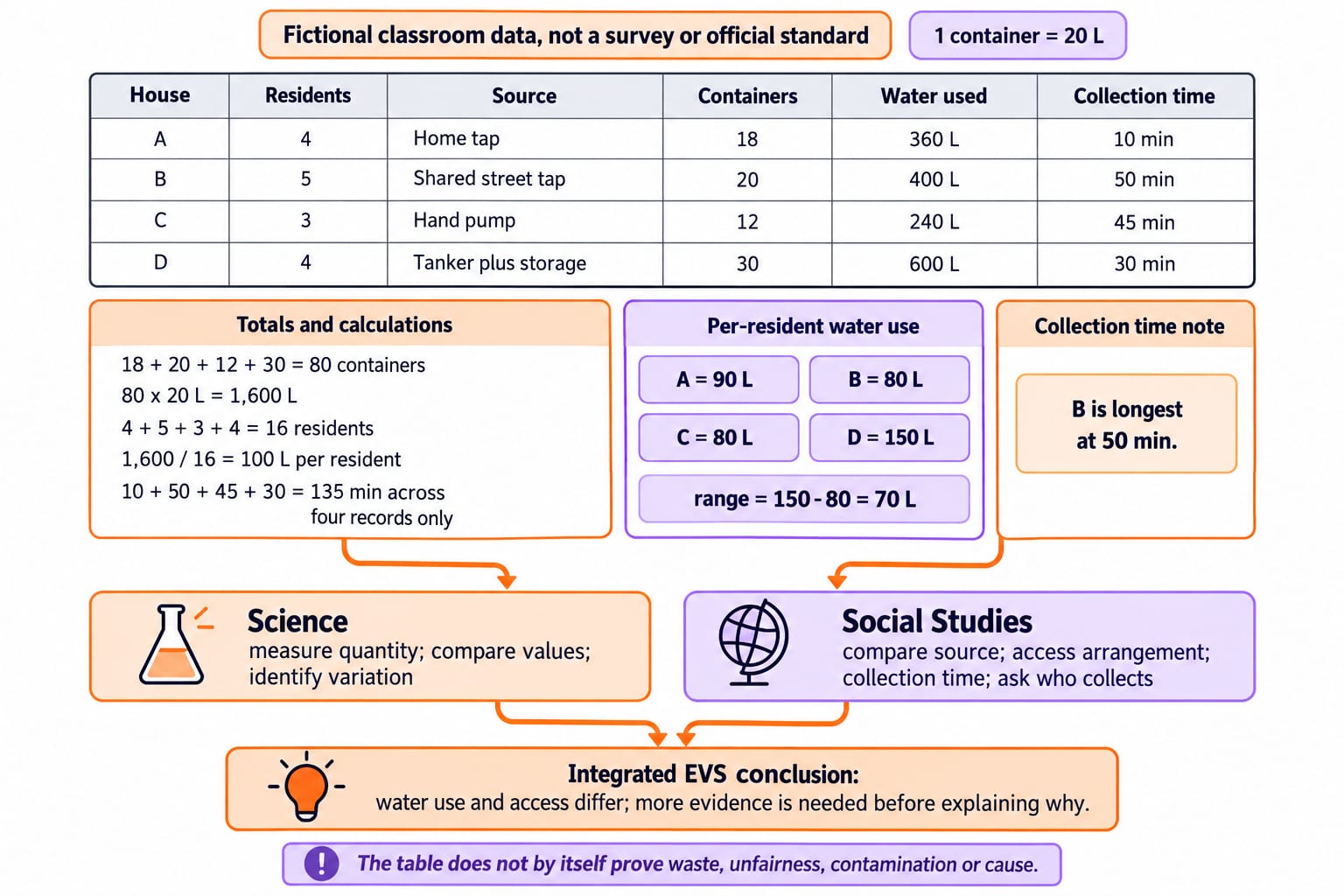
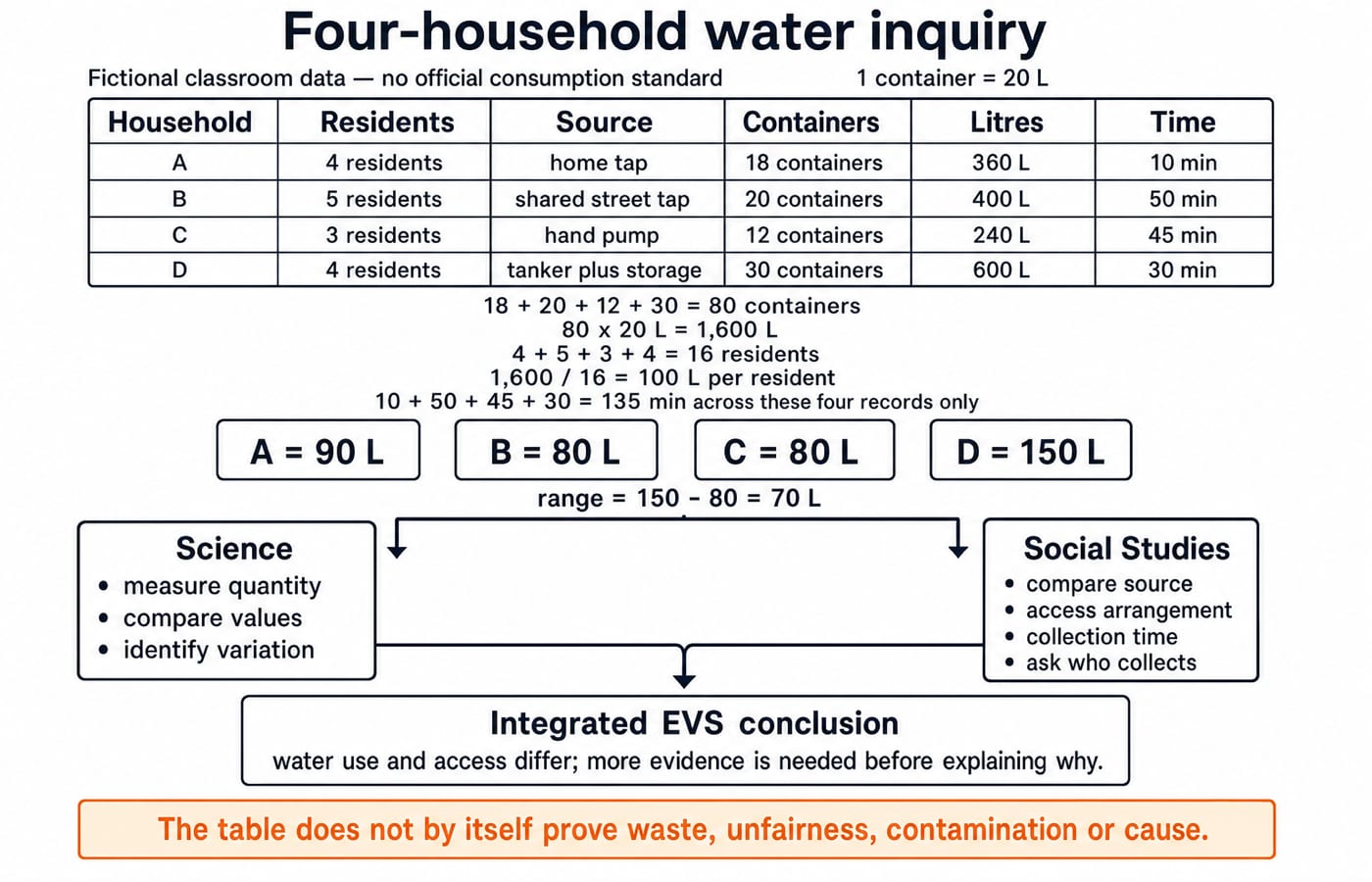
This is fictional classroom data, not a survey or official standard. One container equals 20 L.
House | Residents | Source | Containers | Water used | Collection time |
|---|---|---|---|---|---|
A | 4 | Home tap | 18 | 360 L | 10 min |
B | 5 | Shared street tap | 20 | 400 L | 50 min |
C | 3 | Hand pump | 12 | 240 L | 45 min |
D | 4 | Tanker plus storage | 30 | 600 L | 30 min |
Containers:
18 + 20 + 12 + 30 = 80.Water:
80 x 20 L = 1,600 L.Residents:
4 + 5 + 3 + 4 = 16.Overall average:
1,600 / 16 = 100 L per resident.Per resident: A
360 / 4 = 90 L; B400 / 5 = 80 L; C240 / 3 = 80 L; D600 / 4 = 150 L.Highest-minus-lowest gap:
150 - 80 = 70 L per resident.Times:
10 + 50 + 45 + 30 = 135 minacross four records only. B is longest at 50 min.
Quantities vary: B and C tie at 80 L per resident; D records 150 L. Sources and times differ, including B's shared tap and 50 min. Storage, leaks, collectors, special needs and typicality need evidence. Conclude only that water use and access differ here.
Learner prompt: Using two calculations and one source or collection-time detail, explain why this is an integrated EVS inquiry rather than only a Science exercise.
Model answer: The average is 1,600 L / 16 = 100 L; B records 400 / 5 = 80 L, a shared tap and 50 min. Measurement plus access makes this integrated EVS.
Turn the example into child-centred EVS pedagogy
Use 5 min to predict sources, 8 min to check the table and convert to litres, 7 min for per-resident calculations, 6 min to sort Science and Social Studies questions, and 4 min for the exit response. Total: 30 min. Local observation must be safe, anonymised and non-intrusive. Otherwise use the table.
The teacher elicits experience, supplies a unit, requests evidence, challenges judgment and frames new questions. These are observation, discussion, calculation and feedback as pedagogical choices. Neither lecture nor unstructured activity is automatically child-centred.
Award one point each for 1,600 L total, 100 L average, a Science observation, and a Social Studies or access question. Name the gap: You calculated the total, but you have not yet connected source or collection time to the inquiry.
How CTET can test scope and relation through classroom scenarios
The bulletin says Paper I EVS items focus on concepts, problem-solving, pedagogical understanding and applications. Find the shared question, evidence and natural-social link.
Author-created practice item 1: A teacher gives the four-household water table, asks pupils to convert 20 L containers into litres, calculate use per resident, compare water sources and frame one question about collection time. Why is the task integrated EVS?
(a) It teaches arithmetic without an environmental context
(b) It treats water only as a chemical substance
(c) It connects measurement and comparison with access and everyday human arrangements
(d) It asks pupils to memorise a conservation slogan
Answer: (c). Options (a) and (b) omit part; (d) replaces inquiry with recall.
Author-created practice item 2: Class IV pupils observe five locally available leaves, classify them by shape, ask family members about two household uses, and compare whether the same leaf has different uses in different homes. Which description best fits the activity?
(a) Pure botany because leaves are plants
(b) Integrated EVS because observation and classification are connected with social and cultural use
(c) Social Studies only because families are interviewed
(d) Environmental Education only because no evidence is required
Answer: (b). A plant does not make the whole task pure Science; an interview does not remove scientific observation.
Ecosystems, biomes and environmental issues are a deeper content extension, not a substitute for integration.
Common traps and the better replacement
Trap | Why it fails | Better replacement |
|---|---|---|
EVS is elementary Science | Drops social and cultural relationships | Use one theme with natural and human questions |
EVS is Social Studies plus pollution | Drops observation and material or biological processes | Require evidence and inquiry |
Integrated means mixing facts | Unrelated facts make no connection | Organise around one shared question |
Activity-based means any hands-on work | Busy work may lack thinking | Specify observation, calculation and inference |
Environmental Education means slogans | Slogans can bypass evidence | Move from evidence to realistic action |
The average explains every household | A mean hides variation and context | Inspect A, B, C and D before concluding |
Reject sealed subjects, copying, unsupported judgment and claims beyond evidence. Prefer the child's surroundings, inquiry, natural-social connections and discussion.
In 30 seconds, name all six themes, explain two lenses on one question, and say why D = 150 L per resident does not prove waste. If stuck, revisit both tables.
EVS in CTET: the short version and next step
EVS connects natural, social and cultural surroundings through child-centred themes. Science adds observation, measurement and process. Social Studies adds people, place, work, institutions and access. Environmental Education turns evidence into action. The water inquiry unites them within the evidence.
In 10 minutes, redraw six themes, reconstruct 90, 80, 80 and 150 L, then write one Science and one Social Studies question.
Continue with the CTET Paper 1 Course 2026 for structured primary EVS study. Use the CTET category linked at the start as the neutral route for browsing related preparation resources.
Go deeper with the full courseCTET Paper 1 2026 — प्राथमिक शिक्षक (कक्षा 1–5)
Keep learning
EVS for CTET: Environmental Studies vs Environmental Education with Worked Examples
Learn how primary-stage EVS differs from Environmental Education, how six themes integrate around a child's life, and how to solve evidence-led CTET choices.
Updated 11 Nov 20265 min readCTET & UPTET
Flood Control and Disaster Management EVS Notes: CTET and TET Concepts with a Worked Example
Learn how floods turn into disasters, match controls to causes, sort actions across four management phases, and check a fictional evacuation plan step by step.
Updated 13 Nov 20266 min readCTET & UPTET
CTET EVS pedagogy: the concepts, themes and testing pattern
A CTET Environmental Studies pedagogy guide for Paper 1: the six syllabus themes, the integrated approach, activities, and how EVS is actually tested.
Updated 30 Oct 20265 min read173 viewsCTET & UPTET
Communication General Knowledge and General Studies for Teaching Exams: Facts and Worked Examples
Build a reliable Communication GK revision map for teaching exams, then practise chronology, matching and statement questions with fully checked answers.
Updated 1 Aug 20265 min readCTET & UPTET