

UGC NET Computer Science Machine Learning Revision Map: Topics, Calculations and Traps
Connect the data-mining and neural-network topics in UGC NET Computer Science through a practical revision map, four worked examples and a focused seven-session schedule.
KnowledgeGate Team
Exam prep & CS education
Updated 31 Oct 20265 min read
You may have revised regression, clustering and neural networks from different notes, yet still struggle to see how they fit together. The official UGC Computer Science and Applications syllabus, subject code 87, places these ideas in Unit 4 and Unit 10. Foundations, algorithms, neural networks and evaluation connect through calculations you can reproduce without a calculator-heavy detour.
Mark the official boundary before making the map
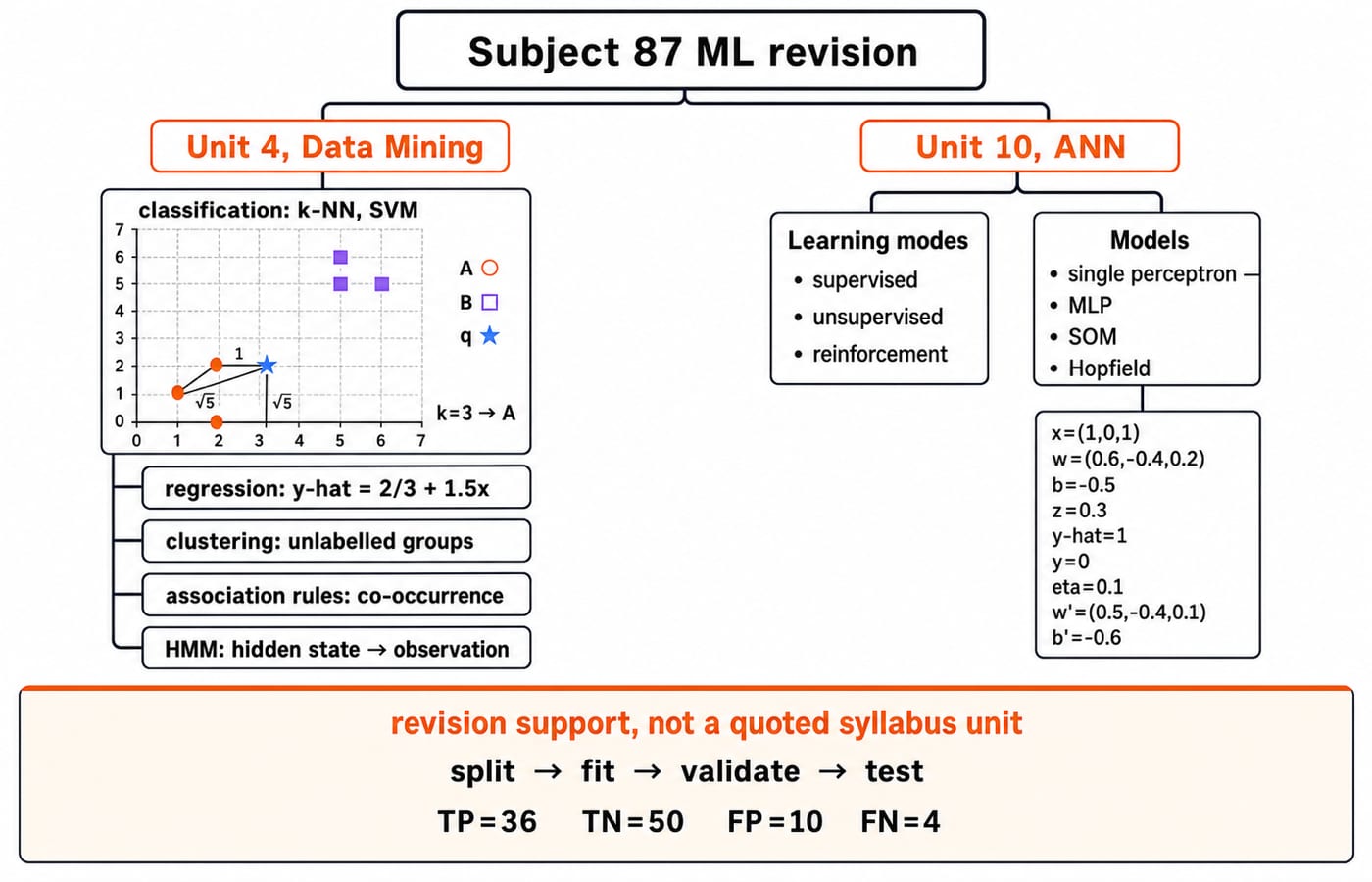
The published UGC syllabus for Computer Science and Applications, code 87 lists data warehousing and data mining in Unit 4. Its named topics include association rules, classification, clustering, regression, Support Vector Machine, K-Nearest Neighbour and Hidden Markov Model.
Unit 10 separately lists Artificial Neural Networks, supervised, unsupervised and reinforcement learning, single and multi-layer perceptrons, self-organising maps and Hopfield networks. Data splitting, scaling, bias-variance and model evaluation are supporting concepts for understanding and comparing those topics, not quoted syllabus headings. Use the wider UGC NET Computer Science syllabus areas map for Paper 2 context, and let the current NTA bulletin or corrigendum prevail for rules.
Block A: rebuild the statistical learning foundation
Use this chain: data -> representation -> objective -> fitted model -> held-out check. A feature is an input measurement; a target is the value to predict; a loss measures error; and a parameter is learned by fitting. Supervised learning uses labelled examples, unsupervised learning finds structure without targets, and reinforcement learning improves actions from rewards. Underfitting misses useful structure, while overfitting learns training detail that does not generalise. Training fits parameters, validation guides choices, and the untouched test set estimates final performance. Scaling, splitting and bias-variance remain supporting knowledge.
For x=(1,2,3) and y=(2,4,5), x-bar=2 and y-bar=11/3. The slope is (5/3+0+4/3)/(1+0+1)=3/2=1.5; the intercept is 11/3-(3/2)(2)=2/3. Thus y-hat=2/3+1.5x, giving 20/3=6.667 at x=4. Training predictions are 13/6, 11/3, 31/6. Squared errors are 1/36, 1/9, 1/36, so MSE=(1/36+1/9+1/36)/3=1/18=0.0556.
Block B: sort algorithms by the question they answer
Task | Input clue | Output | First algorithm to recall | Calculation cue |
|---|---|---|---|---|
Classification | Labelled classes | Class | k-NN or SVM | Distance or boundary |
Regression | Numeric target | Number | Fitted regression | Substitute inputs |
Clustering | Unlabelled items | Groups | Clustering method | Similarity |
Association rules | Co-occurring items | Rule | Rule mining | Support and confidence |
Sequence modelling | Ordered observations | Hidden-state account | HMM | State and observation probabilities |
For k-NN, take A points (1,1), (2,2), (2,0), B points (5,5), (6,5), (5,6), query q=(3,2) and k=3. In that order, Euclidean distances are sqrt(5), 1, sqrt(5), sqrt(13), sqrt(18), sqrt(20). The three nearest points all belong to A, so q is A. Changing k, distance or feature scale can change the result. k-NN votes among neighbours; SVM seeks a separating boundary; clustering has no labels; an HMM separates a hidden state from its observed symbol.
Block C: revise neural networks as model, signal and update
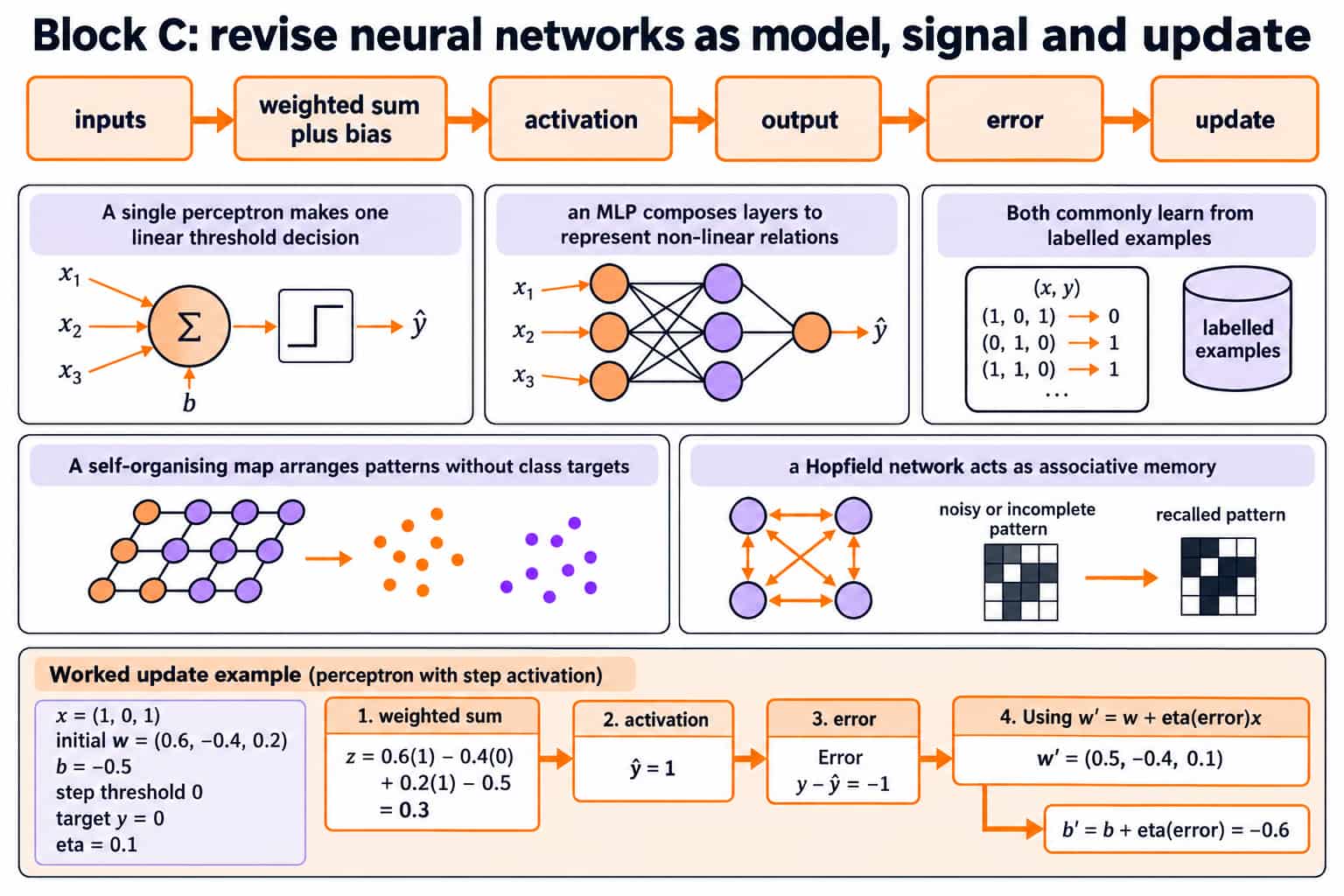
Follow inputs -> weighted sum plus bias -> activation -> output -> error -> update. A single perceptron makes one linear threshold decision; an MLP composes layers to represent non-linear relations. Both commonly learn from labelled examples. A self-organising map arranges patterns without class targets, while a Hopfield network acts as associative memory. The compact update below connects those Unit 10 labels to one calculation. For sigmoid derivatives, gradient descent and parameter counting, use Artificial Neural Networks: Complete Guide with Worked Examples for GATE and Interviews.
Take x=(1,0,1), initial w=(0.6,-0.4,0.2), b=-0.5, step threshold 0, target y=0 and eta=0.1. Then z=0.6(1)-0.4(0)+0.2(1)-0.5=0.3, so y-hat=1. Error y-y-hat=-1. Using w'=w+eta(error)x gives w'=(0.5,-0.4,0.1); b'=b+eta(error)=-0.6.
Block D: measure a model without trusting accuracy alone
In a confusion matrix, TP and TN are correct positive and negative predictions; FP is a false alarm; FN is a missed positive. With TP=36, TN=50, FP=10, FN=4, total 100:
Accuracy is
(36+50)/100=86%.Precision is
36/(36+10)=78.26%.Recall is
36/(36+4)=90%.Specificity is
50/(50+10)=83.33%.F1 is
72/(72+10+4)=83.72%.
The model retrieves 90% of actual positives, but 10/46=21.74% of its positive predictions are false. The operational cost of FP versus FN decides whether precision or recall needs more attention. For numeric predictions, the earlier MSE=0.0556 is an error measure, not a classification score. Use validation to choose a model or threshold and a held-out test for the final estimate.
Recognise the question type and avoid predictable traps
For define or match, recall the defining property. For compare two models, draw two columns. For calculate an output or metric, write a labelled formula. For interpret a changed assumption, identify the changed input first.
Do not confuse a class label with a cluster ID, or a nearest neighbour with a support vector. Regression does not output a class probability by default. A single perceptron cannot solve every non-linear separation. SOM and Hopfield networks do different jobs. Precision and recall have different denominators. Prioritise the four blocks from your error log, not from unsupported weightage claims.
Turn the map into seven focused revision sessions
Assign one 60-minute session each to: foundations and splitting; regression and loss; k-NN and SVM; clustering, rules and HMM; perceptron and MLP; SOM, Hopfield and evaluation; mixed retrieval and repair. Keep the clock fixed: 10 minutes blank-page recall, 25 minutes concept plus one example, 20 minutes questions, and 5 minutes error log.
Collect a mixed pool of ANN and data-mining questions, and check the stated source before you count any of them as previous-year paper items. In session seven, attempt 20 mixed questions, tag each miss concept, formula, calculation or reading, then schedule only the weakest tag next. Use the UGC NET CS test series for mixed practice.
The short version and the next action
Frame the task, fit the model, separate the classes, represent the network, measure the result. Unit 4 houses the named data-mining methods; Unit 10 houses ANN. Return to the official syllabus for exact scope. For structured teaching, use the NTA UGC NET Paper 2 course, then explore the UGC NET category. Now redraw the two-branch map from memory and reproduce every calculation without notes.
Keep learning
Model Tracking: How to Record Experiments, Metrics and Artefacts
Build a reproducible model tracking record from one constructed churn experiment. Learn which fields, metrics, artefacts and promotion rules make a run trustworthy.
Updated 6 Nov 20266 min readML & Data Science
GATE DA Machine Learning Revision Map: From Probability to Neural-Network Calculations
Connect five machine-learning note sets through four worked problems and a complete neural-network forward pass, with a focused 90-minute revision loop.
Updated 5 Nov 20265 min readML & Data Science
Neural Network Architectures: Layers, Forward Passes and Worked Examples
Learn to read dense, convolutional and recurrent network diagrams as calculations. Count parameters, follow an exact 2-2-1 forward pass, and see what sharing changes.
Updated 4 Nov 20266 min readML & Data Science
Silhouette Score vs Inertia: Compare Clustering Quality with a Worked Example
Follow one dataset through two partitions to see why lower inertia and higher silhouette can support different choices, then learn how to compare them fairly.
Updated 3 Nov 20266 min readML & Data Science