

CTET Syllabus: Paper 1 and Paper 2 Section-by-Section Study Map
Choose the correct CTET paper, map every section into content and pedagogy tasks, and use worked examples plus a seven-day diagnostic to set priorities.
KnowledgeGate Team
Exam prep & CS education
Updated 16 Nov 20265 min read
CTET preparation starts by choosing the right paper, separating content from pedagogy, and turning syllabus bullets into testable tasks. KnowledgeGate's Govt Teaching Eligibility Tests category covers CTET and UPTET preparation.
Official details follow CBSE's CTET February 2026 bulletin on the official page. Compare with current bulletin.
1. CTET Paper 1 and Paper 2: choose the correct syllabus first
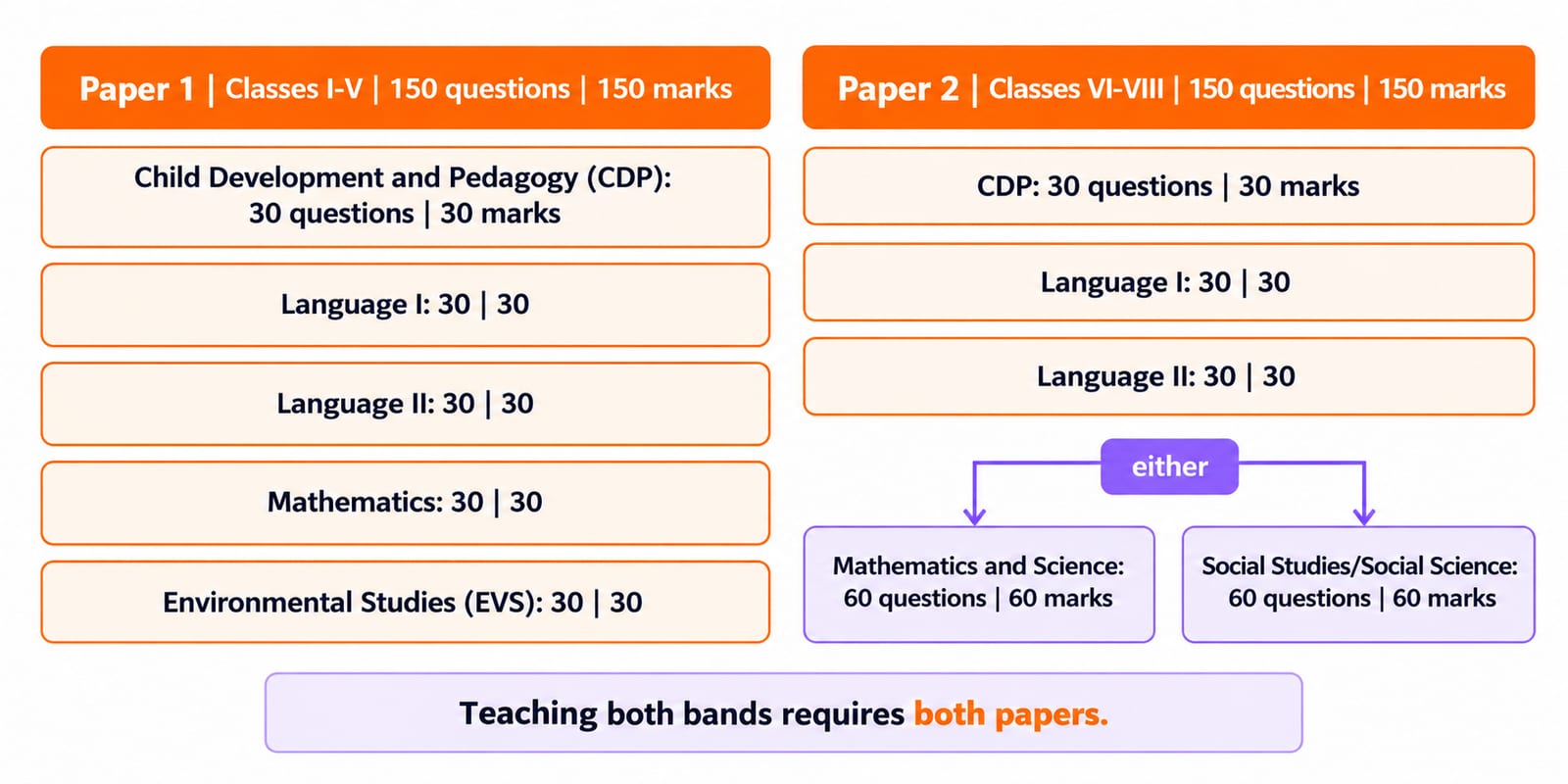
Paper 1, for Classes I-V, has five compulsory 30-question, 30-mark sections: Child Development and Pedagogy (CDP), Mathematics, Environmental Studies (EVS), Language I, and Language II. Total: 150 questions and 150 marks.
Paper 2, for Classes VI-VIII, has CDP, Language I, and Language II at 30 questions and 30 marks each, plus either Mathematics and Science or Social Studies/Social Science at 60 questions and 60 marks. Total: 150 each. Teaching both bands requires both papers.
Choose Paper 1 for primary, Paper 2 for elementary, or both when required. The earlier CTET syllabus guide maps the paper sections and weightage; use worked checks, testable cards, and a seven-day diagnostic to apply that map. Before registering, confirm that you meet the eligibility requirements for your chosen paper.
2. Child Development and Pedagogy: the common 30-question core
CDP divides into Child Development (15 questions), Inclusive Education and children with special needs (5), and Learning and Pedagogy (10). Paper 1 applies them to primary children, Paper 2 to elementary children.
Build three study folders:
Development: learning, heredity, environment, socialisation, Piaget, Kohlberg, Vygotsky, intelligence, language, thought, gender, differences, assessment.
Inclusion: diverse or disadvantaged learners, learning difficulties, disability, talent, and creativity.
Learning and pedagogy: learning, errors, problem solving, cognition, emotion, motivation, personal and environmental factors.
Study idea -> classroom implication -> diagnostic choice, not names. The CTET CDP high-yield concepts guide develops this method. KnowledgeGate's question bank offers a broad Pedagogy practice set.
3. Language I and Language II: comprehension plus language pedagogy
Paper 1 Language I has 15 comprehension questions from two unseen passages, one prose or drama and one poem, plus 15 pedagogy questions. Language II has 15 comprehension questions from two unseen prose passages plus 15 pedagogy questions, and must differ from Language I. Paper 2 keeps the 15 plus 15 split. Check the current CBSE bulletin for the passage types specified for each paper.
Pedagogy covers acquisition versus learning, teaching principles, listening, speaking, grammar in communication, multilingual classrooms, skills, assessment, materials, and remediation. A complete language plan must therefore cover both communicative grammar and pedagogy.
Use this drill: read 180 words in 8 minutes; answer five questions, two direct, two inference, and one grammar, in 5 minutes; then spend 7 minutes reviewing options and rejecting distractors. 8 + 5 + 7 = 20 minutes. Log 4/5 = 80% by type.
4. Paper 1 Mathematics and EVS: study content and pedagogy in equal blocks
Mathematics divides 15 content plus 15 pedagogy. Content covers operations, geometry, space, measurement, weight, time, volume, data, patterns, and money. Pedagogy covers reasoning, mathematical language, evaluation, error analysis, diagnosis, and remediation.
For example, a class runs from 09:35 to 11:10.
09:35 to 10:00 = 25 minutes10:00 to 11:00 = 60 minutes11:00 to 11:10 = 10 minutes25 + 60 + 10 = 95 minutes = 1 hour 35 minutes
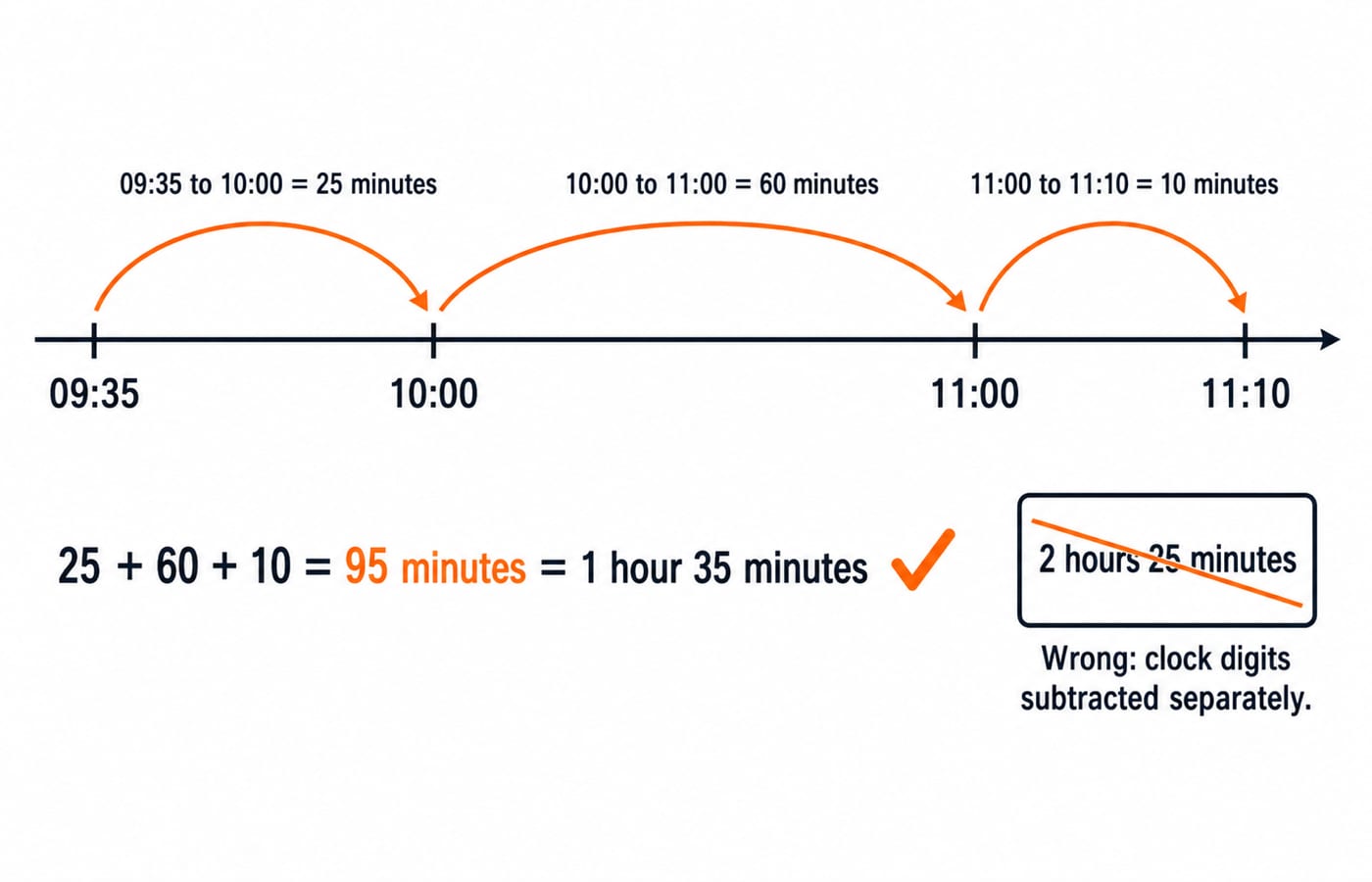
For the wrong 2 hours 25 minutes, draw and total these jumps on a clock or number line.
EVS also divides 15 plus 15. Content covers Family and Friends, Food, Shelter, Water, Travel, and Things We Make and Do. Pedagogy covers integration, subject links, activities, practical work, discussion, CCE, materials, and problems. The CTET Paper 1 course combines all sections, PYQs, and practice.
5. Paper 2 subject block: Mathematics and Science or Social Science
In Mathematics and Science, each subject has 20 content and 10 pedagogy questions. Mathematics covers number systems, integers, fractions, algebra, ratio, geometry, construction, mensuration, and data. Science covers food, materials, living things, motion, circuits, magnets, natural phenomena, resources, and pedagogy.
For example, red to blue is 3:5, with 32 counters. 3 + 5 = 8 parts; 32 ÷ 8 = 4 each; red 3 × 4 = 12; blue 5 × 4 = 20; check 12 + 20 = 32. For 3 and 5, build 8 groups of 4 before multiplying.
Social Studies/Social Science has 40 content and 20 pedagogy questions. Group it into History, early societies to India after Independence; Geography, globe to agriculture; Social and Political Life, government to social justice; plus sources, projects, critical thinking, and evaluation. Choose the subject block that matches your teaching route. The CTET Paper 2 course covers both routes, CDP, languages, PYQs, and practice.
6. Convert syllabus bullets into testable study cards
Official bulletin bullet | Concept task | Pedagogy task | Proof of readiness |
|---|---|---|---|
Time | Solve | Diagnose the | Solve 4/5 fresh elapsed-time items and explain the wrong option |
Ratio and proportion | Split 32 in | Model the misconception with 8 equal groups of 4 | Solve 4/5 fresh ratio items and state one remedial prompt |
Cycle: concept note 25 minutes, examples 20, questions 20, error log 5. Thus 25 + 20 + 20 + 5 = 70 minutes. Use the bulletin section divisions to organise these study cards.
7. Run a seven-day diagnostic before making the full plan
Paper 1 audit: Day 1, 20 CDP questions; Day 2, 20 Language I; Day 3, 20 Language II; Day 4, 20 Mathematics; Day 5, 20 EVS; Day 6, redo errors; Day 7, label them concept, comprehension, calculation, or pedagogy choice.
Results: CDP 14/20 = 70%, Language I 16/20 = 80%, Language II 12/20 = 60%, Mathematics 11/20 = 55%, EVS 15/20 = 75%. Study Mathematics, Language II, CDP, EVS, then Language I.
For Paper 2, keep CDP and both languages. Use the other days for Mathematics and Science, or two Social Science content-and-pedagogy sessions.
8. Syllabus mistakes to avoid, then the next step
Both Paper 2 blocks -> wasted effort -> confirm your block.
Pedagogy as a footnote -> gaps -> pair content with a teaching decision.
Chapter names alone -> no proof -> add a readiness task.
Unverified cycle details -> wrong pattern -> check the current bulletin at
ctet.nic.in.
The short version: choose the right paper. Keep CDP and two languages. Pair content with pedagogy. Study your Paper 2 block. Validate with questions and an error log.
Primary candidates can open Paper 1 above; elementary candidates, Paper 2. Compare this February 2026 structure with the current bulletin.
Go deeper with the full courseCTET Paper 1 2026 — प्राथमिक शिक्षक (कक्षा 1–5)
Keep learning
MPPSC Assistant Professor Computer Science Syllabus: Paper 1, Paper 2 and Study Order
Separate MPPSC Assistant Professor Computer Science from MP SET, map both preparation lanes, and use worked checks to decide what to revise next.
Updated 31 Oct 20266 min read219 viewsMPPSC Teaching
CTET Eligibility, Paper 1 vs Paper 2, and Lifetime Certificate Validity
Understand which CTET paper matches your teaching goal, how eligibility is verified, and why a lifetime certificate still does not guarantee appointment.
Updated 6 Nov 20264 min readCTET & UPTET
CTET Syllabus 2026 Decoded: Paper 1 and Paper 2 Subject-wise Topics and Weightage
The CTET 2026 syllabus decoded subject by subject: Paper 1 and Paper 2 section structure, subject-wise topics, and the pedagogy vs content mark split, mapped to the official CBSE bulletin and to our course coverage.
Updated 29 Oct 20264 min readCTET & UPTET
CTET Paper 1 vs Paper 2: which one should you attempt in 2026?
CTET Paper 1 vs Paper 2 for the Sept 2026 cycle: who each paper is for, the shared and separate sections, and how to decide, or attempt both, sensibly.
Updated 29 Oct 20264 min read68 viewsCTET & UPTET