React State Updates: Trace Queues, Batching and Functional Setters
Follow one React counter from its captured state through replacement updates, functional updaters and a batched next render, with every queue entry traced.
KnowledgeGate Team
Exam prep & CS education
Updated 21 Sep 20265 min read
A counter displays 10. Its click handler calls the state setter three times, yet the next screen shows 11, not 13. Each direct call queues the same replacement, while each functional setter transforms the pending value. React waits until the event handler finishes before rendering the batch. Skill Development Courses place this React skill within the wider front-end path.
Start with the render snapshot, not the setter call
React state is a render snapshot: calling a state setter requests another render, but it does not change the state variable already captured by the current render.
Fix the example at const [score, setScore] = useState(10). When this render creates handleAddThree, every read of score inside that handler is 10 until the handler finishes. That remains true even after one or more setScore(...) calls.
Keep three moments separate:
The current render gives the handler
score = 10.One click runs the handler and queues updates.
React processes that queue, then the next render receives the result.
The setter therefore makes a specific request for the next render. It does not mutate the current render's snapshot.
Trace why three direct setters produce only 11
Start with the stale-value version, keeping all three calls together:
function handleAddThree() {
  setScore(score + 1);
  setScore(score + 1);
  setScore(score + 1);
}
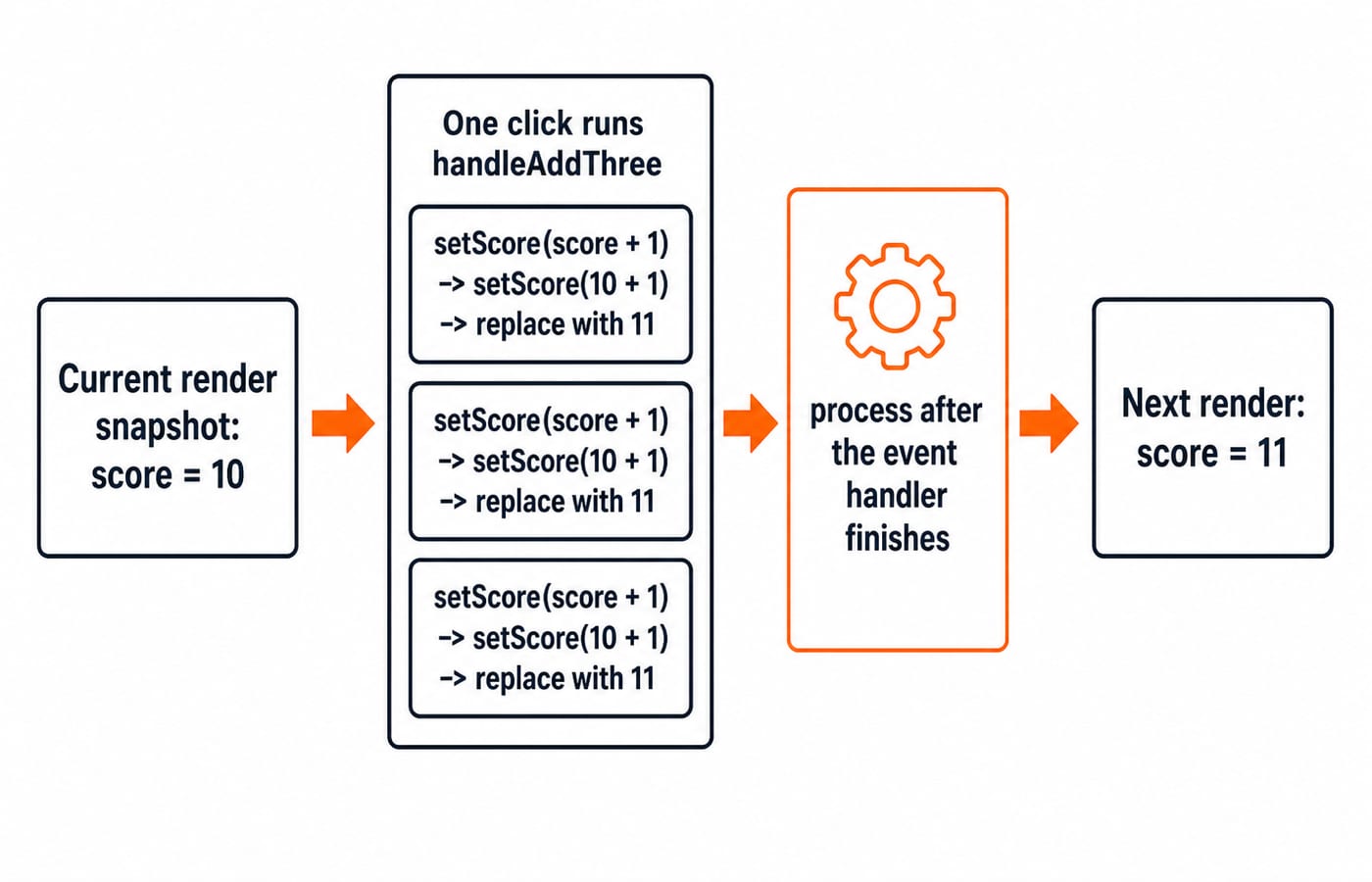
Now substitute the captured value into every expression. Line 1 computes 10 + 1 = 11 and queues "replace with 11". Line 2 also computes 10 + 1 = 11 and queues the same replacement. Line 3 does it once more. A later expression does not read the result of an earlier queued replacement because all three expressions read score from the current snapshot.
After the button handler completes, React processes the queue. Replacing the pending value with 11 three times still leaves 11, so the next render displays 11. React did not ignore two setter calls. All three calls were made, but each supplied the same replacement value.
Queue entries are concrete requests, not three arithmetic operations performed in sequence on the state variable. The original snapshot stays 10 throughout the handler.
Repair the queue with functional setters
Change only the handler body so that every update is expressed as a function:
function handleAddThree() {
  setScore(s => s + 1);
  setScore(s => s + 1);
  setScore(s => s + 1);
}
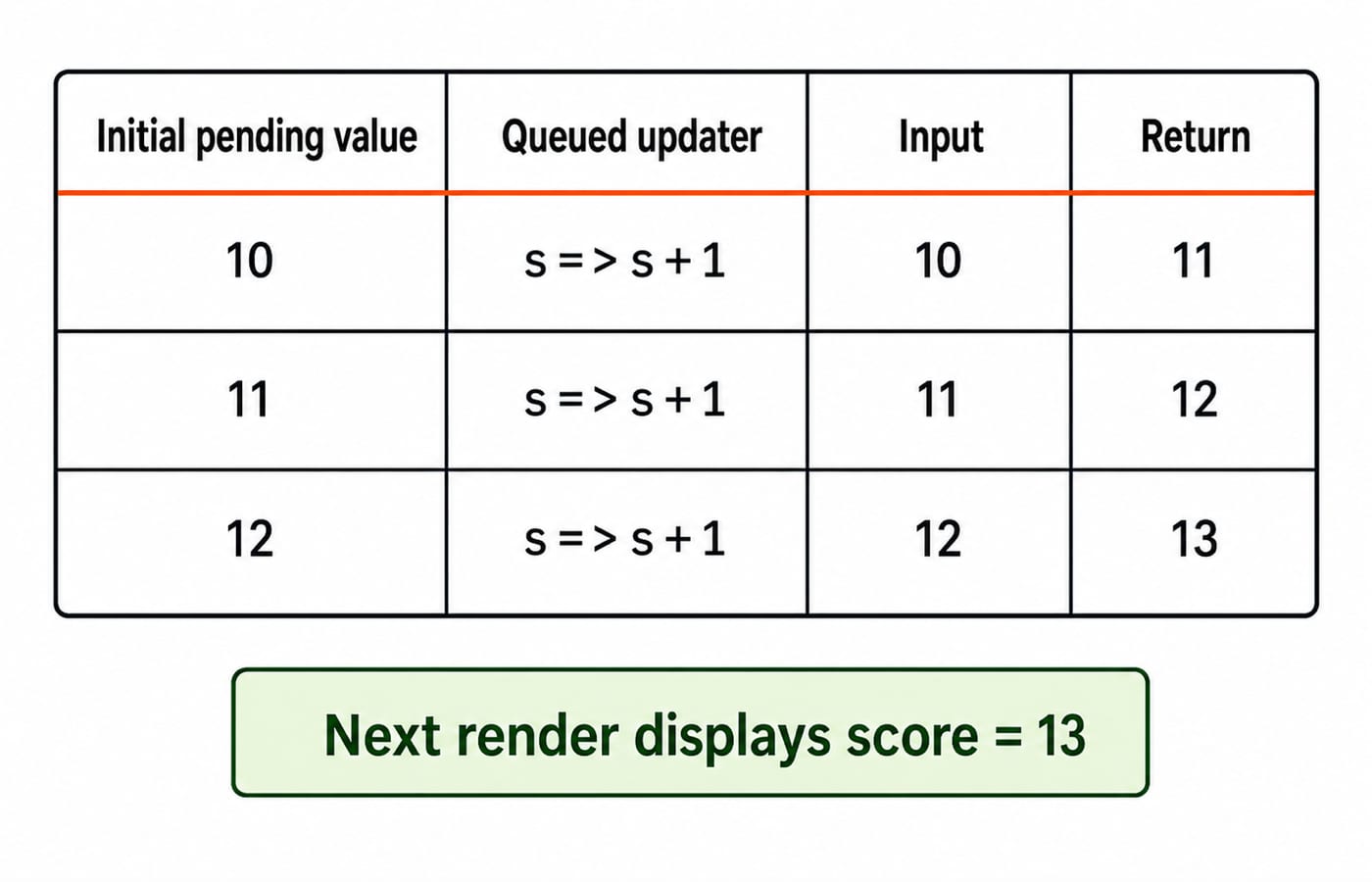
According to React's official Queueing a Series of State Updates guide, each updater function is queued. During the following render, React passes the result of one updater to the next. The first updater receives 10 and returns 11. The second receives 11 and returns 12. The third receives 12 and returns 13. The next render therefore displays 13.
Use the functional form when the next state is computed from the previous queued state. It does not force an immediate render. The parameter s is the pending value React supplies at that position in the queue, not a live mutation of the closed-over score variable.
That chained input is why identical updater functions can return different values within one processed queue.
Learn the queue grammar: replace versus transform
The queue can contain replacement values and updater functions in the same handler. Extend the same score = 10 example:
setScore(score + 5);
setScore(s => s + 1);
setScore(42);
The first line reads the snapshot, computes 10 + 5 = 15, and queues "replace with 15". The updater is next, so it receives pending value 15 and returns 16. The last line queues "replace with 42". It comes after the transformation, so the next render displays 42. This is the replacement and updater ordering described in React's queueing guide.
Queue entry | Meaning |
|---|---|
Plain value such as | Replace the pending value with that value. |
Function such as | Transform the pending value at this position in the queue. |
Order matters because each entry operates at its own position, not according to which form looks more important.
Batching explains when the queue is processed
React waits until all code in this event handler has run before processing the queued updates. Batching produces one coherent next render instead of three intermediate renders.
React also keeps separate intentional events separate. Suppose click 1 starts with score = 10 and the functional three-update handler produces 13. Click 2 runs later from a render whose snapshot is 13. Its queued transformations are 13 to 14, 14 to 15, and 15 to 16, so the second click displays 16.
React state-update queues are not the JavaScript task or microtask queues. This event-handler boundary explains the click trace precisely: React collects all three entries before rendering their final result.
Avoid the four traps that create stale-value bugs
Treating an immediate log as a failed update.
scorelogged aftersetScore(score + 1)still reads10because it uses the current render's snapshot. Inspect the next render to see11.Repeating a direct setter for dependent work. Three copies of
setScore(score + 1)each compute from10. When every result must build on the preceding queued result, usesetScore(s => s + 1)for each increment.Assuming every setter needs a function. Direct replacements are clear when the target is independent of pending state, as in
setScore(0),setOpen(false)orsetName('Asha').Putting a side effect inside an updater. Do not increment an external variable or send a request from
s => s + 1. Updaters must be pure and return only the next state. React's queueing guide notes that Strict Mode may run them twice in development, discarding one result. Purity makes that safe.
Show how coding assessments and interviews test the model
For an output-prediction check, begin every row with score = 10 and give both the result and a one-line queue explanation.
Handler sequence | Next render | Queue explanation |
|---|---|---|
Three |
| Three entries each replace with |
Three |
| The pending value transforms from |
Replace with |
| The pending value becomes |
A useful debugging prompt is: "Why does the value logged immediately after the setter remain 10?" An acceptable answer names the current render snapshot and the requested next render. "React is slow" explains neither.
For broader interview coverage, React Interview Questions for Freshers covers Hooks, reconciliation, and state-management choices. Queue questions need a narrower trace: classify each entry as a replacement or transformation, preserve its position, then predict the batched render.
The short version and the next step
Keep five rules: state is a render snapshot, setters queue work, plain values replace, functional setters transform the pending value, and React processes this documented batch after the event handler. Predict 11, 13 and 42 before running the code. For focused practice, continue with the React and Redux course. If you want to move from React into a broader full-stack path, use the MERN Stack course.
Keep learning

JavaScript Event Delegation: Bubbling, target and currentTarget with Runnable Examples
Learn how browser events travel through the DOM, then build one delegated listener that handles nested controls and rows added later.
Updated 6 Oct 20265 min readWeb Development
JavaScript Operators: Types, Precedence and Runnable Examples
Learn how JavaScript arithmetic, assignment, comparison, logical and modern operators behave by tracing one score program from inputs to final output.
Updated 2 Oct 20266 min readWeb Development
JavaScript Data Types and Coercion: Beginner Tutorial with Runnable Examples
Learn how JavaScript stores values, copies primitives and objects, converts input, compares values and produces surprising output. Trace each rule in the console.
Updated 27 Sep 20265 min readWeb Development
JavaScript Conditionals and Loops: Beginner Tutorial with Runnable Examples
Learn how JavaScript chooses a branch and repeats work. Build from small syntax examples to a complete score classifier with a traced average.
Updated 25 Sep 20265 min readWeb Development