

Functional Programming: Functions, Recursion and Immutability with a Worked Trace
Trace one JavaScript cart pipeline to see how functions as values, recursive reduction and immutable updates work together without changing the input.
KnowledgeGate Team
Exam prep & CS education
Updated 22 Nov 20266 min read
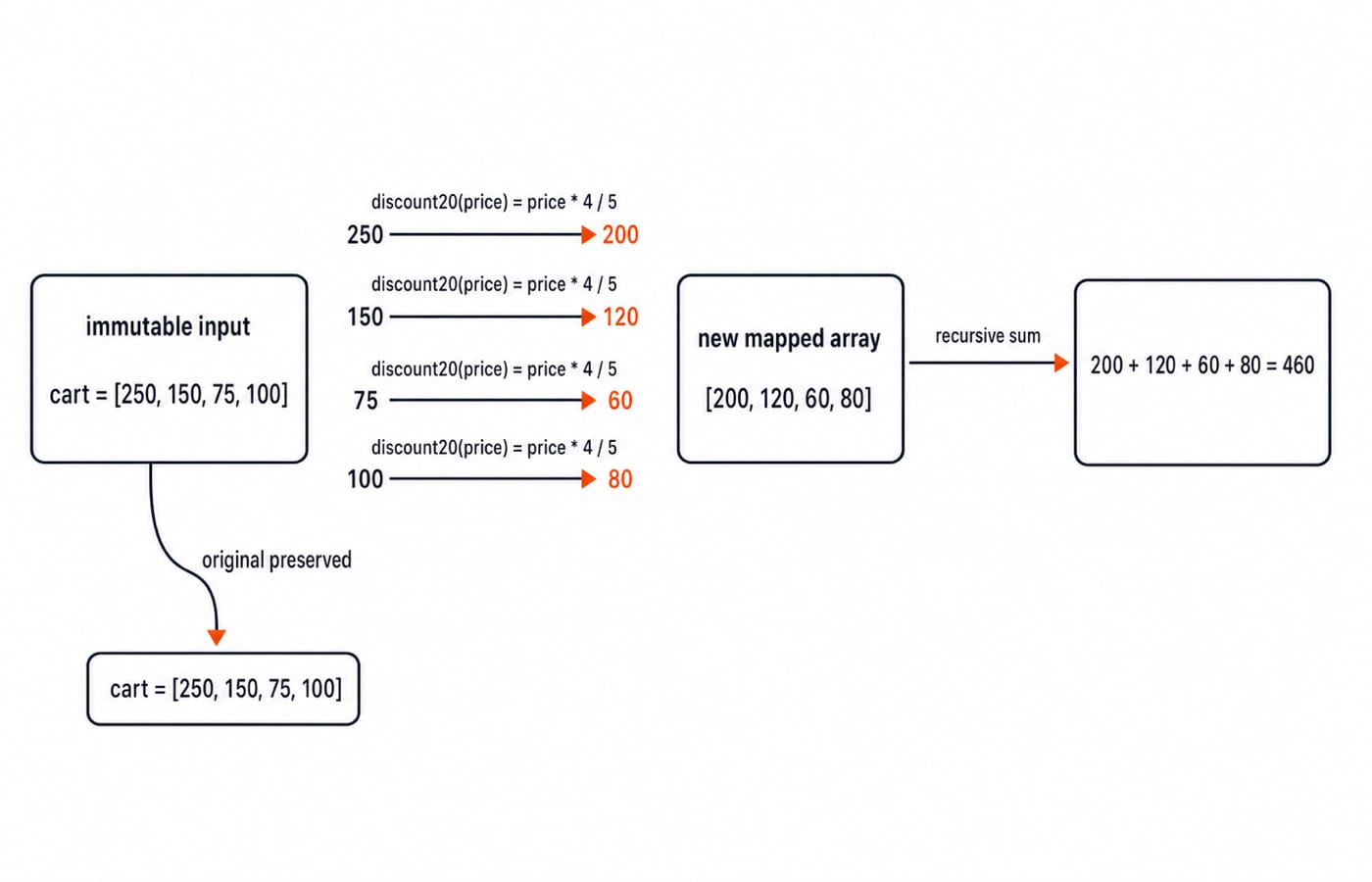
You may be able to recite that functional programming uses functions and avoids changing state, yet still struggle to predict a recursive result or explain why repeated calls should agree. One exact JavaScript cart pipeline connects the ideas. It starts with [250, 150, 75, 100], maps that cart to [200, 120, 60, 80], and recursively totals the new list to 460. Following those values will make functions, recursion and immutability concrete.
Functional programming expresses computation through values and functions
Functional programming builds results by evaluating and combining functions. It favours explicit inputs, returned outputs and immutable values. Real programs still read input, store data and produce output, so effects remain. Functional design keeps them at clear boundaries, making central transformations easier to reason about.
Three related ideas do different jobs. A function can be treated as a value and combined with other functions. Recursion defines a result through smaller instances plus a base case. Immutability means an existing value is not altered, so an update produces a new value. They reinforce one another, but are not synonyms. The Programming Languages Survey places this paradigm beside other language families. Functional and imperative features can coexist, so JavaScript is readable notation here, not a purely functional language.
Pure, first-class and higher-order functions have distinct roles
A pure function satisfies two conditions: the same explicit inputs give the same result, and evaluation causes no externally visible side effect. Consider const discount20 = price => price * 4 / 5;. It gives discount20(250) = 200 and discount20(150) = 120. Calling it again with 250 still returns 200, without changing a cart.
First-class functions are values that can be stored, passed or returned. A higher-order function takes or returns a function. In cart.map(discount20), discount20 is passed as a value, map is higher-order, and the result is a new array.
Composition joins these roles:
const totalAfterDiscount = prices => sum(prices.map(discount20));Read it inside out. discount20 transforms each price, map collects the transformed values, and sum reduces the list to one number. Short arrow syntax alone proves nothing about purity. A short function that reads or changes hidden state can still be impure.
Worked example: map four prices, then sum recursively
The runnable cart example is:
const cart = Object.freeze([250, 150, 75, 100]);

const discount20 = price => price * 4 / 5;

function sum(xs) {
  if (xs.length === 0) return 0;
  const [head, ...tail] = xs;
  return head + sum(tail);
}

const totalAfterDiscount = prices =>
  sum(prices.map(discount20));

const total = totalAfterDiscount(cart);
Compute every mapped value before tracing the recursion:
250 * 4 / 5 = 200150 * 4 / 5 = 12075 * 4 / 5 = 60100 * 4 / 5 = 80
Therefore, cart.map(discount20) produces [200, 120, 60, 80]. It does not rewrite cart in place. Adding the new values gives 200 + 120 + 60 + 80 = 460, so total = 460. A second call to totalAfterDiscount(cart) also returns 460, and cart remains [250, 150, 75, 100]. That stability comes from explicit inputs and pure helper functions, not memoisation or caching.
Recursion needs a base case, progress and a complete trace
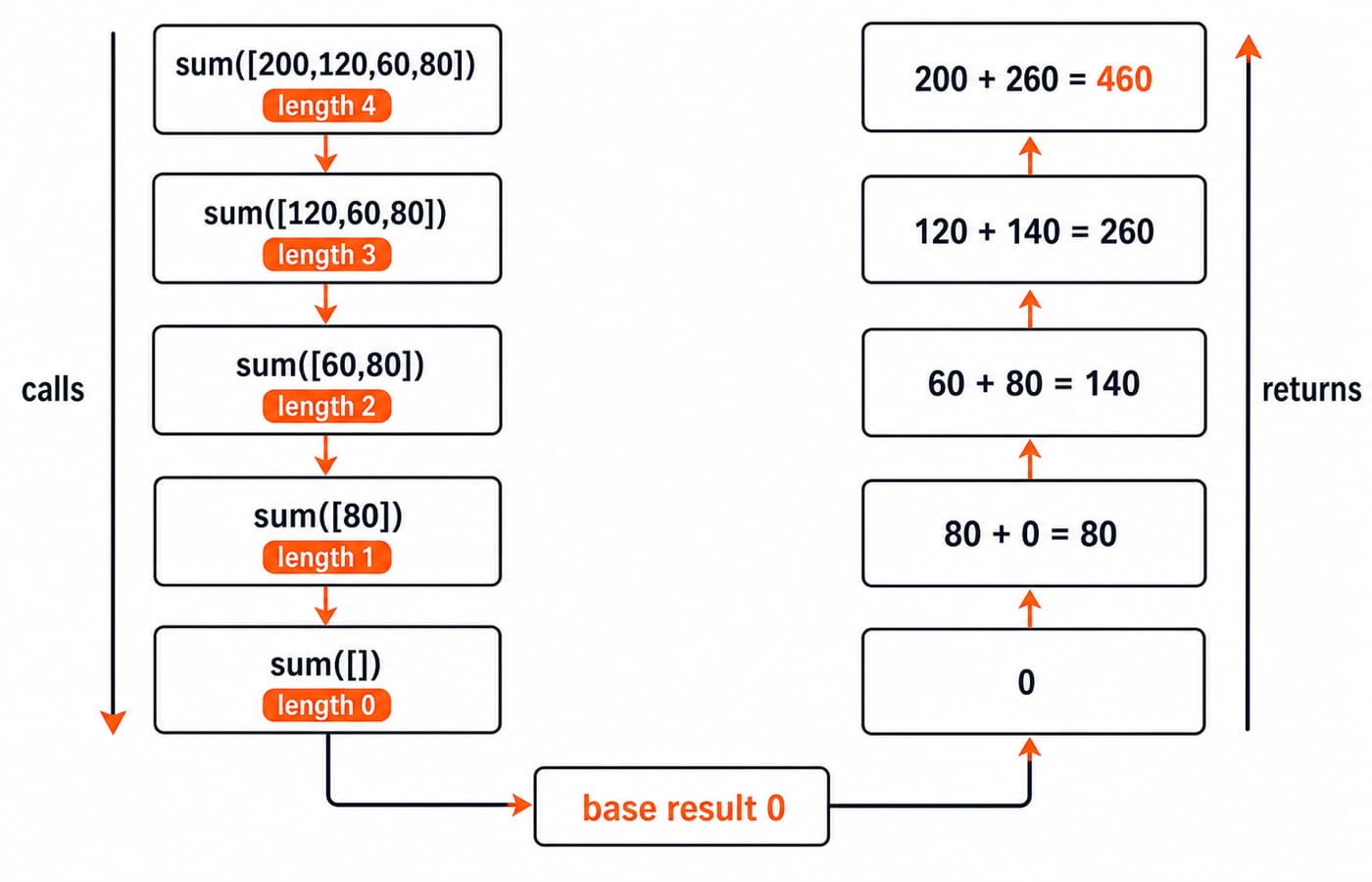
The base case is sum([]) = 0. The recursive step is sum([head, ...tail]) = head + sum(tail). Each call here shortens the list, with lengths 4 -> 3 -> 2 -> 1 -> 0, so the base case must be reached.
Expand the calculation without skipping a call:
sum([200,120,60,80])
= 200 + sum([120,60,80])
= 200 + 120 + sum([60,80])
= 200 + 120 + 60 + sum([80])
= 200 + 120 + 60 + 80 + sum([])
= 460
The return values unwind as 0 -> 80 -> 140 -> 260 -> 460.
This semantic trace is separate from runtime implementation. Pending calls form before unwinding, so stack depth can matter for large inputs. Some implementations optimise particular recursive forms, but not every runtime removes every frame. When an assessment gives no optimisation guarantee, solve the value trace first and discuss space separately.
Immutability preserves old values while updates create new ones
const discounted = cart.map(discount20) binds a second array, [200, 120, 60, 80]; it does not replace elements inside cart. Rebinding and mutation are different. For a correction, const revisedCart = cart.map((p, i) => i === 2 ? 90 : p) produces [250, 150, 90, 100], while cart[2] remains 75.
A total calculation can trust that another helper did not silently change its input, earlier versions remain available, and independent functions are easier to test. Immutability does not eliminate every bug or make every operation free.
Two caveats matter. JavaScript const prevents variable rebinding but does not make an object deeply immutable, and Object.freeze is shallow. Persistent lists and trees can limit copying by sharing unchanged structure. In a singly linked [250,150,75,100], replacing 75 with 90 copies the changed path but can share the unchanged tail node 100.
How assessments test functional programming: traps, costs and paradigm choices
First, do not omit or mis-specify the base case. If this example used sum([]) = 1, every total would be one too high, producing 461. With no reachable base case, calls continue until the runtime fails. Write the empty-input result and prove that each call is smaller before tracing.
Second, familiar syntax does not guarantee purity:
let calls = 0;
const twice = x => { calls += 1; return 2 * x; };
The numeric return is predictable, but evaluating twice changes hidden state. Return the count as part of a new value, or keep the effect at an explicit boundary.
Third, do not assume every array method preserves its receiver. JavaScript map returns a new array, while methods such as sort can mutate the array they are called on. Check the operation's contract when the old order must remain observable.
Functional design also has costs. Allocation, retained versions and recursive stack depth can consume memory or time. Persistent structures, controlled effect boundaries and suitable iteration abstractions are practical responses. There is no forced choice between paradigms: Object Oriented Technology Explained shows the wider object model. Objects can contain pure functions and immutable values, while functional code can use modules and data abstractions.
Assessment questions typically ask you to predict a mapped array or recursive return, identify whether a function is pure or higher-order, distinguish rebinding from mutation, and compare stack or allocation costs. For a code trace, record the original input, every intermediate value and the base case. For a theory question, name the observable effect or mutation that makes a tempting statement false.
The short version: self-checks and next steps
Test your understanding against the same program:
Derive the mapped list
[200,120,60,80].Expand the recursive sum to
460.Name
0as both the additive identity and the base result.State that
cart[2]remains75afterrevisedCartis created.Identify
mapas higher-order because it receivesdiscount20.
Then transfer the method. For input [50, 25], mapping gives [40, 20], and the recursive total is 60.
The decision rules are compact: track values instead of vague labels, ask whether output depends only on explicit inputs, find the base case and shrinking argument, distinguish a new value from an in-place change, and never assume stack optimisation that the question does not state.
For a structured preparation route, use GATE Guidance to sequence programming-language study, compare the wider Computer Science syllabus in the NTA-UGC-NET Paper 2 course, or review subject options in the GATE CS category.
Keep learning

React State Updates: Trace Queues, Batching and Functional Setters
Follow one React counter from its captured state through replacement updates, functional updaters and a batched next render, with every queue entry traced.
Updated 21 Sep 20265 min readWeb Development
C Functions Formula Sheet and Revision Notes: Prototypes, Scope and Recursion
Revise C functions through compact syntax cards, when-to-use cues and exact traces for value copies, pointer mutation, static locals, recursion and callbacks.
Updated 24 Nov 20266 min readC Programming & Data Structures
Functions in C Mistakes: Fix 11 Errors in Calls, Parameters and Recursion
Trace eleven common Functions in C errors without guessing the output. Learn what fails, why it fails, and the precise repair for each case.
Updated 22 Nov 20265 min readC Programming & Data Structures

ISRO CS C Output Questions: Trace Pointers, Arrays and Recursion Step by Step
Learn a repeatable trace-first method for C output problems. Three worked programs show copied pointers, array parameters and recursive output in exact execution order.
Updated 30 Oct 20266 min readC Programming & Data Structures