

McCall’s and ISO 9126 Quality Factors MCQs: 12 Solved Questions with Explanations
Solve 12 published MCQs on McCall’s model, ISO 9126, software measures and the ISO 25010 trap. Each answer includes a direct exam-focused explanation.
KnowledgeGate Team
Exam prep & CS education
Updated 18 Nov 20267 min read

Students often remember McCall and ISO 9126 but mix up their factor lists, McCall’s three perspectives, and direct versus indirect measures. The hardest distinctions are factor versus characteristic, direct observation versus inferred quality, and ISO 9126 versus ISO/IEC 25010. Answer each question before opening its explanation.
Build the two-model map before solving
McCall’s model has three views. Product operation covers correctness, reliability, efficiency, integrity, and usability. Product revision covers maintainability, flexibility, and testability. Product transition covers portability, reusability, and interoperability.
ISO/IEC 9126 names functionality, reliability, usability, efficiency, maintainability, and portability. Five terms overlap with McCall’s list, but shared names need not have identical scope. ISO/IEC 25010 is the later model in Question 12.
The payroll example illustrates how these quality concepts differ. A payroll app processes 10,000 salary records in 40 seconds, produces 2 incorrect records, needs 6 developer-hours for a tax-rule change, and runs unchanged on Linux and Windows. These values indicate efficiency, correctness or reliability, maintainability, and portability. They are not platform statistics.
Use Quality Factors: McCall’s and ISO 9126 Models with a Worked Scoring Example for factor-to-metric hierarchies and weighted maintainability scores. Then practise factor classification, definition matching, direct-versus-indirect measures, and model boundaries with these MCQs.
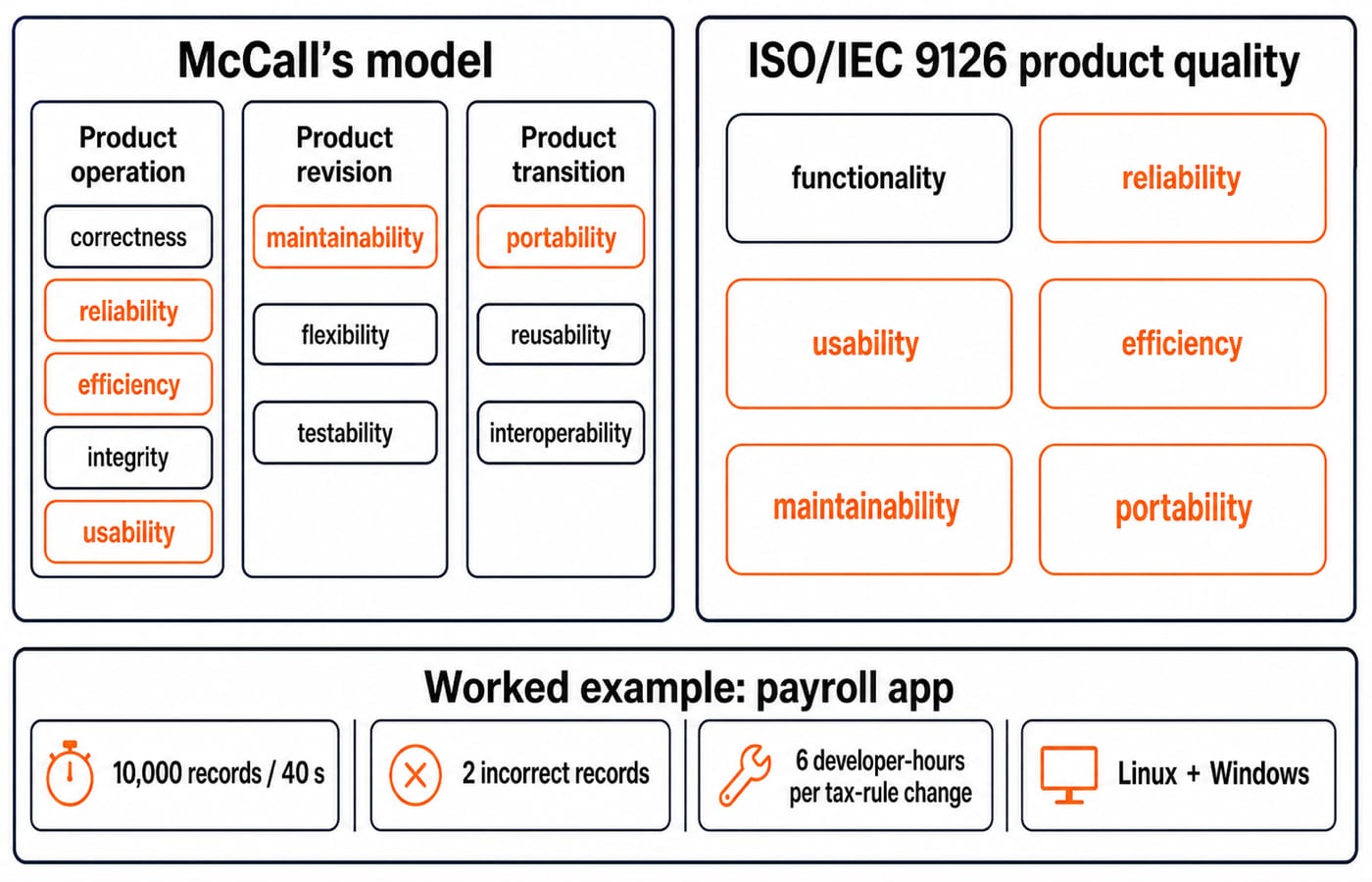
McCall’s three product aspects and factor membership
Question 1, UGC NET 2017
Single-question pages open where available. When a numbered link opens the quality-factor module, use the printed question number to locate it there.
Which of the following is not one of three software product aspects addressed by McCall’s software quality factors?
(a) Ability to undergo change
(b) Adaptability to new environments
(c) Operational characteristics
(d) Production costs and scheduling
Answer: (d) Production costs and scheduling. The three views are operation, revision or change, and transition or adaptation. Costs and schedules are project-management concerns, not McCall product-quality aspects.
Question 2, UGC NET 2025
Which of the following belongs to McCall’s quality factors? Choose the correct answer from the options below:
A. Maintainability; B. Usability; C. Integrity; D. Functionality.
(a) A and D Only
(b) A, B and D Only
(c) C and D Only
(d) A, B and C Only
Answer: (d) A, B and C Only. Maintainability is under revision. Usability and integrity are under operation. Functionality is not named in McCall’s original list, though later models use related terms.
ISO 9126 definitions and matching questions
Question 3, UGC NET 2019
Question 4478 in the quality-factor module
According to the ISO 9126 Standard Quality Model, match the attributes in List I with their definitions in List II:
List I: (a) Functionality; (b) Reliability; (c) Efficiency; (d) Maintainability.
List II: (i) relationship between performance and resources; (ii) characteristics related to achieving the intended purpose; (iii) effort needed for improvement; (iv) capability to maintain performance.
(a) (a)-(i), (b)-(ii), (c)-(iii), (d)-(iv)
(b) (a)-(ii), (b)-(i), (c)-(iv), (d)-(iii)
(c) (a)-(ii), (b)-(iv), (c)-(i), (d)-(iii)
(d) (a)-(i), (b)-(ii), (c)-(iv), (d)-(iii)
Answer: (c), (a)-(ii), (b)-(iv), (c)-(i), (d)-(iii). Purpose means functionality. Maintaining performance means reliability. Performance per resource means efficiency. Improvement effort means maintainability. For the payroll app, 10,000 ÷ 40 = 250 records per second is efficiency evidence; 6 developer-hours for the tax change is maintainability evidence.
Question 4, UGC NET 2025
Question 16591 in the quality-factor module
Match List I with List II.
List I: A. Reliability; B. Efficiency; C. Maintainability; D. Portability.
List II: I. ability to transfer software between organisations or hardware/software environments; II. capability to maintain performance under stated conditions for a stated time; III. relationship between performance and resources used; IV. effort needed for corrections, improvements, or adaptation.
(a) A-II, B-III, C-I, D-IV
(b) A-II, B-III, C-IV, D-I
(c) A-III, B-II, C-I, D-IV
(d) A-IV, B-II, C-I, D-III
Answer: (b) A-II, B-III, C-IV, D-I. Reliability maintains performance under stated conditions; efficiency compares performance with resources; maintainability concerns modification effort; portability concerns transfer between environments. The payroll app’s unchanged Linux and Windows runs illustrate portability.
External quality, architecture sensitivity, and related terms
Question 5, UGC NET 2016
Question 5196 in the quality-factor module
Which of the following are external qualities of a software product?
(a) Maintainability, reusability, portability, efficiency, correctness.
(b) Correctness, reliability, robustness, efficiency, usability.
(c) Portability, interoperability, maintainability, reusability.
(d) Robustness, efficiency, reliability, maintainability, reusability.
Answer: (b) Correctness, reliability, robustness, efficiency, usability. Here, external qualities are observed through behaviour or user experience. Maintainability, reusability, and interoperability depend more on internal structure. The 2 incorrect records and 40-second run are observable evidence, but one run cannot measure overall quality.
Question 6, UGC NET 2015
Which of the following non-functional quality attributes is not highly affected by the architecture of the software?
(a) Performance
(b) Reliability
(c) Usability
(d) Portability
Answer: (c) Usability. Architecture strongly influences throughput, fault isolation, redundancy, abstraction layers, and platform dependencies. Interface and interaction design affect usability more directly, though architecture can affect responsiveness.
Question 7, UGC NET 2014
Match List I with List II:
List I: a. Correctness; b. Accuracy; c. Robustness; d. Completeness.
List II: i. tolerates unexpected problems; ii. meets its specification; iii. has the specified functions; iv. meets specifications with precision.
(a) a-ii, b-iv, c-i, d-iii
(b) a-i, b-ii, c-iii, d-iv
(c) a-ii, b-i, c-iv, d-iii
(d) a-iv, b-ii, c-i, d-iii
Answer: (a) a-ii, b-iv, c-i, d-iii. Correctness means meeting specifications; accuracy means specified precision; robustness means tolerating unexpected problems; completeness means having every specified function. In the payroll app: correct tax formula, salary to 2 decimal places, invalid ID handled without crashing, and all 4 required outputs generated.
Direct versus indirect software measures
Question 8, UGC NET 2022
Question 4236 in the quality-factor module
Which of the following is an indirect measure of product?
(a) Quality
(b) Complexity
(c) Reliability
(d) All of these
Answer: (d) All of these. Quality, complexity, and reliability are inferred from indicators, not counted as one physical quantity. The observed defect proportion is 2 ÷ 10,000 = 0.0002 = 0.02%. The 40 seconds is timed and the 6 developer-hours is recorded directly. Broader quality judgements need several observations and criteria.
Question 9, DSSSB 2021
Which of the following statement(s) is/are correct regarding software metrics in software engineering?
I. Direct measures of the software product include functionality, quality, efficiency etc. of the software.
II. Indirect measures of the software product include lines of code produced, execution speed, memory size etc. of the software product.
(a) Only I
(b) Only II
(c) Both I and II
(d) Neither I nor II
Answer: (d) Neither I nor II. Both statements reverse the categories. Lines of code and memory size are counted, and execution time is observed. Functionality, quality, and efficiency are inferred from measurements and criteria. Apply the count-or-infer test.
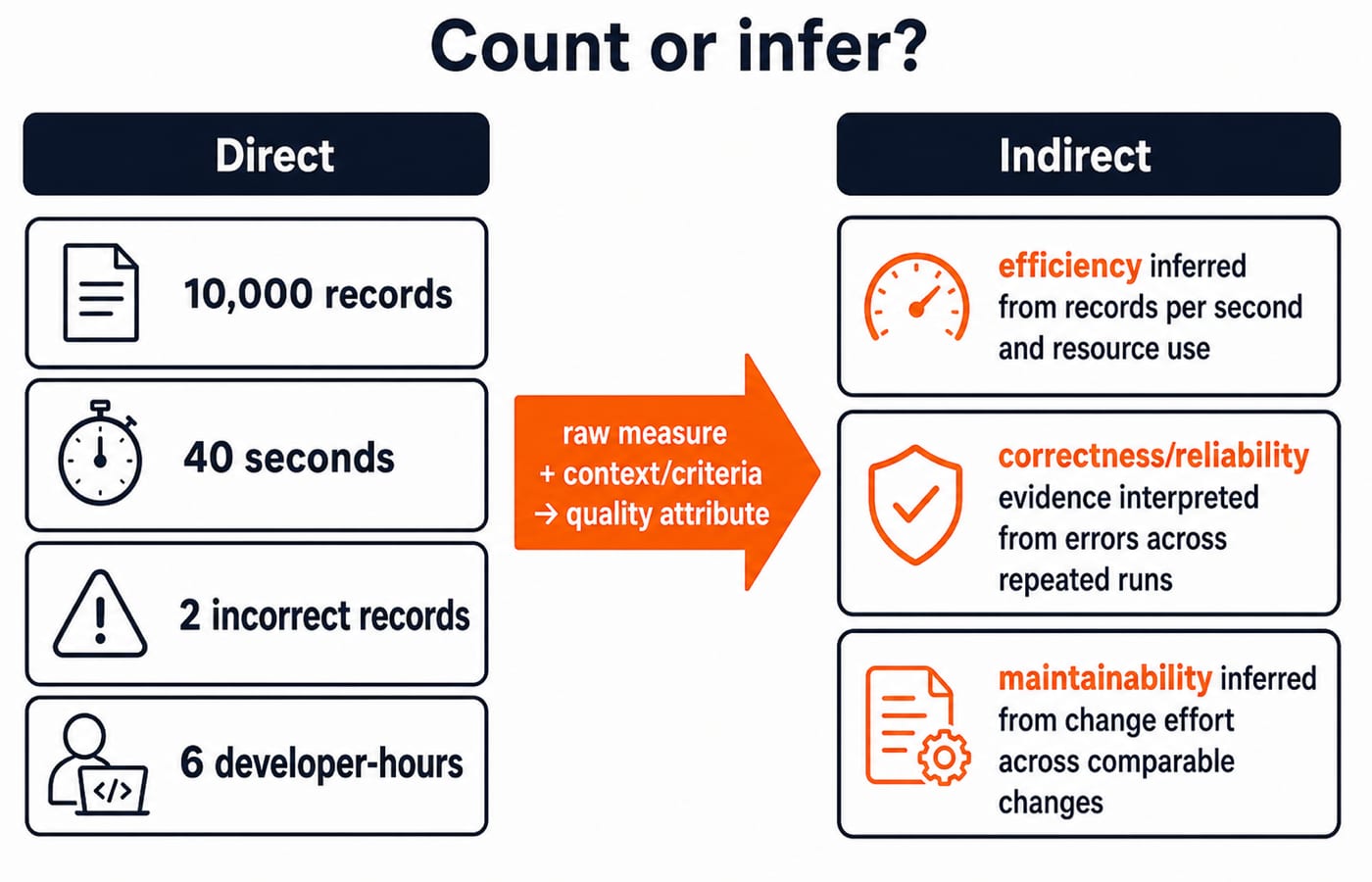
Model boundaries, factor inventory, and the ISO 25010 trap
Question 10, UPPSC Polytechnic Lecturer 2022
Question 20369 in the quality-factor module
Which one is not a software quality model?
(a) ISO 9000
(b) McCall Model
(c) Boehm Model
(d) ISO 9126
Answer: (a) ISO 9000. McCall, Boehm, and ISO/IEC 9126 are software product quality models. ISO 9000 is a family of quality-management-system standards. It can matter to software organisations, but it serves a different purpose.
Question 11, UGC NET 2012
Question 62812 in the quality-factor module
The factors that determine the quality of a software system are
(a) correctness, reliability
(b) efficiency, usability, maintainability
(c) testability, portability, accuracy, error tolerances, expendability, access control, audit
(d) All of the above
Answer: (d) All of the above. This tests a broad factor inventory, not one model’s taxonomy. “Expendability” is the question’s wording. Do not treat the mixed list as official ISO 9126 terminology.
Question 12, BEL 2023
Question 70780 in the quality-factor module
As per ISO 25010 quality model which of the following is not the characteristics which describe quality in use model?
(a) Efficiency
(b) Effectiveness
(c) Compatibility
(d) Satisfaction
Answer: (c) Compatibility. In ISO/IEC 25010, effectiveness, efficiency, and satisfaction belong to quality in use. Compatibility is a product-quality characteristic. The question changes both model and view, so the ISO 9126 list is insufficient. ISO/IEC 25010 is not part of ISO 9126.
Score the set and choose the next resource
Count one point for each correct answer, for a score out of 12. Use each miss to choose the repair. Questions 1-2 point back to McCall’s perspectives; Questions 3-4 to ISO 9126 definitions; Questions 5-7 to external quality and related terms; Questions 8-9 to direct and indirect measures; and Questions 10-12 to model boundaries. Explain the missed distinction aloud, then retry that group.
For broader treatment of quality metrics, testing, cyclomatic complexity, and reliability, read the Software Quality in Software Engineering guide. For deeper study, continue with NTA-UGC-NET Paper - 2. For timed practice, use the UGC NET Computer Science and Applications Test Series. You can also browse the wider UGC NET CS exam preparation category.
Now retry only the questions you missed, without looking at the answers.
Go deeper with the full courseUGC NET Computer Science (Paper 1 + Paper 2)
Keep learning
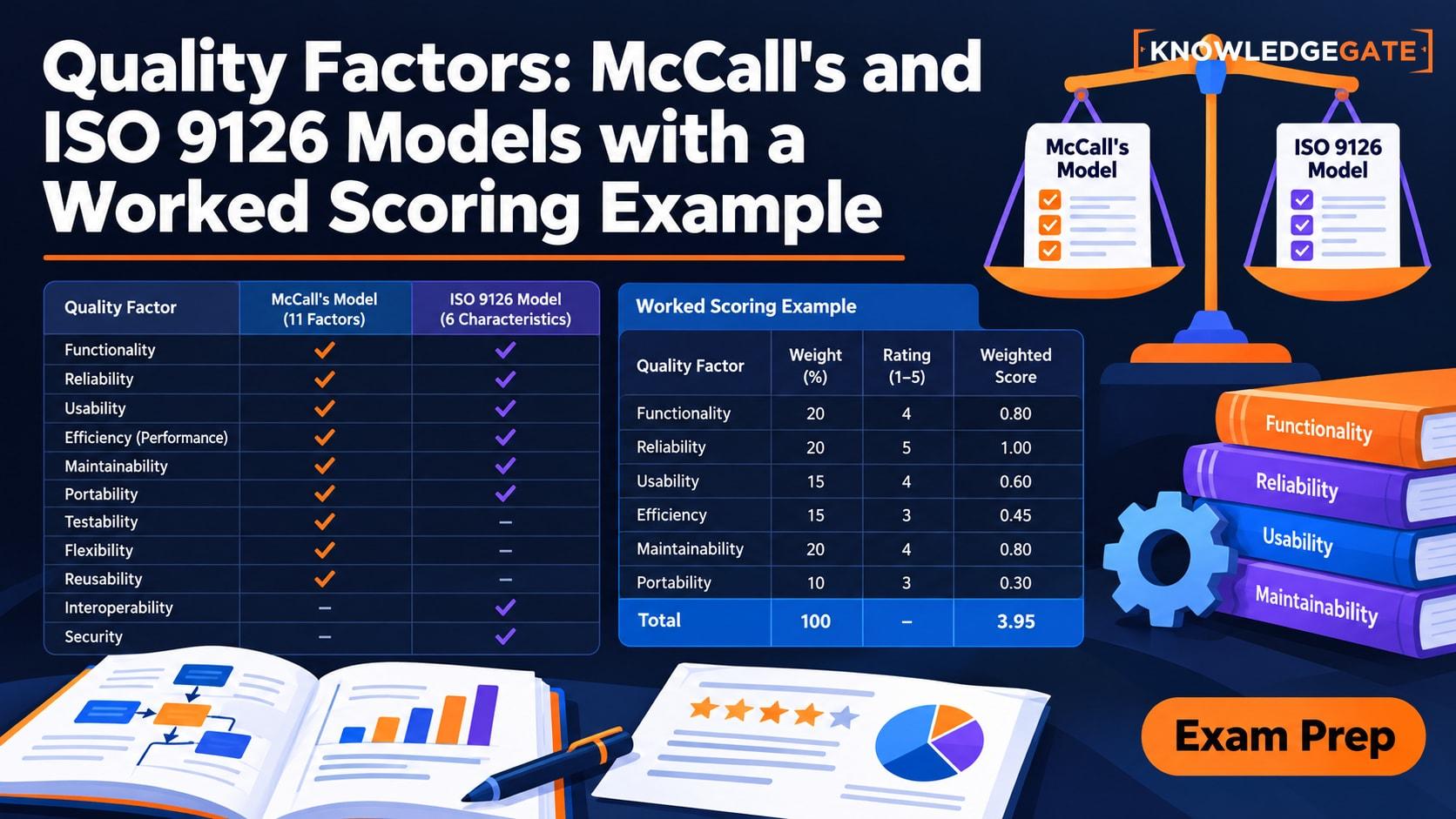
Quality Factors: McCall’s and ISO 9126 Models with a Worked Scoring Example
Build both quality models around one maintainability audit. This guide maps their vocabulary, calculates McCall-style and ISO-style scores, and ends with exam-focused checks.
Updated 25 Sep 20265 min readUGC NET Computer Science

Threading Models MCQs: 12 Solved Operating System Questions with Explanations
Test the boundaries between shared process resources and private thread state through 12 solved PYQs, then revise mapping models, switching and hyper-threading.
Updated 29 Oct 20268 min read129 viewsOperating System MCQs

Prescriptive Process Models MCQs: 12 Solved Questions on Waterfall, Spiral and Incremental Models
Solve 12 MCQs on Waterfall, Spiral and Incremental models. Use sequence, risk, change and release cues to distinguish the models under exam pressure.
Updated 16 Nov 20267 min readUGC NET Computer Science

COCOMO and Cost Estimation Models MCQs: 12 Solved Questions
Test your COCOMO basics with 12 solved MCQs. Each answer explains model levels, effort and duration equations, unit conversion, cost drivers and common traps.
Updated 11 Nov 20267 min readUGC NET Computer Science