

Software Development Life Cycle MCQs: 12 Solved Questions on SDLC Stages
Solve 12 published SDLC MCQs with direct explanations, stage cues, and a worked campus clinic portal that connects requirements, design, testing, and maintenance.
KnowledgeGate Team
Exam prep & CS education
Updated 17 Nov 20267 min read
SDLC questions look like vocabulary, but their distractors swap adjacent stages, mix a high-level phase with an activity, or place maintenance work under implementation. Software development follows a process lifecycle with distinct stages. Commit to one option before reading each key, then study the reason and the worked clinic-portal example instead of memorising letters.
How to use this 12-question SDLC set
The individual question pages are currently unavailable, so use the working Process Lifecycle and Stages of Software Development topic hub for follow-up practice after these 12.
Make three columns on paper: chosen option, stage cue, and why the nearest distractor is wrong. After the set, redraw the phase chain from requirements through maintenance without looking.
Questions 1-2: what SDLC is and where it starts
Question 1.
A __________ is an outline of a process that develops successful information systems.

A. Software development
B. CASE tool
C. System analysis
D. System development life cycle
Answer: D, System development life cycle. SDLC is the framework from identifying a need through operation and maintenance. Software development is the work being organised, a CASE tool supports activities, and system analysis is one part of the lifecycle.
Question 2.
Which of the following is the first step in the software development lifecycle (SDLC) ?

A. Testing
B. Design
C. Requirement gathering and analysis
D. Coding
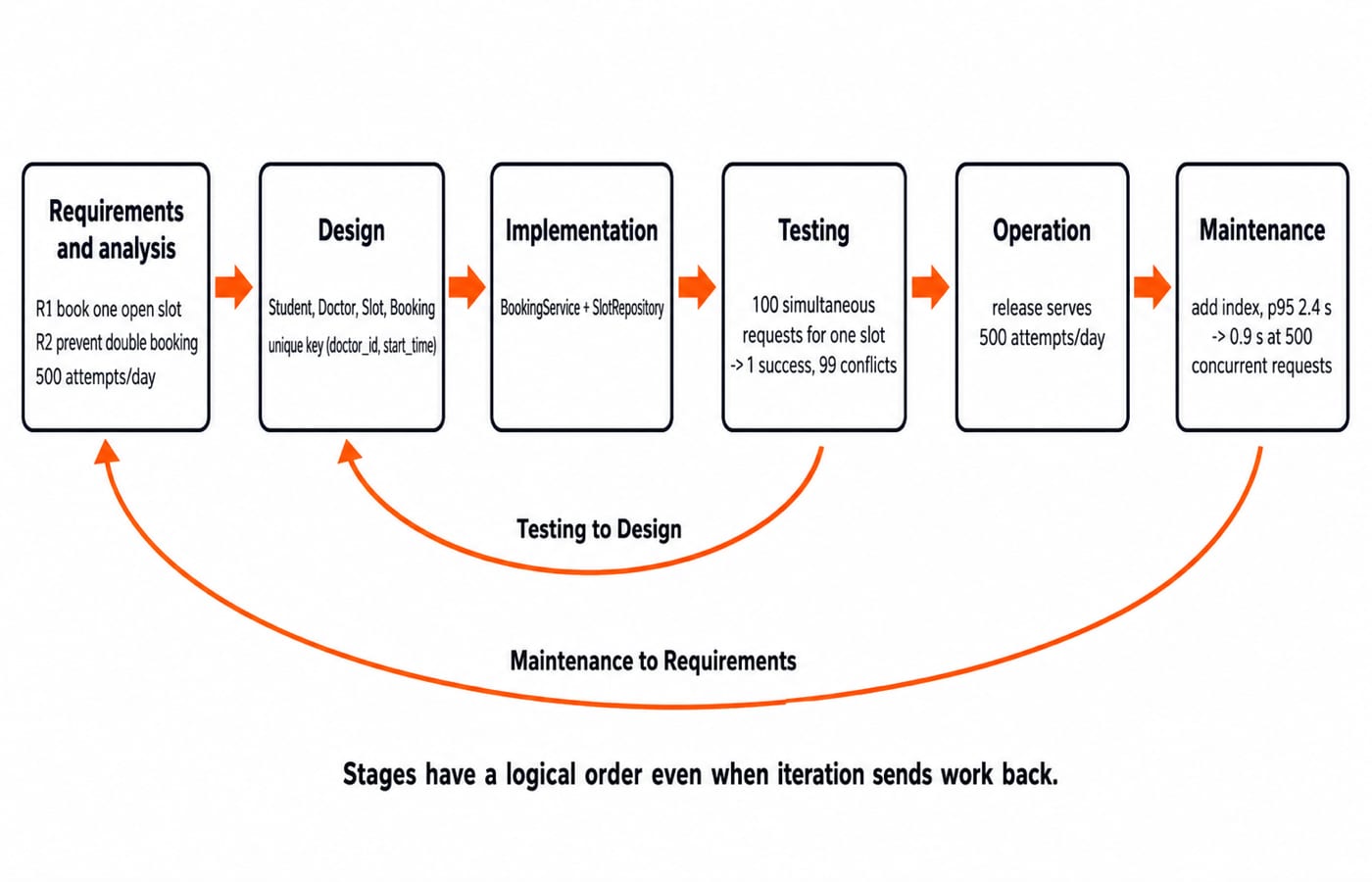
Answer: C, Requirement gathering and analysis. For a campus clinic portal, the first record says R1: a student can book one open slot, R2: two students cannot hold the same slot, expected volume is 500 booking attempts/day, and confirmation should appear within 2 seconds. Understand these needs before choosing tables, APIs, or tests. Design sounds like planning, but follows requirements and analysis. Testing and coding also need a target.
Questions 3-4: feasibility before commitment
Question 3.
What is the primary objective of feasibility analysis in a software project ?

A. Define the detailed system requirements
B. Assess the project's technical, economic, and operational viability
C. Design the system architecture
D. Estimate the development timeline and cost
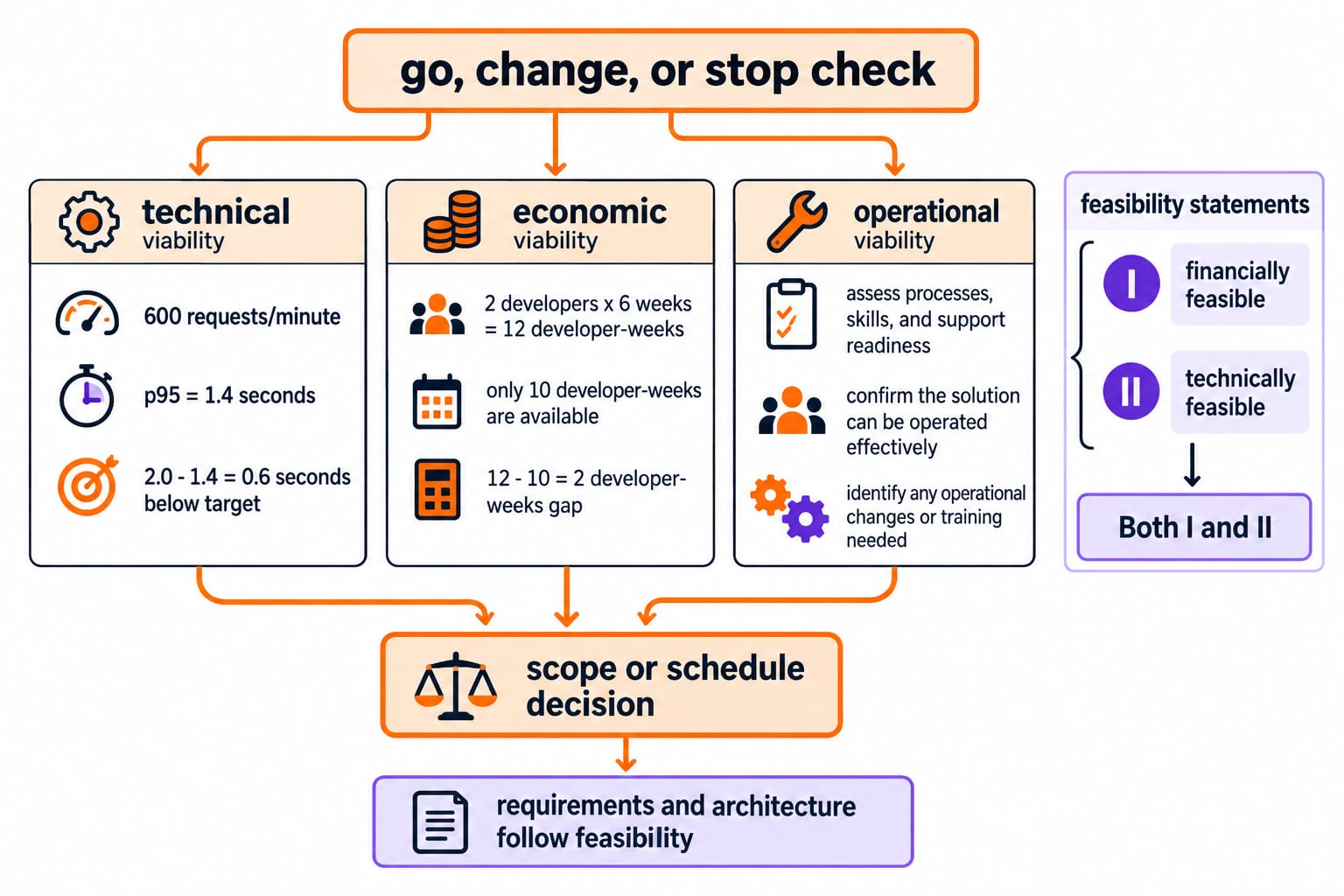
Answer: B, Assess the project's technical, economic, and operational viability. Feasibility is a go, change, or stop check. Requirements and architecture follow. Schedule and effort estimates inform viability but do not define it.
The clinic proof of concept handles 600 requests/minute at p95 = 1.4 seconds, which is 2.0 - 1.4 = 0.6 seconds below target. Staffing needs 2 developers x 6 weeks = 12 developer-weeks; only 10 developer-weeks are available. The 12 - 10 = 2 developer-weeks gap requires a scope or schedule decision. Economic feasibility compares expected benefits with the people, time, tools, and budget the project would consume.
Question 4.
Which statement(s) is/are correct regarding the feasibility study?
 I. It determines whether developing the product is financially feasible.
 II. It determines whether developing the product is technically feasible.

A. Only I
B. Only II
C. Both I and II
D. Neither I nor II
Answer: C, Both I and II. Both are feasibility dimensions. Other checks may be operational, schedule, legal, or organisational. Their omission leaves I and II true. Software engineering is not only technical.
Questions 5-6: put stages and activities in the right order
Question 5.
Which of the following represents the life-cycle of software development?

A. Design → Analysis → Coding → Operation and maintenance
B. Analysis → Design → Coding → Testing → Operation and Maintenance
C. Design → Analysis → Coding → Testing → Operation and Maintenance
D. Analysis → Design → Coding → Operation and Maintenance → Testing
Answer: B, Analysis → Design → Coding → Testing → Operation and Maintenance. Use dependencies. Design needs analysed requirements, testing needs an implementation, and operation follows a tested release. Iteration revisits stages but does not reverse that logic in an order MCQ.
Question 6.
What is the appropriate pairing of items in the two columns listing various activities encountered in a software life cycle?

P. Requirements capture
Q. Design
R. Implementation
S. Maintenance

1. Module development and integration
2. Domain analysis
3. Structural and behavioral modeling
4. Performance tuning

A. P-3, Q-2, R-4, S-1
B. P-2, Q-3, R-1, S-4
C. P-3, Q-2, R-1, S-4
D. P-2, Q-3, R-4, S-1
Answer: B, P-2, Q-3, R-1, S-4. Requirements capture uses domain analysis. Design creates structural and behavioural models. Implementation develops and integrates modules. Maintenance includes performance tuning.
In the clinic trace, requirements identify Student, Doctor, Slot, and Booking; design produces a class model and bookSlot() interaction; implementation connects BookingService to SlotRepository. Maintenance adds an index, reducing a hypothetical p95 query time from 2.4 seconds to 0.9 seconds at 500 concurrent requests. The improvement is 2.4 - 0.9 = 1.5 seconds. This measured change shows how maintenance work can be evaluated.
Questions 7-9: implementation boundaries and lifecycle activities
Question 7.
Which of the following activities does not belong to implementation phase of SDLC?

A. Program testing
B. File conversion
C. User training
D. New changes to the system
Answer: D, New changes to the system. In this classification, program testing, file conversion, and user training support implementation and rollout. A request made after the system is in use belongs to maintenance or a new change cycle. Organisations label boundaries differently, so apply the distinction the question is testing.
Question 8.
Which of the following are typical activities in the software process lifecycle?
(A) Requirement Analysis
(B) System Design
(C) Code Refactoring
(D) Deployment
(E) Substructure
Choose the correct answer from the options given below :

A. (A), (B), (C) Only
B. (B), (C), (D) Only
C. (A), (B), (D) Only
D. (A), (D), (E) Only
Answer: C, (A), (B), (D) Only. At stage level, requirement analysis, system design, and deployment are recognised activities. Refactoring is a development or maintenance technique, not the high-level activity tested, though it occurs during a lifecycle. Substructure is not a standard stage label. Use needs -> analysis, solution structure -> design, and release into use -> deployment.
Question 9.
What term describes the manual method of reviewing and stepping through a program's intended steps before any code is written?

A. Desk checking
B. Flowcharting
C. Testing
D. Compiling
Answer: A, Desk checking. Before coding a slot-capacity rule, take capacity = 20, booked = 14, and requested = 7. Compute remaining = 20 - 14 = 6. Since 7 > 6, reject the request. Flowcharting draws control flow; compiling and testing need code or an executable artefact.
Questions 10-12: models, order, and maintenance
Question 10.
Which of the following is a software development life cycle model?

A. Waterfall model
B. Agile model
C. Spiral model
D. More than one of the above
E. None of the above
Answer: D, More than one of the above. Waterfall, Agile, and Spiral all organise lifecycle work. Since A, B, and C are valid examples, the combined option wins. The earlier Agile Process Models MCQs separates Scrum, XP, and adaptive-method cues; here Agile appears only as one valid SDLC model.
Question 11.
The order of Phases of Software Life Cycle is

A. Testing, design, operation, coding, analysis
B. Design, analysis, operation, testing, coding
C. Operation, analysis, design, testing, coding
D. Analysis, design, coding, testing, operation
Answer: D, Analysis, design, coding, testing, operation. Apply Question 5's dependency test. This compact form omits separately named planning and maintenance, but keeps understand -> design -> build -> verify -> operate.
Question 12.
Modifying the software to match changes in the ever changing environment is called as

A. Adaptive maintenance
B. Corrective maintenance
C. Perfective maintenance
D. Preventive maintenance
Answer: A, Adaptive maintenance. An external notification service changes its request field from phone in version 1 to phoneNumber in version 2. Updating the portal adapter so all 200 prepared test records are accepted is adaptive maintenance because the environment changed. Corrective fixes a defect, perfective improves the system, and preventive reduces future risk.
Answer key, stage cues, and next practice step
Question | Answer | Stage cue |
|---|---|---|
1 | D | Lifecycle framework |
2 | C | Requirements first |
3 | B | Multi-dimensional viability |
4 | C | Financial and technical |
5 | B | Analysis before design |
6 | B | P-2, Q-3, R-1, S-4 |
7 | D | New change belongs to maintenance or a change cycle |
8 | C | A, B, and D |
9 | A | Desk checking |
10 | D | Waterfall plus Agile plus Spiral |
11 | D | Analyse, design, code, test, operate |
12 | A | Adapt to the environment |
Check four traps: activity versus phase, analysis versus design, implementation versus maintenance, and one option versus More than one. Below 9 of 12, redraw the clinic flow and redo Questions 5, 6, and 11 without options.
Use NTA-UGC-NET Paper - 2 for guided learning, NTA UGC NET Paper - 2 Test Series for practice, and Software Engineering for CS Teaching Exams for another topic map. Solve before reading the explanation.
Go deeper with the full courseUGC NET Computer Science (Paper 1 + Paper 2)
Keep learning
SDLC and Development Approaches in System Analysis and Design: Models, Selection Rules, and a 16-Week Worked Example
Learn how analysis, design, traceability, and major SDLC models fit together. Then use project conditions and risk exposure to plan a 16-week examination portal.
Updated 6 Nov 20265 min readGATE Strategy & Roadmap
Software Engineering Basics Explained: SDLC, Process Models and Worked Example
Learn how software engineering extends beyond coding, how major process models differ, and how to choose and apply one in a constructed student portal project.
Updated 30 Oct 20266 min readUGC NET Computer Science
Software engineering for CS teaching exams: SDLC, models and testing
The software engineering spine for TGT and PGT computer science papers: the SDLC phases in order, waterfall vs spiral vs agile, functional and non-functional requirements, cohesion and coupling, and the four testing levels.
Updated 18 Jul 20265 min read64 viewsUGC NET Computer Science
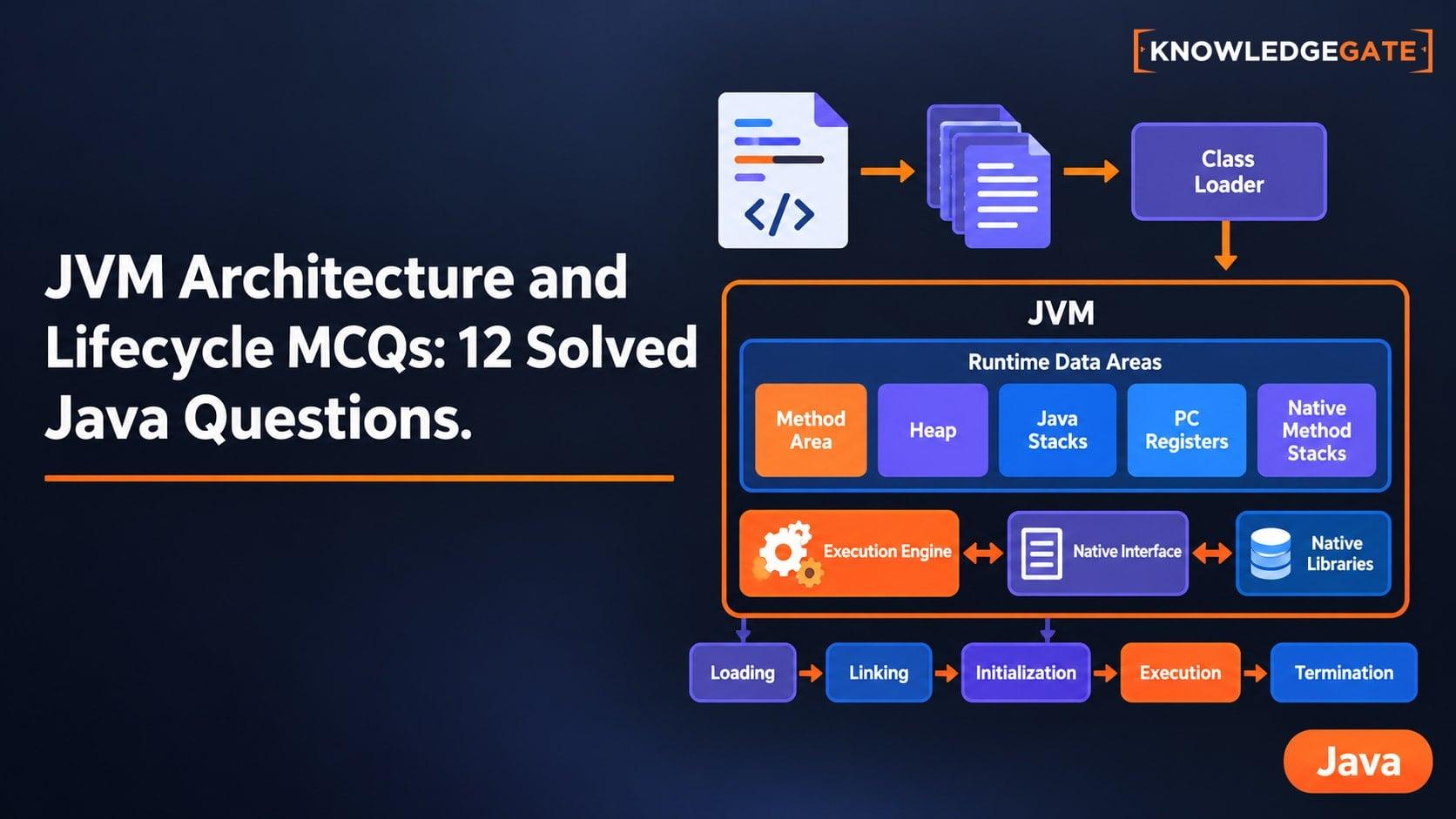
JVM Architecture and Lifecycle MCQs: 12 Solved Java Questions with Explanations
Solve 12 published JVM questions, then use the explanations to separate bytecode, loading, execution, memory areas, reachability and runtime type checks.
Updated 17 Nov 20267 min readJava